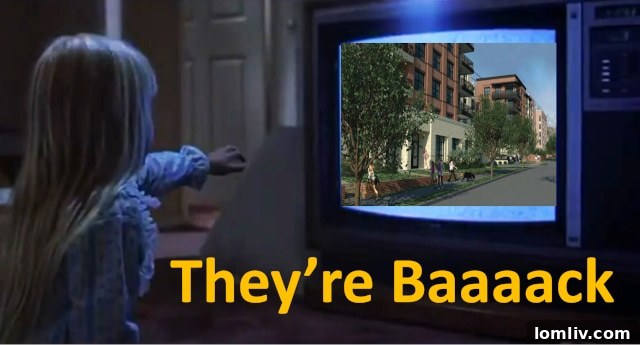
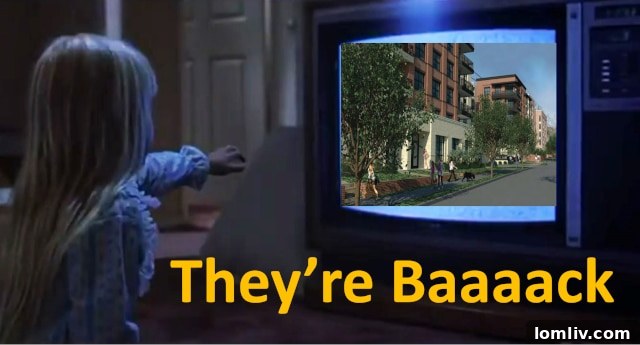
As anticipated, the controversial Lincoln Katy Trail project, spearheaded by Lincoln Property Company, is back on the table. This significant development proposal targets a prime location on Carlisle, nestled between Bowen and Hall Streets. The resurgence of this project signals several underlying dynamics in the Dallas real estate market and urban development landscape:
- The property owners of Turtle Creek Terrace may not have received more attractive offers, suggesting Lincoln Property Company potentially overpaid for its initial land option.
- Investor-owners of Turtle Creek Terrace appear content to lease out units while awaiting the promised substantial profits from this development.
- The project’s reintroduction, despite previous rejections and community opposition, speaks to a persistent arrogance on the part of the developer, a trait that might deter other less persistent firms from pursuing similar ventures.
For those new to the intricacies of this particular Dallas development saga, Lincoln Property Company has dedicated five years to its endeavor of upzoning this substantial 3.8-acre parcel. The property is currently zoned as MF-2, which permits a maximum height of 36 feet and 60 percent lot coverage. A deeper dive into the historical twists and turns of this project can refresh memories here. Today, the developer is making an even more aggressive play, requesting an astonishing maximum of 80 percent lot coverage, a 70-foot height limit (which, notably, may no longer include above-ground parking in its calculation), an unlimited unit count, and significantly reduced setbacks and sidewalk widths. These demands represent a substantial departure from the existing zoning and previous proposals, raising significant concerns among residents and urban planning advocates alike.
The Resurgence of the Schmooze: A Familiar Playbook
In a move that feels strikingly familiar to those who have followed the Lincoln Katy Trail project, the developer has begun circulating selectively chosen images to generate public perception. These visuals are, in essence, carbon copies of those presented during their last attempt: the same building footprint, identical setbacks, and the exact same height profiles. However, it is crucial to remember a fundamental tenet embedded within their proposed sub-district language: “If there is a conflict between the text of this division and the development plan, the text of this division controls.” This clause underscores a vital point: the attractive renderings are merely illustrative. The true blueprint for this project lies not in the glossy pictures, but in the meticulously crafted, and often obscure, legal text of the division.
Why Visuals Can Be a Distraction in Dallas Development
The history of this development provides a stark reminder of why text, not imagery, dictates outcomes. Lincoln’s prior submission to the Dallas City Council in 2019 contained a specific proposal: in exchange for dedicating 5 percent of the units as affordable housing, they would agree to a 70 percent lot coverage and a 70-foot height limit. Importantly, this height calculation explicitly encompassed a “partly above-grade parking garage,” and the plan detailed a total of 307 units.
During that pivotal council meeting, Lincoln’s representative, Jeff Courtwright, dramatically increased the affordable housing component to 15 percent. This significant concession was, however, tied to a project with 10 percent less lot coverage than what is being requested in the current iteration. When judged solely on the merits of affordable housing and lot coverage, the new proposal appears to allow Lincoln to net an additional 10 percent in lot coverage while paradoxically providing roughly 30 fewer affordable units. This original, less dense deal was repeatedly rejected by influential bodies such as the Oak Lawn Committee, city staff, the City Plan Commission, and the City Council. While it did pass the Oak Lawn Committee once by a single vote, it was ultimately denied, highlighting the significant, sustained opposition to its previous form.
Beyond these primary considerations, several other discrepancies between the two plans warrant careful scrutiny. A notable shift is the previous explicit inclusion of above-ground parking in the overall height calculation, which is now conspicuously absent. Similarly, the project’s total unit count, a critical detail, was present in their original filing but is missing from the current documents. One might dismiss these as mere oversights, but in complex urban planning, every detail holds weight. Lincoln’s initial plan, for instance, called for a maximum height of 79 feet before being reduced to 70 feet. If parking garages are suddenly excluded from height computations, could this be a veiled attempt to reintroduce a previously dropped floor, thereby increasing density without exceeding the nominal height limit? This potential manipulation could also explain the missing unit count, allowing for greater flexibility and ultimately, more units than previously disclosed.
It’s also worth recalling that city staff’s earlier recommendation for the site suggested a maximum of 230 units. While this figure is double the number of existing units on the property, it is still 87 fewer than Lincoln’s initial desired count. Staff based their calculation on a meticulous assessment of the average units per acre in the surrounding area, taking into account both newer developments and existing structures. This underscores the professional planning assessment of appropriate density for the location.
Therefore, it bears repeating: in evaluating this Dallas development, one must trust the application’s explicit wording over any captivating, yet potentially misleading, visual presentations.
Beyond the Aesthetics: Trust These Pictures of Deliberate Neglect
There’s a subtle but powerful tactic often employed in the realm of real estate development, particularly when rezoning is desired: the deliberate neglect of a property. Property owners, especially investors anticipating a sale, often let their assets fall into disrepair. This strategy serves a dual purpose. Firstly, why invest money in maintaining a building that is slated for demolition? Secondly, and perhaps more importantly, a dilapidated property creates an urgent narrative that “something must be done” and that the current owners are powerless against the perceived “march of time.”
This narrative, however, is often mere hogwash, driven purely by financial motives. A critical look at the property, as evidenced by historical imagery, reveals a telling story. Between 2008 and 2019, this specific portion of the property suffered the loss of several mature trees, which were never replaced. Over the same period, photographic evidence consistently shows a visible decline in landscaping. Planter boxes that once boasted vibrant floral displays have either been removed entirely or replaced with unremarkable, generic bushes.
Lincoln Property Company’s application attempts to justify demolition by stating that the 1960s Turtle Creek Terrace condos are “nearing the end of their built lifespan.” This assertion begs the question: is our modern construction so inherently fragile that a mere 55 years signals its obsolescence? Has this message been conveyed to the countless Midcentury Modern homes that populate the Metroplex and indeed, the entire nation, many of which are significantly older and still thriving? The reality is quite different. A building’s “time is up” primarily because a developer has identified it as a target for lucrative redevelopment – a convenient and often self-serving perspective. This same pattern of neglect can be observed directly across Hall Street at the developer-owned Carlisle on the Katy complex, reinforcing the suspicion of a premeditated strategy.
Thus, while the complex may indeed appear “tatty” today, it is not a testament to its inherent age or structural failure. Rather, it is likely a calculated ploy designed to evoke public sympathy and encourage a lenient hand during the crucial rezoning process.
Park Cities Proves Obsolescence is a Choice, Not a Fact
To further debunk the notion of forced obsolescence, one only needs to look to the nearby Park Cities area, where rezoning efforts are notoriously difficult, if not impossible. There, even older apartment buildings, many of which have been successfully converted into condos, line the Katy Trail. These properties are not only meticulously well-maintained but also command impressive prices on the market. As of this writing, a modest 526-square-foot condo within a two-story 1957 building on Abbott Avenue is listed for $210,000, translating to a remarkable $400 per square foot. Another comparable 1958 two-story walk-up is asking $374 per square foot for its 895 square feet.
This stark contrast illustrates a crucial point: where buildings are protected from easy rezoning, owners are incentivized to maintain them, undertake necessary repairs, and ultimately sell them for fair market values. These are healthy, sustainable prices, though perhaps not the exorbitant “developer prices” that are predicated on massive increases in building rights and density. The difference highlights a fundamental flaw in the argument for demolition based on age.
The irony in Lincoln’s proposed sub-district language is almost comical: “The Property must be properly maintained in a state of good repair and neat appearance.” One might well ask if an asterisk is missing from this statement, perhaps indicating “unless you’re trying to redevelop the parcel?” This proposed clause, juxtaposed with the apparent deliberate deterioration of Turtle Creek Terrace, exposes a cynical game where developers seemingly exploit lax enforcement to push through their agendas, with the city appearing to be an unwitting or unwilling participant.
Unpacking the “Underground” Parking Paradox
The issue of parking, particularly its designation as “underground” or “above-ground,” has been a point of contention in previous iterations of the Lincoln Katy Trail project. During its last presentation, former city council member Angela Hunt, representing Lincoln at the time, emphatically asserted that the project’s parking would be “100 percent underground.” This claim, however, flew in the face of visual evidence, as an open-air garage was clearly visible from the back elevation of the proposed design. It’s worth noting that Lincoln has since moved on from Hunt, now being represented by Suzan Kedron from Jackson Walker.
This time, the proposed sub-district language attempts to clarify the parking arrangement with the phrase: “Below and above grade parking. A majority of parking must be provided below grade.” This statement, interpreted literally, suggests that at least 51 percent of the parking must be situated beneath the existing ground level. However, the definition of “below grade” becomes complex and potentially ambiguous given the property’s topography. The lot itself experiences a significant grade change of over 30 feet from its highest to its lowest point. This raises critical questions:
- Does “underground” genuinely mean that over 51 percent of the parking must be beneath the property’s *existing* grade, irrespective of its variable elevation?
- Or, as some suspect, could a convenient midway point be artificially selected as the “grade” reference, thereby allowing a portion of what is visually above-ground parking to be technically classified as “underground” simply because it falls below the highest point of the site?
The lack of clear definition and the potential for selective interpretation of “grade” could allow the developer to fulfill the letter of the law without adhering to its spirit, potentially resulting in more visible parking structures than the community expects or desires. This ambiguity is a significant cause for concern for urban planners and residents alike.
Assessing the Adequacy of Parking Provision
Beyond the “underground” designation, the sheer quantity of parking spaces proposed for the Lincoln Katy Trail project warrants close examination. The prevailing statute mandates 1.5 parking spaces for each residential unit. If we assume the original 307-unit count, this translates to a requirement of 461 parking spaces. Furthermore, the statute stipulates that “at least 15 percent of the required parking must be available for guest parking.” This provision effectively reduces the number of parking spaces dedicated solely to residents to 392, or approximately 1.27 spaces per unit. To put this into perspective, this means that roughly only a quarter of the units within the development would be able to accommodate more than a single car parked on-site.
While opinions on car ownership vary, a critical question arises: is 1.27 spaces per unit truly sufficient for a modern residential development, especially one situated in a dynamic urban environment like Dallas? For a multi-family rental apartment complex, this might be marginally acceptable. However, this seemingly inadequate parking provision strongly signals an intention for the project to be a “forever-rental” property rather than a condominium complex. Condo owners typically expect and require more generous parking allocations, often two spaces per unit, reflecting the higher likelihood of multi-car households and long-term ownership. The constrained parking suggests a strategic choice by the developer that prioritizes maximizing unit count and minimizing costly underground parking, at the potential expense of future resident convenience and property value for potential condo conversion.
Does “Paseo” Equate to “Concrete” in Spanish?
In previous designs, Lincoln’s original, monolithic, block-long structure for the Katy Trail project raised significant aesthetic and urban planning concerns. To address this, the developer introduced a central opening, effectively splitting the vast building into two distinct sections. One might naturally assume this central gap would be dedicated to much-needed greenspace or a vibrant public plaza. However, a closer look at the proposed language reveals a different reality. This central void between the buildings, optimistically termed “the paseo,” is intended to sit atop the parking garage.
While the proposal states it will be “a minimum of 5,000 square feet” and “be publicly accessible,” its definition of what constitutes this space is far from a lush urban oasis. The “paseo” is defined primarily as “hardscape, seating areas and perhaps bicycle parking, flag poles and landscape walls no taller than 36 inches.” Crucially, the proposal adds that “none of it has to be shown or detailed on the development plan.” This lack of detailed commitment is a red flag. Essentially, what the community is being offered is 5,000 square feet of predominantly concrete, with any minimal greenery confined to planter boxes. It’s a stark contrast to the aspirational urban parks often envisioned for such spaces. To draw a local analogy, think of it as the poor, poor, poor man’s Klyde Warren Park – a public space in name, but devoid of the expansive green infrastructure and thoughtful design that makes true urban parks valuable amenities.
Unresolved Questions: Oncor Easement and Katy Trail Access
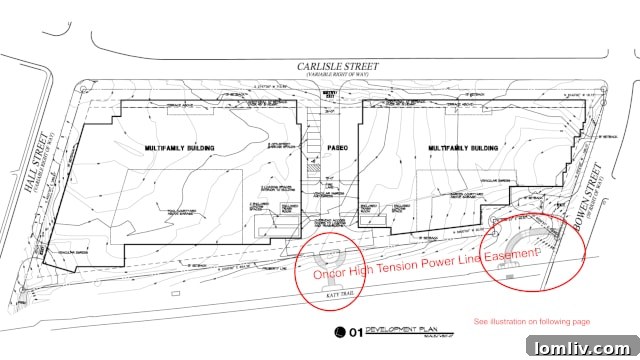
Among the limited visual materials made available for the Lincoln Katy Trail project, one image particularly stands out: it depicts a pair of entrances directly connecting the development to the popular Katy Trail. These proposed access points were conspicuously absent in previous iterations of the project, raising a significant and unresolved question: has Oncor, the utility company, granted permission for these new entrances to traverse their established easement? Securing such permission is not a simple request; it involves complex negotiations, safety considerations, and potentially significant infrastructure adjustments. The inclusion of these entrances in a selective rendering without explicit confirmation of Oncor’s approval adds another layer of uncertainty and potential future hurdles for the project, hinting at an incomplete or overly optimistic planning approach.
The Political Tides: Why This Project Resurfaces
The reappearance of the Lincoln Katy Trail project, with terms arguably worse than those previously rejected, begs a fundamental question: why would the city consider a deal that was universally panned just two years prior? And why would the developer even bother filing it again in its current form? Two primary factors likely explain this seemingly audacious move.
Firstly, there has been a significant shift in the composition of the Dallas City Council and the City Plan Commission. Key figures have been replaced. For instance, the District 14 council/commission duo of Philip Kingston and Paul Ridley, who were vocal critics of the previous proposal, have been succeeded by David Blewett and Wayne Garcia. This change in leadership undoubtedly alters the political landscape and potentially creates a more favorable environment for developers. It is important to note that David Blewett received at least $4,000 in campaign donations from two Lincoln executives and their wives. While Blewett will likely make a public show of returning these donations as part of addressing this case, the initial contributions undeniably raise questions about potential influence and the perception of impartiality.
Secondly, it is plausible that Lincoln Property Company suspects the new members of the City Council and Plan Commission may not undertake a thorough review of the extensive history and inherent flaws of this project. By presenting a slightly altered, yet fundamentally more disadvantageous, proposal, Lincoln could then engage in a calculated maneuver. They might shed “crocodile tears” as they ostensibly “compromise” by giving up elements they never truly intended to keep, or were willing to concede. This tactic is akin to asking for $2 when one only genuinely needs $1, then making a grand show of “settling” for the $1, creating an illusion of concession while still achieving the desired outcome. This strategy leverages the turnover in public office, banking on the idea that new decision-makers might not possess the institutional memory or the inclination to scrutinize the project with the same depth as their predecessors.
Ultimately, this latest iteration of the Lincoln Katy Trail project may simply be another demonstration of the persistent arrogance that has characterized Lincoln Property Company’s previous attempts to develop this site, an unwavering confidence that continues to drive their efforts despite consistent community and professional resistance. The developer’s representatives were contacted for comment, but an interview could not be arranged by press time. Any responses received will be published here as they become available.
In the ongoing dialogue surrounding this significant Dallas development, it is imperative for residents, urban planners, and city officials to remain vigilant. Remember, the nuanced wording embedded within the legal application and proposed sub-district language holds far greater weight and consequence than any aesthetically pleasing, yet potentially misleading, visual renderings. The future of this vital section of the Katy Trail depends on a rigorous and critical examination of the written details.