Preserving a Piece of History: The Frank Lloyd Wright Cottage in Glencoe Finds a New Home
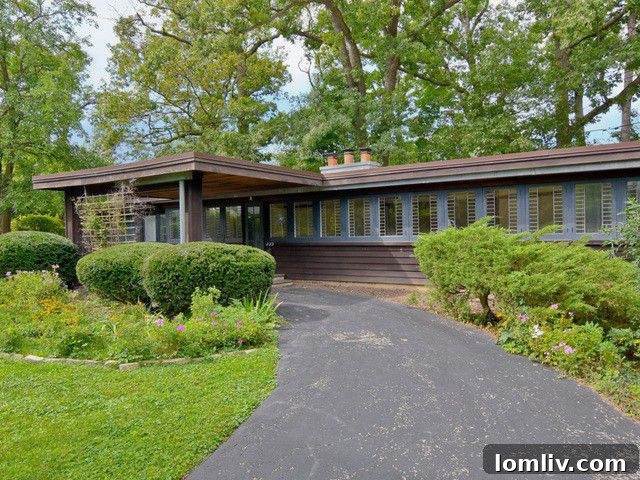
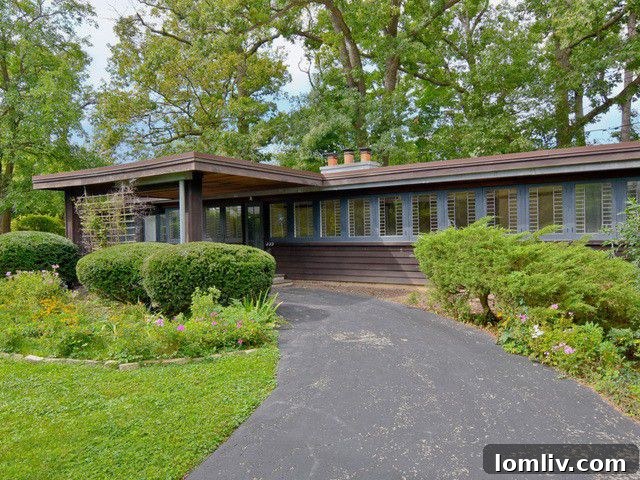
The saga of a historic 1913 Frank Lloyd Wright cottage in Glencoe, Illinois, captivated architecture enthusiasts and preservationists alike. Last June, news broke that new owners of the property had promptly filed for a demolition permit, sparking outrage within the community and the wider Frank Lloyd Wright world. This modest yet significant structure, a precursor to Wright’s iconic Usonian designs, faced an uncertain future, its historical value seemingly overshadowed by plans for a larger, modern dwelling. However, through determined advocacy and community spirit, this architectural gem has been granted a new lease on life, signaling a triumph for historic preservation.
Despite the cottage’s historic designation by the town of Glencoe, its protective status initially proved fragile, capable only of delaying demolition for a mere 180 days. This period, which expired in November, provided a crucial window for action. The town wisely leveraged its regulatory power, refusing to issue a full demolition permit until the proposed 4,200-square-foot McMansion replacement received all necessary approvals. This strategic “slow-rolling” of the development process bought invaluable time, allowing preservation efforts to coalesce and gain momentum.
The tireless work culminated on January 23 with the announcement of a groundbreaking agreement. A deal was struck between the property owners, the Glencoe Park District, and the Glencoe Historical Society to relocate the cottage to a new site within a park, approximately a quarter-mile from its original location. This remarkable solution not only saves the cottage from demolition but also ensures its future accessibility and appreciation by the public. As part of this ambitious move, the home will undergo a sensitive restoration, being pared back from its currently expanded 1,755 square feet to its original, more intimate 1,100 square feet, reflecting its historical integrity.
The very possibility of this relocation, a complex and costly endeavor, was made real by an intense and passionate fundraising campaign spearheaded by the Glencoe Historical Society. Their dedication galvanized support from individuals and organizations committed to safeguarding Wright’s legacy. While significant funds have been raised to cover the immediate costs of the move and the exterior restoration of the cottage, the journey is far from over. Ongoing fundraising efforts are critical to complete the interior renovation, which will transform the cottage into a vibrant research center and museum, further cementing its role as an educational resource and a beacon of local history.
Under the terms of the agreement, the Glencoe Park District will lease the land for the cottage to the Historical Society for a symbolic $1 per year. This collaborative spirit exemplifies how communities can come together to protect their heritage. The vision for the cottage extends beyond mere preservation; it aims to create an engaging space where visitors can delve into the world of Frank Lloyd Wright, understand the evolution of American architecture, and explore Glencoe’s rich past. This project is a testament to the power of community, advocacy, and the enduring appeal of architectural masterpieces.
Ravine Bluffs: Frank Lloyd Wright’s Pioneering Subdivision in Glencoe
In discussions about Frank Lloyd Wright’s extensive oeuvre, the term “subdivision” rarely comes to mind. While areas like Oak Park, Illinois, are celebrated for their dense concentration of Wright-designed homes, these were typically individual commissions rather than planned communities. This makes Glencoe’s Ravine Bluffs, Wright’s inaugural foray into community planning, a singularly important and often overlooked chapter in his career. The cottage at the heart of our story is an integral part of this unique development, providing crucial insights into Wright’s evolving design philosophy and his pragmatic approach to architectural challenges.
The genesis of Ravine Bluffs dates back to a commission from Wright’s attorney, Sherman Booth. Booth had initially envisioned a grand, expansive estate, a common aspiration among Wright’s affluent clientele. However, the ambitious scope and prohibitive costs – a frequent challenge in Wright’s projects – led to a strategic pivot. The original estate parcel was subsequently re-envisioned as a subdivision comprising 25 individual homes, a decision that would allow Booth to construct a more modest, though still substantial, personal residence within the community.
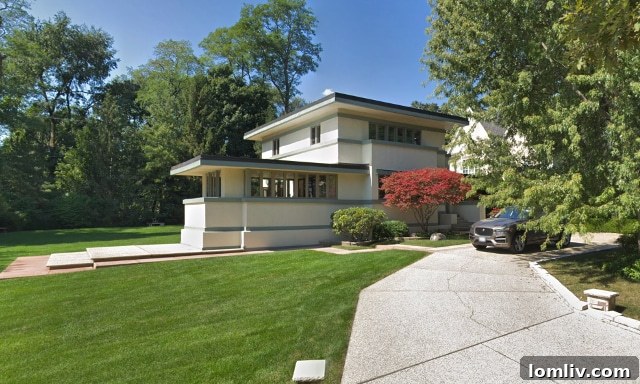
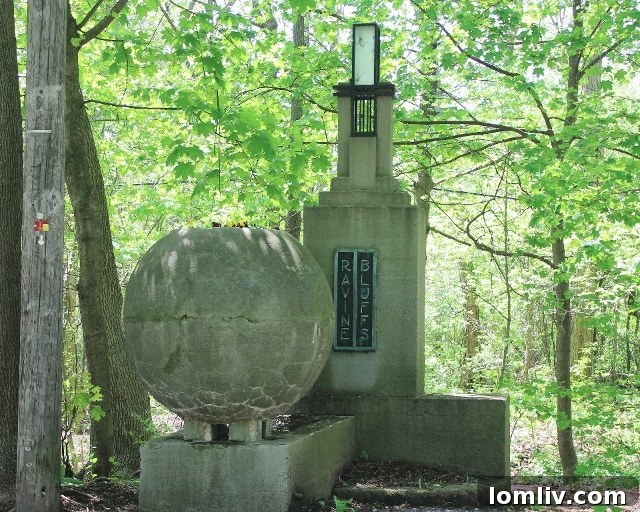
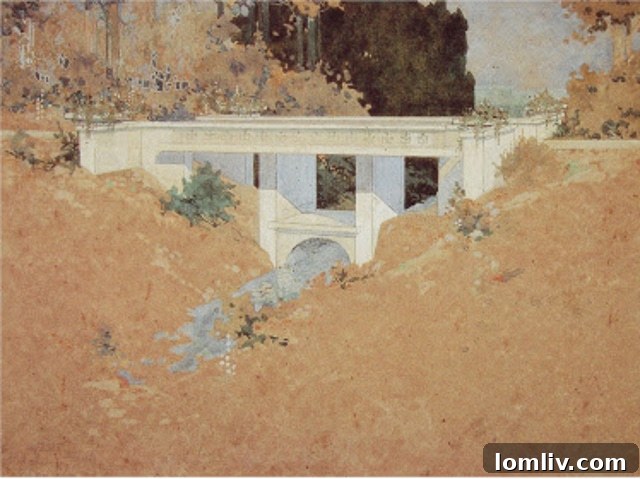
Unfortunately, the timing for marketing the Ravine Bluffs community could not have been worse. Launching in 1915, the project coincided precisely with the United States’ inexorable march towards World War I. The ensuing economic uncertainties and shifts in national priorities severely hampered sales, preventing the full realization of Wright’s vision. Consequently, only five homes were ultimately constructed, alongside three distinctive entrance markers and Wright’s solitary bridge design, a structure elegantly spanning a natural ravine, further integrating the community with its natural surroundings. These elements, though few, stand as enduring testaments to an ambitious plan that, despite its incomplete execution, holds immense architectural and historical significance.
The “Fireproof House” and Its Influence on Ravine Bluffs Architecture
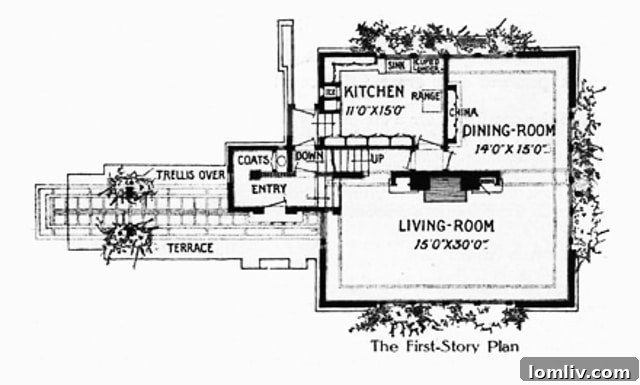
Each of the homes in Ravine Bluffs is a variation on Frank Lloyd Wright’s celebrated “A Fireproof House for $5,000” design. This innovative concept, originally featured in the prestigious Ladies Home Journal, was itself a sophisticated reinterpretation of the popular American Foursquare style, a common architectural form of the era. Wright’s genius lay in his ability to take a familiar template and imbue it with his signature design principles, creating spaces that were both functional and aesthetically groundbreaking.
Wright introduced several revolutionary changes to the traditional Foursquare layout. Most notably, he pioneered the connection of the living and dining rooms into a more fluid, open-plan space – a remarkable innovation in 1915 when separate, compartmentalized rooms were the norm. This approach fostered a greater sense of connection and spaciousness within the home. Additionally, he strategically relocated the main staircase, often pushing it to the periphery, which allowed for a significant increase in the size and prominence of the living room, transforming it into the true heart of the home. These spatial reconfigurations marked a pivotal step in Wright’s journey towards the open-plan layouts that would become a hallmark of modern architecture.
An intriguing historical note regarding the “Fireproof House” design is its practical application. While conceived as an all-concrete, genuinely fireproof structure, many of the eleven additional homes built using this design were, in a curious departure, constructed with traditional timber frames. This meant they were, in reality, far from fireproof, highlighting a pragmatic adaptation to construction methods or client preferences that sometimes diverged from Wright’s original material specifications. The Ravine Bluffs homes, however, were more closely aligned with the concrete ideal, pushing the boundaries of residential construction materials for their time.
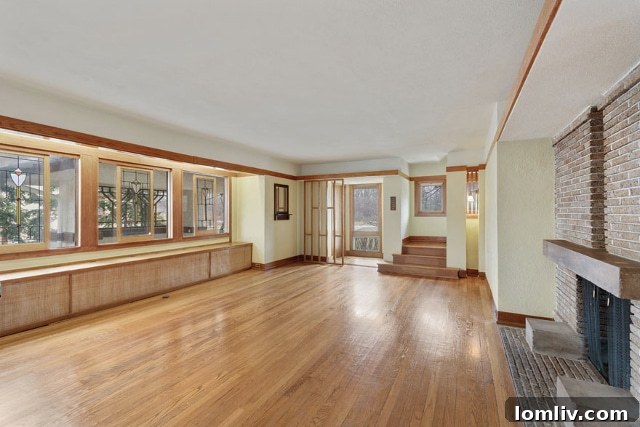
In Ravine Bluffs, Wright allowed for a degree of customization within the core Foursquare footprint, incorporating variations such as additional conservatories, distinct patios, and unique entrance halls. This flexibility ensured that while the homes shared a common architectural lineage, each possessed its own character. Advertised at a cost of $7,500, these homes were positioned at the higher end of Glencoe’s housing market of the era, where prices typically capped around $10,000. Both figures were considerably above the national average home price of approximately $3,500 in 1915, underscoring the quality and design prestige associated with a Wright creation.
Furthermore, while the Ravine Bluffs homes might appear modest by today’s expansive standards, their average size of 1,800 square feet was notably generous for 1915, surpassing the national average of 1,500 square feet. This combination of thoughtful design, innovative spatial planning, and superior construction quality positioned the Ravine Bluffs properties as aspirational homes, representing a significant investment and a testament to modern living in the early 20th century. They encapsulated Wright’s vision for accessible, well-designed homes that offered a new paradigm for American domestic architecture.
Architectural Harmony and Discord: Wright’s Legacy Among Later Neighbors
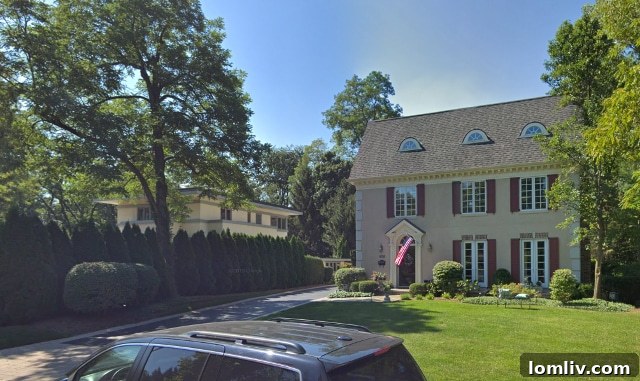
Today, the five surviving Frank Lloyd Wright homes in Ravine Bluffs stand in striking, almost jarring, contrast to their architectural neighbors. This visual dichotomy raises an important question: what architectural style could truly complement a Wright masterpiece without appearing hideously out of place? Wright’s Prairie Style and his burgeoning Usonian principles were so singular and groundbreaking that they often defy easy integration with later, more conventional designs. The deep overhangs, horizontal lines, and organic connection to the landscape that characterize Wright’s work demand a sympathetic architectural dialogue, which is rarely achieved by chance.
While the immediate neighbors might lack a certain design pedigree, one might speculate that architectural movements such as Streamline Moderne and Bauhaus homes from the 1930s and 1940s could have offered a more harmonious, albeit distinctly different, counterpoint. Both Streamline Moderne, with its emphasis on smooth, aerodynamic forms and clean lines, and Bauhaus, with its minimalist aesthetic, functionalism, and rejection of ornamentation, shared Wright’s modernist spirit and a departure from revivalist styles. Though different in expression, these styles might have provided a fascinating architectural conversation, emphasizing innovation and forward-thinking design rather than the often bland or incongruous structures that eventually rose beside these historic homes.
The Enduring Significance of the Sherman Booth Cottage and Ravine Bluffs
The successful campaign to save the Sherman Booth cottage from demolition is of paramount importance, not just for Glencoe, but for the broader understanding of American architectural history. This seemingly humble cottage tells a unique and compelling story. It served as temporary housing for Sherman Booth himself while his larger residence and the ambitious Ravine Bluffs subdivision were under construction. This detail offers a rare glimpse into the practicalities and stages of development within Wright’s projects, showcasing an architect at work, adapting to circumstances, and designing even the most temporary structures with his signature touch.
Beyond its immediate historical context, the cottage holds profound architectural significance as a progenitor of Wright’s later Usonian homes. The Usonian concept, developed by Wright in the mid-1930s, aimed to provide affordable, well-designed, and distinctly American housing for middle-income families. These homes typically featured open floor plans, flat roofs, natural materials, and an organic integration with their sites – many elements of which can be traced back to earlier designs like the “Fireproof House” and the Ravine Bluffs cottages. In turn, the Usonian ideals profoundly influenced the post-World War II American ranch home boom, shaping suburban landscapes across the nation.
Thus, the Glencoe cottage is far more than just an old house; it is a vital link in the evolutionary chain of American residential architecture. Its preservation ensures that architecture students, historians, and the general public will have the invaluable opportunity to study this pivotal structure firsthand. It serves as a tangible learning tool, demonstrating Wright’s early experiments with spatial fluidity, material innovation, and the integration of indoor and outdoor living – principles that would define his later, more famous works and continue to inspire architects worldwide. The cottage’s survival is a victory for education, preservation, and the enduring legacy of one of America’s greatest architects.
Exploring Architecture: My focus often delves into high-rises, homeowners’ associations, and the intricacies of renovation. However, I also deeply appreciate modern and historical architecture, always balancing these passions against the dynamic forces of urban development, including the YIMBY movement. I believe in fostering vibrant discussions about the built environment and its impact on our lives.
Do you have a compelling story about architecture, preservation, or urban planning to share? Or perhaps a groundbreaking idea that deserves attention? Feel free to reach out via email at [email protected]. You’re also welcome to look for me on social media platforms like Facebook and Twitter, though my virtual footprint there tends to be as elusive as a hidden Frank Lloyd Wright detail. Your insights and stories are always welcome.