Unpacking the Future of Fair Park: A Deep Dive into Dallas’s Iconic Landmark
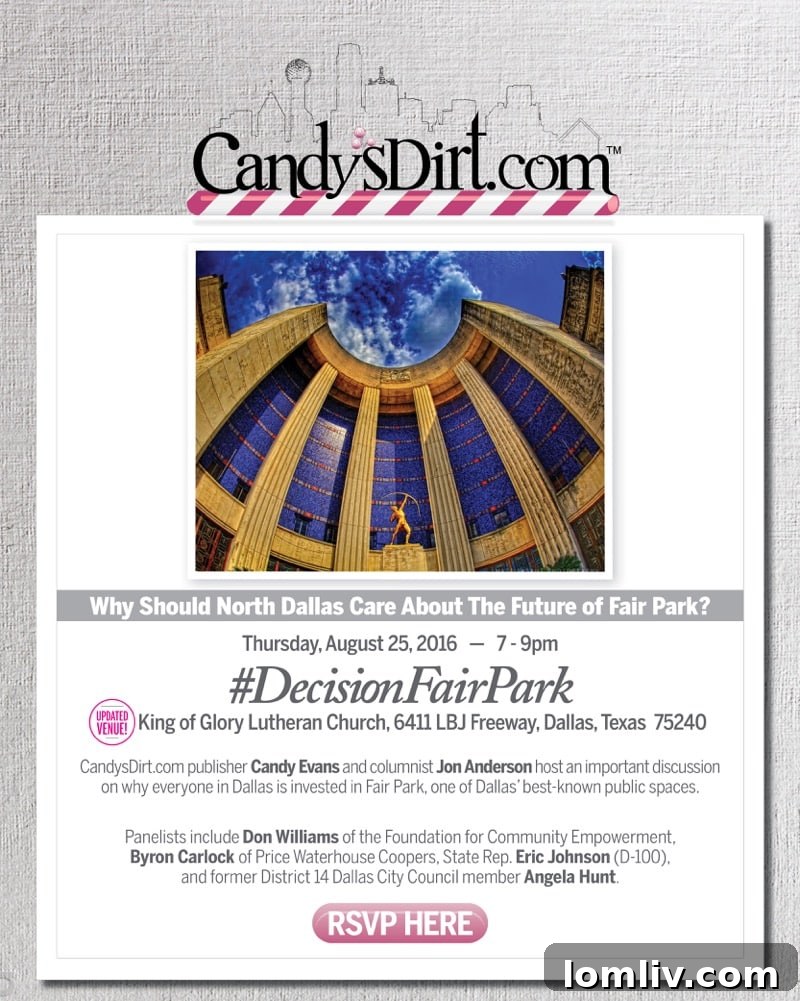
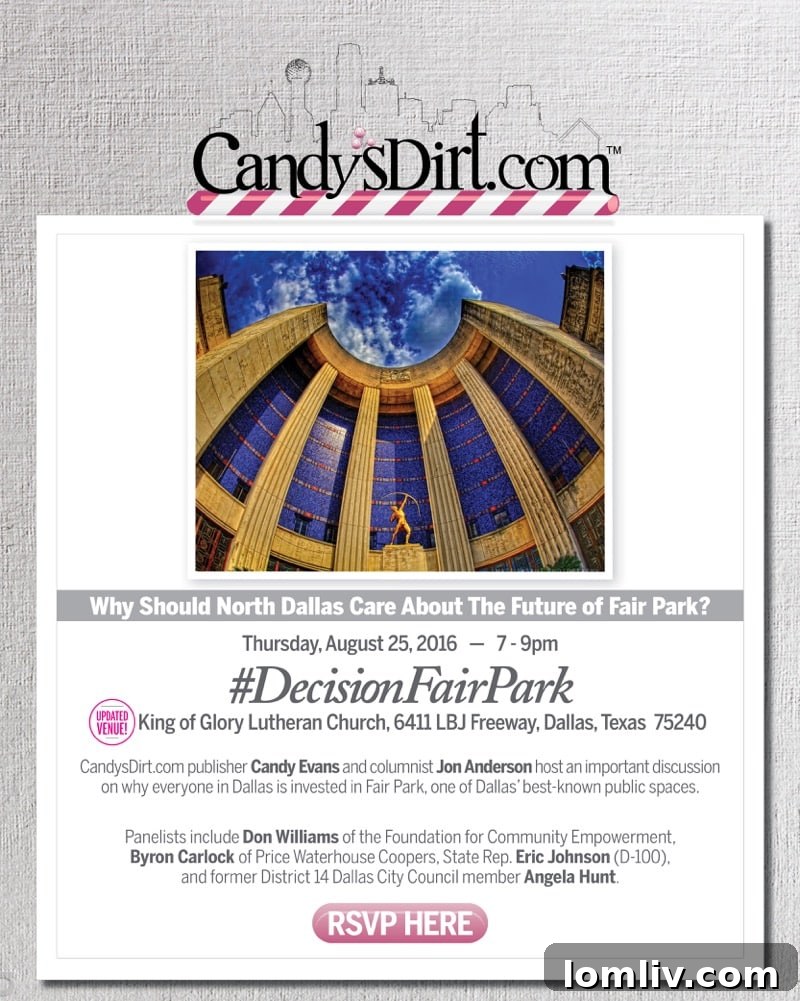
NOTE NEW VENUE: KING OF GLORY LUTHERAN CHURCH, 6411 LBJ FREEWAY, NORTH SIDE ACCESS ROAD, WEST OF HILLCREST, EAST OF PRESTON ROAD
Fair Park stands as a cornerstone of Dallas’s rich history and cultural identity. More than just the site of the annual State Fair of Texas, it’s a sprawling urban park, a collection of art deco masterpieces, and a vital public space with immense potential. Yet, like many historical assets, its future often becomes a subject of intense debate, particularly when significant public funds and private partnerships are involved. As a community member, I often find myself fielding questions about city developments, especially from my husband, who, despite his demanding professional life, strives to stay informed about how our tax dollars are utilized and the direction our city is taking.
Recently, the proposed Fair Park plan, endorsed by Mayor Rawlings, became a hot topic. As he pressed me for details, I realized that despite my efforts to stay “in the know,” many aspects of this complex proposal remained shrouded in ambiguity. This article aims to pull back the curtain on these critical questions, offering a clearer perspective on what the plan entails for Dallas citizens and the future of Fair Park.
The Financial Heart of the Matter: Investment vs. Return
Any large-scale urban development project naturally raises questions about its financial implications. The Fair Park plan is no exception, and the figures involved are substantial. My husband’s first query cut straight to the chase:
How much will this plan cost the city?
The initial figures are quite striking: an immediate allocation of $21 million, supplemented by an additional $75 million in bond funds. Furthermore, projections indicate another $50 million in bonds might be sought in 2020/2022. This totals a staggering $146 million in public funds earmarked for the revitalization of Fair Park. For context, such a significant investment demands clarity on what the city and its taxpayers will receive in return.
What exactly do we get for this considerable sum?
The answer, perhaps surprisingly, is primarily a “management fee.” These funds are designated for a newly established Foundation, which will oversee the revitalization efforts. The primary focus is described as “re-vamping the existing buildings.” While renovation is undoubtedly necessary for historical preservation, labeling this multi-million-dollar allocation as a “management fee” raises questions about the direct tangible benefits to the public versus operational overhead.
Does the city make any money off the State Fair?
This is a crucial point concerning potential revenue streams. The current State Fair contract, which extends until 2024, is slated to be assigned to the Foundation. This means any rental revenues generated from the State Fair, or indeed any other events held within Fair Park, would subsequently flow directly to the Foundation. This raises concerns about the city’s financial returns from an asset it continues to heavily fund. Historically, such public assets often generate some revenue for the city, which can then be reinvested into other public services. Diverting all potential rental revenues to a private foundation, even one dedicated to Fair Park’s improvement, signifies a significant shift in financial dynamics for the city budget.
Governance and Accountability: Who Holds the Reins?
With such a substantial commitment of public funds and the transfer of management to a private entity, questions of governance, oversight, and accountability become paramount. Citizens naturally want to know if there are mechanisms in place to ensure responsible management and performance.
Can the management of this new entity be held accountable if they falter?
The plan reportedly includes a “Remediation Plan” that would be triggered if the Foundation fails to meet its yet-to-be-determined performance measurements. However, the details are less reassuring than one might hope. The plan outlines corrective actions rather than empowering the city to take decisive personnel action. Critically, the power to hire and fire management ultimately rests with the Foundation itself, not with the city or its representatives. This structure vests a considerable amount of autonomy and power in the Foundation, potentially limiting direct public oversight and the city’s ability to intervene effectively should issues arise. The concept of “self-correction” for a public-funded entity, while appealing in theory, often leaves little recourse for external stakeholders if internal mechanisms prove insufficient.
A Year-Round Vision: Reality vs. Ambition
One of the most appealing aspects of any Fair Park revitalization strategy is the promise of transforming it into a vibrant, year-round destination. Dallas deserves a dynamic urban park that serves its residents beyond just the State Fair season.
Are they going to try to utilize Fair Park year-round?
The Foundation’s stated intention is indeed to “create a year-round venue,” with the State Fair maintaining its traditional place. This vision aligns with long-standing aspirations for Fair Park, aiming to activate its beautiful grounds and historic facilities throughout the year for a wider array of cultural, recreational, and educational activities. The idea is to move beyond its seasonal peak and integrate it more fully into the daily life of Dallas residents. This is a positive goal that many in the community support, but the specifics of how this will be achieved and funded remain to be seen.
Are we truly getting a new park?
This is perhaps one of the most significant points of contention and ambiguity within the entire plan. Despite the substantial public investment, there is “no guarantee” of a new park. The Foundation is mandated to “PLAN for a park,” but the actual construction is contingent on sufficient funding being available. If they “don’t feel they have enough money,” they are not obligated to build it. This distinction between “planning for” and “guaranteeing” a park is crucial. It suggests that while the concept of a revitalized green space is central to the narrative, its actualization is conditional, leaving room for a potential outcome where significant funds are spent without the creation of new parkland, which is often a primary expectation when discussing urban park revitalization.
If not for a guaranteed park, what exactly are these millions for?
The use of funds, beyond the vague “re-vamping existing buildings,” is outlined as: “Expanding Fair Park staff and operations and maintenance; funding and creating new departments, including communication and donor relations; and funding new projects.” While operational necessities and new projects are understandable, the emphasis on expanding staff, creating new departments (like communication and donor relations), and general “operations and maintenance” without a clear, guaranteed outcome like a new park, has raised eyebrows. For a significant portion of the public funds to be directed towards administrative growth and potentially undefined “new projects” rather than concrete infrastructural improvements or new public amenities, it necessitates a deeper level of transparency and specific project outlines.
The Foundation’s Commitment: A Public Promise
Despite these lingering questions, the Foundation has articulated a clear vision in its official statements:
“The Foundation hereby commits to fully and completely support Fair Park as a public park, maintaining and managing the events, historic grounds and facilities, and grounds of Fair Park as a vibrant, year-round location for events, daily activities, cultural enrichment, and place for quiet enjoyment.”
This commitment is admirable and encapsulates the collective hope for Fair Park’s future. It outlines a vision of accessibility, vibrancy, and a diverse range of uses for all citizens. However, the challenge lies in reconciling this overarching commitment with the specifics of the financial plan, the governance structure, and the conditional nature of critical deliverables like new park development.
The Importance of Ongoing Dialogue and Civic Engagement
The complexities and ambiguities surrounding the Fair Park plan underscore the vital importance of ongoing public discourse and informed civic engagement. This is precisely why initiatives like a panel discussion are indispensable.
As referenced here: “Why we should care about the future of Fair Park in North Dallas” – understanding and discussing these proposals openly is not just for policy wonks; it’s a fundamental responsibility for every Dallas resident. Our city’s heritage, its financial health, and the quality of its public spaces depend on our collective vigilance and informed participation. The future of Fair Park is not just about buildings and budgets; it’s about shaping a legacy for generations to come, ensuring that this iconic landmark remains a vibrant, accessible, and truly public asset for all.
Ultimately, the Fair Park plan represents a pivotal moment for Dallas. It’s an opportunity for significant revitalization, but it also presents a series of critical questions that demand clear, transparent answers. As citizens, our role is to continue asking these questions, demanding accountability, and ensuring that the promises made for Fair Park translate into tangible, beneficial realities for the entire community.