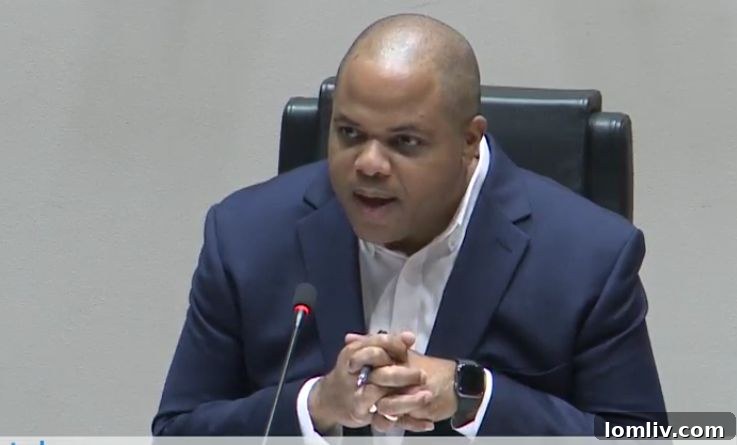
In a move that has sent ripples through Texas politics and garnered national attention, Dallas Mayor Eric Johnson announced a significant shift in his political identity. On a recent Friday, Mayor Johnson declared his intention to change his political party affiliation, opting to vote in the Republican primary come spring. This declaration from the leader of the ninth-largest city in the United States immediately ignited debate and speculation, considering that the office of mayor, along with city council positions in Dallas, are officially nonpartisan. Yet, in the deeply politicized landscape of modern America, such an announcement from a prominent urban figure carries immense weight and implies much more than a simple change in voting preference.
For many observers, this dramatic party switch almost certainly signals Mayor Johnson’s ambitions for higher office. Johnson, 47, boasts a distinguished political career, having served as a Democrat in the Texas House of Representatives from 2010 until 2019, the year he was first elected Mayor of Dallas. A proud Harvard graduate, Johnson has often referenced his legislative tenure in the Texas House during his time presiding over the Dallas City Council, suggesting a familiarity and comfort with state-level political operations. His journey from a Democratic state legislator to a nonpartisan mayor, and now to a declared Republican, paints a picture of a politician strategically navigating the evolving dynamics of Texas’s political scene.
The announcement itself, strategically unveiled in an exclusive op-ed published in the prestigious Wall Street Journal, was swiftly picked up by virtually every major news outlet across the country, highlighting its national significance. This platform choice underscored the carefully calculated nature of Johnson’s move, granting it an air of gravitas and ensuring maximum reach. At its core, the party switch appears to be Mayor Johnson’s public endorsement of fiscal conservatism, a principle he has increasingly championed during his mayoral term. This was starkly evident just the week prior, when Johnson stood as one of only five elected officials to vote against the city’s largest budget in history. His opposition stemmed from what he criticized as a “meager” property tax decrease, arguing it would provide insufficient relief to Dallas homeowners and businesses.
Following that crucial budget vote, Johnson articulated his stance with conviction: “It is preposterous to suggest that our city government could not, by being more efficient, deliver essential services next year using the same amount of tax revenue collected from Dallas residents and businesses just a year ago.” This statement is a clear indicator of his alignment with traditional conservative fiscal principles, emphasizing governmental efficiency, responsible spending, and minimizing the tax burden on citizens. This philosophical alignment forms the bedrock of his declared shift to the Republican Party, positioning him as a voice for fiscal prudence in urban governance.
The Strategic Road to the GOP
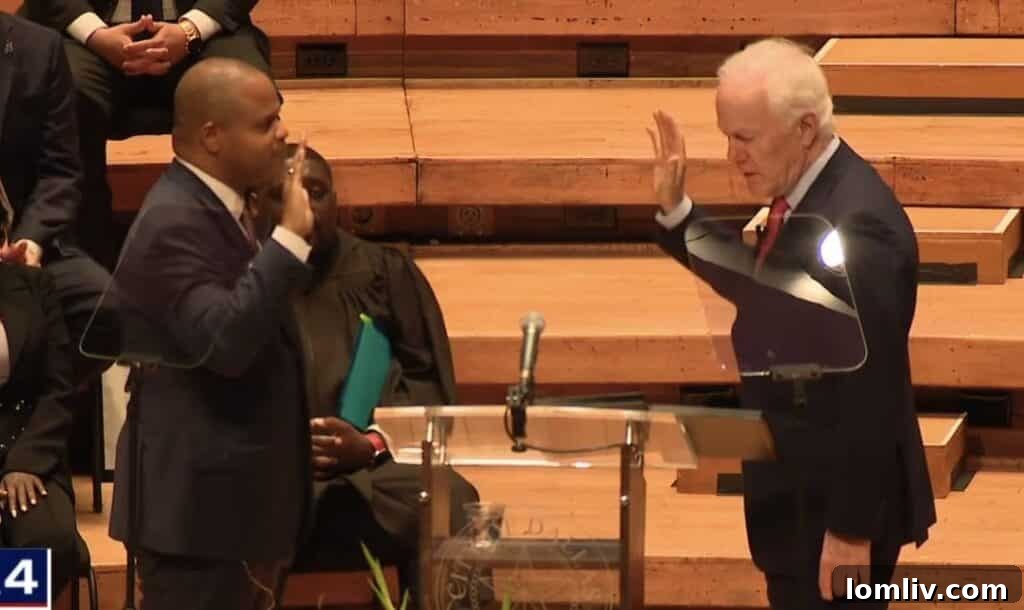
Speculation surrounding Mayor Johnson’s potential party switch had been steadily intensifying for months, bubbling beneath the surface of Dallas politics. One of the most significant indicators came early in his current term when he extended invitations to prominent Republican U.S. Senators, John Cornyn and Ted Cruz, to attend and participate in his inauguration ceremony. This gesture, unusual for a mayor with a Democratic background in a largely Democratic-leaning city, was interpreted by many as a deliberate signal of his shifting allegiances and a clear effort to build bridges with the state’s dominant political party. These early overtures laid the groundwork for the monumental announcement that would eventually follow.
Johnson’s announcement unequivocally positions Dallas as the largest city in the U.S. with a Republican mayor, a distinction that carries considerable symbolic weight. This fact, highlighted by outlets like the Texas Tribune, challenges conventional narratives about urban political leadership often associated with the Democratic party. It also draws parallels with Fort Worth, Texas’s 12th largest city, which is already led by Republican Mayor Mattie Parker. The presence of two Republican mayors in major Texas cities suggests a potential trend or at least an opening for the GOP in traditionally blue urban centers, albeit often on a platform emphasizing local governance and fiscal responsibility over national partisan divides.
The political ramifications of Johnson’s switch extend far beyond the Dallas city limits. Many political analysts and insiders believe this move is a calculated step toward higher statewide office in Texas, where the Republican Party holds a supermajority. Former Dallas City Councilman Phillip Kingston was quick to offer a stark prediction on Friday, suggesting that Mayor Johnson will resign from his current post in 2025 to launch a bid for Texas Attorney General. This particular prediction resonates with Johnson’s background as a Harvard-trained lawyer and his prior legislative experience, making a legal-focused statewide office a plausible next step for a politician with his profile. Kingston’s outspoken remarks, while highly critical, reflect a sentiment of betrayal among some former colleagues and local Democrats.
While I certainly saw this coming, it’s somehow even dumber than it sounded
Oh, and all you dumb sons of bitches who voted for this fraud may line up on Greenville Ave to kiss my ass https://t.co/yxkYxnH526
— FREE THE POKER ROOMS (@PhilipTKingston) September 22, 2023
The real estate sector, a significant economic driver in Dallas, was naturally curious about the implications of the mayor’s party shift. However, direct public comments proved elusive. When daltxrealestate.com reached out to local builders and real estate experts for their reactions to the announcement, the responses were largely guarded. Linda McMahon, president and CEO of The Real Estate Council, politely acknowledged the inquiry but stated she had no comment on the matter. Many other industry professionals either did not respond or chose to remain silent, perhaps indicating a wait-and-see approach or a reluctance to wade into highly charged political territory. Nevertheless, the announcement sparked no shortage of opinions on social media platforms, particularly X (formerly Twitter), where the discourse was vibrant and often polarized.
A Political Firestorm: Reactions and Implications
The political repercussions of Mayor Johnson’s party switch were immediate and intense, drawing sharp criticism from his former political allies and enthusiastic praise from newly found ones. The Dallas County Democratic Party chairman, Kardal Coleman, minced no words, publicly stating that the mayor’s party switch was an “insult to the electorate.” Coleman’s powerful statement underscored a feeling of betrayal among Democrats, many of whom had supported Johnson based on his past affiliation and progressive-leaning positions. He further elaborated on this sentiment, accusing Johnson of prioritizing personal ambition over public service: “This switch is the launch of a self-centered agenda that puts politics over people.” This viewpoint frames the party change not as an evolution of political philosophy but as a calculated, self-serving maneuver to advance his career within a more politically advantageous framework in Texas.
Similarly, Mark Melton, the outspoken founder of the Dallas Eviction Advocacy Center, echoed strong disapproval, publicly labeling the mayor a “charlatan.” Such harsh characterizations from local figures indicate the depth of anger and disappointment felt within segments of the Democratic base and progressive advocacy groups in Dallas. These critics view Johnson’s move as a pragmatic abandonment of the principles and constituents he once represented, especially given Dallas’s historically Democratic leanings and diverse demographic.
Conversely, the Republican establishment in Texas, predictably, welcomed Mayor Johnson with open arms and resounding approval. High-profile figures were quick to embrace him, eager to capitalize on the symbolic victory of attracting a sitting mayor from a major urban center. Texas Governor Greg Abbott issued a public statement effusively praising Johnson’s decision: “He’s pro-law enforcement and won’t tolerate leftist agendas.” Abbott’s statement highlights key tenets of the Republican platform, suggesting that Johnson’s shift aligns him with conservative priorities on public safety and resistance to progressive policies. The Governor also proudly noted the increasing presence of Republican leadership in Texas’s largest cities, stating, “Two of the 10 largest cities in America now have Republican mayors and they are both in Texas,” a clear reference to Dallas and Fort Worth.
Lieutenant Governor Dan Patrick, another powerful figure in Texas Republican politics, also hailed the decision as a significant win for the party. “Mayor Eric Johnson announced he is switching to the Republican Party,” Patrick remarked. “He’s a good man. Welcome to our party.” These endorsements from the state’s highest-ranking Republicans provide immediate validation for Johnson’s pivot and solidify his standing within the new party. Their enthusiastic welcome suggests that Johnson is perceived as a valuable asset, capable of broadening the Republican Party’s appeal, particularly in traditionally Democratic urban areas.
The long-term implications of Mayor Johnson’s party switch are manifold. For Dallas, it might mean a continued emphasis on fiscally conservative policies, potentially influencing future budget debates, infrastructure projects, and city-wide development strategies. For the Republican Party in Texas, it represents a strategic gain, demonstrating their ability to attract leadership from diverse backgrounds and urban centers, thereby challenging the conventional wisdom that major cities are exclusively Democratic strongholds. It also provides a high-profile figure who could potentially contest statewide elections, adding to the depth of their candidate pool. For Mayor Johnson himself, this move is a high-stakes gamble, potentially alienating his former base but opening new doors to political advancement in a state dominated by Republicans. His decision will undoubtedly be scrutinized for years to come as a case study in political realignment and ambition in a rapidly evolving national political landscape, shaping not only his career but potentially the future trajectory of Texas politics.