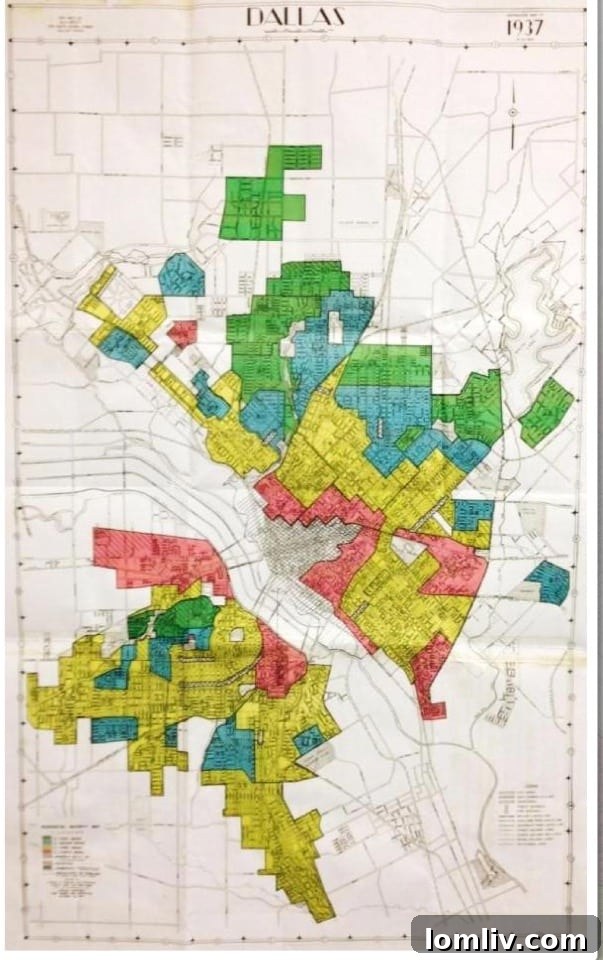
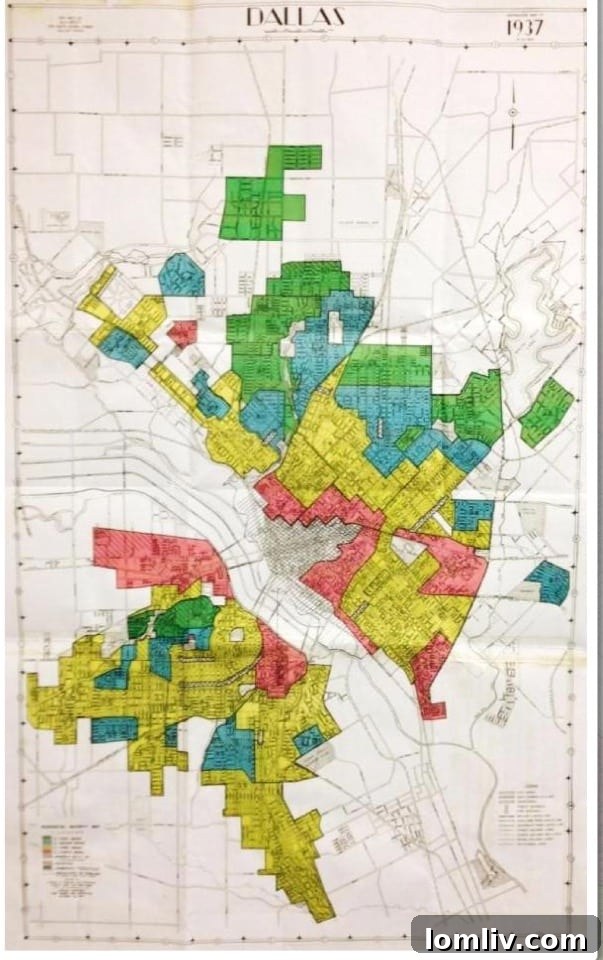
This 1937 Home Owners’ Loan Corp. map of Dallas shows who could get a loan, and who couldn’t.
Imagine navigating the housing market today under the lending rules of the 1940s. Would you have qualified for the mortgage that secured your current home? For residents in some areas of Dallas, the answer might be a confident yes. However, for others, the harsh realities of historical financial discrimination could have profoundly altered their lives, revealing a system that systematically excluded specific communities from homeownership and wealth building.
Recently, I had the invaluable opportunity to attend a workshop co-hosted by Children’s Medical Center and Ohio State’s Kirwan Institute. This session shed critical light on post-Depression era lending practices, particularly those that were openly embraced until their prohibition in 1968. Despite being outlawed over half a century ago, these deeply ingrained practices continue to cast a long shadow, fundamentally shaping the socio-economic landscape and residential patterns of neighborhoods even in contemporary Dallas and across the nation.
The Genesis of Modern Home Financing and Its Hidden Flaws
To fully grasp the magnitude of these discriminatory practices, it’s essential to understand the state of home ownership before the Great Depression. In the pre-Franklin D. Roosevelt era, securing a home loan was a vastly different endeavor from the standard 30-year, fixed-rate mortgage with a 20% down payment we recognize today. Homeownership was largely an aspiration reserved for the affluent or those with substantial financial flexibility. Mortgages often featured variable interest rates, demanded exceptionally high down payments, and required short repayment terms, typically only a few years. It wasn’t uncommon for homeowners to renegotiate their mortgage annually, living with persistent financial uncertainty. Many also faced the daunting prospect of a large “balloon payment” at the conclusion of their loan term, a sum that could easily lead to foreclosure if not adequately prepared for.
The economic devastation of the Great Depression, however, necessitated a radical shift in federal policy. With nearly 10 percent of all homes facing foreclosure at the height of the crisis, and approximately 250,000 homes foreclosed upon annually between 1931 and 1935, the housing market was in disarray. In a dual effort to stabilize the collapsing housing sector and stimulate employment in the construction industry, the federal government intervened to overhaul the entire system of home finance. This intervention marked a pivotal moment, transforming homeownership from an elite privilege into a more broadly accessible goal.
One of the most significant outcomes of this federal intervention was the Home Owners’ Refinancing Act of 1933. This landmark legislation led to the creation of the Home Owners’ Loan Corporation (HOLC). The HOLC, funded by government-backed bonds, embarked on a mission to purchase defaulted mortgages from struggling homeowners and banks, then reinstate these loans under revised, more manageable terms. Crucially, the HOLC didn’t just refinance; it fundamentally reshaped the structure of mortgages, pioneering the fully amortized, fixed-rate, long-term loans that are the bedrock of modern home financing. On the surface, this innovation was a triumph, democratizing homeownership by lowering down payments, ensuring predictable monthly installments, and eliminating the dreaded balloon payments. However, this seemingly equitable system harbored a deeply discriminatory secret: its benefits were not extended to everyone, particularly not to Black Americans.
The Sinister Side of Progress: The HOLC’s Residential Security Maps and Redlining
As the Federal Housing Authority (FHA) was established to guarantee mortgages and mitigate lender risk, the HOLC was tasked with assessing neighborhoods to inform these risk calculations. This assessment process gave rise to the infamous “Residential Security Maps,” which visually codified systemic discrimination through color-coded districts. These maps were not merely administrative tools; they became instruments of racial segregation and economic injustice, determining who could access the newly standardized, government-backed loans, and who would be deliberately excluded.
- Green (A-grade) areas were designated as “First Grade” and represented the most desirable and low-risk neighborhoods. These areas were almost exclusively inhabited by white, Anglo, and Protestant families. Homebuyers in these districts could qualify for FHA-guaranteed loans covering up to 80 percent of the home’s value, requiring only a 20 percent down payment.
- Blue (B-grade) areas, or “Second Grade,” were deemed “still desirable.” While predominantly white, these neighborhoods included residents of other European ethnic origins, such as Jews, Italians, and Irish, who were generally upwardly mobile. These areas qualified for 60-80 percent loan-to-value ratios.
- Yellow (C-grade) areas were classified as “Third Grade” and labeled “definitely declining.” These were characterized by a mix of ethnicities, often including Black residents, and typically had lower-income populations. Mortgages here would only be guaranteed for about 15 percent of the home’s value, necessitating an exorbitant 85 percent down payment, a barrier to entry for most.
- Red (D-grade) areas, infamously known as “redlined” districts, were declared “Hazardous.” These neighborhoods were almost exclusively inhabited by Black communities and were deemed too risky for any government-backed loan. This categorization effectively cut off these areas from legitimate access to mortgage credit, condemning them to disinvestment and decay.
Deconstructing the Criteria: What Justified “Hazardous” Designations?

Notice “type of population” is one of the factors that earned this neighborhood a redlined status (click to enlarge).
The criteria for these classifications were disturbingly explicit in their racial and social bias. Accompanying documentation for a 1937 HOLC map of Dallas detailed the purpose of the Residential Security Map: “to graphically reflect the trend of desirability in neighborhoods from a residential viewpoint.” While factors such as “intensity of the sale and rental demand,” “percentage of home ownership,” “age and type of building,” “economic stability of area,” “sufficiency of public utilities,” and “accessibility of schools, churches and business centers” were listed, two criteria stood out for their overt discriminatory implications: “social status of the population” and “the restrictions set up to protect the neighborhood.” The disclaimer that “The price level of the home is not the guiding factor” further underscored that the issue was not purely economic but deeply social and racial.
These “restrictions” were, in fact, restrictive covenants – clauses embedded directly into property deeds that legally prohibited the sale of a home to non-white individuals. To this day, many homeowners, upon scrutinizing their property titles, are astonished to discover these discriminatory clauses, even though they were rendered unenforceable by the Supreme Court in 1948. Their continued presence serves as a stark reminder of a segregated past that once dictated who could live where.
Homer Hoyt, the chief economist at the FHA during this period and instrumental in shaping HOLC mapping standards, candidly articulated the underlying rationale: “If the entrance of a colored family into a white neighborhood causes a general exodus of white people, such dislikes are reflected in property values.” This statement explicitly links racial prejudice to perceived property risk, institutionalizing the notion that the presence of Black residents inherently devalued a neighborhood.
The Profound and Enduring Legacy of Redlining in Dallas
The consequences of redlining were immediate and devastating. Redlined areas in Dallas, and countless other cities, were effectively starved of credit and investment. Without access to conventional loans, residents struggled to maintain their homes, businesses found it impossible to expand or even establish themselves, and the cycle of disinvestment accelerated. This lack of financing prospects stifled business growth, leading to the creation of “food deserts” where fresh, healthy food was scarce, and vast “opportunity gaps” that persist to this day, limiting educational, employment, and economic advancement for generations.
Furthermore, redlining inadvertently fostered the rise of predatory lending practices. Denied legitimate bank loans, Black families trapped in redlined districts became vulnerable to unscrupulous lenders who offered usurious and often illegal loans. These exploitative terms were frequently designed to strip homeowners of their equity, with clauses that allowed lenders to foreclose on a property for even a single missed or late payment. This insidious practice ensured a continuous turnover of properties, enriching predatory lenders while systematically extracting wealth from Black communities.
The long-term effects of this institutionalized discrimination are undeniably visible today. A compelling comparison of a 1937 HOLC map with a recent map compiled by Parkland, illustrating disparities in life expectancy (years of life lost per racial group), graphically demonstrates the enduring health consequences of policies enacted more than eight decades ago. Similarly, a Kirwan Institute map measuring child opportunities across the Dallas-Fort Worth area reveals striking correlations, indicating that children in historically redlined neighborhoods continue to face significant disadvantages in terms of health, education, and economic mobility.
The End of Official Redlining, The Persistence of Its Shadow
The HOLC, having completed its initial mandate, was disbanded in 1936, though the FHA continued its mortgage guarantee programs. The Supreme Court’s 1948 ruling in Shelley v. Kraemer declared restrictive covenants unenforceable in courts, a critical step towards racial equality in housing. Officially, the practice of redlining was outlawed with the passage of the Fair Housing Act in 1968, a landmark piece of civil rights legislation designed to prohibit discrimination in housing. However, the legal cessation of redlining did not instantly erase its profound physical and social impact. The lines drawn on those post-Depression maps continue to influence neighborhood development, wealth distribution, and racial segregation in Dallas and countless other American cities to this very day, manifesting in stark disparities in everything from public services and school quality to health outcomes and economic opportunity.
Understanding this intricate history of redlining is not just an academic exercise; it is crucial for comprehending the roots of contemporary urban inequalities. By acknowledging how past policies have shaped our present, we can better work towards building more equitable and inclusive communities for the future. For those interested in visualizing this history firsthand, an annotated Dallas HOLC map, overlaid onto a current map for reference, can be accessed here (please click “OK” on any surface water error message).