

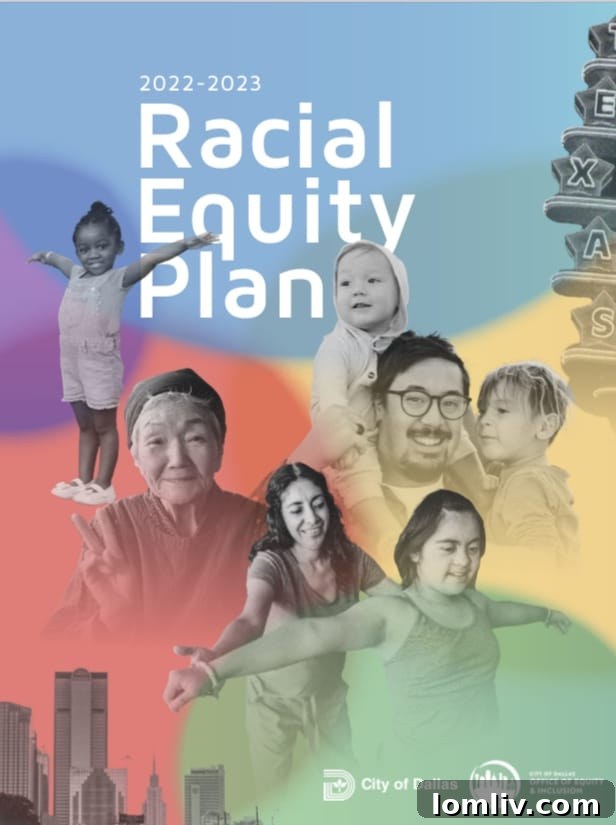
The City of Dallas has recently taken a significant step towards addressing systemic inequalities by adopting a comprehensive Racial Equity Plan. This ambitious 75-page document aims to translate the city’s commitment to creating affordable housing and revitalizing historically neglected communities into tangible policy actions. Approved during an August 24 City Council meeting, the plan represents a pivotal moment in Dallas’s ongoing journey toward greater social and economic justice for all its residents.
While the plan garnered broad support, its adoption was not without critical deliberation. One council member expressed skepticism regarding the document’s immediate efficacy and its chosen direction, sparking a vital conversation about the most effective strategies for city-wide positive change. This dialogue highlights the complexity of tackling deeply entrenched issues like racial and economic segregation in a major metropolitan area.
City leaders acknowledge that the plan’s adoption is merely the first stride in a marathon effort. Continued community engagement, the identification of specific, measurable deliverables, and robust funding strategies remain crucial next steps. Assistant City Manager Liz Cedillo-Pereira emphasized the administration’s commitment to transparency and accountability, announcing that the plan would be accessible in five languages and that an “equity dashboard” had been established. This dashboard will serve as a public platform, allowing citizens to monitor the progress of city staff in meeting the plan’s accountability measures, ensuring that goals are not only set but actively pursued and reported on.
A Call for a Master Plan: Councilwoman Mendelsohn’s Dissent
District 12 Councilwoman Cara Mendelsohn cast the lone dissenting vote against the Racial Equity Plan. Despite her well-documented history of advocating for marginalized communities and individuals, Mendelsohn articulated a belief that the adopted plan missed a crucial opportunity to tackle Dallas’s most pressing challenges head-on. She argued that while the intention behind the plan was commendable, its approach might not yield the desired systemic change.
Mendelsohn underscored Dallas’s unenviable position among major U.S. cities, citing one of the highest poverty rates in the nation. For her, addressing this pervasive poverty should be the paramount and urgent priority for the entire city council. Her primary critique centered on the plan’s perceived failure to directly confront what she identifies as the root problem: the persistent racial and financial segregation within Dallas. Instead of a broad racial equity plan, Mendelsohn advocated for a targeted, comprehensive “master plan for southern Dallas.” Such a plan, she contended, would not only address deep-seated poverty but also integrate critical elements of environmental justice, which disproportionately affect these underserved areas.
The Councilwoman emphasized the economic potential of southern Dallas, calling for a dedicated commitment to development in the area. “If we were serious about what we were doing in southern Dallas, we would all commit to subsidizing only development in southern Dallas,” Mendelsohn stated. She posited that providing developers with certainty regarding zoning and development frameworks would significantly incentivize investment in a region often overlooked by major projects. Her vision suggests a more focused, economic development-centric approach to equity, believing that targeted investment in southern Dallas would ultimately uplift the entire city by creating jobs, improving infrastructure, and reducing segregation.
Addressing Dallas’s Critical Affordable Housing Crisis
A core component of the Racial Equity Plan is its strategic focus on housing, a vital area where racial disparities are starkly evident in Dallas. District 1 Councilman Chad West highlighted the plan’s direct engagement with issues like access to rental housing, the widening homeownership gap, and the implementation of anti-displacement measures. These elements are designed to tackle the immediate and long-term housing challenges faced by many Dallas residents, particularly those in marginalized communities.
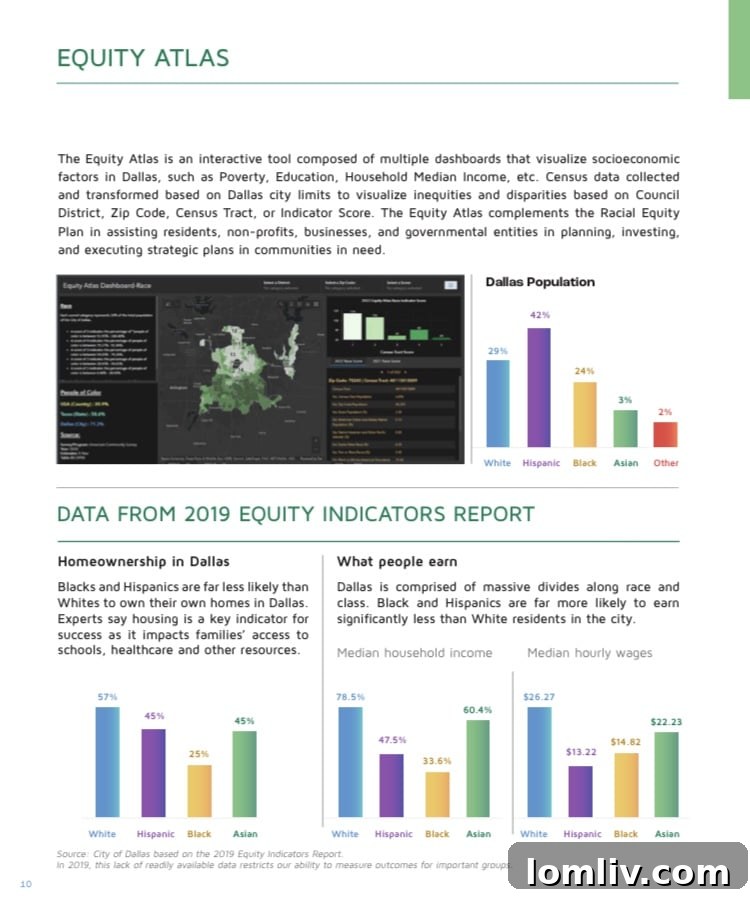
The urgency of these housing initiatives is underscored by alarming statistics. A recent report from the Child Poverty Action Lab revealed that market-rate rents in Dallas surged by 12.3 percent over the past year, while average incomes increased by only 4.1 percent. This growing disparity places an immense burden on low and moderate-income households. Councilman West illustrated this challenge, noting that the average rent of $1,524 per month requires an annual income of at least $60,000 to maintain the recommended 30 percent housing-to-income ratio. In stark contrast, an average minimum wage worker earns less than $20,000 annually, rendering even average city rents unaffordable. This critical affordability gap fuels housing instability and perpetuates cycles of poverty.
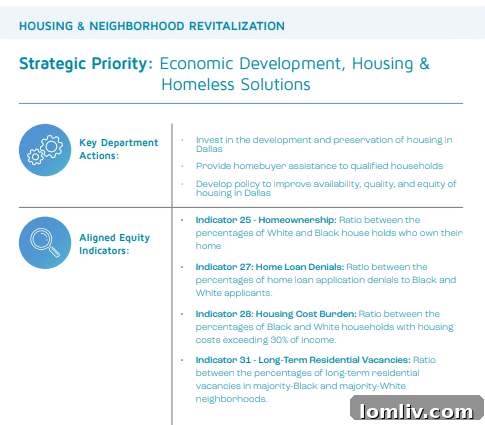
Assistant City Manager Cedillo-Pereira articulated the “big, audacious goal” of the housing strategy: to narrow the homeownership gap and foster enduring housing stability across Dallas. While the plan, often referred to as the REP, outlines these overarching objectives, questions persist about its immediate impact on increasing access to affordable housing in the short term. Page 40 of the document details several key departmental actions aimed at achieving these goals:
- Investing strategically in the development and preservation of diverse housing options across Dallas.
- Providing essential homebuyer assistance to qualified households, breaking down barriers to ownership.
- Developing robust policy frameworks to enhance the availability, quality, and equity of housing access throughout the city.
Councilman West further emphasized the importance of fostering mixed-income communities, stating, “We really just need to make sure that we’re not just consolidating lower incomes in one part of the city, that we’re spreading everyone out because all ships rise together.” This perspective advocates for an inclusive approach to urban planning, ensuring that economic diversity is integrated across all neighborhoods, preventing the concentration of poverty and promoting city-wide prosperity.
Innovative Partnerships and Anti-Displacement Strategies
David Noguera, Dallas’s director of housing and neighborhood revitalization, detailed the city staff’s proactive efforts in developing an “anti-displacement toolkit.” This initiative signifies a strategic shift from relying solely on city resources for housing preservation and homeownership access. Instead, the city is actively pursuing robust partnerships with the private sector, aiming to leverage external capital and expertise.
Noguera highlighted the necessity of this collaborative approach, especially as the city plans for the 2024 bond and rolls out the anti-displacement toolkit. “We realize that city resources can’t do everything that’s in front of us,” he explained. The strategy involves engaging with banks, understanding their community reinvestment goals and obligations, and effectively leveraging these relationships. Noguera’s vision is to multiply the impact of city funds: “If all we have is $1 million for a project or a program, how do we take that $1 million and turn it into $10 million? We’re just getting started, but the big piece of it is the leverage factor.”
An early example of this partnership model is already underway. Bank of America recently announced a groundbreaking initiative to offer zero-down mortgages in Black and Latino neighborhoods across several major cities, including Dallas. Noguera clarified that his office’s strategy isn’t about specifically targeting individuals based on race, but rather identifying and focusing on particular communities and ZIP codes that have historically faced systemic disadvantages. “We want to make sure that those who have historic ties to communities are given the first opportunity to access these resources,” he affirmed, emphasizing a commitment to honoring existing community fabric.
Furthermore, Noguera’s team is dedicated to prioritizing the creation of mixed-income housing, an essential step toward desegregating neighborhoods. This involves a dual approach: “We’re looking to drive market-rate housing to areas of high poverty,” he said, indicating efforts to introduce diverse housing options and stimulate economic growth in underserved regions. Simultaneously, they aim “to drive lower-income households to high-opportunity areas to achieve mixed-income communities,” thereby expanding access to better schools, services, and job prospects for historically disadvantaged populations. These strategies are designed to create more equitable and integrated urban landscapes, moving Dallas closer to its “one city” ideal.
Implementing the Vision: The ‘How’ of Engagement
Councilman West repeatedly pressed for clarity on the practical implementation of these ambitious goals, particularly regarding the engagement of non-traditional developers for affordable housing stock. “How are we going to reach out to them? How do we get that group identified and built up?” he questioned, highlighting the need for concrete action plans beyond general statements of intent.
Noguera responded by outlining a multi-faceted approach to developer engagement. He explained that outreach would extend beyond conventional real estate channels to include a diverse array of community stakeholders. “It’s going to come from looking at our faith-based community, our housing advocacy groups, and those who work in the social service space, education, healthcare, those who have tangential relationships to housing,” he detailed. This strategy aims to encourage these organizations to deploy their resources and networks in support of housing initiatives, tapping into existing community trust and infrastructure to foster sustainable development.
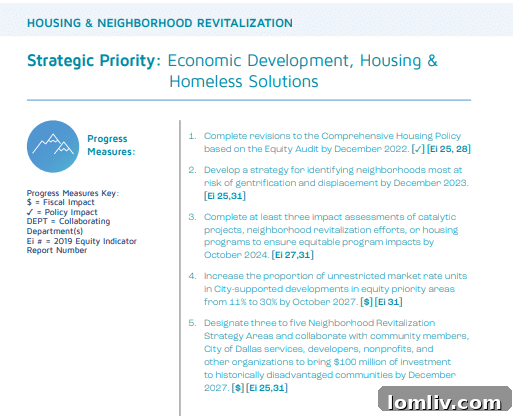
Cedillo-Pereira further elaborated on the plan’s structure, explaining that it outlines specific “action targets” that serve as stepping stones towards the larger, more audacious goals. She clarified that the Racial Equity Plan is conceived as a continuous process, not a swift solution. In a testament to broad city involvement, forty-two city departments have developed individualized progress measures. These measures are meticulously crafted based on extensive feedback gathered from both Dallas residents and city council members, ensuring they directly align with the overarching objectives articulated within the plan. These goals are envisioned as three- to five-year targets, allowing for flexibility and adaptation. “It allows us to go back and work with departments and the community to modify them and hone in on what needs to be addressed moving forward,” Cedillo-Pereira stated, committing to annual reporting on their progress. This iterative approach underscores the city’s understanding that achieving racial equity is a long-term commitment requiring ongoing evaluation and adjustment.
Public Feedback and Community Perspectives
The Racial Equity Plan has elicited a range of reactions from Dallas residents, reflecting both hope for systemic change and concerns about effective implementation. Angela Willis, a Realtor with Keller Williams and a resident of District 4, expressed optimism about the plan’s potential. She believes it will generate increased opportunities, particularly for women of color, by fostering access, advancement, and inclusivity across all dimensions of diversity. Willis also proposed concrete ideas for accelerating progress, suggesting that more financial support and tax incentives be directed toward nonprofit organizations, property management companies, and developers. Her vision includes collaborative efforts to offer vocational training and after-school programs for low-to-moderate-income teenagers, especially in Districts 4 and 8. She argued that such initiatives would play a crucial role in reducing crime rates and deterring juvenile delinquency, addressing root causes of social issues.
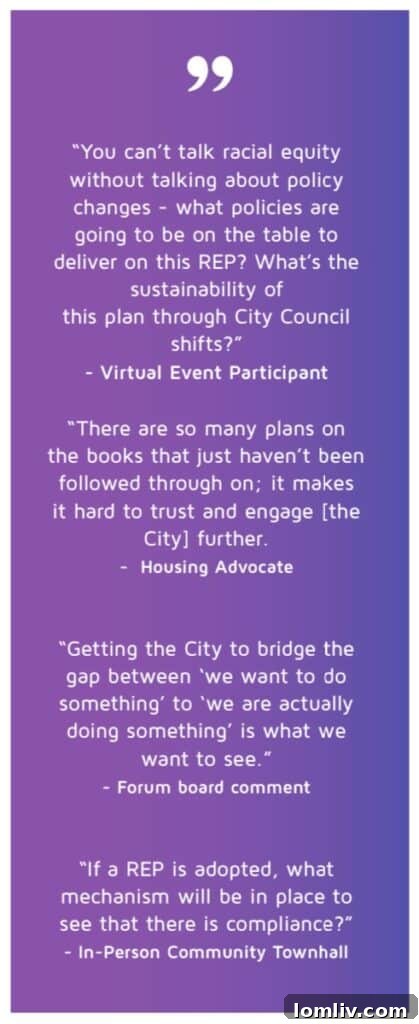
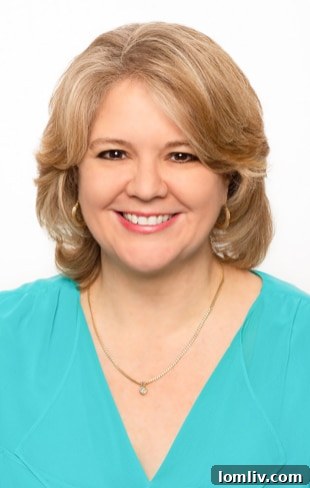
However, the plan also drew constructive criticism. Evelyn Mayo, a prominent advocate for fair housing and environmental justice and chairwoman of Downwinders at Risk, voiced support for the city’s racial equity goals but raised significant concerns regarding the plan’s practical execution. Her primary apprehension revolved around the absence of dedicated funding to ensure the comprehensive implementation of the plan’s ambitious recommendations. Mayo also highlighted the Downwinders’ Coalition for Neighborhood Self-Determination’s unease with the “ad hoc way that outreach and engagement was conducted for the plan to be created,” pointing to a perceived lack of thoroughness in involving community voices. Furthermore, she noted insufficient detail regarding how many of the proposed recommendations would actually be put into practice, emphasizing the need for concrete action plans.
Another crucial piece of feedback came from Kathryn Bazan, who called for greater accessibility for Spanish speakers during subsequent engagement phases. She pointed out that the Spanish version of the plan was made available for public review just two days before the council meeting where it was adopted, a timeline she deemed insufficient for meaningful community input. Bazan’s powerful statement underscored a fundamental principle: “If community members don’t believe that this plan will bring them any tangible equity — its core purpose — it’s useless.” This feedback highlights the critical importance of inclusive engagement and ensuring that the plan’s benefits are genuinely felt by all residents, particularly those who have historically been marginalized.
Council Perspectives: Unity, Courage, and Systemic Change
The Dallas City Council discussion surrounding the Racial Equity Plan was marked by a range of impassioned comments, reflecting the diverse perspectives and commitments of its members. District 3 Councilman Casey Thomas II emphasized the proactive steps already taken, noting that all performance measures had been publicly available on the We Are One Dallas website for weeks. He framed the plan as a critical opportunity to rebuild trust with communities of color, signaling the city’s dedication to implementing policies that will level the playing field. “We have the chance to be the council of courage,” Thomas declared, reaffirming the extensive community engagement that preceded the plan’s approval.
District 13 Councilwoman Gay Donnell Willis, who moved to approve the plan, articulated the profound necessity of acknowledging past injustices. “It’s time to acknowledge that we all have different experiences and some of us have been disgustingly discriminated against,” she stated, asserting that historical discrimination has weakened the city, and a strong Dallas requires unified action. Willis expressed full support for the plan, eagerly anticipating the refinement of its program measures and the creation of an equity atlas. These tools, she believes, will ensure fidelity to the March 2021 resolution passed by the council, which laid the groundwork for the current equity initiatives.
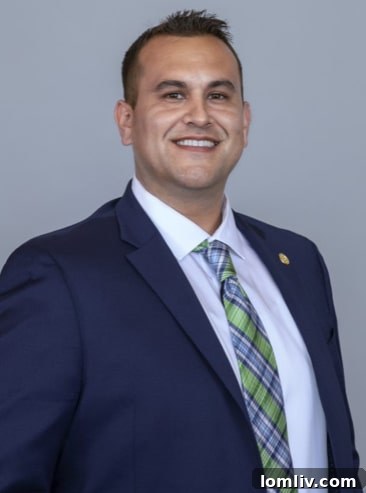

Councilman Adam Bazaldua invoked the powerful vision of Martin Luther King Jr.’s “I Have a Dream” speech, connecting the civil rights movement’s aspirations to the current policy initiatives. “We want the same dream and now we’re going to implement policy to allow for the next generation of Dallasites to accomplish that,” he proclaimed. Bazaldua emphasized that the plan directly addresses systemic issues and seeks to right the wrongs of the past for historically disadvantaged people. He acknowledged the challenge of securing funding, stating, “We’re going to have to hold feet to the fire to get funding to see these things accomplished.” His comments highlighted the critical need to translate rhetoric into action, emphasizing that meaningful change requires not just words, but financial commitment and unwavering political will to tackle disparities across all districts. “This is putting our actions behind our words, and we’re going to put money behind our actions. That’s what it’s going to take to make any change in this city,” he concluded.
Mayor Pro Tem Carolyn King Arnold delivered a poignant reminder of the enduring struggles faced by some communities, citing District 8 as a “whole community on septic tanks,” a stark symbol of neglected infrastructure. Her impassioned plea transcended political maneuvering, focusing on fundamental human dignity: “It is painful that we are still talking today about treating people humanely. Let’s stop making it difficult to feed people, to house people, to protect people. We have to stop worrying about who’s not going to vote for us in the next election and who’s not going to give to the campaign.” Her words served as a powerful call to prioritize human needs over political expediency.
Missing The Mark? The Core Debate on Dallas’s Segregation
During the intense council discussion, Mayor Eric Johnson intervened to caution members against direct personal critiques, as the debate around Councilwoman Mendelsohn’s objections grew heated. Mendelsohn consistently reiterated that her opposition was not against the principle of racial equity itself, but rather with a plan that, in her view, failed to explicitly identify and confront Dallas’s most profound systemic issue: the deeply entrenched racial and financial segregation of the city.
“It’s missing the mark of addressing that overarching problem,” she asserted. Mendelsohn argued that many of the initiatives outlined in the plan were not new, having already been approved, funded, and in some cases, implemented by the council. From her perspective, the plan, therefore, risked being more of a political statement than a novel, impactful solution. She contended that focusing on these existing initiatives under a new banner distracted from the more fundamental, unresolved issues.
“We really just need to make sure that we’re not just consolidating lower incomes in one part of the city, that we’re spreading everyone out because all ships rise together.”
District 1 dallas city councilmember Chad West
Mendelsohn also urged her fellow council members to cease infighting over resources, emphasizing that every district in Dallas has genuine needs. She strongly criticized what she perceived as the “weaponization” of the racial equity plan, labeling such tactics as “ugly and unbecoming.” Her perspective suggested that many of the plan’s components represent basic municipal functions that should already be efficiently provided. The existence of deficiencies, she argued, points to shortcomings within City Hall itself, rather than a need for an entirely new plan. Instead, she advocated for directing resources directly to city departments to strengthen their capacity for effective service delivery, rather than allocating funds to a new overarching plan. For Mendelsohn, the solution lies in improving existing operations and accountability, not in crafting another document.
In response, Councilman Bazaldua countered that genuine change often emerges from honest and difficult conversations among policymakers. He viewed Mendelsohn’s characterization of the plan as merely “political” as “absolutely beyond out of touch,” especially when the council possesses the power to effect meaningful change. Bazaldua warned that continued deflection and ignorance of systemic problems would only perpetuate the issues, making the council “part of the problem when we are trying to be part of the solution.” His comments underscored the belief that confronting uncomfortable truths is essential for progress.
District 8 Councilman Tennell Atkins frequently employs the vivid metaphor of a “tale of two cities” to describe the enduring imbalance between what he terms the “old city” (north of Interstate 30 and the Trinity River) and the “young city” (south of I-30). This dichotomy powerfully illustrates the stark historical and ongoing disparities within Dallas. Atkins emphasized, “We’re talking about equity. We’re not talking about districts.” His statement highlights the need for a city-wide approach to equity that transcends individual district interests, ensuring that resources and opportunities are distributed fairly across the entire metropolis. “If we’re going to be one Dallas, we’ve got to share the wealth. Let’s do it right for Dallas, not one-fourteenth of Dallas,” he passionately declared, encapsulating the aspiration for a truly unified and equitable Dallas where prosperity is shared by all.