

In the vibrant real estate landscape of Tarrant County, conversations often revolve around new listings and exciting opportunities. However, this week, we’re shifting our focus to a question that’s on everyone’s mind: “Is the real estate market slowing down?” This isn’t just idle curiosity; for both prospective buyers and sellers, understanding market dynamics is crucial for informed decision-making. After an unprecedented period of rapid appreciation and intense competition, the mere mention of a “slowdown” can trigger anxieties. But before jumping to conclusions, it’s essential to dissect the current environment with a clear, rational perspective, distinguishing between a healthy market rebalance and a dire crash.
First and foremost, let’s address the most common fears and set the record straight — RELAX. The signals we are currently observing do not indicate a catastrophic crash in the housing market. Nor are we hurtling towards an economic recession akin to the devastating period of 2007-2013 that profoundly impacted the real estate sector. Despite some sensational headlines or fearful rhetoric, the sky is emphatically not falling. While the frenetic pace of recent years might be easing, buyers should not expect to suddenly stumble upon “great deals” on every home. Instead, what we’re witnessing are subtle, yet significant, indicators that the market is beginning a journey towards a more sustainable and balanced state, a shift that ultimately benefits all participants.
Decoding the Signs of a Balancing Market
To truly understand the current state of real estate, it’s important to define what constitutes a balanced market. In real estate terminology, a balanced market is characterized by a sufficient supply of inventory to meet buyer demand for approximately six months. This equilibrium allows buyers adequate time to explore options without extreme pressure, while sellers can still achieve fair prices. For the past several years, particularly in competitive markets like Tarrant County, we’ve operated with less than one month’s supply of inventory. This scarcity created an environment where bidding wars were commonplace, homes sold sight-unseen, and buyers often felt immense pressure to make offers far above asking price, leading to widespread frustration and, for many, a decision to postpone their home search altogether due to limited selection and intense competition.
When inventory levels are critically low, the market becomes heavily skewed in favor of sellers. Buyers face daunting challenges: a limited pool of suitable homes, swift transaction timelines, and aggressive bidding that can push prices beyond their budget. This environment can lead to buyer burnout, as countless offers are rejected and the dream of homeownership seems increasingly out of reach. A prolonged period of such imbalance is unhealthy for the market, creating unsustainable price growth and potential accessibility issues for first-time homebuyers. Therefore, any movement towards increasing inventory, even seemingly small increments, is a positive development that fosters a healthier, more equitable market for everyone involved in the home-buying and selling process.
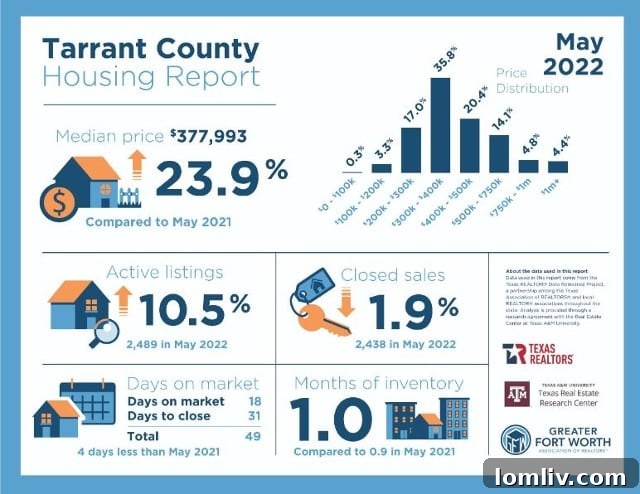
Recent data provides concrete evidence of this nascent shift. According to the Greater Fort Worth Association of Realtors, May 2022 marked a significant milestone, with Tarrant County recording a full one month’s supply of housing inventory. While this number is still a considerable distance from the ideal six-month equilibrium, its significance lies in the trend it represents. Just a month prior, in April 2022, Tarrant County’s inventory stood at a mere eight-tenths of a month’s supply. This incremental gain, moving from 0.8 to 1.0 month, might appear modest on the surface, but in a market accustomed to continually dwindling inventory, these “small gains are still gains.” They signify a crucial turning point, suggesting that new listings are coming onto the market at a slightly faster pace than homes are being sold, offering buyers a marginally wider selection and signaling the initial steps towards a less frenzied environment. This upward trend in inventory is a foundational element in establishing a more balanced and sustainable real estate market.
Why 2022 Is Not a Repeat of 2007: Dispelling the Bubble Myth
It’s crucial to resist the urge to draw parallels between the current market climate and the profound housing crisis of 2007. Stop. Stop. Stop. This is not the prelude to another Great Recession, irrespective of any attempts by politicians or media to incite fear, panic, or blame inflation. The current real estate adjustments we are observing bear little resemblance to the systemic collapse that occurred over a decade ago, and for numerous compelling reasons. Understanding these fundamental differences is key to accurately assessing the market’s trajectory and avoiding unfounded alarm, particularly for those looking to buy or sell in the near future. The underlying economic conditions, lending practices, and homeowner equity positions are vastly different today.
The previous housing recession was primarily fueled by an egregious era of irresponsible and extremely risky lending practices. Lenders were approving loans for individuals without proper income verification, often referred to as “No Income, No Job, No Assets” (NINJA) loans. Borrowers frequently didn’t have to demonstrate any ability to repay the loan, nor was there sufficient verification beyond their basic existence. A massive proportion of these loans were sub-prime, meaning they were issued to borrowers with terrible credit scores, indicating a high risk of default. A staggering figure from 2007 shows there were over 13 million Adjustable Rate Mortgages (ARMs) in circulation, many of which reset to unaffordable payments, trapping homeowners. In stark contrast, today’s market features only around 2.5 million ARMs, and lending standards are significantly more stringent, requiring robust proof of income, assets, and creditworthiness. This fundamental shift in lending practices acts as a powerful safeguard against a repeat of the 2007 collapse.
Furthermore, the market dynamics themselves were distinct. In 2007, even in Texas, a period of false demand and an overwhelming supply of housing contributed significantly to the bursting of the housing bubble. Speculative buying, often by investors seeking quick profits, artificially inflated demand. When this speculative activity subsided and the actual demand couldn’t absorb the heavy supply, prices plummeted. Currently, the landscape is entirely different: there is genuine high demand driven by demographic shifts and population growth, coupled with persistently low, though improving, inventory. This fundamental imbalance, high demand against limited supply, means that we are not in a housing bubble poised to burst; rather, we are seeing a market that needs to rebalance to meet sustained demand without unsustainable price acceleration. So, if you find yourself at a social gathering and someone confidently predicts a housing market crash, it’s perfectly acceptable to politely disengage, as their understanding of the current economic and real estate fundamentals is likely misinformed.
Similarly, dismiss any claims about an impending “rush of foreclosures and bank-owned homes” that can be scooped up at bargain prices. This narrative, a painful reality of the 2007 crisis, is highly unlikely to materialize today. One of the primary reasons is the substantial appreciation in home values over the past few years. Even if a homeowner faces financial hardship and defaults on their loan for 30, 60, or even 90 days, and even if their home’s value experiences a slight dip from its current peak, the vast majority still possess a significant amount of equity. This equity provides a crucial safety net. It allows homeowners in distress to sell their property, repay their outstanding mortgage, and often walk away with a profit, rather than face foreclosure. This strong equity position fundamentally differentiates the current market from the highly leveraged and underwater mortgages prevalent during the last downturn, making a widespread wave of foreclosures improbable.

Additional Indicators: Interest Rates, Affordability, and Property Taxes
Beyond inventory levels, several other factors are contributing to this observed market slowdown, and interest rates are undoubtedly a major player. Currently, the rates for 30-year conventional mortgages hover around 5.75 percent. While this figure might seem elevated compared to the historically low rates of 2.3875 percent seen just a few months ago, it’s important to put it into historical context. Any Baby Boomer will readily recount stories of purchasing their first homes with interest rates ranging from 11 to 20 percent. From that perspective, 5.75 percent remains a very good and manageable rate. However, the rapid increase from recent lows has a tangible impact on affordability, as higher rates translate directly to higher monthly mortgage payments, thereby reducing a buyer’s purchasing power and tempering overall demand.
More than just the absolute interest rate, this Bow Tie Realtor would contend that the overall, unprecedented escalation in home prices is the most significant driver of the current market rebalancing. When a “starter home” in areas like Tarrant County commands prices well into the $300,000 range, and even then remains difficult to find, secure under contract, and close, it automatically excludes a substantial segment of first-time and entry-level buyers from the market. This creates a bottleneck, as potential buyers, despite having stable incomes, find themselves priced out. The ripple effect of these high prices combines with other significant financial burdens: absurdly high property tax rates in Texas, which add thousands annually to homeownership costs, and the recently rising interest rates. The cumulative effect of these three factors — high home prices, escalating property taxes, and increasing mortgage rates — creates a formidable barrier to entry for many, collectively leading to the signs of a slowdown as buyer demand cools in the face of diminishing affordability.
Understanding “Price Improvement” and Market Adjustments
Another compelling indicator that the market is recalibrating is the noticeable increase in what real estate professionals politely term “price improvements.” This phrase, however, is a softer way of saying that we are witnessing more price drops than we have in many months. Let’s be candid: sellers naturally aim to maximize their profit, and Realtors, working diligently for their clients, strive to achieve the highest possible selling price. Consequently, an initial list price might occasionally be a “titsch” (as my former mother-in-law would affectionately say) too high. This is fair enough; there’s no fault in aiming high when the market has shown a willingness to absorb such prices. If buyers are eager and able to pay a premium, or even overpay, to secure their desired home, there’s nothing inherently wrong with that market dynamic. However, as any fundamental economic principle will dictate, there eventually comes a price point where a segment of buyers will simply refuse to pay. This is the market speaking.
The recent trends in Tarrant County clearly illustrate this shift. In the past week alone, nearly 500 homes across the county saw a decrease in their asking price, a significant number reflecting a change in seller expectations or a response to buyer resistance. Simultaneously, in that very same week, nearly 900 new homes entered the market. This dual movement — an increase in new listings coupled with a rise in price reductions — paints a clear picture. Sellers can certainly set their asking price as high as they wish, but if a substantial portion of potential buyers are unwilling or unable to meet that figure, then the market has unequivocally expressed its sentiment. This dynamic signifies a crucial step towards a more balanced market, where pricing becomes more aligned with present demand and affordability, moving away from the aggressive upward trajectory of the past few years. And in the long run, this market adjustment is genuinely a positive development for stability.
Final Thoughts: Towards a Healthier, More Balanced Market
Let’s reiterate, for the sake of clarity and peace of mind: the sky is not falling on the Fort Worth and Tarrant County real estate market. Home values are not poised for a significant, widespread drop akin to a market crash. What we are experiencing, and what will likely continue for the foreseeable future, is still a strong seller’s market. However, the intensity is diminishing, and the frenetic pace is giving way to a more measured environment. Crucially, the signs are unequivocally there, pointing towards a much-needed return to a degree of normalcy and equilibrium within the real estate landscape, moving away from the unsustainable hyper-growth of recent years. This rebalance creates a more predictable and less stressful environment for all participants.
Therefore, it’s unproductive to engage in debates with those convinced we are heading into another housing crash. That scenario, based on current economic fundamentals and lending standards, is simply not going to happen, especially not in robust markets like Texas. Similarly, don’t waste your energy trying to persuade someone that homes will soon be available for “50 cents on the dollar.” Such drastic drops are unrealistic given the underlying demand and equity positions. Instead, focus on the practical implications of this shift. If you’re a seller, continue to aim for the maximum value for your home; you are entitled to and deserve the best possible return on your investment, but be prepared for a slightly longer marketing period or potential adjustments. If you’re a buyer, this evolving market means you might no longer have to drastically overpay or even pay the full asking price for the home of your dreams. If nothing else, the most immediate benefit is the increased inventory, offering a wider selection of homes to choose from, thereby enhancing your chances of finding the perfect property without the intense pressure of constant bidding wars. Hang in there, everyone. We are on a path towards normalcy and a significantly more balanced real estate market, which ultimately benefits the entire community.