

North Texas Real Estate: A Decade of Unprecedented Growth Predicted for Dallas-Fort Worth
North Texas has long been recognized as a dynamic economic powerhouse, attracting businesses and individuals with its vibrant job market and appealing lifestyle. As early as 2015, robust economic indicators, significant job creation, and a surging population led leading real estate experts to predict substantial growth in North Texas home prices. Specifically, forecasts at the time projected an astonishing 35 percent increase in home values over the subsequent three years within the highly active Dallas-Plano-Irving metropolitan areas. This optimistic outlook laid the groundwork for what would become a sustained period of real estate prosperity, reinforcing the region’s status as a prime destination for homeowners and investors alike.
The foundation of these remarkable predictions was rooted in comprehensive analyses of market fundamentals. These insights provided a clear picture of the underlying strengths driving demand and value appreciation across the region. The sustained momentum observed in key economic metrics served as a powerful testament to the resilience and attractiveness of the North Texas housing landscape, drawing national attention and solidifying its reputation as a consistent leader in real estate performance.
Unpacking the Local Market Monitor Report: Key Insights into North Texas Growth
In December 2014, Local Market Monitor, Inc. (LMM) released detailed local market reports for North Texas, offering a meticulous examination of crucial factors influencing the housing market. Their analysis delved into an array of indicators, including local job growth, population migration trends, housing permit issuances, the local market risk premium, and average home prices. By synthesizing these diverse data points, LMM provided a sophisticated prognosis for regional real estate trends.
Key Indicators Driving LMM’s Optimistic Forecasts
LMM’s methodology hinges on several interconnected indicators, each playing a vital role in forecasting market stability and growth:
- Job Growth: A primary driver of housing demand, as an expanding job market attracts new residents and increases household formation.
- Population Migration: Reflects the influx of new individuals and families moving into the area, directly impacting the need for housing.
- Housing Permits: An essential measure of future housing supply, indicating developers’ confidence and planned construction activity.
- Local Market Risk Premium: An assessment of the investment risk associated with a particular market, guiding investor decisions.
- Average Home Prices: The current market values, analyzed in conjunction with income levels to determine affordability and potential for appreciation.
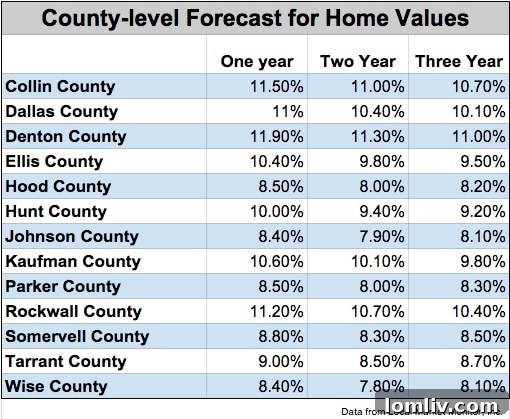
Based on their rigorous analytics, LMM projected a robust 11 percent increase in home prices across the eastern counties of North Texas and an 8 percent rise in the western counties over the subsequent 12 months. This regional performance significantly outpaced national forecasts, which anticipated a 6.3 percent increase in prices across the United States during the same period. The disparity underscored North Texas’s exceptional economic health and real estate appeal.
Eastern vs. Western DFW: A Regional Breakdown of Home Value Predictions
LMM’s foresight extended beyond a single year, providing a comprehensive three-year outlook for the region. The forecasts highlighted distinct yet strong growth trajectories for different parts of the Dallas-Fort Worth (DFW) metroplex:
- In the eastern DFW counties, home values were predicted to climb by 11 percent in 2016 and an additional 10 percent in 2017, showcasing sustained high-level appreciation.
- For the western counties, a steady 8 percent increase was anticipated for both 2016 and 2017, demonstrating consistent, albeit slightly moderated, growth.
Collectively, the report predicted an overall home price increase of 25 percent over the three-year period. A particularly compelling finding was that the market was considered approximately 17 percent underpriced relative to local income levels at the time. This “underpriced” status was a critical indicator, suggesting significant room for further appreciation and confirming that the market was not overheated, but rather offered substantial long-term value potential for both buyers and investors.
Pillars of Prosperity: Why North Texas Thrives in Real Estate
These insightful reports from Local Market Monitor resonated deeply with the sentiments expressed by local realtors and real estate experts who had been actively observing and participating in the region’s remarkable growth. Their consensus pointed to a confluence of powerful market forces that were collectively propelling the North Texas real estate sector forward. The core drivers included sustained and robust job growth, bolstering both buyer and seller confidence, the persistent appeal of historically low interest rates (at the time), and a significant surge in investor demand.
The underlying fundamentals were unequivocally in place to support this period of sustained expansion. LMM, in particular, emphasized job growth as the most immediate and impactful guide to housing demand. It’s an economic axiom that where jobs proliferate, populations follow, and with them, the need for housing intensifies.
Explosive Job Growth: A Magnet for Talent and Investment
North Texas has consistently demonstrated an exceptional capacity for job creation, setting it apart on the national stage. In the Dallas-Plano-Irving areas, job growth soared by 4 percent in the 12 months preceding the report, a rate double the national average of 2 percent. Similarly, the Fort Worth-Arlington area experienced a healthy 2.5 percent job increase. This impressive employment expansion is not merely statistical; it has profound ripple effects throughout the economy and the housing market. Strong job markets act as powerful magnets, drawing skilled professionals and diverse workforces from across the country and even internationally.
The proliferation of new job opportunities directly fuels population migration to the area. As individuals and families relocate for work, new households are formed, creating an immediate and pressing demand for both rental and for-sale housing. This cycle of job growth, population influx, and household formation creates a self-sustaining ecosystem for real estate appreciation. Moreover, a robust job market significantly mitigates investment risks, making the region highly attractive to developers and long-term capital investors who seek stable environments for their ventures. Major corporate relocations and expansions in technology, finance, logistics, and manufacturing sectors have further cemented North Texas’s position as an economic hub, ensuring a continuous pipeline of employment opportunities.
Consumer Confidence and Favorable Economic Conditions
Beyond raw job numbers, the prevailing mood of optimism among consumers and businesses played a crucial role. Increased buyer confidence stems from job security, rising wages, and the expectation of continued home value appreciation. Sellers, in turn, feel more confident listing their properties knowing there’s a strong pool of eager buyers. At the time the report was published, interest rates were also at historically low levels, significantly enhancing affordability for potential homebuyers. Lower interest rates reduce monthly mortgage payments, allowing buyers to qualify for more expensive homes or simply make homeownership more accessible to a broader demographic. This combination of confidence and affordability acted as a potent catalyst, accelerating transaction volumes and contributing to the upward pressure on prices.
Investor Confidence: Capitalizing on Growth Opportunities
The favorable economic climate in North Texas also attracted substantial interest from real estate investors. The blend of steady population growth, robust job creation, and appreciating property values presented an ideal scenario for both short-term gains and long-term wealth building. Investors sought opportunities in various segments, from single-family homes destined for rental portfolios to multi-family developments catering to the rapidly expanding population. The perceived low risk and high potential returns in the North Texas market made it a preferred destination for capital, further tightening inventory and contributing to competitive bidding environments.
The Dynamic Rental Market and Construction Boom: Meeting Surging Demand
The strength of the North Texas real estate market was not confined to home sales alone; the rental sector also exhibited remarkable vitality. The Local Market Monitor reports extended their analysis to rental prices, forecasting significant increases that mirrored the growth in home values. For the Dallas-Plano-Irving areas, rents were predicted to surge by 18 percent over the subsequent three years, reaching an average of $1,238 per month. Similarly, the Fort Worth-Arlington area was expected to see a 16 percent increase, with average rents climbing to $1,147 per month. These projections were partly attributed to broader inflationary pressures but primarily reflected the intense demand for housing in the region.
Surging Rents and Dwindling Vacancies
A key indicator of this robust rental demand was the dramatic fall in rental vacancy rates. By the third quarter of 2014, vacancy rates across all North Texas areas had dropped to a mere 8.5 percent. A low vacancy rate is a direct signal of high demand relative to available supply, giving landlords leverage to increase rents. This tight rental market directly influenced housing decisions, with many new arrivals opting to rent initially, further fueling rental demand, while others found themselves in a competitive environment for available units.
A Skyline of Opportunity: Record-Breaking Apartment Construction
The escalating demand for rental units served as a powerful impetus for new construction. As extensively reported at the beginning of 2015, apartment construction in North Texas reached its highest levels since 1999, positioning the region as the second highest in the nation for new apartment developments, trailing only Houston. In 2014 alone, developers completed an impressive 15,575 new apartment units across DFW. Furthermore, an astonishing 30,196 units were actively under construction by the end of 2014, signaling a massive expansion aimed at accommodating the region’s rapidly growing population. This construction boom was a direct response to the market’s pressing needs, showcasing developer confidence and the sheer scale of the housing shortage that needed to be addressed.
A “Low Risk” Investment Haven: Local Market Monitor’s Endorsement
The comprehensive analysis conducted by Local Market Monitor culminated in a compelling endorsement of North Texas as an exceptionally attractive investment destination. LMM assigns an “investment score” to various markets, categorizing risk levels to guide potential investors and developers. Their scoring system defines anything under zero as “dangerous,” scores between 0 and 3 as “speculative,” scores from 3.1 to 6 as “moderate risk,” and any score above 6 as “low risk.”
In this framework, the Dallas-Plano-Irving areas received an outstanding investment score of 10.2, firmly placing them in the “low risk” category. This high score reflected the region’s robust economic fundamentals, strong job growth, controlled supply, and promising appreciation forecasts. The Fort Worth-Arlington area also received a highly respectable score of 8.4, similarly indicating a “low risk” investment environment. These scores serve as a powerful testament to the market’s stability and growth potential, making North Texas an ideal choice for a wide spectrum of real estate investments, from individual homebuyers looking for long-term appreciation to institutional investors seeking reliable returns.
Conclusion: North Texas – A Real Estate Powerhouse with Enduring Appeal
The detailed reports and forecasts from Local Market Monitor, corroborated by local real estate experts, painted a vivid picture of North Texas as a dynamic and exceptionally promising real estate market. The convergence of powerful economic factors—including explosive job growth, significant population migration, and a thriving rental sector—created a fertile ground for sustained home price appreciation and overall market stability. The region’s ability to consistently outperform national averages, coupled with its attractive “underpriced” status relative to income and high investment scores, highlighted its unique appeal.
Even looking back at the 2015 predictions, it’s evident that North Texas was on the cusp of a remarkable growth period, one that has largely come to fruition and continues to evolve. The sustained expansion of the DFW metroplex underscores its enduring appeal as a hub for economic opportunity and a desirable place to live. For anyone considering homeownership or real estate investment, North Texas represents a market characterized by strong fundamentals, robust growth potential, and a consistently low-risk profile, solidifying its reputation as a true real estate powerhouse.