Dallas is gearing up for a pivotal moment in its urban development as the 2024 bond election approaches. A recent marathon meeting saw over 130 Dallas residents flood the Council Chambers, passionately advocating for increased funding across various vital sectors, including housing, parks, and arts and culture. Yet, as one Community Bond Task Force (CBTF) member highlighted, the city’s true underlying needs often lie in less glamorous but equally critical areas such as streets and drainage infrastructure. This dynamic underscores the complex challenge facing city leaders: balancing visible community desires with essential, foundational investments.
Following an extensive four-hour public comment session, which offered a crucial platform for diverse community voices, Arun Agarwal, the respected chair of the Community Bond Task Force, officially presented the panel’s comprehensive recommendations during a critical council briefing. These recommendations are designed to guide the allocation of substantial funds for projects that will shape Dallas’s future for years to come. The process reflects a concerted effort to engage citizens and experts in determining the city’s most pressing investment priorities.
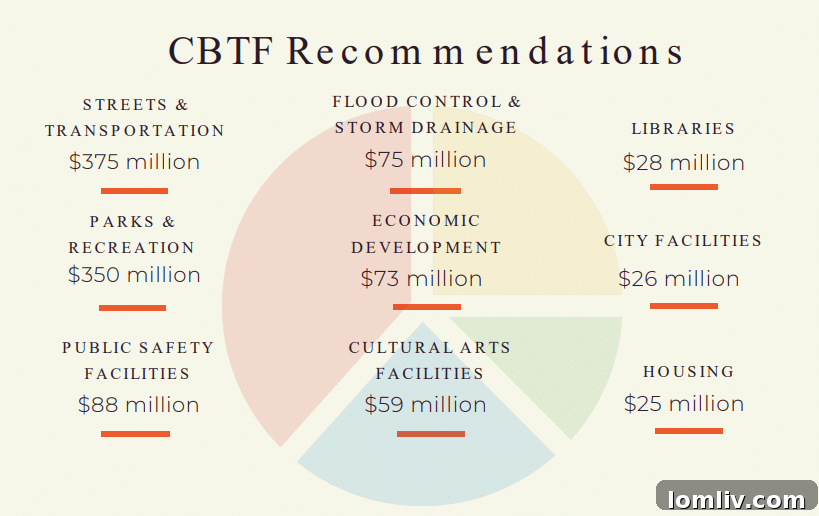
The Community Bond Task Force, after months of diligent research, public hearings, and careful deliberation, formally issued its detailed recommendations for the 2024 Dallas bond election, proposing a total investment package of $1.1 billion. This substantial sum is earmarked for projects categorized under several key areas, each vital for the city’s sustained growth, livability, and public welfare. The recommended allocations are as follows, reflecting a comprehensive approach to urban development:
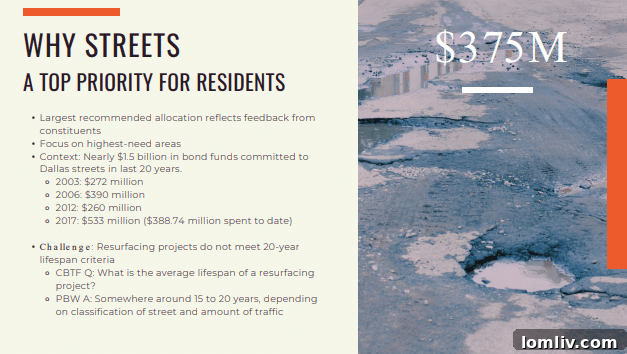
- Streets and Transportation: $375 million – This largest allocation underscores the critical need to improve Dallas’s aging road network, enhance connectivity, and ensure efficient traffic flow, which is fundamental for both daily commutes and economic logistics.
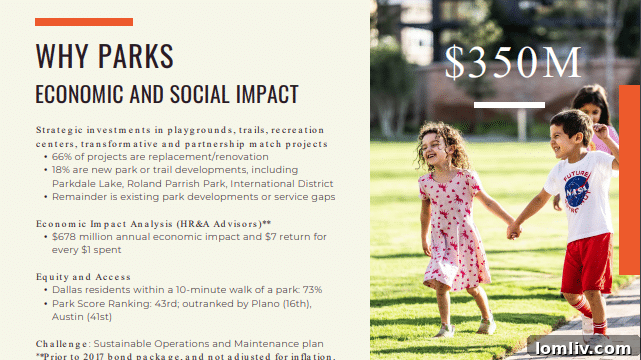
- Park and Recreation: $350 million – Investing in green spaces, recreational facilities, and vibrant parks is crucial for residents’ quality of life, promoting community health, and fostering a sense of belonging.
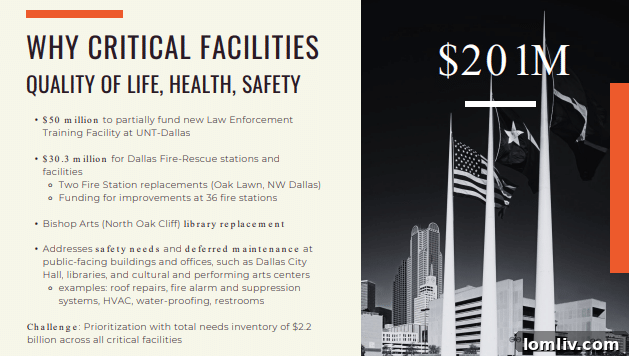
- Public Safety Facilities: $88 million – Modernizing and maintaining police and fire stations, training facilities, and emergency services infrastructure is essential for the safety and security of all Dallas residents.
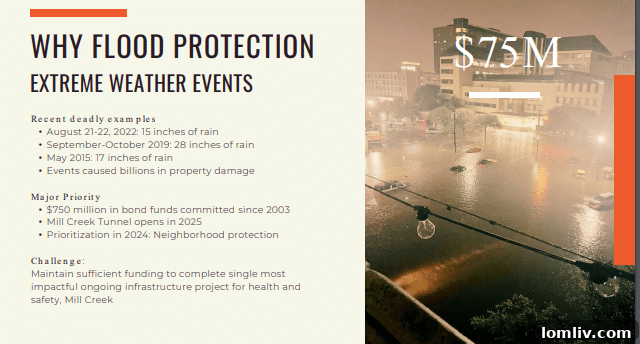
- Flood Control and Storm Drainage: $75 million – With increasing weather volatility, robust flood control systems and efficient storm drainage are paramount to protect properties, prevent disruptions, and ensure public safety during adverse weather events.
- Economic Development: $73 million – Strategic investments in economic development initiatives are designed to foster job growth, attract new businesses, and support existing enterprises, contributing to a vibrant and resilient local economy.
- Cultural Arts Facilities: $59 million – Supporting Dallas’s rich cultural landscape through upgrades to museums, theaters, and arts venues enriches the community, attracts tourism, and provides essential outlets for creative expression.
- Libraries: $28 million – Libraries serve as vital community hubs, offering educational resources, digital access, and cultural programs. This funding ensures these essential institutions can continue to serve diverse populations.
- City Facilities: $26 million – Maintaining and upgrading municipal buildings, administrative offices, and other city-owned properties ensures efficient government operations and provides a comfortable environment for both staff and citizens accessing services.
- Housing: $25 million – While a smaller allocation in comparison to others, this funding aims to address the pressing need for affordable housing solutions within the city, a challenge that continues to impact many Dallas families.
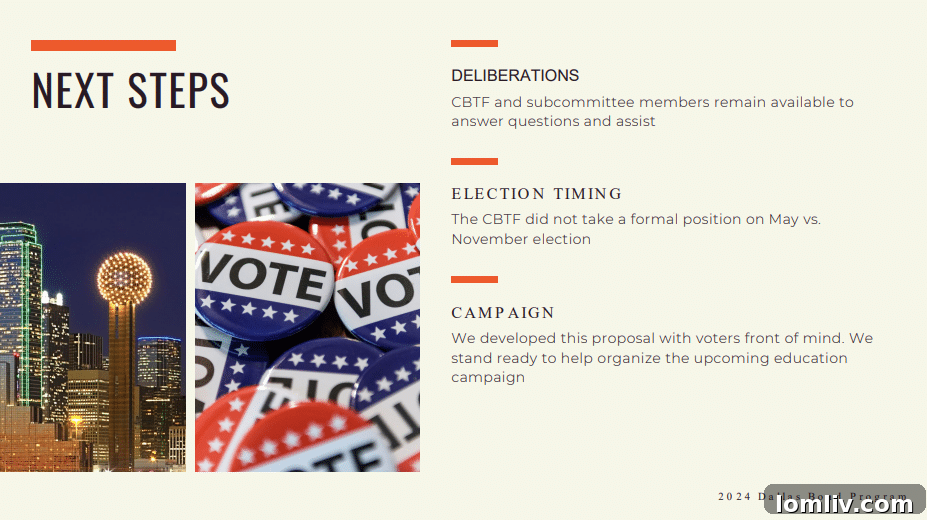
The Dallas City Council members, facing the immense responsibility of finalizing this crucial bond package, engaged in extensive questioning and robust debate throughout the lengthy meeting. Their discussions highlight the complexities involved in balancing competing needs and priorities across a diverse and rapidly growing city. Council will now embark on the critical task of revising the project list in the coming weeks, a process that promises further intense deliberation. The ultimate decision on the bond election date – whether it will be held in May or November of next year – also remains a subject of ongoing discussion, with significant implications for voter turnout and campaign strategies.
A notable voice in the discussion was Courtney Spellicy, the Community Bond Task Force representative for District 9, who articulated concerns that the presented recommendations might not fully align with the community’s most fundamental needs. Spellicy emphasized the distinction between what residents vocally express a desire for and the often-overlooked, yet critical, infrastructure requirements necessary for the city’s long-term stability and functionality.
“I think it’s really important… that this proposal that’s being presented today by Chair Agarwal is a reflection of what the community wants and what the citizenry wants,” she stated, highlighting a perceived disconnect. Spellicy continued, challenging the broad consensus: “I would wager that if you polled all 90 constituents that participated, you would find, at max, 30 percent that would support this program and find it to be a responsible utilization of funds.” Her remarks underscore the nuanced challenge of truly representing a diverse populace’s needs, especially when some critical projects lack immediate public appeal.
Spellicy further elaborated on this point by noting that during the CBTF’s extensive data gathering process, residents frequently advocated for highly visible and impactful projects such as parks, housing, and cultural arts. However, discussions rarely touched upon essential, albeit less glamorous, issues like the persistent waterproofing problems in the parking garage beneath City Hall. “But we all know it has to be addressed,” she forcefully reminded the City Council, drawing attention to the often-hidden infrastructure deficits that demand attention despite their lack of public fanfare.
She urged the council to make difficult but necessary decisions: “My desire would be that, although it is certainly popular and more politically expedient to support a number of things, you’re going to have to do the tough thing, which is to increase funding in streets and infrastructure, increase funding in all of your facilities… and in regard to housing, it’s disingenuous to say that the city is becoming a developer by putting bond funds toward housing because the reality is that money is going to be utilized for streets and transportation infrastructure as well as water.” Her statement highlighted the interconnectedness of infrastructure and housing, suggesting that basic city services are foundational to any successful housing strategy, even if not directly allocated to “housing” per se.
Navigating the Divide: Parks Versus Housing in Dallas’s Bond Debate
One of the most intense and recurring themes during Wednesday’s extensive council briefing revolved around the perceived conflict between various critical city needs. A significant portion of the discussion centered on the idea that one vital sector should not be pitted against another in the fight for bond funding, a sentiment echoed by several council members and advocates alike.
District 1 Councilman Chad West articulated this concern eloquently, emphasizing the sheer breadth of the city’s requirements. “Everything is important, and the needs are endless,” he remarked, capturing the daunting scale of the decision-making process. West expressed frustration over the divisive nature of the public discourse: “I don’t see this as one department versus the other, although I feel like I’ve been expressing my concern on that for months that I feel like it’s been pitted that way.” He passionately rejected the media narrative, stating, “I don’t see this as housing versus parks and I feel like it’s become that in the media. I don’t like that because they’re both so important.” His comments underscore the challenge of fostering a collaborative approach when various advocacy groups are vying for limited resources.
Councilman West further elaborated on the complexities surrounding housing initiatives, noting that the sector “gets beat up a lot in the media for not having a set goal.” He highlighted a fundamental disparity in public engagement: “So often we find that with housing and homelessness, the people who need our help the most are not the ones who have the time to take off work to be down here.” This observation points to a significant democratic challenge, where the voices of those most impacted by housing insecurity are often underrepresented in public forums, making it harder to garner widespread support for these crucial projects.
District 7 Councilman Adam Bazaldua raised significant questions regarding the discrepancy between the CBTF’s recommendations and the initial preferences expressed by council members. He noted that the average dollar amount council members had originally recommended for housing was a substantial $150 million, starkly contrasting with the CBTF’s proposed $25 million. “It almost seems like this was a pointless exercise and it created more work,” Bazaldua asserted, expressing his frustration over the perceived lack of alignment and the potential for the task force’s efforts to complicate, rather than streamline, the process. This divergence highlights a fundamental tension in city governance, where citizen-led task forces and elected officials may hold different views on priority funding areas.
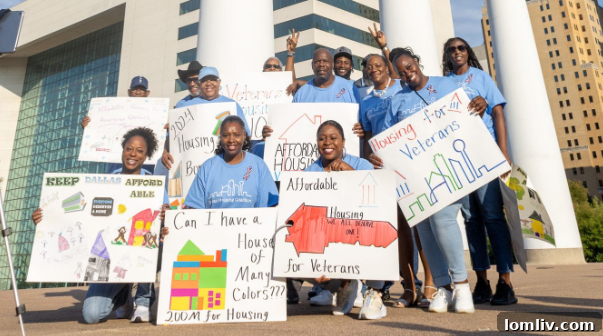
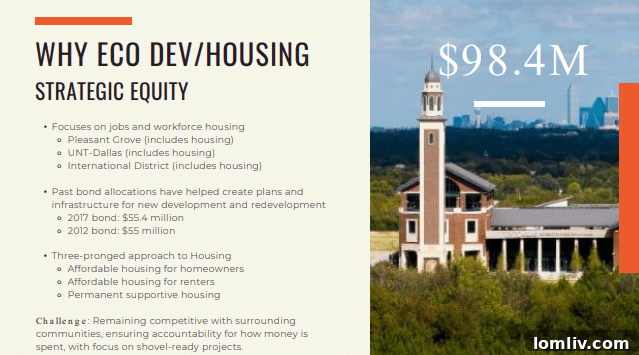
The Dallas Housing Coalition, a prominent advocacy group, has been steadfastly campaigning for a much more significant investment in affordable housing, specifically requesting $200 million. They argue that this level of funding is essential to make a meaningful impact on Dallas’s growing housing crisis. The CBTF, in its recommendations, proposed a total of $100 million for a broader category encompassing housing, economic development, and homelessness initiatives, with only about $25 million specifically earmarked for direct affordable housing projects. This significant gap between demand and recommendation underscores the intense debate surrounding housing affordability and how best to tackle it within the city’s financial framework.
Bryan Tony, a key organizer of the influential Dallas Housing Coalition, articulated the profound aspirations of his members, emphasizing their desire to establish families, age gracefully within their communities, and ensure that future generations can afford to live and thrive in Dallas. “We are here because if Dallas is not intentional about its investments now, we and many of the people, businesses, and neighborhoods we are all here to serve are at risk of not being here any longer,” Tony powerfully stated. His words underscore the existential threat posed by rising housing costs and the urgent need for strategic, long-term city investments to preserve Dallas’s social and economic diversity.
To further bolster their case, DHC leaders presented a compelling argument in an email rallying support for Wednesday’s council meeting. They highlighted the transformative potential of targeted housing investments, writing that “A $25 million investment in housing could easily grow to over $2 billion worth of impact generating thousands of new housing units thanks to additional support from traditional lenders, state, and federal funding.” This demonstrates their belief in the catalytic effect of initial bond funding, leveraging it to attract substantially larger external investments and address the housing crisis on a much grander scale.
On the other side of the allocation debate, parks advocates vociferously championed their segment of the proposed bond, emphasizing the significant economic and social returns on investment. They referenced a comprehensive report from HR&A Advisors, which unequivocally found that for every dollar invested in parks, the city sees more than $7 returned in various benefits, including increased property values, improved public health, and enhanced tourism. This robust argument for parks funding illustrates not just a quality-of-life improvement but also a sound financial investment for the city.
In line with this, the CBTF is recommending a substantial $350 million allocation for parks and recreation, acknowledging the profound impact these spaces have on the well-being and vibrancy of Dallas communities. This recommendation reflects a recognition of parks as essential infrastructure that contributes to the city’s overall attractiveness and economic competitiveness.
Brian Luallen, CEO of Fair Park First, passionately supported significant investments in “catalytic projects” related to parks and the arts, emphasizing their unique funding challenges. “At the end of the day, these facilities don’t have other capital mechanisms,” he explained, highlighting that many cultural and recreational assets, being owned by the City of Dallas, heavily rely on bond funding for their maintenance and development. Luallen stressed the importance of aligning investments with the bond task force’s vision and the compelling pleas of citizens who spoke on behalf of critical needs in their communities across the city. He concluded by underscoring the broader impact: “When we invest in quality of life, we create further investment in housing, and that draws the fabric of this city together. It’s what makes Dallas special.” This perspective reinforces the idea that investments in quality of life indirectly support other essential city goals, including housing stability.
Dallas City Council Prepares to Finalize the 2024 Bond Package
The Dallas City Council members now face the formidable task of meticulously reviewing both the comprehensive staff recommendations and the Community Bond Task Force’s proposals, ultimately aiming to craft their own definitive bond package. This crucial stage involves navigating a complex landscape of competing priorities and differing opinions. During their deliberations, elected officials engaged in a vigorous discussion about whether to use the city staff’s detailed presentation or the CBTF’s recommendations as the foundational baseline for their final decisions. Several council members openly questioned the “arbitrary” nature of some numbers and pressed for greater transparency on how specific allocations were determined, signaling a desire for a data-driven and justifiable approach to funding.
Councilman Bazaldua powerfully encapsulated the dilemma facing the city, articulating the interconnectedness of various urban challenges. “I love parks, but I also want to be able to afford to live in this city,” he remarked, highlighting the essential balance between quality-of-life amenities and economic accessibility. He then posed a rhetorical question that resonated deeply: “If we can’t drive to these parks without getting a blowout, what’s good about these parks?” This statement underscored the critical importance of foundational infrastructure, such as well-maintained streets, arguing that even the most appealing recreational facilities lose their value if they are inaccessible or if basic city services are neglected.
Further adding to the multifaceted discussion, District 12 Councilwoman Cara Mendelsohn and District 9 Councilwoman Paula Blackmon unequivocally voiced strong support for holding the bond election in November, a strategic choice that could impact voter turnout and overall campaign dynamics. Concurrently, District 13 Councilwoman Gay Donnell Willis raised an important procedural question, inquiring about how the proposed projects had been “pressure tested” to ascertain the availability of alternative funding sources. This line of questioning emphasizes the council’s commitment to fiscal prudence and ensuring that bond funds are utilized only for projects where other financial avenues are not viable or sufficient, thereby maximizing the impact of taxpayer dollars.
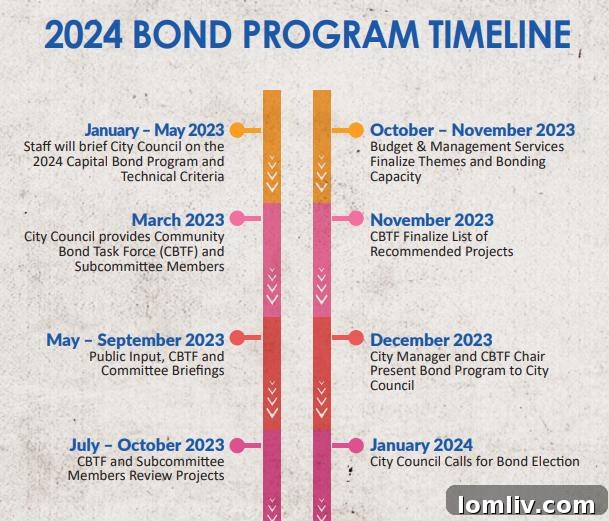
As the marathon 10-hour meeting concluded around 7:30 p.m., council members reached a consensus to revisit the crucial matter soon, acknowledging the sheer volume and complexity of the decisions ahead. The timeline remains tight; if an election is to be held in May, the council would be tasked with setting a definitive date as early as January or February, demanding swift and decisive action.
City Manager T.C. Broadnax outlined the next strategic steps to guide the council through this intricate process. He confirmed that his staff would engage in individual meetings with council members, facilitate communication through detailed memoranda, and schedule another comprehensive council briefing. Broadnax expressed his commitment to a thorough and collaborative approach: “We’re going to go back, sharpen our pencils, take all the feedback that we received, have individual council conversations about good, bad, and indifferent, and maybe get some priorities around certain projects.” He further elaborated on the process: “We can run that through our own filters and share something with council at a future date via memo and then come back and do a full briefing to try to advance the conversation.” This meticulous process aims to refine the bond package, ensuring it addresses the city’s most pressing needs while reflecting a consensus among elected officials and community input.
Residents and stakeholders interested in the full scope of the discussions can view the complete December 6 Dallas City Council briefing here, providing transparency and access to the detailed deliberations that will ultimately shape Dallas’s future investments.