
Navigating the Dallas-Fort Worth Housing Market: A High-Stakes Game of Uncertainty and Opportunity

Navigating the current housing market in Dallas-Fort Worth feels akin to a high-stakes poker game in Las Vegas – every decision a calculated risk, every move scrutinized. With home prices in the DFW metroplex reaching unprecedented heights, potential buyers and sellers alike are grappling with a pervasive question: Is this the right time to make a move, or are we on the precipice of a significant market shift? The prevailing sentiment among many is that purchasing real estate in the Dallas-Fort Worth region today feels like a considerable gamble, a feeling that, according to recent expert analyses, may not be far from the truth.
The euphoria of recent years, characterized by soaring prices and bidding wars, appears to be giving way to a more cautious and complex environment. As economic indicators fluctuate and interest rates climb, the DFW housing market, once a beacon of seemingly endless growth, now presents a landscape fraught with both apprehension and the potential for new opportunities. Understanding the underlying dynamics at play, from national trends to local nuances, is crucial for anyone looking to make informed decisions in this pivotal period.
Understanding the Overvaluation: A National Perspective
A recent and revealing report, drawing on comprehensive data from The Real Estate Initiative at Florida Atlantic University, casts a long shadow over the nation’s housing stability. The study indicates that numerous major metropolitan areas across the United States are currently experiencing home valuation levels at or even exceeding those recorded just before the catastrophic housing bubble burst in 2008. While the 2008 crisis was primarily triggered by rampant, fast-and-loose lending practices and subprime mortgages, the current situation presents a distinctly different set of challenges and underlying causes.
Unlike the speculative frenzy fueled by irresponsible lending that characterized the mid-2000s, today’s market dynamics are shaped by a complex interplay of factors including persistent housing shortages, unprecedented demand driven by demographic shifts, and the transformative impact of the “work from anywhere” boom accelerated by the pandemic. These elements, combined with initial periods of ultra-low interest rates, created an environment ripe for rapid price appreciation, pushing home values far beyond what traditional economic fundamentals might typically support.
According to a detailed analysis published by Fortune, the scope of this overvaluation is startling:
At the latest reading in March, Florida Atlantic University researchers found every one of America’s 100 largest housing markets overpriced relative to what economic fundamentals in the market would support. That includes 44 markets overpriced by at least 30% and 13 overpriced by at least 50%.
The most overpriced markets are Boise (by 75%); Austin (66%); Ogden, Utah (63%); Las Vegas (60%); and Atlanta (60%). Those places have all seen an influx of new residents amid the pandemic’s “work from anywhere” boom. That, in part, explains why home prices there have soared well above what local incomes can afford. It also raises the question: If a 2023 recession does come and employers finally have the economic power to force staffers back into the office, will those housing markets be at a higher risk of home price correction?
This widespread overvaluation signals a potential disconnect between market prices and the underlying economic health of these regions. The “work from anywhere” phenomenon, while offering flexibility to employees, has disproportionately driven up prices in attractive, often smaller, markets, straining local affordability. The lingering question of a potential recession and its impact on remote work policies adds another layer of uncertainty, posing a significant risk for regions where housing values have outpaced local income growth at an unsustainable rate.
The Impact of Rising Interest Rates: A Market Under Pressure
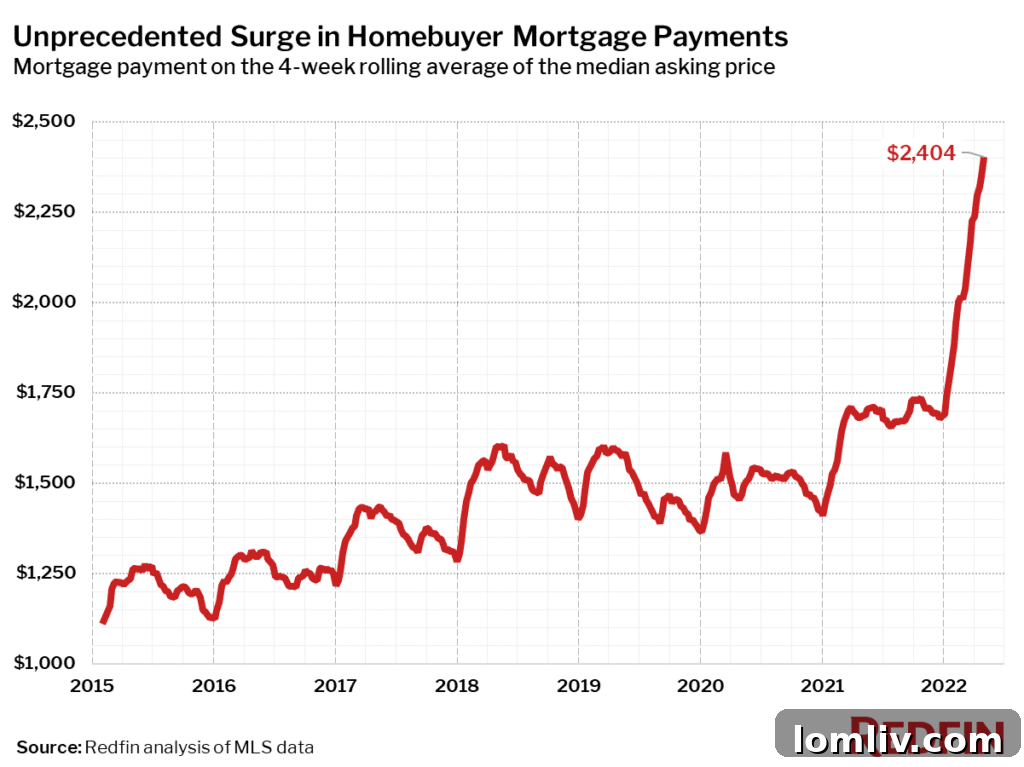
One of the most immediate and potent forces currently shaping the housing market is the rapid ascent of interest rates. These skyrocketing rates represent a significant shift from the historically low borrowing costs of the pandemic era and are exerting considerable pressure on both buyers and sellers. For potential homeowners, higher interest rates translate directly into substantially larger monthly mortgage payments, severely impacting affordability and forcing many to reassess their purchasing power or step back from the market entirely.
This shift in financial landscape is already prompting a measurable response from sellers. New data released by Redfin, a leading real estate brokerage, highlights this emerging trend:
The share of home sellers who dropped their asking price shot up to a six-month-high of 15% for the four weeks ending May 1, up from 9% a year earlier. The 5.9% increase is the largest annual gain on record in Redfin’s weekly housing data back through 2015. For homebuyers, the typical monthly mortgage payment skyrocketed a record 42% to a new high during the same period. Although a growing share of sellers are responding to the palpable drop in homebuyer demand by lowering their prices, sellers remain far outnumbered by buyers, so the typical home flies off the market at the fastest pace on record and for more than its asking price.
The Redfin report paints a complex picture: while price reductions are becoming more common, indicating a cooling of aggressive buyer demand, the overall market still heavily favors sellers. This apparent contradiction underscores the persistent imbalance between supply and demand. Even with higher rates, the fundamental shortage of available homes means that desirable properties continue to attract strong interest, often selling quickly and above their asking price. However, the record 42% surge in typical monthly mortgage payments signifies an affordability crisis that simply cannot be ignored, pushing homeownership out of reach for a growing segment of the population.
Buyer Exhaustion and Seller Adjustments
Redfin chief economist Daryl Fairweather elaborates on these converging pressures, noting that homebuyers are being “squeezed in nearly every way possible.” This multifaceted pressure, combining high home prices with rapidly rising interest rates and broader inflationary concerns, is inevitably causing many prospective buyers to hesitate or withdraw from the market. The psychological toll of intense bidding wars and continuously escalating costs has led to a palpable sense of “buyer exhaustion.”
Yet, the market’s dynamics remain stubbornly in “seller’s territory.” Fairweather explains, “Unfortunately for buyers hoping to find a deal as competition cools, sellers are pulling back even faster, which is keeping the market deep in seller’s territory. So even though price drops are becoming more common, most homes are still selling above asking price and in record time.” This suggests that while individual price cuts grab headlines, the overall inventory remains tight. Many potential sellers, perhaps wary of losing out on peak prices or facing their own higher borrowing costs for a new purchase, are choosing to hold off, thereby perpetuating the supply shortage and keeping upward pressure on prices for available homes.
The Dallas-Fort Worth Housing Market: A Deep Dive into Local Overvaluation
The broader national trends of overvaluation and rising interest rates find a distinct and amplified echo within the Dallas-Fort Worth-Arlington Metropolitan Statistical Area (MSA). Florida Atlantic University’s detailed analysis for March paints a stark picture: our region’s housing market could be overvalued by a staggering 45.85 percent. To put this into perspective, the same data showed the DFW MSA as being overvalued by 9.66 percent in March 2020. More strikingly, in 2007, right before the monumental collapse of the housing market, Florida Atlantic University’s data indicated our MSA was overvalued by a comparatively modest 2.79 percent.
This exponential increase in overvaluation for DFW is a critical indicator of the dramatic shifts that have occurred in the local real estate landscape. The region has experienced explosive population growth, fueled by corporate relocations, a robust job market, and a perceived affordability advantage compared to coastal metropolitan areas. This influx of residents, coupled with a lagging housing supply, created an intense demand-supply imbalance that drove prices skyward, pushing them far beyond historical norms relative to local incomes and rents.
For buyers’ agents operating in the DFW region, the concept of homes being “overvalued,” as researchers at Florida Atlantic University describe it, comes as no surprise. The daily reality of working in this competitive market has long reflected this imbalance. Consequently, Redfin’s data pointing to an increasing number of price reductions for some homes, though still a minority, is indeed a welcome development for those struggling to find affordable options. However, it prompts a crucial question: Is every price reduction solely a direct consequence of higher interest rates and the diminishing buying power of prospective homeowners, or are other market forces also at play?
The Voice of Local Real Estate Professionals
Local real estate experts offer valuable insights into the nuances of the DFW market. Travis Lee-Moore, a realtor with Coldwell Banker in Fort Worth, points directly to a phenomenon he calls “buyer exhaustion.” He observes, “We’re seeing the results of buyer exhaustion. These poor guys and gals are no longer willing to be one of 40 offers and pay so far beyond an already inflated asking price.” This exhaustion stems from months, if not years, of battling in intense bidding wars, often waiving contingencies and stretching budgets to their absolute limit, only to be outbid repeatedly. The emotional and financial toll has become unsustainable for many.
Lee-Moore doesn’t mince words regarding the seller side either: “The sellers got greedy for a minute and their agents were actually encouraging them to do so. Nobody can afford to or wants to wait several years for their purchase price to catch up to their actual value and defer their equity like that. It never was sustainable and I’m surprised it lasted as long as it did.” His perspective highlights the speculative element that crept into the market, where sellers and some agents pushed prices to extreme highs, betting on continued rapid appreciation. However, the current environment makes it challenging for buyers to justify such high prices, knowing that it might take years for market values to catch up to their purchase price, effectively delaying their equity build-up.
Local Pockets of Resilience Amidst Shifting Tides
While the overall DFW market shows signs of cooling and recalibration, it is imperative to remember that real estate is fundamentally a local business. Trends can vary significantly from one neighborhood or town to another, even within the same metropolitan area. While some areas are indeed experiencing price reductions and a slowdown in activity, other specific neighborhoods and towns within DFW continue to exhibit remarkable resilience, holding strong against the broader market shifts.
Katrina Whatley, an Oak Cliff Realtor with Ultima Real Estate, offers a contrasting perspective from her corner of the market. “With interest rates on the rise, monthly mortgage costs are increasing. However, I have not seen a slow down in the number of clients that are still eagerly looking to purchase a home,” she states. “Multiple offers above the asking price are still the norm. Rising interest rates have not deterred buyers in this market.” Whatley’s observations suggest that highly desirable micro-markets, perhaps due to unique amenities, strong community ties, excellent school districts, or ongoing revitalization efforts, continue to attract robust buyer demand, demonstrating that the market’s story is far from uniform across the entire DFW region.
Is a Housing Bubble Burst Imminent? Expert Divergences
The persistent question echoes through the corridors of real estate forums and dinner table conversations: Are we on the verge of a market correction, or is this a housing bubble poised to burst catastrophically, reminiscent of 2008? The answer, according to leading economists, is nuanced and far from definitive, pointing to fundamental differences in the market’s structure today.
Mark Zandi, chief economist at Moody’s Analytics, offers a more tempered outlook than those predicting a full-blown collapse. While acknowledging that “overvalued” housing markets are widespread – his own research finds 96% of housing markets are overvalued – Zandi differentiates this period from a true housing bubble. He does not foresee a housing bust over the coming year, instead predicting that “overvalued” markets could experience home price declines of 5% to 10% over the next 12 months, with national home price growth potentially flatlining to zero. This expected deceleration, he argues, is a direct consequence of “the economic shock caused by spiking mortgage rates,” which should finally rein in the rapid pace of home price appreciation. Indeed, we are already seeing discernible signs of a cooling housing market, a shift from the overheated conditions of the past few years.
The key distinction for Zandi lies in the absence of widespread speculation. A true housing bubble, in his view, requires both significant home price overvaluation *and* rampant speculation in the market. Unlike the “FOMO-driven” (fear of missing out) housing market of the 2000s, where loose lending standards fueled speculative buying and flipping, Zandi believes that speculation is not the primary driver of the current boom. Stricter lending regulations and a general hesitancy among financial institutions to repeat past mistakes mean that current homeowners are typically more financially stable, reducing the risk of a widespread default cascade.
Beyond Interest Rates: The Crucial Role of Employment
While the impact of rising interest rates is undeniably significant, they are not the sole determinant of the housing market’s future trajectory. Nor do they mean that the DFW market, despite its relative resilience, is entirely in the clear. As Dr. Jim Gaines, a distinguished research economist at the Texas Real Estate Research Center at Texas A&M, emphasized earlier this year, employment levels remain a critical factor to watch – perhaps the most crucial one.
However, widespread job loss — similar to what we saw at the onset of the pandemic — could create complications for the economy and, in turn, the housing market. Could that cause a bubble? Maybe, Gaines said, especially if marginal borrowers defaulted en masse.
Dr. Gaines’s warning underscores the foundational link between a robust job market and a healthy housing sector. Sustained employment provides individuals with the income necessary to afford mortgage payments, maintain their homes, and contribute to overall economic stability. A significant, widespread contraction in employment, akin to the initial shocks of the COVID-19 pandemic, could trigger a domino effect. Job losses would not only reduce the pool of eligible buyers but could also lead to an increase in defaults among existing homeowners, particularly those who are “marginal borrowers” (those with less financial buffer). Such a scenario, if severe enough and widespread, could indeed destabilize the market, potentially leading to a sharp downturn and fulfilling the conditions for a housing bubble to burst, irrespective of interest rate movements.
Conclusion: Navigating a Period of Unprecedented Change
The Dallas-Fort Worth housing market, like many across the nation, stands at a pivotal juncture. It is a market characterized by paradoxes: record overvaluation coexisting with persistent buyer demand, rising interest rates pushing some sellers to drop prices while others maintain strong positions. The consensus among experts suggests that while a catastrophic 2008-style collapse is unlikely due to different underlying causes, a period of significant recalibration is inevitable.
For potential buyers, the coming months might offer increased opportunities as competition eases and price adjustments become more widespread. However, higher interest rates will continue to challenge affordability. For sellers, understanding the nuanced dynamics of their specific sub-market and pricing realistically will be paramount. Ultimately, the DFW housing market will remain highly sensitive to a confluence of factors: the trajectory of interest rates, the overall health of the national and local economies, and critically, the stability of the employment landscape. Navigating this complex environment will require vigilance, adaptability, and a deep understanding of both broad economic forces and hyper-local market conditions.