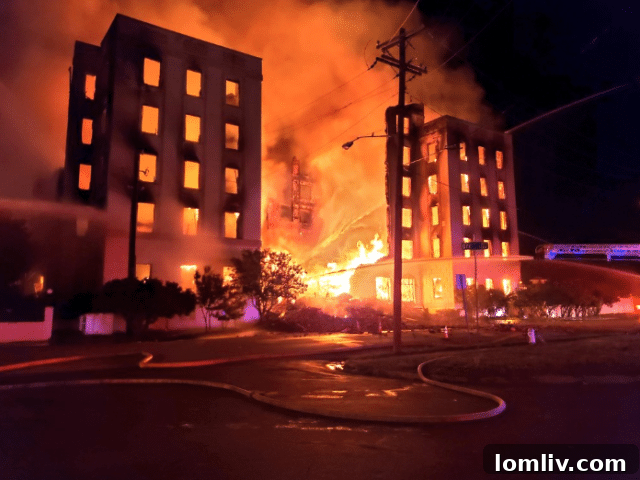
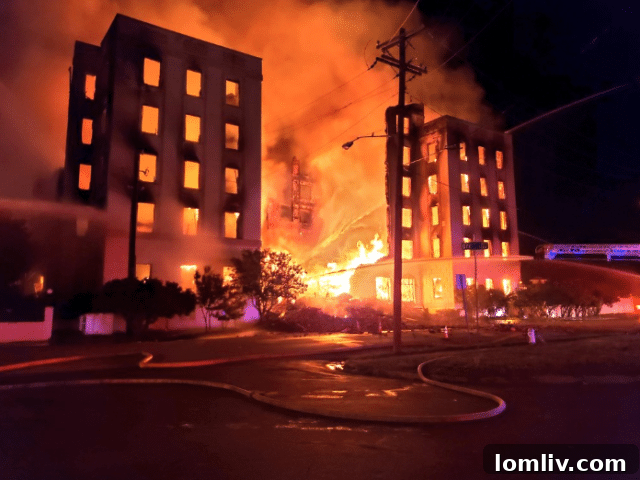
In the pre-dawn hours of a Tuesday morning, Dallas witnessed a devastating loss as the historic Ambassador Hotel, a cherished landmark in The Cedars neighborhood, succumbed to a ferocious four-alarm fire. While the exact time the inferno began remains uncertain, the first alarming reports emerged around 2 a.m., painting a grim picture of the vacant structure engulfed in flames. This iconic building, steeped in over a century of Dallas history, quickly became a focal point of emergency response and community heartache.
Upon arrival, Dallas Fire-Rescue (DFR) teams were met with a rapidly escalating situation, finding the second and third floors ablaze. Within a mere fifteen minutes, by 2:15 a.m., the fire had consumed the entire structure, escalating to a four-alarm incident. The scale of the disaster necessitated a monumental response, with a rough count of the DFR active call list indicating that more than 45 units and over 100 firefighters were deployed to battle the relentless blaze. Their efforts were concentrated on containing the inferno and preventing its spread to adjacent properties, an arduous task given the intensity of the flames.
As the first rays of morning pierced through the thick smoke, the true extent of the devastation became starkly apparent. The once-grand Ambassador Hotel, which had stood as a testament to Dallas’s rich past, was reduced to a charred shell. Despite the heartbreaking visual, there was a small measure of relief: the building had been vacant, and miraculously, no injuries were reported, a testament to the rapid response and the building’s unoccupied status. Early speculation regarding the fire’s cause, specifically a potential transformer blow, was addressed by Dallas Fire and Rescue spokesperson Jason Evans. He clarified, “During the course of fire suppression efforts a transformer in front of the hotel blew, but I never heard any reports indicating power lines to be down before that point.” Regarding the origin of the inferno, Evans stated, “As far as the cause is concerned, it is currently undetermined.” He further elaborated on the daunting challenge investigators face, noting, “Considering the amount of damage done by the fire, debris left by it and the likelihood that the amount of debris will only increase when the rest of the structure is demolished, the chances are slim that investigators could get the access that would allow them to fully examine the evidence they’d need to in order to rule anything out.” This unfortunate reality means that the precise cause of the destruction of this historic Dallas landmark may forever remain a mystery.
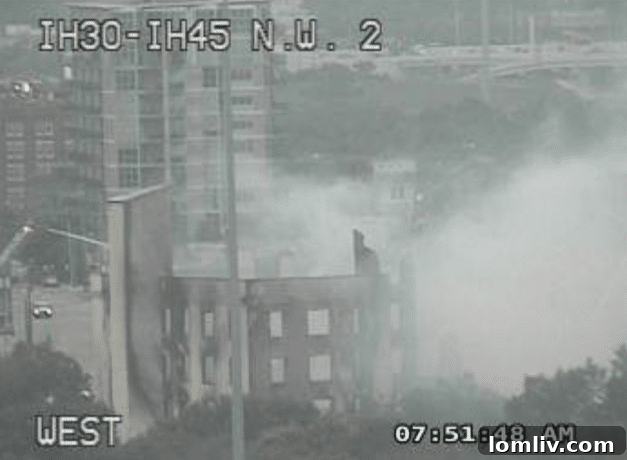
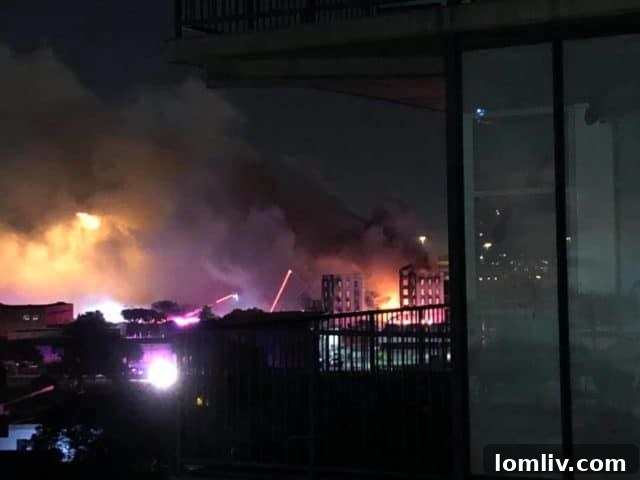
The first 9-1-1 calls reporting the fire came in shortly after 1:30 a.m., indicating the rapid escalation of the event. The Ambassador Hotel was swiftly deemed a total loss. Compounding the challenge for Dallas Fire-Rescue, fire crews were simultaneously battling other blazes nearby, specifically in the 600 block of South Harwood Street and the 1800 block of Corsicana Street. One particularly harrowing incident involved the roof of another hotel on Harwood Street catching fire, reportedly from embers carried by the wind from the Ambassador fire. Fortunately, firefighters were able to quickly extinguish this secondary blaze, preventing further widespread damage in the dense urban environment.
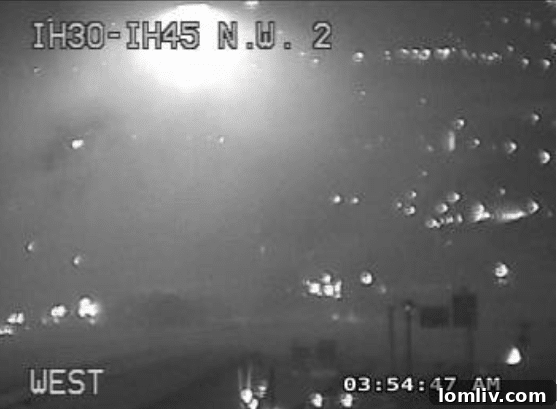
The massive smoke plume and falling debris from the four-alarm inferno created significant disruptions across downtown Dallas. Around 4 a.m., eastbound I-30 from Akard to I-45 was completely shut down, along with most side streets, due to severely restricted visibility and the hazard posed by debris. The fire’s impact on morning traffic was substantial, snarling commutes and diverting essential services. By 5 a.m., the main lanes of I-30 had cautiously reopened, but residual debris issues persisted around Griffin Street, and firefighters remained on the scene, diligently working to extinguish lingering hot spots. Although the fire appeared largely contained by this time, the frontage road along eastbound I-30 near the scene remained closed at 5:20 a.m., as did critical arterial side roads like northbound Ervay near Belleview and southbound St. Paul closed at Cadiz, reflecting the ongoing complexities of the operation and the necessity of ensuring public safety.
A Youtube user captured this video, offering another perspective on the fire. You may want to leave the sound off.
The news of the Ambassador Hotel fire quickly spread across social media, eliciting a wave of horror, disbelief, and profound sadness from the Dallas community and beyond. Residents of The Cedars, a neighborhood deeply connected to the hotel’s history, discussed the unfolding tragedy with a sense of helplessness as they watched an integral part of their community burn to the ground. Preservation Dallas, a vocal advocate for the city’s architectural heritage, took to Facebook to mourn the loss, highlighting the hotel’s significant historical status. “The Ambassador Hotel was just entered on the National Register of Historic Places on April 4. It was built in 1905 with a red brick exterior with the stucco cladding added in 1932,” they stated. The post further emphasized its presidential connections: “Presidents Theo. Roosevelt, Taft, and Wilson all stayed there. It was designated a city landmark in 1982 and became a Recorded Texas Historic Landmark in 1965. Sadly the red brick can be seen clearly in some burned areas,” illustrating the devastating extent of the damage. This recent national recognition made the loss particularly poignant, as a century of history was erased just weeks after its renewed acknowledgment.
The Ambassador Hotel at 1312 S Ervay St in Downtown Dallas is on fire. from r/Dallas
#BREAKING The old Ambassador Hotel is burning. This just south of Downtown #Dallas. Story @GoodDayFox4 @FOX4 pic.twitter.com/IVlb5i8xzZ
— FOX4Terry (@FOX4Terry) May 28, 2019
Dallas Fire Rescue on scene fighting a fully involved structure fire at the old Ambassador Hotel on Ervay. pic.twitter.com/ok2VV6TgaV
— Mike Forbes (@mikeforbeswfaa) May 28, 2019
@DallasFireRes_q responding to 4-alarm fire at Old Ambassador Hotel. No reported injuries. Over 100 firefighters responding. https://t.co/RphHatcSQm pic.twitter.com/tSLJ5Ld1yE
— DALLAS FIRE-RESCUE (@DallasFireRes_q) May 28, 2019
Card
Card
Ambassador Hotel going up in flames overnight. Air 1 assisting with locating spot fires. pic.twitter.com/TYbhOYMn8h
— Dallas Air One (@DPDAir1) May 28, 2019
As sunrise painted the sky, the true scale of the devastation at the Ambassador Hotel became even more painfully clear. The morning light revealed a stark image of destruction, a powerful symbol of a profound loss for the city’s architectural and cultural heritage.
Overnight a fire overtook our historic Ambassador Hotel. As much as we are devastated by the loss of a Cedars icon, we thank the first responders @DallasFireRes_q and @dallaspd
The Cedars community is grateful pic.twitter.com/obhWRR6yeu— CNADallas (@CNADallas) May 28, 2019
The tragic fire at the Ambassador Hotel also brought to light the ongoing challenges surrounding its redevelopment. As recently as February, reports indicated that the ambitious plans by Jim Lake Companies, who acquired the structure in 2015 with the vision of transforming it into multifamily housing, had been significantly held up by the complex process of obtaining permits for a historic building. This bureaucratic hurdle, ironically, kept the building vacant and perhaps more vulnerable to such a devastating event.
Steve Owen, Project Manager for Jim Lake Companies (JLC), had previously explained that the primary construction delay was linked to JLC’s request for the City of Dallas to amend the thoroughfare plan at the St. Paul Street connection to Ervay Street, specifically by abandoning a portion of St. Paul. According to Ashley Eubanks, assistant director of the Real Estate Division of the Sustainable Development and Construction Department for the City of Dallas, these critical applications were filed by JLC in late 2017 and were still painstakingly winding their way through the city’s approval process. This prolonged administrative journey meant that a building earmarked for revitalization remained in a state of limbo, ultimately facing a tragic end before its new chapter could even begin. The loss is twofold: not only is a historic structure gone, but also the promise of a significant residential development for The Cedars neighborhood.
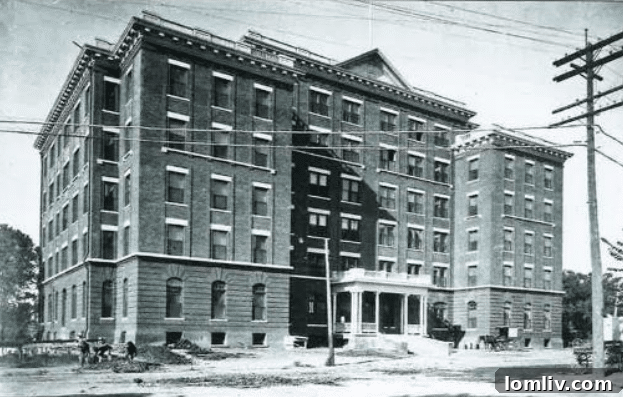
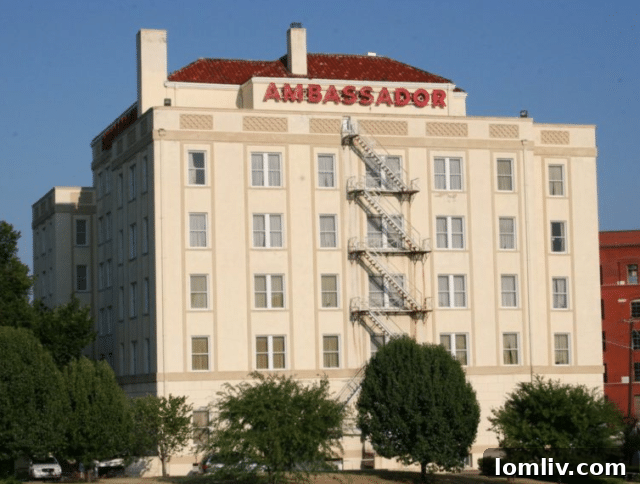
Constructed in 1904, the building that would become the Ambassador Hotel originally opened its doors as The Majestic. Until this tragic fire, it held the distinction of being considered the oldest luxury hotel still standing in Dallas. Located in the bustling 1300 block of Ervay within the vibrant Cedars neighborhood, this magnificent six-story edifice was once heralded as a high-rise marvel at the peak of its popularity. Its opulent reputation attracted an array of distinguished guests, including U.S. Presidents Theodore Roosevelt, William Taft, and Woodrow Wilson, solidifying its place in the annals of American history. Its presence was a cornerstone of early 20th-century Dallas society, hosting lavish events and serving as a beacon of sophistication.
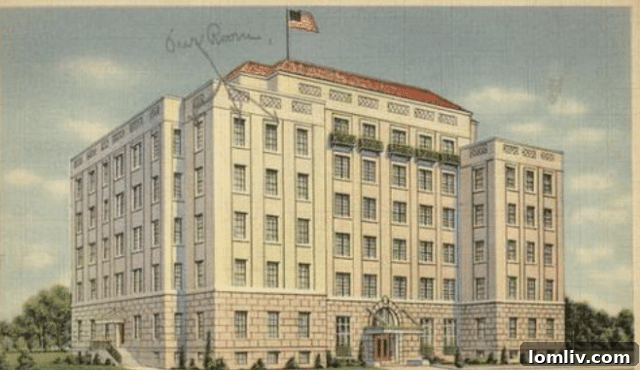
The hotel’s narrative also included a fascinating, clandestine chapter during the Prohibition era, when it famously operated as the site of an underground speakeasy, adding to its mystique and local lore. Its architectural evolution is equally compelling. According to the recently completed National Registration of Historic Places registration form, “The Ambassador Hotel, in the Cedars neighborhood immediately south of downtown Dallas, Texas, is a six-story stuccoed brick building built in 1905 and remodeled to its current Mediterranean-inspired appearance in 1932.” The document further details its early transformations: “The building opened as the Majestic Hotel and was considered at that time as one of the city’s premier hotels, but soon went into receivership and reopened as the Park Hotel under new owner F.W. Boedecker in 1907.”
The original Majestic Hotel design exuded a distinctive elegance. It was a six-story structure crafted from striking red brick, beautifully contrasted with a white limestone entrance portico, featuring a dentilled pediment and a prominent belt course above the first story. Before its extensive renovations in 1932, the west façade roof boasted a charming Georgian-style gable, complemented by a balustraded deck on the flat roof. All windows were adorned with refined limestone lintels, contributing to its sophisticated aesthetic. The main west entrance porch, a grand focal point, was supported by stately Ionic columns and crowned with an elegant balustrade. The north and south facades were largely symmetrical, maintaining a harmonious design.
In its initial configuration, the north façade of the building included a dining room and kitchen annex, which was later demolished in the 1930s, along with the south portico. When the Majestic Hotel first opened its doors in 1905, it was vigorously promoted as the premier luxury destination in Dallas. Its reputation quickly drew in luminaries of the era, including the legendary French actress Sarah Bernhardt, who stayed there while performing in Dallas, alongside a host of other celebrated actors, actresses, and opera stars. Beyond the performing arts, the hotel also welcomed three U.S. Presidents—Theodore Roosevelt, William Taft, and Woodrow Wilson—who reportedly lodged at The Majestic during their visits to Dallas. A highlight of its early social calendar was the Idlewild Club Ball on November 18, 1905, which was famously covered by the *Dallas Morning News*. The newspaper’s vivid description painted a scene of unparalleled splendor: “The ballroom was resplendent in the Club’s colors…the center pillar represented a birch tree … an orchestra of twenty-eight pieces was stationed on the balcony,” showcasing the hotel’s role as the epicenter of Dallas’s elite social scene.
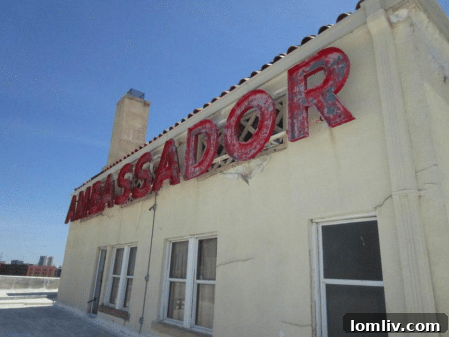
As the city evolved, The Majestic, despite its early grandeur, eventually found itself “eclipsed by the establishment of luxury hotels in downtown Dallas, such as the 1912 Adolphus,” as detailed in its historical records. Concurrently, The Cedars neighborhood itself underwent a significant transformation, transitioning from an upscale residential district to a more industrial and commercial area. In response to these changes, the hotel adapted, serving long-term and short-term tenants under various owners until its pivotal purchase in 1955. It was then converted into affordable housing for elderly residents, following the innovative plan spearheaded by developer Charles Lavin, marking a significant shift in its purpose and impact on the community.
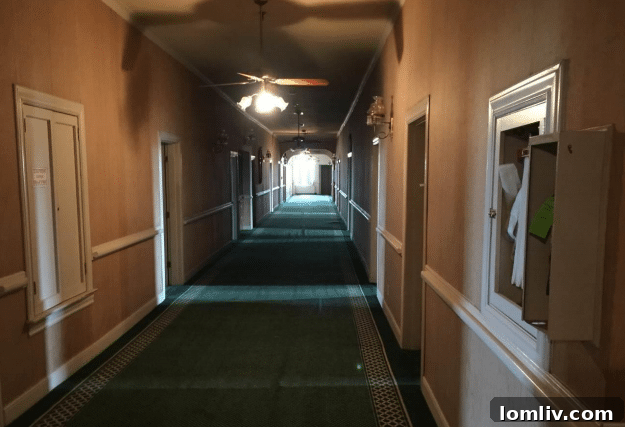
The Ambassador Hotel stood as a pivotal local example of a mid-rise commercial building within The Cedars neighborhood, serving as a powerful reflection of the dramatic socio-economic and urban transitions that South Dallas experienced throughout the 20th Century. Its recent nomination to the National Register under Criterion A, in the area of Commerce at the local level, underscored its historical significance, with a period of significance extending from its major renovation in 1932 through 1956, the year it was innovatively repurposed into a long-term residential retirement facility under the influential Lavin Plan. This transformation from a luxury hotel to a vital community resource highlights its enduring adaptability and its deep connection to the evolving needs of Dallas.
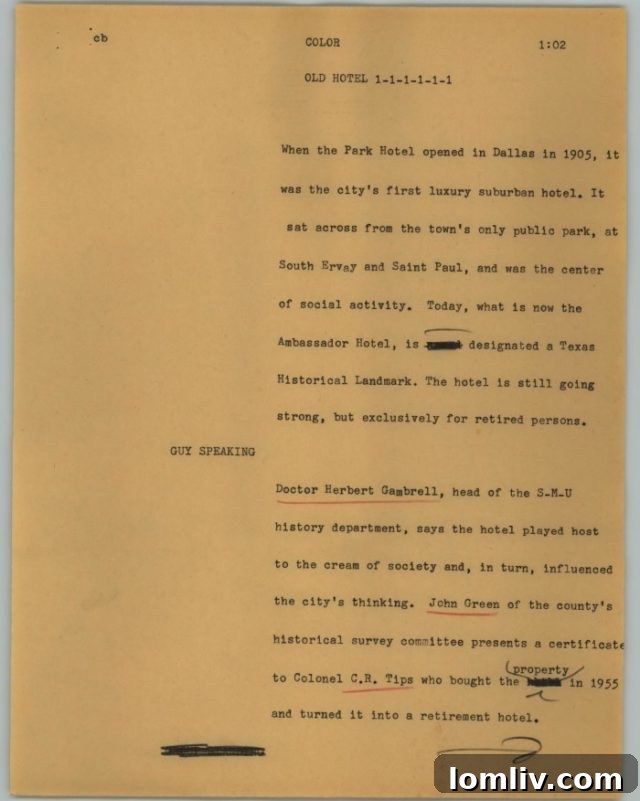
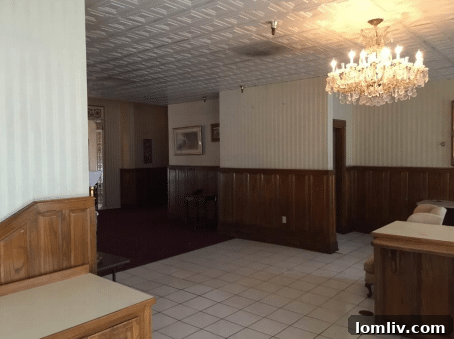
The Ambassador Hotel’s history is punctuated by periods of ambitious revitalization and subsequent challenges. In 1981, Sadrudin Alani acquired the hotel, embarking on a renovation project to restore some of its former glory. By 1982, the Great Texas Development Corporation took over ownership, announcing plans to complete the renovation. However, their efforts were cut short when the company declared bankruptcy. After reorganizing as TAP Historic Properties, they successfully reopened the property as a luxury hotel once again in 1983, breathing new life into the aging structure. This resurgence, however, proved temporary. By 1990, the hotel temporarily closed its doors due to financial difficulties, reflecting the volatile economic climate of the time.
Another significant chapter began in 1993 when Bill Gothard purchased the Ambassador for $800,000 to establish the Institute in Basic Life Principles (IBLP). Under IBLP’s ownership, the building served as a headquarters and training facility, operating for over two decades until it was eventually sold to Jim Lake Companies in 2015, setting the stage for its most recent, and ultimately thwarted, redevelopment plans. This long and varied history underscores the Ambassador Hotel’s resilience and its continuous reinvention in response to changing times, until its final, tragic chapter.
This recent fire was not the first time the historic Ambassador Hotel had faced the threat of flames. On November 18, 2017, just over a year prior to this devastating event, firefighters were called to the scene to combat a blaze on the second floor. That incident, however, was significantly smaller in scale and intensity. It was successfully contained to the second floor, requiring only two units to bring it under control, and ultimately resulted in minimal structural damage. The stark contrast between the two fires—a minor, localized incident in 2017 versus the catastrophic, four-alarm inferno that consumed the entire building—highlights the unforeseen and total nature of this most recent tragedy, leaving behind only memories and rubble where a significant piece of Dallas history once proudly stood.