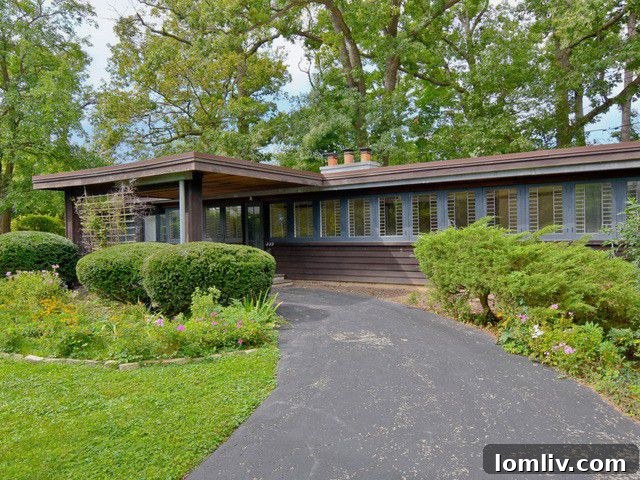
Architectural Heritage Under Threat: A Frank Lloyd Wright Cottage in Glencoe Faces Demolition
The delicate balance between progress and preservation is once again being tested, this time in the tranquil Chicago suburb of Glencoe, Illinois. While cities like Dallas frequently grapple with the fate of historic properties, a deeply significant Frank Lloyd Wright-designed home is currently battling for its survival, highlighting a worrying trend in the preservation community.
For enthusiasts of legendary architect Frank Lloyd Wright, recent years have delivered a series of disheartening blows. Last year witnessed the unfortunate demolition of a Wright-designed medical clinic in Montana. Now, another crucial piece of Wright’s legacy, a precursor to his iconic Usonian homes, stands on the brink of destruction. Such events are remarkably rare, underscoring the gravity of the current situation. Prior to these two instances, the last known Wright structure to be torn down was a Michigan beach house in 2004, and before that, one would have to look back to 1973 for a similar loss. This trend signals an alarming shift in how society views and values its architectural heritage.
The Modest Origins of a Historic Gem: The Booth Cottage
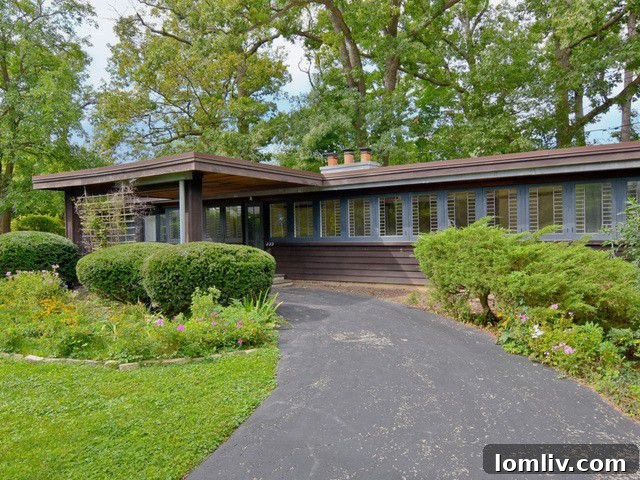
The structure at the heart of this controversy is the charming cottage located at 239 Franklin Road in Glencoe. Built in 1913, this home wasn’t initially intended as a permanent dwelling. It served as a temporary residence for Sherman Booth, Wright’s lawyer, and his wife while Wright embarked on designing and constructing their much larger, primary home. This cottage, though modest in scale, holds immense architectural importance, serving as a pivotal point in Wright’s evolving design philosophy.
Originally a mere 1,100 square feet, the cottage was later expanded by subsequent owners, adding a garage and additional bedrooms, bringing its current size to a still-humble 1,755 square feet, featuring three bedrooms and two-and-a-half bathrooms. After the completion of the main Booth residence in 1915, the cottage was relocated to its present site, a testament to its initial temporary nature, yet a move that did not diminish its inherent design significance.
For an impressive 63 years, since 1956, the cottage was lovingly maintained by the Rudoff family. When it was listed for sale in 2017 with an initial asking price of $1 million, hopes were high that a preservation-minded buyer would emerge. However, successive price reductions, culminating in a January 2019 price tag of $599,900—essentially lot value for the area—signaled trouble. The property, while well-lived-in, required extensive updating, a factor that likely deterred buyers seeking move-in ready luxury. Ultimately, the property was purchased by Jean Jingnan Yang and Justin Jun Lu. Following the closing on May 9th, they swiftly filed for a demolition permit, setting the stage for the current preservation battle.
The Fragility of “Honorary” Status: A Preservationist’s Nightmare
The impetus for demolition stems largely from local building codes that permit a new construction of up to 4,322 square feet on the lot. This size discrepancy, coupled with the rising trend of “McMansions” mirroring the scale of neighboring properties, makes the modest Wright cottage an appealing target for redevelopment. The potential for a much larger, modern home to replace the historic structure is a grim reality that preservationists fear.
This situation starkly illustrates the inherent limitations of an “honorary landmark” status, which the Booth Cottage has held since 1996. Despite this recognition, the Village of Glencoe finds its hands tied, lacking the legal authority to prevent the demolition. This absence of protective ordinances renders such honorary designations largely meaningless in the face of economic development pressures. Just eight days prior to the cottage’s sale, Landmarks Illinois, a prominent preservation advocacy group, had already listed the property as “endangered” in its annual report, a designation heavily influenced by the drastically lowered listing price. This signaled its vulnerability to developers prioritizing land value over architectural merit.
Tragically, this isn’t an isolated incident in Glencoe. Another property on Landmarks Illinois’s “endangered” list, the 12-acre estate featuring the Tudor-style home of vacuum cleaner pioneer H.E. Hoover, has also recently been sold. Its new developer owner plans to demolish the historic residence to make way for 29 new homes, further eroding the village’s rich architectural tapestry. These examples underscore a disturbing pattern where historic homes, even those with significant architectural pedigree, are increasingly seen as mere obstacles to maximizing real estate profit.
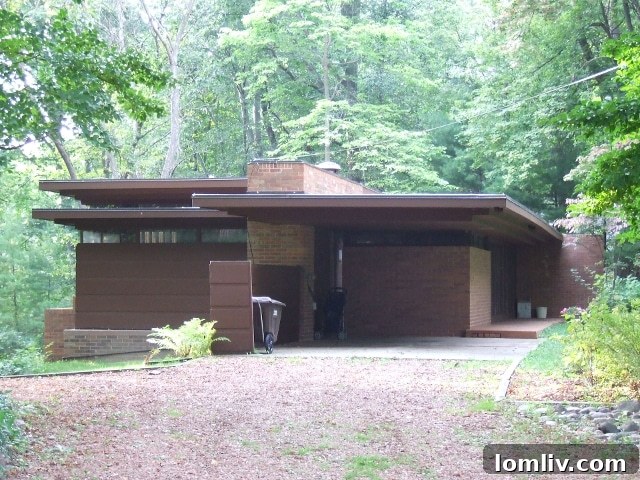
The Usonian Vision: Wright’s Legacy of Affordable, Modern Living
The Booth Cottage’s importance transcends its status as an early Wright commission; it represents a crucial step in the evolution of his design philosophy that would eventually culminate in his groundbreaking Usonian vision. This revolutionary design language served as one of the primary catalysts for the widespread popularity of the ranch-style trend that swept across the nation in the post-World War II era. Usonian homes were conceived as modest, affordable residences for middle-class families, characterized by their flat roofs, pronounced overhangs, and an abundance of windows. These features offered the dual benefit of flooding interiors with natural light while also contributing to passive heating and cooling, demonstrating Wright’s early commitment to sustainable and integrated design.
It is truly remarkable that many of these defining Usonian elements can be observed in the Glencoe cottage, completed in 1913, decades before Wright’s “first” officially recognized Usonian home emerged in the mid-1930s. This early manifestation vividly illustrates the progressive trajectory of Wright’s architectural thinking and his persistent exploration of innovative design principles. Despite only approximately 60 Usonian homes ever being constructed—a testament to Wright’s often challenging and unconventional business practices—the profound impact of their design resonated throughout the country, shaping residential architecture for generations and firmly establishing Wright as a visionary whose influence extended far beyond his direct commissions.
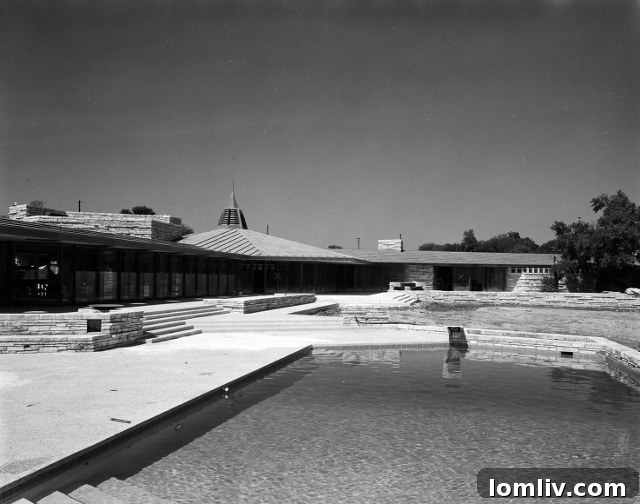
Dallas’s Usonian Gem: The John Gillin Residence
Further south, completed in 1958, Dallas is home to its own magnificent example of Wright’s later Usonian work: the sprawling John Gillin Residence. While far from “middle-class” in its grandeur and scale, this property is nonetheless considered a significant late-period Usonian design and holds the distinction of being Dallas’s only Frank Lloyd Wright-designed home. Its expansive layout and integration with the landscape reflect the advanced evolution of Wright’s Usonian principles, adapted for a larger, more opulent setting. For those interested in exploring this unique property, Douglas Newby offers some compelling photographs and insights into the home here, showcasing its distinctive architectural features and the enduring power of Wright’s vision.
A Glimmer of Hope: Community Efforts to Save the Cottage
Amidst the looming threat of demolition, a glimmer of hope has emerged for the Glencoe cottage. Representatives from the Village of Glencoe, its historic preservation commission, and members of the Frank Lloyd Wright Building Conservancy have engaged in discussions with one of the new owners to explore alternative solutions. These options include the possibility of relocating the cottage on the current site to allow the owners to construct a larger home, or even moving the cottage to an entirely new location. The village described the initial meeting as “positive and productive,” a promising sign that a mutually beneficial resolution might be achievable.
Further aiding the preservation effort is the fact that, as a recognized historic property, any demolition is automatically delayed for 180 days from the completion of the demolition application. This crucial time frame provides a window for continued dialogue, fundraising, and the potential development of a viable plan to save this invaluable piece of architectural history from the wrecking ball. The Frank Lloyd Wright Building Conservancy, a non-profit organization dedicated to preserving the existing architecture of Frank Lloyd Wright, is actively involved, leveraging its expertise and resources to advocate for the cottage’s future.
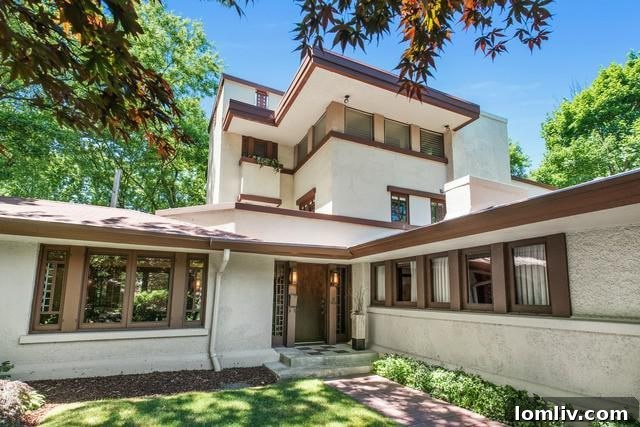
The Other Booth Home: A Challenging Market for Architectural Icons
While the Booth family resided in the modest cottage, Frank Lloyd Wright was simultaneously crafting their magnificent five-bedroom primary residence, situated on three-quarters of an acre at 265 Sylvan Road in Glencoe. This grander Booth home is also currently on the market, listed for $1.150 million. Its sporadic presence on and off the market since 2016 serves as another compelling example of how even a meticulously maintained Frank Lloyd Wright masterpiece, which in past decades would have been swiftly sold, now faces significant challenges in attracting a buyer. This trend suggests a cultural shift where architecturally significant homes appeal to an increasingly specialized and smaller segment of buyers.
Last year, a similar scenario unfolded with the Coonley Estate, another landmark Chicago Wright property. Despite undergoing a $1 million-plus renovation, its final sale price of $1.15 million barely exceeded the $975,000 paid for the home in 2010. These instances highlight the economic realities and changing preferences in the modern real estate market, where the unique requirements and design particularities of architecturally significant homes can be perceived as drawbacks rather than distinguishing features.
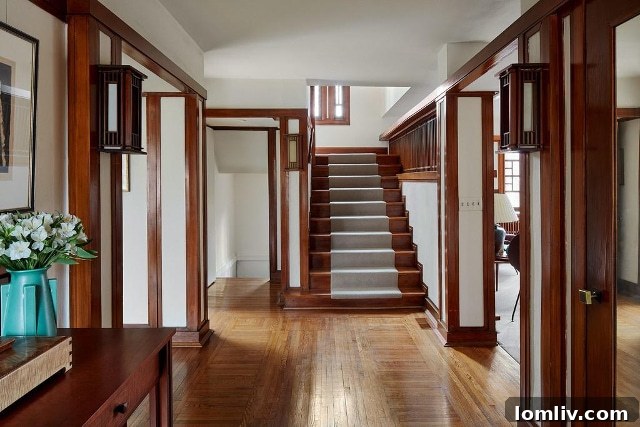
The main Booth house stands as a remarkably well-preserved testament to Wright’s genius, showcasing all the signature architectural touches one would anticipate from his Prairie School period. From the intricate leaded glass details that filter natural light to the expansive, thoughtfully designed interior spaces, and an unparalleled attention to detail, the home is a living museum. Its entry, a classic Wright design, embodies a subtle compression, a relatively constrained space that artfully leads and transitions into the more open, dramatic, and public areas of the home, creating a compelling sense of arrival and spatial progression.
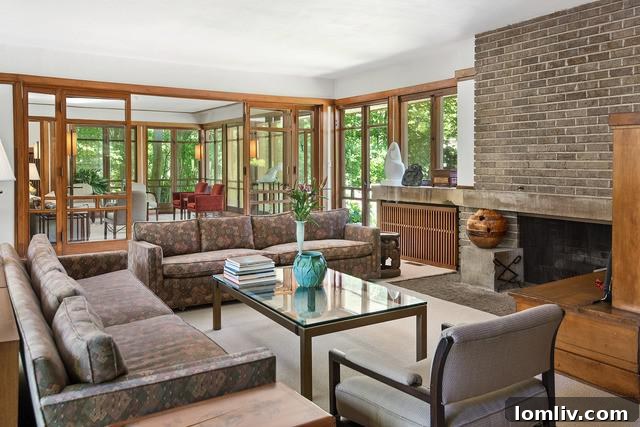
Central to Wright’s design philosophy was the fireplace, often serving as the heart of the home. In the Booth house, the glass-enclosed living and sunrooms beautifully contrast with the solid, grounding mass of the fireplace and its signature Wright hearth. Wright’s ingenuity extends even to functional elements like radiators; he cleverly integrates them into the design by extending the mantle to frame them, effectively allowing the solid mass to absorb and then radiate heat back into the room, blurring the lines between aesthetics and utility.
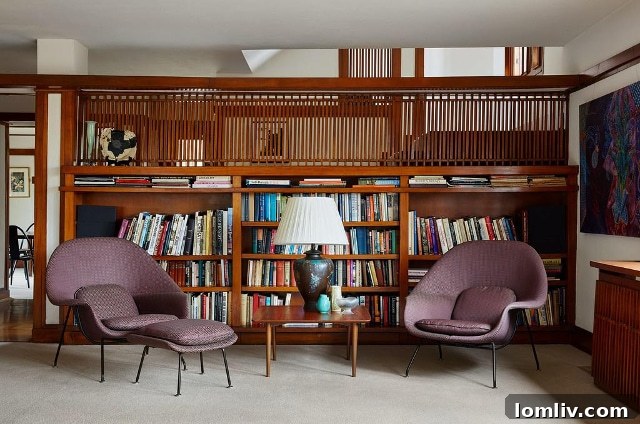
Beyond the main public spaces, intricate details like the pocket library nestled behind the entry stairs further reveal Wright’s masterful control of scale and functionality. The bookshelves are positioned at the perfect height for comfortable perusal while seated, inviting quiet contemplation. Simultaneously, a decorative balustrade thoughtfully captures and diffuses light, providing both a visual separation and a sense of privacy without isolating the space entirely. These nuanced design elements collectively illustrate Wright’s holistic approach to architecture, where every detail contributes to the overall experience of the home.
The Modern Dilemma: Preserving Yesterday’s Shells in a Disposable Society
As someone deeply involved in renovation, I understand the inherent challenges of adapting historic structures to contemporary lifestyles. Frank Lloyd Wright was not only meticulous in his overarching designs but also exceedingly particular about countless specific details. While many find his homes utterly fascinating and artistically profound, some contemporary occupants struggle to find them “livable” due to these unique, often rigid, design parameters that clash with modern open-plan preferences or technological integrations. Today’s society, however, seems increasingly defined by a throw-away culture, where the expectation of upgrading phones every two years and discarding $25 party outfits after a single wear has become the norm. This mentality extends beyond consumer goods, subtly influencing our perception of durable assets, including historic homes.
In this context, Wright’s homes, with their demand for careful stewardship and adaptation, appear symptomatic of a much larger societal disease: an ingrained culture of disposability. This culture is, ironically, propagated by a generation that frequently pays lip service to the ideals of sustainability. The destruction of architecturally significant homes, especially those by a master like Frank Lloyd Wright, underscores a profound disconnect between our stated values and our practical actions. Preserving these homes is not merely about saving old buildings; it’s about honoring design innovation, acknowledging cultural heritage, and embracing a more sustainable future that values longevity and adaptive reuse over fleeting trends and demolition for immediate gain.

About the Author: My professional focus spans high-rises, HOAs, and the intricate world of renovation. Beyond these beats, I possess a deep appreciation for both modern and historical architecture, always seeking to balance preservation efforts against the realities of the YIMBY (Yes In My Backyard) movement. My writing has been recognized by the National Association of Real Estate Editors, earning three Bronze awards in 2016 (for an article on housing styles), 2017 (on property taxes), and 2018 (covering a condo fire), alongside two Silver awards in 2016 (for a piece on a Marrakech home) and 2017 (exploring second homeownership in Bermuda). Should you have a story to share, a perspective to offer, or even a unique marriage proposal, please feel free to reach out via email at [email protected]. While you’re welcome to search for me on Facebook and Twitter, you might find my digital footprint elusive.