Unmasking the Myth: A Critical Look at Experian’s “Wealthiest ZIP Codes” Data
In an age where information is abundant, discerning truth from misinformation has become paramount. Especially when it comes to vital economic indicators and data provided by reputable organizations, the expectation of accuracy is high. This article delves into an intriguing case study involving credit reporting giant Experian, a company whose very tagline, “Data Quality,” sets a high bar. We examine an infographic published by Experian purporting to reveal “The Wealthiest ZIP Codes in America,” and uncover significant discrepancies that challenge the very foundation of its claims, prompting a necessary reevaluation of how such financial data is compiled and presented.
The Quest for Wealth: Decoding “America’s Wealthiest ZIP Codes” Infographic
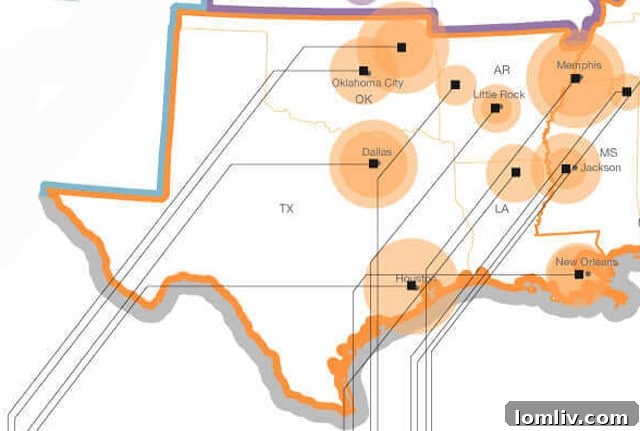
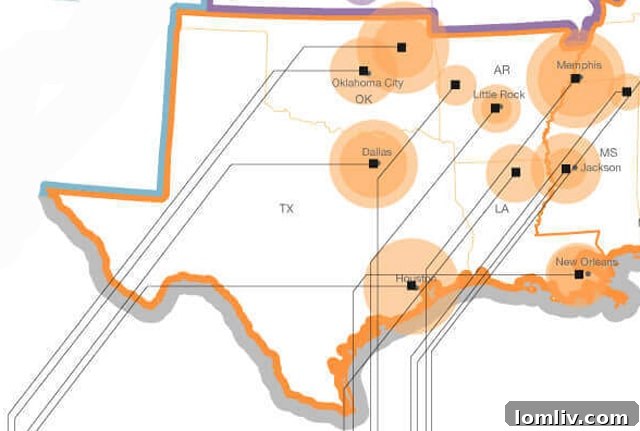
The infographic in question, presented by credit bureau Experian, aimed to highlight the top three wealthiest ZIP codes in each U.S. state. It categorized states into regions, such as Texas falling within the West South Central region alongside Louisiana, Oklahoma, and Arkansas. The data reportedly leveraged insights from the IRS and U.S. Census, further filtered through various third-party sources like wealth.mongabay.com, freep.com, and zipatlas.com. While the concept is compelling, offering a glimpse into areas of concentrated affluence, a closer inspection reveals a startling divergence from reality, particularly concerning the true nature of these “wealthy” enclaves.
It’s crucial for clarity to point out that while the chart uses the expansive term “America,” its focus is exclusively on the United States, a nuance often lost in broader discussions. The infographic’s methodology, while appearing robust on the surface with its mention of official data sources, immediately raises questions about how this data was interpreted, aggregated, and ultimately presented. Our investigation reveals that what appears to be a straightforward ranking of wealth is, in fact, a complex web of potentially misconstrued data points, leading to some truly bewildering conclusions about where the nation’s wealthiest truly reside and how their economic status is calculated.
The allure of discovering the nation’s most affluent postcodes is undeniable, captivating audiences from potential homebuyers to urban planners. However, when the data itself is flawed, the insights derived become misleading. Our deep dive scrutinizes Experian’s definitions of “wealth” and “household,” particularly when applied to ZIP codes that are predominantly commercial rather than residential. This examination reveals not just minor errors, but fundamental misrepresentations that demand a thorough review of data collection and quality assurance processes from institutions like Experian. The ability to distinguish between genuine residential wealth and statistical anomalies caused by commercial addresses or sparse, ultra-high-income residents in specific buildings is paramount for accurate reporting.
Texas Tales of Dubious Wealth: Scrutinizing Experian’s Top ZIP Codes
Our journey into data scrutiny begins in Texas, a state synonymous with vast landscapes, a dynamic economy, and significant pockets of affluence. Experian’s infographic identifies Houston’s 77010 and Dallas’s 75247 and 75270 as the state’s most affluent ZIP codes. However, for anyone even vaguely familiar with these major Texas metropolitan areas, these selections immediately raise eyebrows. Traditional bastions of wealth like Houston’s River Oaks, West University Place, or Dallas’s prestigious Park Cities and Preston Hollow are conspicuously absent from this list. This glaring anomaly prompted a deeper dive, uncovering some truly astonishing findings that challenge the very definition of “wealthy ZIP code.”
Houston’s 77010: A Commercial Hub or a Residential Goldmine?
Experian credits Houston’s 77010 with an astounding average household income of $640,198, labeling it as the highest in the entire four-state West South Central region. The infographic claims 247 households call this area their primary residence. This figure immediately begs the question: where exactly is this hidden oasis of wealth? Is it nestled within the exclusive tree-lined streets of Tanglewood, the sprawling estates of River Oaks, or perhaps the modern luxury homes of the Galleria area? Surprisingly, no. ZIP code 77010 is situated in the bustling heart of downtown Houston, an area predominantly defined by its towering commercial buildings, convention centers, and major highways.
This ZIP code is a nexus of corporate activity, home to major firms like Ernst & Young, Hess Corporation, and even the Consulate General of Japan. The presence of such prominent businesses underscores its commercial character. Residential options within 77010 are exceptionally sparse and highly concentrated. They primarily consist of a limited number of luxury condominiums located on the top floors of the Four Seasons Hotel (a building constructed in 1982) and the several hundred units within the One Park Place apartment tower, proudly owned and managed by the “Distinguished Finger Companies.” While these residences are undoubtedly upscale and cater to a high-income demographic, their limited number and specific, often transient, resident profile make Experian’s average income figure highly suspect when applied to the entire ZIP code.
A stark contrast emerges when comparing Experian’s data with verifiable statistics. The 2010 U.S. Census places the average household income for 77010 at approximately $200,000 – a figure dramatically lower than Experian’s claim. It strains credulity to suggest that the opening of One Park Place in 2009, no matter how luxurious its apartments, could single-handedly triple the average household income for the entire ZIP code within a year. This significant discrepancy points to a potential flaw in Experian’s data aggregation or interpretation, possibly conflating corporate earnings, business addresses, or commercial real estate values with actual residential household wealth. The challenge of accurately assessing wealth in mixed-use or predominantly commercial ZIP codes highlights the need for more nuanced data methodologies.
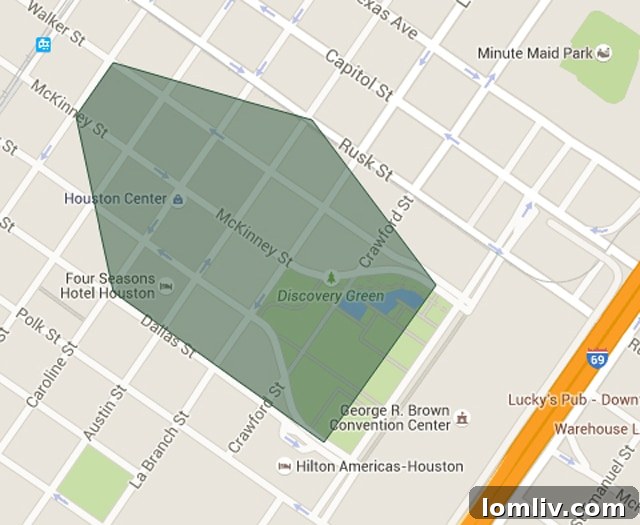
Figure 1: Alleged #1 Wealthiest Zip Code in Texas – 77010. A map illustrating the largely commercial downtown Houston area bordering the George R. Brown Convention Center and Highway 59.
Dallas’s 75270: The Enigma of the Renaissance Tower
Moving north to Dallas, Experian designates 75270 as the state’s third wealthiest ZIP code, boasting an average income of $382,037 across a mere 27 households. The identification of this ZIP code is even more perplexing than Houston’s 77010. Where are these 27 households generating such immense wealth? ZIP code 75270 is exclusively assigned to the Renaissance Tower at 1201 Elm Street, a prominent commercial skyscraper in downtown Dallas. Famous for its fictional portrayal as the headquarters of “Ewing Oil” in the iconic TV show “Dallas” during the 1980s, the Renaissance Tower is undeniably a commercial landmark, housing numerous businesses and offices.
However, the idea of 27 primary residences within its confines strains credulity to the breaking point. Official records further debunk this audacious claim: the 2000 U.S. Census reported zero population, zero average household income, and zero average home value for 75270, precisely because there are no residential units within the building or the ZIP code. The Dallas Central Appraisal District (DCAD) also unequivocally lists no current residential properties within the Renaissance Tower. This glaring inconsistency raises serious questions about the data sources, filtering, or methodologies employed by Experian. It appears to be a clear case of a commercial address being completely misidentified as a hub of residential wealth. The humorous, albeit unsettling, image of “eccentric homeless people claiming their mail from cardboard sidewalk shelters” perfectly encapsulates the sheer absurdity of these alleged phantom residents. This example serves as a potent illustration of how easily data can be misinterpreted when basic due diligence is overlooked.
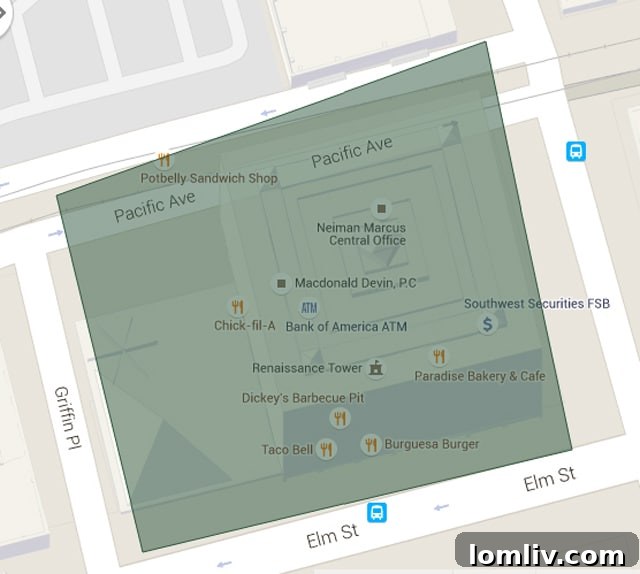
Figure 2: Texas’ Third Wealthiest ZIP Code, 75270, specifically covering the commercial Renaissance Tower, which has no residential units.
Dallas’s 75247: Wealth on Easy Street, or Just a Commercial Mirage?
Rounding out Texas’s top three, Experian names 75247 as the state’s second wealthiest ZIP code, with 264 residents purportedly earning an average household income of $548,640. For local residents, this ZIP code might ring a bell, but certainly not for its opulent residential estates or sprawling mansions. Instead, 75247 is widely recognized as the location of the Dallas Central Appraisal District’s offices – a rather ironic coincidence given the subject of this article and the very agency responsible for property valuation. Beyond this, the area is largely industrial and commercial.
Like its counterparts, 75247 is primarily a commercial and industrial zone, situated just west of Love Field, stretching along Regal Row to the north, bordered by the Trinity River, and meandering through a greenbelt towards Sylvan. It’s an area characterized by warehouses, light manufacturing, and business parks, not high-end residential communities. While it may contain streets with evocative names like “Easy Street” and “Lucky Lane,” the reality of its residential wealth starkly contradicts Experian’s figures. The 2000 U.S. Census data for 75247 painted a very different picture, reporting an average household income of a modest $15,208 and an average home value of $36,300. While the census noted 251 residents in 2000, growing to 264 by Experian’s report, this modest population increase cannot account for such an astronomical leap in reported average income – an increase of over 3,500%. The data strongly suggests that this ZIP code, too, has been profoundly misclassified or its wealth metrics severely skewed by non-residential factors, further undermining the credibility of the infographic.
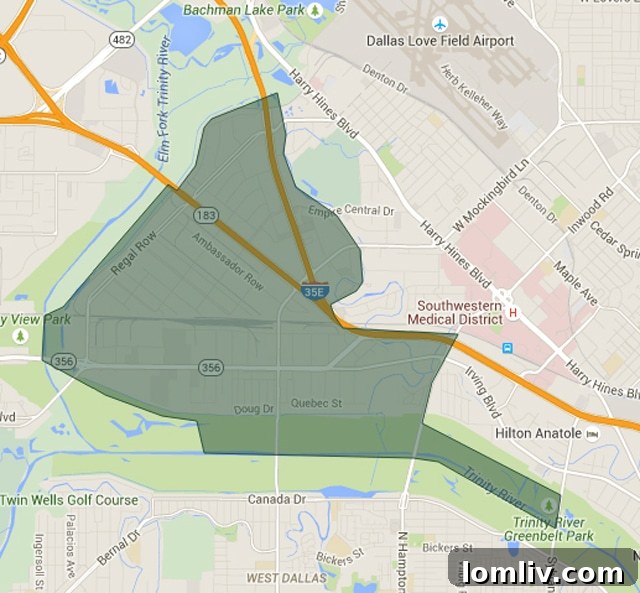
Figure 3: Is 75247 truly Texas’ Second Wealthiest Zip Code? A map of the predominantly commercial 75247 area, including the Dallas Central Appraisal District offices.
Beyond Texas: New York’s Phantom Millionaires and Data Discrepancies
The inconsistencies and statistical anomalies are not confined to Texas. A glance at New York’s supposedly wealthiest ZIP codes, as presented by Experian, reveals a similar pattern of bewildering data. Experian lists New York’s top three ZIP codes with average household incomes soaring above an astonishing $2 million. For instance, ZIP code 10104, though somewhat enigmatic to precisely pinpoint, appears to be associated with a singular, ultra-luxury building, perhaps the prestigious Baccarat Residences. While such an address certainly houses extreme affluence, representing its highly concentrated and tiny population’s average income as indicative of an entire ZIP code’s wealth raises serious questions about statistical validity and methodology, especially when compared to broader residential areas.
Even more startling is ZIP code 10112, designated as New York’s second wealthiest. This code notably covers a significant section of Rockefeller Center, a quintessential commercial, cultural, and entertainment landmark, known for its offices, shops, and iconic attractions, not extensive residential communities. Yet, Experian claims 294 households reside here as primary residents, boasting incredibly high average incomes. This further reinforces the theory that commercial addresses, corporate entities, or even transient populations might be distorting the residential wealth data, creating an illusion of widespread residential affluence where none truly exists on a meaningful scale.
The third wealthiest ZIP code in New York, according to Experian, encompasses an even more improbable collection of addresses. With 1,336 households, it supposedly includes residents of the Statue of Liberty, Ellis Island, Governor’s Islands, Battery Park, and highly commercial sectors of Wall Street. While Battery Park does feature some residential properties, and Wall Street has seen a growing residential component in recent decades, the inclusion of national monuments and historical islands as primary residences for a significant number of “wealthiest” households is simply illogical and borders on the absurd. The U.S. Census, for these very areas, reported an average income of approximately $181,900 – a colossal difference from Experian’s reported $2,118,766. This astronomical disparity is a stark testament to the fundamental inaccuracies and methodological flaws present in Experian’s data set, rendering its claims about New York’s wealthiest ZIP codes largely unreliable.
The Imperative of Data Quality: Implications of Misleading Statistics
The repeated inconsistencies across multiple states and ZIP codes highlighted in Experian’s “Wealthiest ZIP Codes” infographic are deeply troubling, especially coming from a credit reporting agency whose core business relies heavily on “Data Quality.” These aren’t minor discrepancies; they represent fundamental mischaracterizations of residential wealth, often confusing commercial zones with residential enclaves, or dramatically inflating income figures with scant evidence. Such errors erode public trust and can have far-reaching consequences.
Why does this matter? The implications of such misleading statistics extend far beyond a mere infographic or a casual curiosity. Inaccurate wealth data can lead to erroneous conclusions and flawed decision-making in various critical fields:
- Real Estate & Investment: Developers and investors rely on precise demographic and income data to identify viable markets, evaluate property values, and make informed investment decisions. Misinterpretations can lead to misplaced investments, flawed valuations, and ultimately, significant financial losses.
- Urban Planning & Public Policy: City planners and government agencies depend on accurate demographic and income data to allocate resources effectively, plan essential infrastructure projects, and develop targeted community programs. Misinformation can lead to inefficient or inappropriate urban development strategies, failing to address the true needs of a population.
- Business Strategy & Marketing: Businesses targeting affluent consumers, whether in retail, luxury goods, or financial services, depend on precise data to identify prime locations for expansion, direct marketing campaigns, and understand nuanced consumer behavior. Inaccurate data results in wasted marketing resources, missed sales opportunities, and a fundamental misunderstanding of target demographics.
- Economic Research & Public Perception: Such data shapes public understanding of economic disparities, wealth distribution, and informs critical policy debates on taxation, social services, and economic development. Grossly inflated wealth figures in commercial areas or misclassified ZIP codes can distort public discourse, leading to an inaccurate perception of economic health and societal challenges.
Experian, as a leading provider of consumer and business data, bears a significant responsibility to uphold the highest standards of data integrity. The observed discrepancies strongly suggest a critical flaw in their data processing, validation, or aggregation methods, particularly when distinguishing between distinct commercial and residential activities within a given ZIP code. A rigorous and transparent methodology is not just an ideal; it is an imperative for any organization purporting to provide reliable economic insights.
Experian: Data Quality? A Final Scrutiny
The examination of Experian’s “Wealthiest ZIP Codes in America” infographic serves as a compelling reminder that even data from seemingly authoritative sources must be critically evaluated. The stark contrast between Experian’s presented figures and verifiable U.S. Census data, particularly in high-profile areas of Texas and New York, casts a long shadow over the accuracy and reliability of their methodology. The irony of these findings, emanating from a company that proudly champions “Data Quality,” is profound and cannot be overstated. It underscores the critical importance of scrutinizing the origins and processing of data, especially when it influences public perception and significant economic decisions.
Furthermore, it is worth noting the corporate structure of Experian itself. The company has structured its corporate headquarters in Dublin, Ireland, a location often chosen for its favorable tax environment. While its official headquarters may be offshore, the vast majority of its operations – including its extensive employee base, substantial revenue generation, and the collection of vast amounts of consumer and business data – are concentrated in North America, as detailed in its own corporate fact sheet. This corporate strategy, while legal, adds another layer of complexity to the transparency and accountability expected from a global data powerhouse. When a company’s data quality is questioned at such a fundamental level, particularly concerning a public-facing report, it necessitates a deeper look at all aspects of its operations and commitment to accuracy. Ultimately, this detailed analysis serves as a vital lesson in data literacy, urging everyone to question, verify, and scrutinize the information that shapes our understanding of the world, lest we fall prey to statistically misleading narratives.