

The universal yearning for the outdoors is a sentiment deeply ingrained in all of us, a primal desire to connect with nature, breathe fresh air, and find respite from indoor confines. This desire has become particularly acute in recent times, reminding us of the invaluable role urban green spaces play in our well-being. While we collectively anticipate a return to normalcy and the freedom to gather in public spaces without hesitation, it’s an opportune moment to reflect on the state of our urban parks. In this exploration, we turn to the comprehensive data compiled by The Trust for Public Land, a national non-profit organization dedicated to creating parks and protecting land for people. Their meticulous research culminates in the annual ParkScore index, which evaluates parkland and accessibility in the 100 largest U.S. cities, offering critical insights into how well urban areas serve their residents with green infrastructure.
A quick glance at the overall ParkScore rankings reveals a challenging landscape for many Texas metropolitan areas. While Texas is home to a significant number of the nation’s largest cities, their performance in providing quality urban park experiences is, for the most part, underwhelming. Plano stands out as an exception, securing an impressive No. 15 spot, indicating a focused commitment to its green spaces. However, the next Texas city doesn’t appear until Austin at No. 43, followed by a noticeable dip in rankings for the majority. Dallas, for instance, lands at No. 52, sharing its rank with Columbus, Ohio. Further down the list are Corpus Christi at No. 66, Arlington at No. 68, El Paso at No. 71, San Antonio at No. 72, Garland at No. 80, Houston at No. 85, Irving at No. 88, Fort Worth at No. 89, Lubbock at No. 90, and Laredo trailing at No. 94. These figures paint a clear picture: despite Texas hosting 13 of the 100 most populous cities in the U.S., a consistent dedication to robust urban park systems appears to be a statewide challenge, with significant room for improvement across most major metros.
Delving deeper into Dallas’s specific ParkScore metrics offers a more nuanced understanding of its park system. The city’s parks achieve a respectable 75 out of 100 points for median park size, averaging 7.7 acres per park. This suggests that individual park parcels, when they exist, are generally of a decent scale, capable of accommodating various recreational activities. However, this positive aspect is tempered by a stark reality: Dallas lags significantly behind the national average in terms of the overall percentage of its land dedicated to parks. With only 9 percent parkland within city limits, Dallas falls a substantial 40 percent below the national average of 15 percent. This disparity highlights a critical issue: while the existing parks may be adequately sized, their scarcity means there simply aren’t enough of them to serve the city’s rapidly growing population effectively. This low percentage of parkland has broad implications for urban planning, environmental sustainability, and the equitable distribution of green spaces.
Proximity and Equitable Access to Parks
The accessibility of parks, measured by the percentage of residents living within a 10-minute walk, is a key indicator of an urban park system’s effectiveness. For Dallas, this metric initially seems encouraging, with 69 percent of residents falling within this convenient walking distance. This performance earns Dallas a score of 55 out of 100, which is slightly above the national average of 54 percent. Within Texas, Dallas performs relatively well in this category, only surpassed by Plano and Corpus Christi, both boasting 75 percent accessibility. Conversely, San Antonio lags significantly with only 42 percent of its residents having easy park access, earning it the lowest mark among major Texas cities in this critical area. These percentages offer a surface-level view, but the true story of park access, especially regarding equity, lies beneath these aggregate figures.
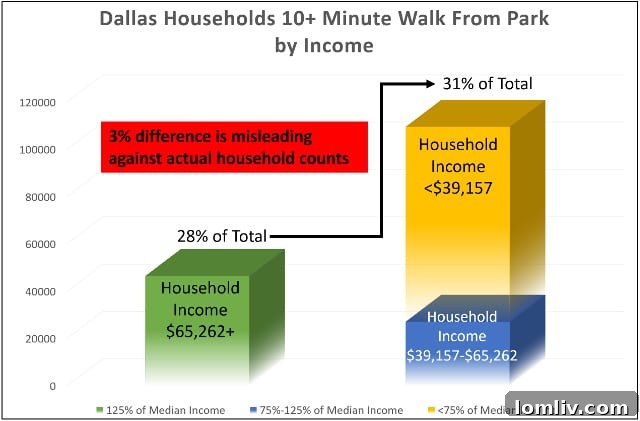
While park access percentages might appear fairly uniform across different age and income brackets within a metro area, relying solely on these averages can be misleading. The distribution of parks and their accessibility often mirrors existing socio-economic disparities, creating what are often termed “park deserts” in underserved communities. This critical point underscores the need to look beyond simple percentages to understand the true impact of park planning on all residents. The Trust for Public Land’s analysis provides a powerful illustration of this, particularly in Dallas, where income levels profoundly influence access to green spaces.
Consider the data for Dallas: there are 262,439 households earning less than 75 percent of the median income. Of these, 69 percent are within a 10-minute walk of a park. While this percentage seems fair, it still leaves a significant 82,376 households in lower-income brackets without easy park access. Now, compare this to the 164,430 households earning over 125 percent of the median income, where 72 percent are within a 10-minute walk. The percentage difference here is only three percent. However, when we translate these percentages into raw numbers, the disparity becomes stark: only 46,411 wealthier households lack walking-distance park access, compared to the 82,376 households earning less than 75 percent of the median income who are in the same predicament. This means there are 77 percent more actual poorer households struggling with convenient park access. The situation becomes even more pronounced when considering the combined 109,451 households earning below $65,262 who reside further from a park – a staggering 235 percent difference in numerical terms. This detailed breakdown unequivocally demonstrates that a seemingly small percentage difference can mask a profound and inequitable distribution of resources, confirming that a “3 percent” gap tells only a fraction of the story.
The message from this in-depth analysis is clear and impactful: socio-economic status plays a significant role in determining a resident’s likelihood of living near a park. This phenomenon, often referred to as “park equity,” highlights how communities with lower median incomes frequently face greater barriers to accessing green spaces. The absence of nearby parks in these areas deprives residents of crucial opportunities for physical activity, relaxation, and community engagement, contributing to health disparities and reduced quality of life. Addressing this inequity requires intentional urban planning and investment strategies that prioritize the creation and enhancement of parks in historically underserved neighborhoods, ensuring that the benefits of green spaces are accessible to all, regardless of their economic background.
Investing in Green Spaces: Park Spending Challenges
Funding is the lifeblood of any robust park system, dictating everything from maintenance quality to the development of new amenities. In Dallas, the data regarding park spending presents a puzzling discrepancy. The summary provided in Dallas’s ParkScore PDF indicates a per capita expenditure of $110.37 on parks, leading to a respectable 57.5 out of 100 points in the spending category. However, a deeper dive into the raw data reveals a different picture. The actual public spending figure reported is only $74.31 per capita. Even when factoring in an additional $7.3 million in private funding, the total expenditure only rises to approximately $80 per capita. To reach the $110.37 figure cited in the summary, Dallas’s parks would require an additional $41.6 million annually, a significant sum. This inconsistency raises critical questions about data accuracy and the true level of investment in Dallas’s park system, prompting a need for clarification from authorities. The integrity of such data is paramount, as it directly influences public perception, policy decisions, and accountability.
The implications of this funding discrepancy are substantial. If the error in reported spending is unique to Dallas, it suggests that the city’s actual investment in its parks is considerably lower than advertised. This would inevitably cause Dallas to plummet in national funding rankings, revealing a more dire financial reality for its green spaces. Such a decline would highlight a serious deficit in resources, potentially impacting everything from park upkeep to future development projects. Conversely, if this data inconsistency is a widespread issue affecting the ParkScore methodology across multiple cities, Dallas’s relative standing might remain unchanged, but it would expose a broader systemic challenge in accurately tracking and comparing park expenditures nationwide. Across Texas, park spending varies dramatically, with Lubbock scoring a mere 12.5 points and Plano achieving a perfect 100 points. The fact that most Texas metros rank significantly below Dallas in this category further hints at a potential statewide issue with transparent and adequate park funding, emphasizing the need for comprehensive review and strategic investment in public green infrastructure.

Park Amenities: A Reflection of Investment
The availability and quality of park amenities often serve as a tangible indicator of municipal investment and a city’s commitment to enhancing the user experience. A well-maintained and diverse array of amenities can transform a simple green space into a vibrant community hub. For instance, sophisticated urban parks like Dallas’s Klyde Warren Park, with its elaborate landscaping, programming, and infrastructure, naturally demand higher maintenance costs than a basic grassy area of comparable size. The scope and condition of amenities directly reflect the financial resources allocated to a city’s park system, influencing everything from recreational opportunities to the comfort and convenience of visitors.
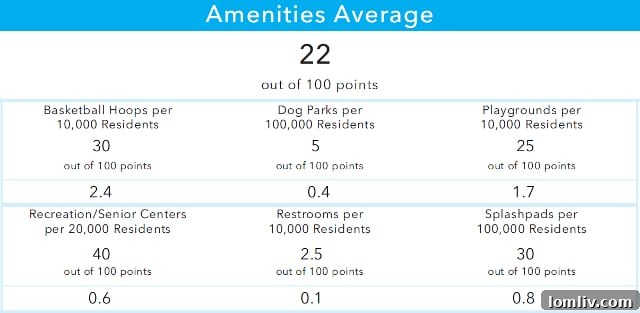
One of the most fundamental, yet often overlooked, amenities is the public restroom. Its availability speaks volumes about a park system’s user-friendliness and its ability to serve diverse populations, including families with young children, the elderly, and individuals with disabilities. Among the 100 largest metros, Henderson, Nevada, leads by a significant margin, providing an impressive five restrooms per 10,000 residents, which translates to one restroom for every 2,019 residents. With 148 park restrooms for its 298,927 residents, Henderson sets a high standard for accessibility and convenience. In contrast, visitors to Texas parks might find themselves in a challenging situation, with San Antonio and Plano, the best performers in the state, offering only 1.5 restrooms per 10,000 residents. The situation in Dallas is particularly stark: with a mere 16 park restrooms serving its 1,356,896 residents, the city provides only one restroom for every 84,806 people. To put this in perspective, Henderson, with over a million fewer residents than Dallas, boasts nine times the number of park restrooms. This disparity is partly attributable to Henderson’s higher per capita park spending of $140, nearly double that of Dallas, illustrating a direct link between investment and essential services. Fort Worth and Irving fare only marginally better, offering one restroom for every 55,185 and 40,613 residents, respectively, highlighting a widespread deficit in this basic necessity across major Texas cities.
Beyond restrooms, access to clean drinking water is another critical amenity, especially in the warm climate of Texas. Dallas reportedly has 220 water fountains across its parks, which is 14 times the number of restrooms. However, on a per capita basis, this still falls short of national leaders. Tucson, for example, provides six times as many water fountains per capita as Dallas. Similarly, cities like Orlando, St. Petersburg (Florida), Madison (Wisconsin), Henderson (Nevada), and Cincinnati all report a water fountain for every 1,500 residents or fewer, showcasing a commitment to hydration and public health. In stark contrast, Dallas offers just one water fountain for every 6,168 residents, indicating a significant gap in providing this essential service. Such deficiencies in fundamental amenities directly contribute to Dallas’s overall score of 22 out of 100 for amenities, with no single category scoring above 40 points (Recreation/Senior Centers being the highest). This underperformance in basic park infrastructure reflects a broader philosophy often associated with “low-tax, low-service” states, where public amenities might take a backseat to fiscal conservatism, ultimately impacting the quality of life for urban residents.
The findings of The Trust for Public Land’s ParkScore report highlight crucial areas where Dallas and many other Texas cities need to enhance their urban park systems. From a low percentage of parkland to significant disparities in access for lower-income households, and a noticeable lack of basic amenities like restrooms and water fountains, the challenges are clear. These issues are deeply intertwined with funding decisions and a broader municipal approach to public services. As we look forward to a time when public spaces can be fully enjoyed without reservation, it’s imperative for city leaders, urban planners, and residents alike to advocate for greater investment in parks. This means not only increasing the number of green spaces but also ensuring their equitable distribution, proper maintenance, and the provision of essential amenities that make them truly welcoming and functional for everyone. When the “all-clear” is finally given, encouraging all Dallasites to explore their city’s parks, even if it requires a drive for those in underserved areas, becomes more than just an invitation—it’s a call to experience and advocate for the critical improvements needed to create a truly inclusive and vibrant urban environment, ensuring that every resident has dignified access to nature and recreation.