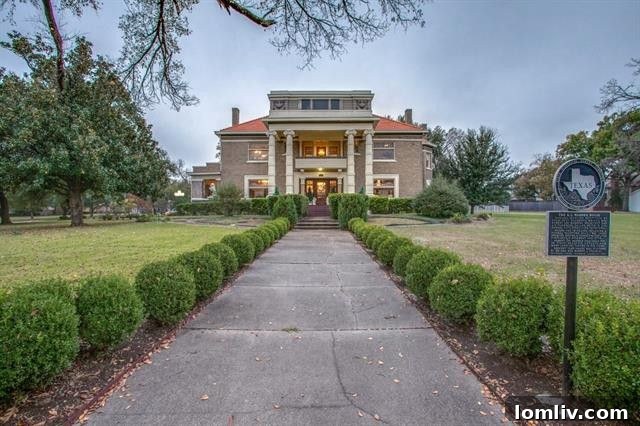
In the vibrant landscape of Terrell, Texas, stands a monumental testament to turn-of-the-century grandeur and architectural innovation: the Robert Lee Warren mansion. Built in 1897, this stately residence emerged during a pivotal era for Terrell, a town that, like so many nascent communities across Texas, owed its very existence and early prosperity to the unwavering march of the railroad. Approximately 24 years after its official establishment, Terrell was a burgeoning hub, and Warren’s decision to construct his Colonial Revival-Prairie School style masterpiece reflected both his personal success and the town’s burgeoning aspirations.
A Visionary Home in a Developing Texas Town
The story of this remarkable historic home is deeply intertwined with the development of Terrell itself. While settlers began arriving in the fertile lands of Kaufman County as early as the 1840s, it was the strategic expansion of the Texas and Pacific Railway that truly galvanized interest in the area. This iron lifeline, stretching across North Texas, transformed sleepy farmlands into thriving commercial centers. Visionary figures like C. C. Nash and John G. Moore recognized this potential, acquiring tracts of land and meticulously planning the layout of what would soon become Terrell. Their foresight laid the groundwork for a community that would flourish spectacularly during the golden age of rail travel, drawing in entrepreneurs and families seeking new opportunities.
It was into this dynamic and promising environment that Robert Lee Warren arrived, a prominent figure whose contributions to the town’s fabric would be cemented not only through his business endeavors but also through the magnificent home he commissioned. His mansion, a symbol of stability and aspiration, was designed with unique personal touches, including a specially appointed room within the expansive master suite. This thoughtfully positioned sanctuary offered Warren a panoramic vista of his burgeoning farm, allowing him to observe the day’s first stirrings, the awakening of his land, from the moment he himself arose each morning. It was a private ritual that underscored his deep connection to the fertile Texas soil and the enterprise he cultivated.
Architectural Harmony: Colonial Revival Meets Prairie School
The architectural distinction of the Warren mansion lies in its fascinating synthesis of two prominent styles: Colonial Revival and Prairie School. The Colonial Revival movement, popular from the late 19th century into the early 20th, sought to hark back to the perceived elegance and symmetry of early American architecture. It often featured classical elements, grand facades, imposing columns, and a sense of dignified formality. In contrast, the Prairie School, championed by architects like Frank Lloyd Wright, emerged as a uniquely American style emphasizing organic forms, horizontal lines, low-pitched roofs, broad eaves, and an integration with the surrounding landscape. It was a rejection of European traditions, aiming for structures that felt rooted in the American prairie.
The Warren mansion’s ability to weave these seemingly disparate styles into a cohesive and elegant design speaks volumes about the ingenuity of its original architects and craftsmen. One can imagine the Colonial Revival influences manifesting in its stately proportions, perhaps a grand entrance, or symmetrically placed windows. Meanwhile, the spirit of the Prairie School might be subtly expressed through its expansive, low-slung rooflines, deep overhangs that provided shade from the Texas sun, or an emphasis on open, flowing interior spaces designed to connect residents with the outdoors. This unique fusion made the Warren home not just a residence, but a living architectural statement, a rare example of design innovation in late 19th-century Texas. The “special room” in the master suite, with its deliberate framing of the landscape, is a prime example of the Prairie School’s philosophy of harmonizing a structure with its environment, allowing the occupant to feel intimately connected to their surroundings, even from within the comfort of their private quarters.
A Testament to Preservation: The Three-Year Renovation
Like many historic treasures, the Robert Lee Warren mansion has journeyed through generations, witnessing the ebb and flow of time. Recognizing its profound historical and architectural significance, the home recently underwent an extraordinary, three-year renovation project. This undertaking was far more than a mere refurbishment; it was a meticulous, passion-driven restoration aimed at breathing new life into every facet of the property while scrupulously preserving its original character and historical integrity. Such a massive endeavor requires not only significant investment but also an unwavering commitment to historical accuracy, demanding specialized skills in heritage restoration.
The extensive renovation likely involved a comprehensive overhaul of its foundational elements, ensuring structural soundness for another century of existence. Modern systems, including electrical, plumbing, and HVAC, would have been discreetly integrated to meet contemporary comfort and efficiency standards without compromising the home’s historic aesthetic. Imagine the careful stripping back of layers of paint to uncover original wood finishes, the painstaking repair of ornate plasterwork, or the restoration of intricate stained-glass windows, each detail brought back to its former glory by skilled artisans. Simultaneously, contemporary amenities, such as state-of-the-art kitchens and luxurious bathrooms, would have been designed to complement the period charm, creating a seamless blend of historic elegance and modern convenience. This careful balance ensures that the Warren mansion, while steeped in history, is perfectly equipped for 21st-century living, offering unparalleled comfort without sacrificing an iota of its storied past.
A Rare Opportunity: The Warren Mansion Returns to the Market
Today, following its magnificent transformation, the Robert Lee Warren mansion is once again gracing the real estate market, presenting an exceptional opportunity for discerning buyers seeking a home with unparalleled history, architectural significance, and modern luxury. This isn’t merely a house for sale; it’s a piece of Texas heritage, meticulously preserved and thoughtfully updated for its next chapter.
For those captivated by the allure of historic homes in Texas, this property offers a unique blend of rural tranquility and accessible urban amenities, given Terrell’s strategic location near the expansive Dallas-Fort Worth metroplex. It appeals to architecture enthusiasts, history buffs, and families yearning for a residence that tells a story, offering spacious living areas, grand entertaining spaces, and private retreats like Warren’s original observation room. The three-year renovation ensures that prospective owners can move in with confidence, knowing that the home’s integrity has been secured and its modern functionalities are fully optimized. This Terrell, Texas, mansion stands ready to be cherished by a new owner who appreciates its rich legacy and the profound beauty of its Colonial Revival-Prairie School design.
For a comprehensive look at this magnificent property, including additional photographs, detailed floor plans, and listing specifics, we invite you to explore the full story on SecondShelters.com. Discover why the Warren mansion is more than just a home—it’s a timeless masterpiece awaiting its next steward.