Nestled around the scenic White Rock Lake and along the bustling Garland Road corridor, Dallas City Council District 9 is home to a vibrant community, many of whom have lived in their beloved neighborhoods for decades. These residents are deeply invested in their local area, actively participating in zoning discussions, development plans, and fostering strong community bonds through neighborhood block parties. While crime might not be their primary topic of conversation, this seemingly tranquil perception belies a deeper, more nuanced set of concerns that significantly impact their quality of life.
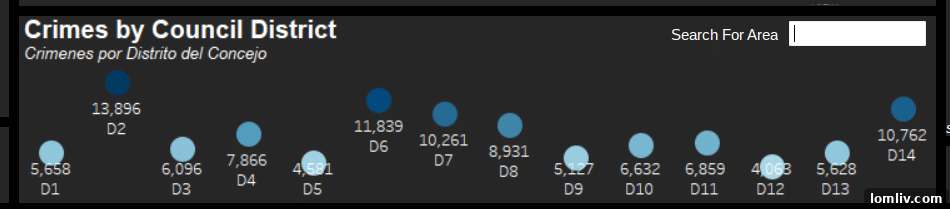
District 9 boasts one of Dallas’s lowest crime rates, ranking third lowest among the 14 council districts last year, surpassed only by Districts 5 and 12. This statistic, while reassuring on the surface, doesn’t tell the whole story for East Dallas residents. For community leaders like Thomas Buck, communication chair for the Lochwood Neighborhood Association, the focus extends beyond traditional crime figures to issues such as reckless driving and the implications of new, large-scale developments, like a proposed apartment complex on Garland Road, which promise an influx of new residents and increased traffic congestion.
Understanding Crime Trends in Dallas City Council District 9
While District 9 maintains a reputation for being relatively safe, crime is not an unfamiliar presence. Many neighborhoods, including Lochwood, frequently grapple with a range of noise and nuisance issues. These disruptive incidents, though often considered minor, are indeed crimes but rarely elicit a swift police response, leading to frustration among residents.
Dallas Police Chief Eddie Garcia has made the reduction of violent crime a top priority, a strategy widely supported by both the City Council and the majority of Dallas residents. However, the Dallas Police Department (DPD) faces significant hurdles in achieving this goal, primarily due to a severe shortage of patrol officers. With over 500 officer vacancies, largely attributed to a staggering $3 billion unfunded liability in the police pension fund, the department struggles to recruit and retain the personnel needed to effectively police the city.
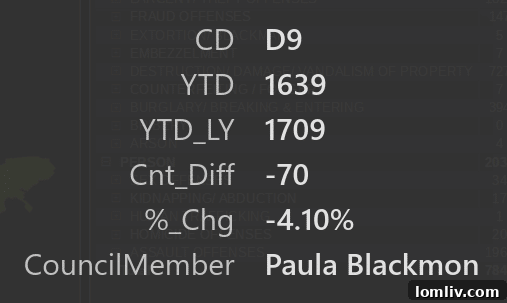
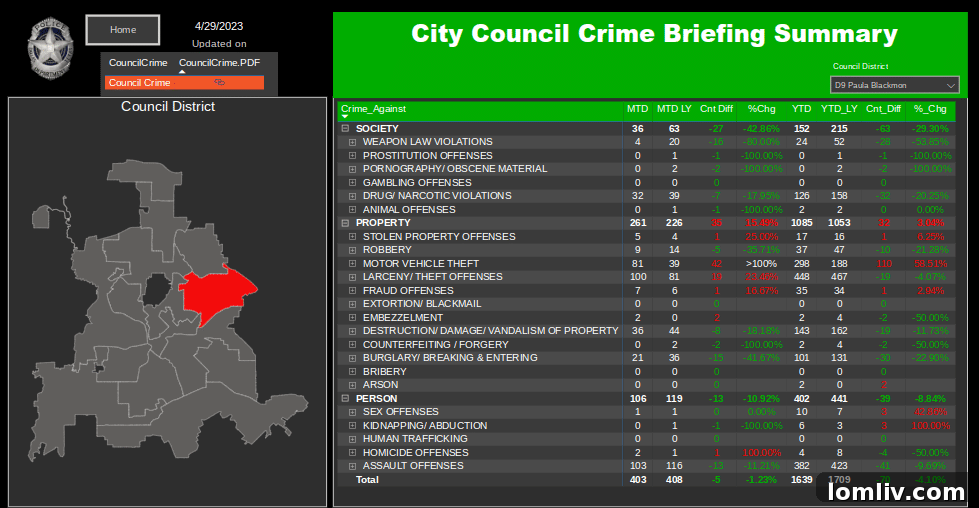
According to the latest data from the Dallas Police Department crime dashboard, District 9 saw an overall decrease in crime of 4.15 percent compared to the previous year. This positive trend is nuanced, however, by specific crime categories. Property crimes experienced a slight increase of 3.64 percent, and vehicle theft notably surged by 58 percent. Despite these increases, several other areas reported significant decreases, with crimes against persons—encompassing serious offenses such as sex offenses, kidnapping, human trafficking, homicide, and assault—declining by almost 9 percent.
These statistics, while providing a broad overview, don’t fully capture the daily anxieties of residents. Thomas Buck expressed a growing concern within the community, noting, “There has been a growing undercurrent of illegal incidents happening in our area ever since COVID that has many residents concerned and on edge.” He attributes this rise, in part, to a weakened police presence, describing a sense that certain individuals engage in “loud and proud” acts of defiance. “It feels there has been a calculated effort to make people feel uneasy by way of noise — whether it be drag racing, celebratory gunshots, doing doughnuts during parking lot takeovers, et cetera. It seems to be a ‘loud and proud’ act of defiance to be heard. I think they enjoy causing this type of mayhem and realize the odds are no consequence will come from it,” Buck shared with daltxrealestate.com. He further cautioned that such actions could escalate into more threatening and violent behavior over time.
The DPD’s staffing crisis is a deepening concern for residents. Buck highlighted the alarming statistic that “27 percent of the 3,000 DPD workforce are eligible for retirement,” amounting to over 800 officers. “This is extremely concerning as the city keeps increasing in population,” he added, underscoring the potential for the police force to shrink even further as Dallas continues its rapid growth. Efforts to address these concerns often involve community liaisons; however, attempts to reach Dallas Police Sgt. Sammie Robinson, who oversees neighborhood patrol for the area, for comment by the article’s deadline were unsuccessful.
The Standard Shoreline Project: A Case Study in Dallas Development
The proposed Standard Shoreline project ignited significant public debate, becoming Dallas’s inaugural Public Facility Corporation (PFC) project to garner widespread media attention. Initially, many residents and stakeholders were unfamiliar with the intricacies of this particular financing structure. Under a PFC model, a developer enters into a 75-year land lease agreement with the Dallas PFC, a corporation appointed by the City Council. In exchange for this long-term lease, the property is removed from the city’s tax rolls. The developer’s commitment, in return, is to designate at least half of the units as affordable housing.
In the specific instance of the Standard Shoreline, the property in question had historically operated as a church, meaning it was not previously contributing property tax revenue to the city’s general fund. This aspect often becomes a point of contention in PFC discussions, as proponents argue that the city isn’t losing existing tax revenue, while critics question the long-term implications of removing potentially taxable properties from the rolls for decades.

Lochwood residents voiced numerous concerns regarding the Standard Shoreline development. Particular apprehension centered on the proposed 59-foot height of the buildings and the substantial increase in residents and vehicles it would introduce to Garland Road, an already congested state highway. Ojala Holdings’ proposal includes 18 two-story townhomes alongside a four-story multi-family complex. While developers committed to implementing buffering and landscaping solutions, neighbors expressed dismay that some units would still offer direct views into their backyards, raising significant privacy concerns. Despite these local objections, the Dallas City Council unanimously approved the project in November. Curiously, neighbors report that the church still occupies the building, and there appears to be no visible progress on the construction of the new apartment complex, leaving many questions unanswered.
Navigating the Garland Road Corridor: Traffic, Safety, and Infrastructure
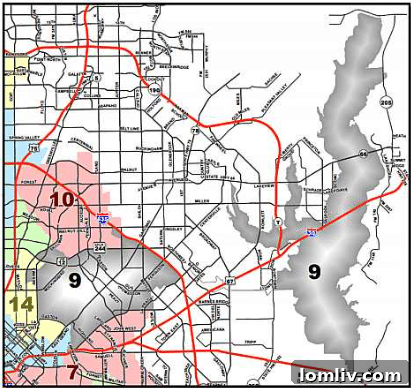
Garland Road is notorious for frequent vehicle accidents, making traffic safety a critical issue for District 9. Councilwoman Paula Blackmon, currently seeking re-election against challenger Kendra Madison on May 6, has publicly committed to addressing these infrastructure and traffic-calming challenges. The upcoming redistricting map, set to take effect soon and updated every decade based on U.S. Census data, will shift District 9’s boundaries westward towards U.S. 75, ensuring each council district serves approximately 91,000 residents and potentially altering the focus of infrastructure efforts.
Following a series of deadly vehicle accidents on Garland Road last month, community engagement has intensified. Betty Dunagan, president of the White Rock Lake Task Force, confirmed in an April 17 email to members that the task force is actively collaborating with city leaders to mitigate car crashes in the area. Dunagan shared that Councilwoman Blackmon swiftly engaged with the task force, informing them of upcoming research into adding protective measures along Garland Road between East Lawther Drive and the White Rock Lake Spillway. These measures aim to enhance pedestrian safety along this section of the trail, which runs perilously close to the highway.
Thomas Buck pointed out that traffic accidents, even fatal ones, are not always categorized as crimes and therefore might not be reflected in standard crime statistics. Nevertheless, he emphasized that road conditions, signalization, and vehicle counts are undeniably critical public safety matters. He proposed several solutions: “Having more of a police presence would logically cause drivers to slow down. I’ve seen more police officers on motorcycles in our area. I hope that continues. Suggestions of adding more stop signs and/or traffic lights would help control speeding a bit.”
Buck also advocated for more transformative urban planning, suggesting that “Streetscape and Pedestrian Improvement Bonds” could be utilized to redesign major arteries. Reducing lanes, for instance, could convert thoroughfares like Jupiter Road into safer, more connected, and functional streets, improving overall mobility and accessibility. He vividly described the local perception of Jupiter Road as “Jupiter Speedway,” noting that installed rumble strips are an ineffective deterrent and speed radar stations do little to control drivers determined to speed. “More lanes add to the allure to go faster. Expecting drivers to go 35 mph on a three-lane road is unrealistic anyway, especially when it bisects Northwest Highway and Garland Road,” he argued, highlighting the need for designs that inherently encourage safer driving.
The debate around the Standard Shoreline project also extends to broader discussions about affordable housing and its integration into established communities. When mixed-income or affordable housing developments are proposed near existing neighborhoods, residents who voice concerns are sometimes unfairly accused of opposing proximity to lower-income individuals. This sentiment was evident in recent contentious debates, such as the proposed Cypress Creek at Forest Lane apartments in District 10.
Thomas Buck clarifies that the core issue for many residents is not the concept of affordable housing itself, but rather the specific implementation and potential unforeseen consequences. He raised a particularly prescient concern about illicit activities: “What’s going to be of great concern with me, involving crime and Shoreline apartments, is illegal apartment subletting.” He described this practice as a “more nefarious form of property management than [short-term rentals],” enabling individuals who would not pass standard background checks to reside in complexes. Buck noted a lack of public discussion on this issue, stating, “To my knowledge, no one is publicly talking about it, because like me, no one has considered how much it contributes to illegal and/or criminal acts. And, as Dallas continues to grow in population and lead the nation in new apartment builds, it’s only logical to assume the market for illegal subletting will grow as well — especially in high-opportunity areas like ours.”
The Lochwood Neighborhood Association addressed the city’s broader affordable housing needs on its website during the Shoreline public hearings. The association articulated a nuanced perspective: “We completely understand the need to provide more affordable housing while densifying. However, we believe there are better, smarter housing solutions that should have been considered.” They highlighted a critical gap in Dallas’s development strategy, advocating for “Missing Middle Housing,” a type of development that hasn’t seen significant construction since the mid-20th century. The site elaborated, “Dallas has been so dominated with single-family and massive multifamily developments, and the struggle continues to create more compatible, transitional housing to fit in between them. Instead, this complex will be adding to the nation-leading 63,000-plus multifamily complexes that are being built in North Texas. Something needs to change with this equation.” This perspective underscores a desire for diverse housing options that blend seamlessly into existing communities, rather than projects that feel out of scale or character.
District 9 Election Campaign: Public Safety and Development as Key Issues
The upcoming District 9 election has brought public safety and thoughtful development to the forefront of the campaign discourse. Councilwoman Paula Blackmon has secured the coveted endorsement of the Dallas Police Association Political Action Committee, a significant indicator of support from law enforcement. Her campaign website prominently features her commitment to Chief Garcia’s agenda and her proactive efforts to bolster the DPD’s ranks. “Paula has heard from families all across East Dallas impacted by or worried about escalating violent and property crimes, and she continues to work hard to make public safety a top priority for our city,” her site states. It further highlights her voting record, noting, “That’s why Paula voted to add 500 more police officers in the last two city budgets, raise the minimum pay and salaries for Dallas’ first responders, and add 60 new civilian staffers for the 911 call center.”

Kendra Madison, a political newcomer, also outlines her priority issues and proposed solutions on her campaign website, offering a fresh perspective on District 9’s challenges:
- Community Support for Law Enforcement: Madison emphasizes a proactive approach to supporting police. “Backing the blue is an action,” she states. “It’s more than a sign in a front yard or a sticker on a bumper. Let’s bring neighborhood-based support for the officers that keep us safe.” This suggests a focus on tangible community engagement and resources for officers.
- Homelessness Intervention: Addressing a visible and growing concern, Madison highlights the impact of encampments. “We are seeing homeless encampments pop up in our backyards overnight (quite literally for some neighbors), and the noise, trash, and disruptions to quality of life within our community,” she explains. Her proposed solution centers on compassionate care and pathways to self-sufficiency: “Let’s look at ways to find compassionate care to get our unsheltered neighbors out of these encampments and onto paths of self-sufficiency.”
- Thoughtful Community Development: Madison advocates for resident involvement in shaping their neighborhoods. “No one wants to live in a blighted community,” she asserts. “Let’s continue to keep our neighborhoods looking their best by getting involved in development projects. We live here and have a say in how our community looks and feels.” This resonates with the community’s concerns about projects like Standard Shoreline, emphasizing local voices in development decisions.
In conclusion, Dallas City Council District 9 presents a compelling microcosm of urban challenges where low crime statistics don’t fully encompass the complexities of public safety, traffic management, and responsible urban development. Residents along the Garland Road corridor and near White Rock Lake, deeply rooted in their community, are actively seeking solutions that go beyond traditional crime metrics. Their concerns about insufficient police staffing, the impact of large-scale apartment developments like Standard Shoreline, and the dangers of a bustling Garland Road highlight a holistic view of public safety that includes quality of life, infrastructure, and community voice. As the District 9 election approaches, candidates Blackmon and Madison are tasked with addressing these multifaceted issues, reflecting the community’s desire for leadership that champions a safe, well-planned, and resident-focused future for East Dallas.