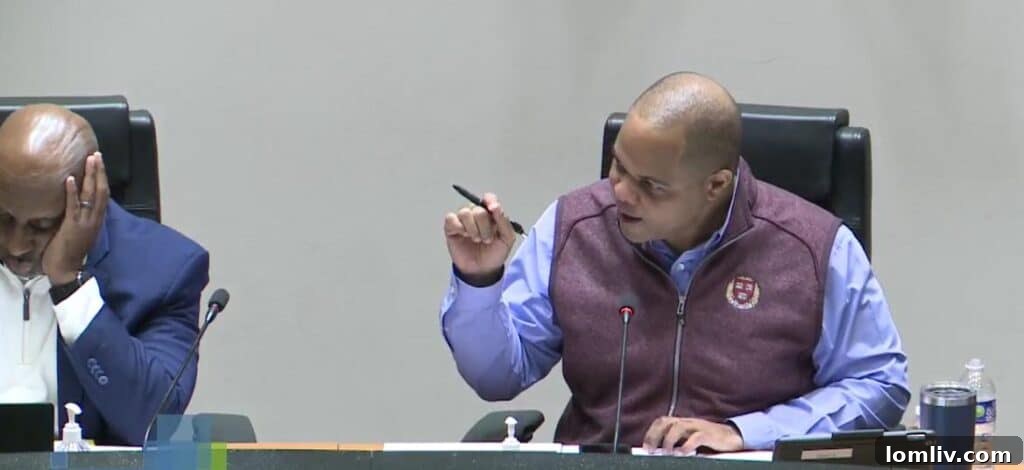
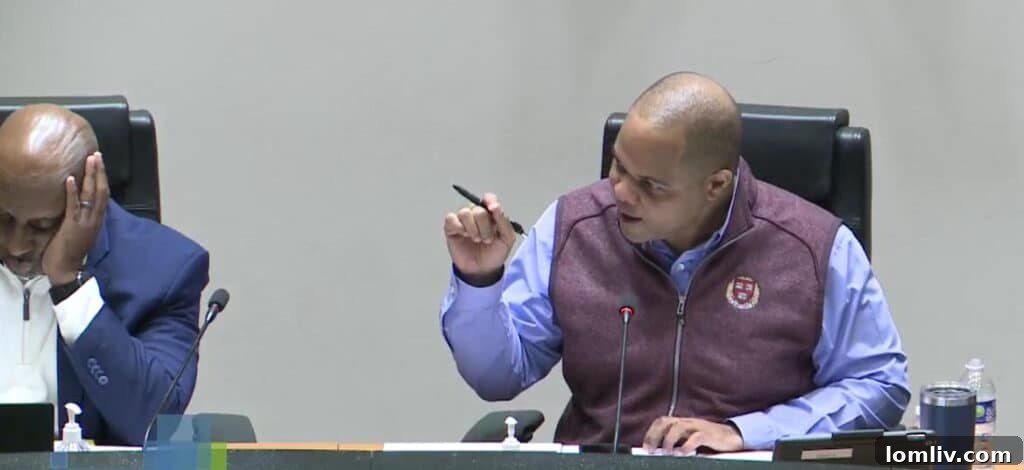
The highly anticipated 2024 Dallas bond propositions, set to appear on the May 4 ballot, have sparked considerable discussion and revealed varying priorities among city leaders and advocacy groups. While the initial framework of the bond package didn’t fully satisfy every stakeholder, a strategic allocation of a $75 million “discretionary fund” has introduced a crucial layer of flexibility. This fund grants $5 million to Mayor Eric Johnson and each council member, allowing them to direct these resources towards projects they deem most critical for their respective districts or the city at large. This means the informal allocations initially approved at a recent Dallas City Council meeting are not final and can still be augmented by these individual pledges.
This innovative approach to funding underscores the dynamic nature of urban development and governance, allowing for a more tailored response to diverse community needs. The ability for council members to allocate a significant sum independently provides an opportunity to address specific, pressing issues that might not have received sufficient attention in the broader bond package. This mechanism ensures that local insights and district-specific challenges can be directly addressed, fostering a greater sense of responsiveness from city leadership.
In the immediate aftermath of Wednesday’s special-called Dallas City Council briefing on the bond, District 12 Councilwoman Cara Mendelsohn was among the first to declare her intentions. She swiftly pledged her entire $5 million discretionary allocation to bolster parks and recreation initiatives across Dallas. This commitment highlights a strong emphasis on enhancing the city’s green spaces, which are vital for residents’ well-being, environmental sustainability, and community engagement. Her decision reflects a broader understanding of the importance of accessible and well-maintained public recreational facilities.
Following suit, Mayor Eric Johnson also filed a memorandum on Thursday, dedicating his $5 million discretionary fund entirely to Dallas parks. In his official memo, Mayor Johnson articulated his vision, stating, “I am confident this $5 million addition to the bond will help make Dallas greener and greater by providing improved access to quality, well-maintained recreational spaces across our city.” He further elaborated on his immediate plans, indicating that he intends to collaborate closely with members of the Dallas Park Board. This collaboration aims to pinpoint specific projects that were previously identified as top priorities by the Park and Recreation Department and validated by public input through the diligent work of the Community Bond Task Force. This collaborative approach ensures that the funds are directed towards initiatives with strong community backing and demonstrable impact, addressing areas of greatest need and potential benefit.
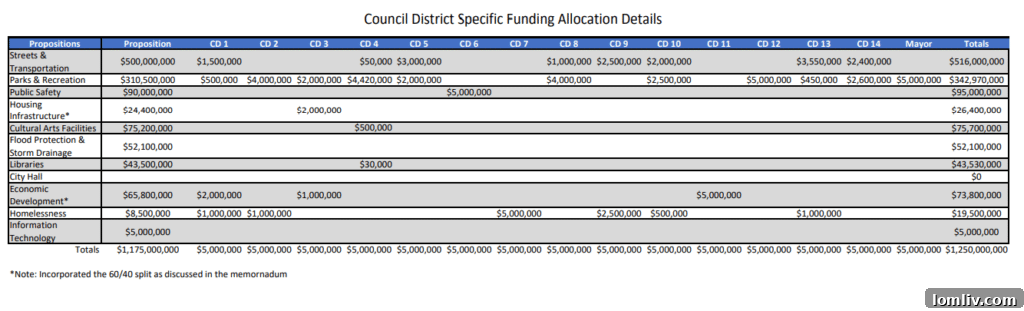
The full scope and distribution of these crucial council discretionary funds were meticulously documented and released Friday afternoon in a comprehensive memorandum from Assistant City Manager Robert Perez. This document provides transparency and clarity regarding how each council member’s allocation is shaping up. Further in-depth discussions and deliberations on this vital topic are slated for Wednesday’s upcoming Dallas City Council meeting, where more details and potentially additional commitments are expected to emerge. This ongoing dialogue is crucial for ensuring that the bond package truly reflects the diverse needs and aspirations of Dallas residents, striking a balance between city-wide priorities and district-specific requirements.
Dallas City Council Members Weigh In on Discretionary Bond Funds
The introduction of discretionary funds, while offering flexibility, was not without its critics. District 13 Councilwoman Gay Donnell Willis voiced her opposition to the amendment that created these council-directed funds. She argued that these allocations came at the expense of “critical need areas” or, in some cases, completely “zeroed out” funding for essential projects. Her concerns highlight the inherent tension between broad city-wide priorities and specific, often underfunded, infrastructure requirements.
In an interview with daltxrealestate.com, Councilwoman Willis articulated her rationale, stating, “I realize that some may figure the City can cover these items in the general fund budget; however, there are some big-ticket items that I think are more appropriate for a bond — such as fire suppression, HVAC, and generators for City Hall.” She pointed out that the bond allocations informally approved at the January 31 meeting notably omitted any provisions for much-needed upgrades at City Hall. This oversight is particularly concerning given that the city’s critical emergency 911 calls and non-emergency 311 call centers are based on-site. The functionality and resilience of these systems are paramount for public safety and city operations. Willis underscored the urgency, asserting, “We must ensure support for these critical public-facing functions of the City. We must also have a safe environment for the thousands who work on site.” Her argument emphasizes the long-term financial wisdom of addressing large-scale infrastructure needs through bond funding rather than deferring them, which often leads to higher costs and compromised services in the future.
Councilwoman Willis further expressed her strong disapproval of “raiding the homelessness line item” to create the discretionary fund. She emphasized that “City staff and this council have learned from the 2017 bond allocation better ways to deploy funds that can get into the marketplace more quickly.” This statement reflects a deeper understanding of the complexities involved in addressing homelessness and the need for agile, effective solutions. She advocated for innovative approaches, noting, “I just toured some successful ‘tiny home’ temporary housing models that I favor the City moving on quickly.” Her vision for tackling homelessness is clear and urgent: “We’ve got to stop treating our underpasses and streets as waiting rooms while outreach teams work to move this compromised population into stable permanent housing.” This impassioned plea highlights the humanitarian imperative and the economic efficiency of proactive, rapid rehousing strategies. Her stance resonates with a growing consensus that sustainable solutions require both compassionate care and efficient resource deployment.
Ultimately, Councilwoman Willis strategically allocated her discretionary funds with a strong focus on core infrastructure and social welfare. Her plan includes a significant $3.55 million directed towards streets, alleys, and sidewalks, recognizing the pervasive need for road improvements across Dallas. An additional $1 million was dedicated to addressing homelessness, reinforcing her commitment to this critical social issue. Finally, $450,000 was allocated to parks, balancing her district’s specific needs with the broader city-wide focus on green spaces. Explaining her substantial investment in transportation infrastructure, she remarked, “The amendment that we are currently operating under has a $500 million allocation for streets, which I was beyond vocal (some would say downright annoying) in getting back to as it had been proposed at $375 million by the 2024 Community Bond Task Force.” This persistent advocacy underscores the sheer scale of the challenge, as she revealed, “District 13 has $550 million in the streets/alleys needs inventory alone,” far exceeding the city’s overall allocation. This statistic powerfully illustrates the critical shortfall in funding for basic urban infrastructure, impacting daily life for countless residents.
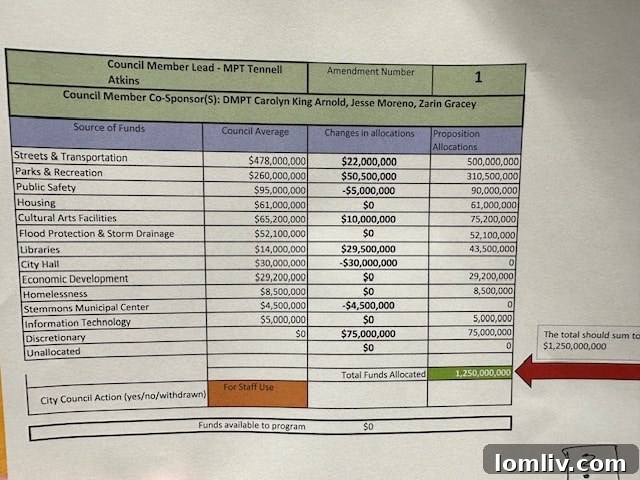
While the overall parks allocation for the bond package has been increased to an impressive $310 million—partially at the expense of other categories—Councilwoman Willis noted that a significant portion of this sum is earmarked for a few “signature projects.” This often means that individual districts, like D13, may not see as much direct representation or funding for their specific park needs. To address this disparity and ensure local park improvements, Willis explained, “As such, I’ve added some funds to help replace aging equipment that may still need some private funds to make happen.” This strategic allocation of her discretionary funds demonstrates a pragmatic approach to filling gaps in funding and leveraging resources to maximize impact for her constituents, ensuring that even smaller, but equally vital, park improvements are not overlooked.
District 1 Councilman Chad West adopted a more diversified approach to his discretionary fund allocation, distributing smaller amounts across several key funding categories. He pledged $2 million to economic development, recognizing its crucial role in fostering job growth and commercial vitality within his district and the city. An additional $1.5 million was designated for streets and traffic calming initiatives, aiming to improve road safety and flow for residents. He also allocated $1 million to address homelessness, aligning with the pressing need to support vulnerable populations. Finally, $500,000 was directed towards parks, contributing to the enhancement of public green spaces. Councilman West’s varied allocation reflects a holistic understanding of community needs, seeking to balance infrastructure improvements, economic growth, and social services within his district, acknowledging that a thriving urban environment requires investment across multiple sectors.
The process of finalizing these discretionary bond allocations remains ongoing. daltxrealestate.com has actively reached out to all Dallas City Council members to gather information regarding their individual pledges. As more details become available and council members formalize their commitments, this story will be updated to provide a comprehensive overview of how these critical funds are being distributed. This transparency is vital for the public to understand the priorities of their elected officials and how the bond package will ultimately serve the Dallas community.
The full $1.25 billion bond election is tentatively scheduled for May 4. This bond package represents a monumental investment in Dallas’s future, encompassing a wide array of projects from infrastructure improvements to quality-of-life enhancements. The ongoing discussions and the allocation of discretionary funds highlight the complex, yet essential, process of city planning and resource management. The outcome of the May 4 election will undoubtedly shape the landscape and livability of Dallas for years to come, making civic engagement and informed voting more crucial than ever.