

Navigating New Horizons: Tricia Quaid’s Innovative Approach to Landscape Design in Challenging Times
The early months of the COVID-19 pandemic cast a long shadow over global mobility, rendering travel for both business and leisure virtually impossible. For Tricia Quaid, an exceptionally talented and globally-minded landscape designer, this unprecedented period of isolation presented a profound challenge to her core creative process. Her professional journey, deeply intertwined with experiencing diverse cultures and landscapes worldwide, suddenly faced an unexpected and immediate halt.
“I am accustomed to extensive travel and have explored numerous corners of the globe. These rich experiences, I believe, have profoundly shaped my perspective, both personally and as a designer, broadening my understanding and stimulating my creativity,” Quaid explained. Constantly seeking fresh inspiration and confronted by the stringent limitations of quarantine, Quaid ingeniously pivoted her approach, choosing to embark on journeys closer to home, albeit virtually. This innovative adaptation led her to explore a series of virtual events, transforming her home into a gateway to distant lands.
Embracing Virtual Frontiers: A New Source of Design Inspiration
The advent of virtual exploration became a lifeline for creative professionals like Quaid. Instead of packing bags, she packed her schedule with online excursions. “I embraced the opportunity to participate in several virtual sightseeing lectures. One memorable evening, I embarked on a virtual tour of Jerusalem, journeying inside its ancient walls from the comfort of my living room,” she recounted. “On another occasion, I virtually transported myself to Barcelona, Spain. This comprehensive tour included the iconic Picasso Museum, the whimsical Gaudi Parks, and the awe-inspiring Sagrada Familia Cathedral. I had visited Barcelona physically many years ago, but I thoroughly enjoyed this renewed visit – with the added convenience of no luggage to pack, of course.”
While acknowledging the irreplaceable value of genuine cultural immersion, Quaid emphasizes the critical role virtual experiences played during an isolating period. “By no means can these virtual tours truly replicate the profound experience of physically engaging with a culture. However, they were instrumental in helping me feel connected to the larger world during a very lonely period of COVID isolation, fostering a sense of global community and continuous learning,” she added. This testament underscores the adaptability required to thrive, even when traditional sources of inspiration are inaccessible.
The Power of Digital Exploration for Designers
For designers, visual and cultural stimuli are paramount. Virtual tours, online seminars, and digital exhibitions offered a unique pathway to maintain a steady flow of creative input. They provided access to historical sites, world-renowned museums, and architectural marvels that would otherwise be out of reach. This shift highlighted the potential of technology to democratize access to global design trends and historical contexts, enabling designers to continue their professional development and seek inspiration without geographical constraints. Quaid’s experience exemplifies how virtual platforms became essential tools for fostering creativity and connection during a time of unprecedented global pause.
Connecting Through Discourse: The Dallas Architecture Forum
The journey of acquiring inspiration, particularly amidst a global pandemic, demanded not only creativity but also collaboration and shared dialogue. This vital theme was central to the Dallas Architecture Forum’s highly anticipated “Design Inspiration” panel discussion, held at 6:30 p.m. on March 1. This significant event brought together leading voices in architecture and design to explore how inspiration is cultivated and maintained in challenging environments.
The insightful discussion was expertly moderated by Ian Zapata, the distinguished design director at Gensler. The panel featured a stellar lineup of industry experts: Tricia Quaid herself, offering her unique perspective as a landscape designer; Daniel Gunn, a talented project designer from BOKA Powell; and the esteemed architect Cliff Welch. Held at the First Unitarian Church of Dallas, located at 4015 Normandy Ave., Dallas, TX 75205, the event was a cornerstone for the local design community. Importantly, the forum remained steadfast in its commitment to accessibility, making this enriching discussion free and open to the public, reinforcing its role as a vital hub for architectural discourse and professional growth.
Fostering Innovation Through Collective Wisdom
The Dallas Architecture Forum serves as a critical platform for designers, architects, and the public to engage with contemporary issues in the built environment. Panels like “Design Inspiration” are invaluable for stimulating new ideas, sharing best practices, and addressing industry challenges. The diverse perspectives offered by Quaid, Gunn, and Welch, under Zapata’s moderation, provided a rich tapestry of insights into how creativity is nurtured, sustained, and translated into tangible projects. Such events underscore the importance of community and intellectual exchange in driving innovation, especially in times of rapid change.
Adapting Workflows: Landscape Design in a Digital Age
While virtual events offered a vital source of inspiration, the practicalities of a hands-on profession like landscape design presented a distinct set of challenges. As Quaid’s line of work inherently involves the physical transformation of outdoor spaces, certain tasks simply couldn’t be accomplished from a home office, no matter how sophisticated the digital tools.
“We still cannot perform an installation, carry out garden enhancements, or manage maintenance remotely. These aspects of our work fundamentally require on-site presence,” Quaid candidly stated. However, necessity truly became the mother of invention. “Despite these limitations, we quickly adapted by conducting client meetings efficiently via Zoom. This allowed us to maintain crucial communication and project momentum without physical contact.”
The pandemic also catalyzed significant internal operational shifts. “Since the pandemic began, my lead designer transitioned to working from out of state, a move unrelated to COVID-19. However, this situation accelerated our adoption of advanced remote collaboration strategies,” Quaid explained. “We swiftly learned to operate seamlessly on a shared digital drive, which necessitated and resulted in a significantly tightened and more efficient design process.” This transition, born out of necessity, ultimately led to a more refined and robust workflow, demonstrating Quaid’s firm’s resilience and capacity for operational innovation.
Streamlining the Design Process for Enhanced Efficiency
The refinement of Quaid’s design process, driven by the need for remote collaboration, highlights a broader industry trend towards digital transformation. Leveraging shared drives, cloud-based design software, and virtual communication platforms allowed her firm to maintain high standards of client service and project delivery. This sharpened process not only improved internal efficiency but also enabled a more dynamic response to client needs, ensuring that even complex design projects could proceed with precision and clarity, irrespective of geographical distances.
A Testament to Innovation: The Orthofix Corporate Campus Project
That sharpened design process, forged in the crucible of pandemic-era challenges, culminated in a truly remarkable and innovative project. This endeavor beautifully incorporates the concept of a “palimpsest” – a rich, intricately layered meaning where past narratives inform present design, creating a profound depth of experience.
Quaid’s firm undertook its first major public space project for Orthofix, a prominent medical products company specializing in solutions that aid patient recovery after orthopedic surgery. The scope of the project involved a comprehensive upgrade of the corporate campus’s entrance garden – a space not only utilized by employees but also equipped with classrooms for training surgeons and medical professionals. This environment, therefore, needed to be not only aesthetically pleasing but also reflective of Orthofix’s mission of healing and innovation.
Designing for Wellness: The Orthofix Entrance Garden
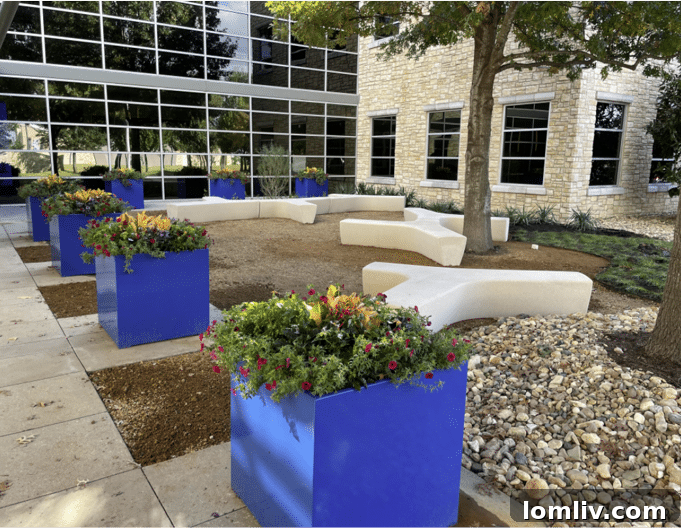
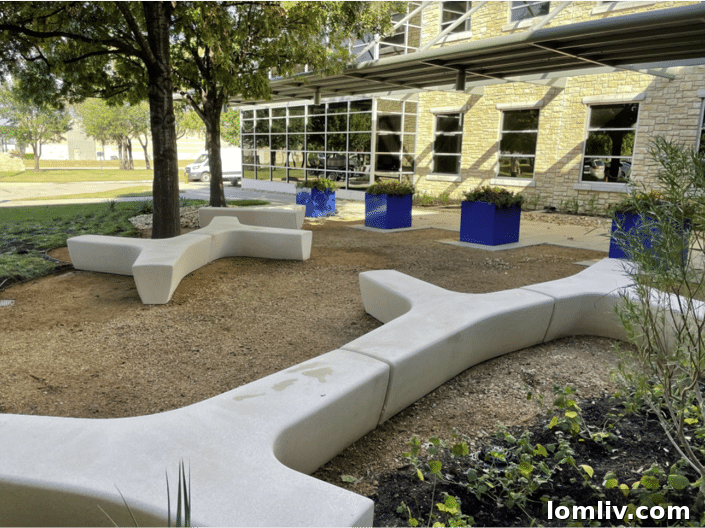
“The primary program directive was to elevate their entrance garden, transforming it into an aesthetically compelling and restorative space for both the doctors attending training and their dedicated employees,” Quaid detailed. The design meticulously integrated elements that resonated with Orthofix’s brand and purpose. “We utilized custom powder-coated steel containers, meticulously finished in the company’s signature blue logo color, creating a strong visual identity right at the entrance.”
Beyond brand integration, the design thoughtfully incorporated symbolic elements. “The Escofet benches, specifically chosen and integrated into the design, subtly replicate the organic, intricate look of bones,” Quaid revealed. This subtle yet powerful design choice perfectly encapsulated the essence of Orthofix’s mission in orthopedics, offering a sophisticated nod to healing and anatomical precision within a serene landscape. This careful layering of corporate identity, functional aesthetics, and symbolic resonance truly embodies the “palimpsest” concept, where every element contributes to a deeper narrative.
Overcoming Supply Chain Challenges: A Triumph of Resourcefulness
Bringing the vision of the Orthofix garden to life was not without its hurdles, particularly regarding the specialized Escofet benches. “Actually sourcing and installing these unique benches demanded considerable patience and ingenuity,” Quaid recalled. The benches, integral to the design’s thematic coherence, were not locally sourced but instead had to be shipped internationally. “These bespoke pieces were shipped directly from Spain, right in the midst of the ongoing pandemic, which introduced significant logistical complexities.”
Despite the global supply chain disruptions that plagued industries worldwide, Quaid’s team persevered. “They experienced a delay of a few weeks due to the unforeseen challenges of international shipping during that period. However, through diligent coordination and resourceful problem-solving, we managed to navigate these obstacles and successfully complete this ambitious project precisely on schedule,” she proudly stated. This accomplishment, in light of the severe worldwide supply chain issues prevalent at the time, stands as a testament to the firm’s unwavering commitment, meticulous planning, and exceptional resourcefulness – a true cause for celebration in the design and construction world.
The Enduring Legacy of Adaptability and Innovation
Tricia Quaid’s journey through the unprecedented challenges of the COVID-19 pandemic offers a compelling narrative of resilience, innovation, and an unwavering commitment to design excellence. From embracing virtual travel as a new wellspring of inspiration to pioneering remote collaboration techniques, her firm not only weathered the storm but emerged stronger and more efficient.
The Orthofix corporate campus project serves as a shining example of this adaptability, marrying a client’s mission with sophisticated design elements and overcoming significant logistical hurdles. It demonstrates that even in the most demanding circumstances, thoughtful design can create meaningful, aesthetically rich, and purposeful environments. Quaid’s experiences underscore the critical importance for designers to remain agile, continuously seek new sources of inspiration, and embrace technological advancements to push the boundaries of creativity and project delivery in an ever-evolving world.