

In a dynamic week for the U.S. and Texas real estate markets, a trio of significant developments reshaped the landscape for homeowners, buyers, and investors alike. The Federal Reserve initiated an emergency interest rate cut in response to emerging global economic headwinds, specifically the burgeoning coronavirus pandemic. Simultaneously, a new report highlighted Texas’s consistent position among states with the highest property tax burdens, a perennial concern for its residents. Amidst these changes, the Texas housing market continued its remarkable trajectory, concluding 2019 with record-breaking sales and sustained price appreciation. This comprehensive roundup delves into these critical real estate news stories, offering detailed insights into their immediate impacts and potential long-term implications for the market.
Federal Reserve Slashes Rates To Bolster Economy Amid Global Health Crisis
In a rare and dramatic move, the Federal Reserve undertook an emergency decision on March 3rd to significantly cut its benchmark lending rate by half a percentage point. This unscheduled action was a direct response to the escalating global threat posed by the rapidly spreading coronavirus, which had begun to exert palpable pressure on financial markets and threatened broader economic stability. The Fed’s proactive intervention aimed to inject confidence into a jittery economy and mitigate potential severe disruptions caused by the unfolding health crisis.
The Federal Open Market Committee (FOMC) stated its commitment to using its tools to support the economy, highlighting the evolving risks to economic activity. This emergency rate cut was the first of its kind since the 2008 financial crisis, signaling the gravity with which the central bank viewed the economic implications of the pandemic. Fed Chairman Jerome Powell addressed the press, acknowledging that the virus — which had already been identified in several Texas residents — would likely impact market activity “for some time.” This statement underscored the uncertainty facing businesses and consumers, prompting the Fed to act decisively to foster accommodative financial conditions.
The decision to lower the federal funds rate affects a wide array of financial products. For the real estate sector, one of the most immediate impacts is on mortgage rates. Lower benchmark rates typically translate to lower interest rates on home loans, potentially making homeownership more accessible and spurring refinancing activity. This could serve as a crucial lifeline for the housing market, providing a counter-cyclical boost just as other sectors began to face significant challenges. Experts noted that while the rate cut wouldn’t solve the health crisis, it would provide crucial liquidity and ease the financial burden on consumers and businesses.

Beyond mortgages, the rate cut influences consumer credit, such as auto loans and credit card rates, making borrowing generally cheaper. For businesses, lower borrowing costs can encourage investment and expansion, theoretically cushioning the economic downturn. However, the unique nature of the coronavirus shock, which simultaneously impacted supply chains and consumer demand, meant that monetary policy alone could not fully address the multifaceted challenges. Nonetheless, the Fed’s rapid response aimed to prevent a liquidity crunch and ensure that financial markets continued to function smoothly. The move also sent a strong signal of commitment to supporting economic growth, attempting to calm investor fears and prevent a more severe market sell-off.
Source: Bankrate
Texas Ranks Seventh In Nation For Highest Property Taxes
As tax season approached, many Americans anticipated potential returns from the Internal Revenue Service. However, for residents of certain states, any federal tax relief often pales in comparison to the substantial burden of their annual property tax bills. A comprehensive study conducted by the personal finance website WalletHub illuminated this disparity, revealing that Texas holds the unenviable distinction of ranking seventh among U.S. states with the highest real estate property taxes. This consistent ranking underscores a significant financial challenge for homeowners across the Lone Star State.
The WalletHub report analyzed effective property tax rates across all 50 states and the District of Columbia, taking into account median home values and the average amount of real estate taxes paid. Texas’s high ranking is largely attributable to its unique tax structure; unlike many other states, Texas does not levy a state income tax. To compensate for this, local governments — including counties, cities, and school districts — rely heavily on property taxes to fund essential public services such as education, infrastructure, police, and fire departments. This reliance translates into a higher tax burden for property owners compared to states with a more diversified tax base.

Leading the nation in property tax rates was New Jersey, followed closely by Illinois, New Hampshire, Connecticut, Wisconsin, and Vermont. These states, much like Texas, often face significant fiscal pressures and utilize property taxes as a primary revenue stream. WalletHub Communications Manager Diana Polk emphasized the widespread impact of these taxes, stating in a press release, “Each year, the average American household spends $2,375 on real-estate property taxes plus another $441 for residents of the 27 states with vehicle property taxes.” She further highlighted the scale of the issue by adding, “With such high costs, it’s no surprise that more than $14 billion in property taxes go unpaid each year, according to the National Tax Association.” This data points to the considerable financial strain property taxes place on households nationwide, with Texas homeowners feeling a particularly acute version of this pressure.
For Texans, the high property tax rates are a constant topic of discussion and a significant factor in housing affordability. While the state boasts a robust job market and relatively lower housing costs compared to coastal metros, the ongoing property tax burden can erode these advantages over time. This challenge is particularly acute for retirees and those on fixed incomes, who may find their ability to remain in their homes jeopardized by steadily increasing tax valuations. Efforts to reform property tax laws and provide relief to homeowners have been ongoing in the state legislature, reflecting the public’s demand for solutions. These reforms often involve homestead exemptions, caps on appraisal increases, and mechanisms to lower local tax rates, though finding a balance that adequately funds public services remains a complex task.
Source: WalletHub
Texas Housing Market Shattered Records In 2019, Signaling Robust Growth
Despite the looming economic uncertainties that would soon emerge globally, the Texas housing market closed out 2019 with a truly remarkable performance, shattering previous records and underscoring its resilience and attractiveness. The Dallas-Fort Worth-Arlington Metropolitan Statistical Area (MSA) served as a prime example of this statewide strength, experiencing a notable 3 percent increase in home sales last year. This surge brought the total number of single-family home sales in the DFW MSA to an impressive figure exceeding 103,000 units, demonstrating sustained buyer demand. Concurrently, the median price for homes within the local MSA rose by 3 percent, reaching $273,000 during the same period, indicating healthy appreciation in property values.
This stellar performance was not isolated to DFW but reflected a broader trend across the state. A comprehensive 78-page report issued by Texas Realtors meticulously detailed the 2019 year in real estate, offering invaluable insights into the market’s dynamics. The report highlighted several key drivers behind Texas’s exceptional growth: a robust job market, continuous population influx from other states and countries, and a relatively affordable cost of living compared to major coastal hubs. These factors fueled consistent demand for housing, leading to competitive market conditions and steady price gains.
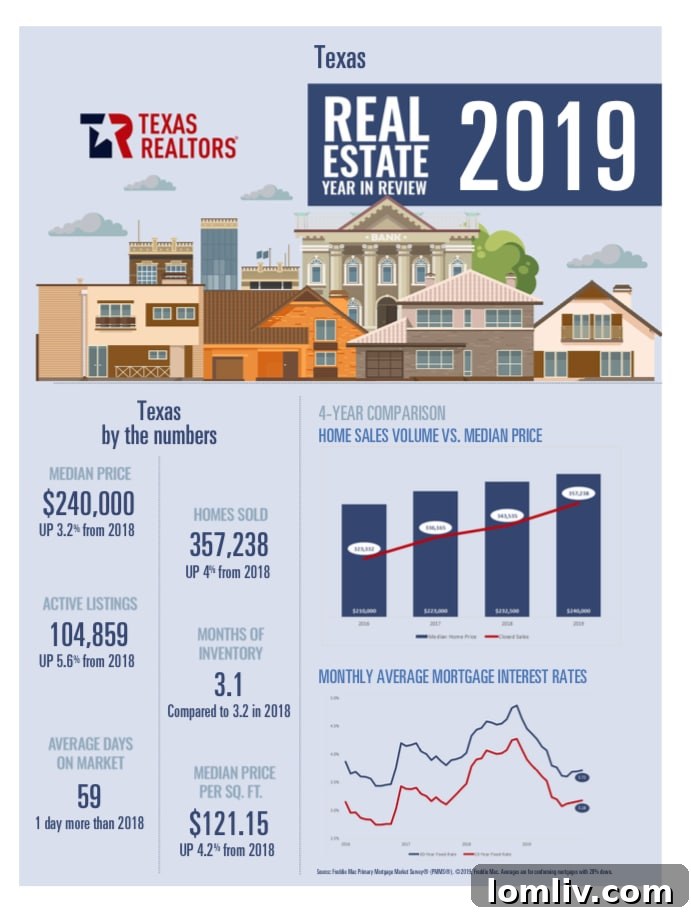
Cindi Bulla, the 2020 chairman of Texas Realtors, succinctly captured the sentiment in a press release: “There is no doubt that the Texas housing market continues to shine, as detailed in this report boasting sustained demand and price appreciation.” Her statement affirmed the state’s position as a national leader in real estate activity. However, Bulla also wisely pointed to an emerging challenge that began to take root even amidst the boom: affordability. She noted, “However, two out of every three homes being sold are now more than $200,000, which puts homeownership out of reach for many Texans.” This observation underscored a growing concern that rising prices, while beneficial for sellers and existing homeowners, were beginning to marginalize a significant segment of potential buyers.
The continued challenge of affordability has become a top priority for Texas Realtors and policymakers alike. As Bulla articulated, “The continued challenge is a top priority of Texas Realtors, as affordability needs to be addressed before it becomes a crisis.” This proactive stance recognized that while demand remained strong, a widening gap between housing costs and median incomes could eventually stifle the market’s growth and impact the state’s economic vitality. Addressing this issue involves a multi-pronged approach, including advocating for policies that encourage the development of diverse housing types, promoting responsible land-use planning, and exploring innovative solutions to enhance access to affordable financing.
Beyond sales and median prices, the 2019 report also likely highlighted other vital metrics such as declining inventory levels, shortened days on market, and the continued migration of businesses and individuals to major Texas metropolitan areas like Austin, Houston, and San Antonio, which also experienced strong housing market performances. The overall picture painted by the 2019 data was one of robust health and enduring appeal, setting a strong foundation for the year to come, albeit with the nascent warning signs of an affordability crunch that would only intensify with time.
Source: 2019 Texas Real Estate Year in Review report by Texas Realtors