

Millennial Homebuyers: Navigating the Market in Austin, Dallas, and Emerging Hubs
The dream of owning a home remains a powerful aspiration, yet for countless millennials, it often feels like a distant goal. As the housing market evolves, a critical question surfaces: where are all the first-time homebuyers? Many find themselves navigating a complex landscape defined by intensely competitive rental markets, relentless increases in property values, and a unique set of financial hurdles. This generation, brimming with potential and approaching their prime earning years, stands at a pivotal juncture in their homeownership journey. Identifying the markets that offer the best value and long-term prospects for these aspiring homeowners is more crucial than ever. Recent analyses suggest that while cities like San Antonio and Houston might present initial affordability, the most robust long-term opportunities for millennials could well be found in dynamic growth centers such as Austin and Dallas.
The Millennial Homeownership Puzzle: Challenges and Undeniable Aspirations
Despite popular narratives often painting millennials as preferring transient urban lifestyles and perpetual renting, the desire for stability, community, and homeownership is, in fact, incredibly strong within this demographic. However, millennials have contended with a distinct array of economic challenges that have significantly deferred their entry into the housing market compared to previous generations. Data from the National Association of Realtors (NAR) starkly illustrates this shift, revealing that homeownership rates for adults under 35, which peaked at 43 percent in 2005, have since declined to a challenging 36 percent. This downturn is not attributable to a lack of ambition, but rather to a potent combination of economic forces.
Overcoming Financial Headwinds: Student Debt, Stagnant Wages, and Soaring Costs
One of the most significant barriers confronting millennial homebuyers is the pervasive weight of student loan debt. Millions of graduates are encumbered with substantial loan balances, which directly impede their ability to accumulate a sufficient down payment, secure favorable mortgage terms, and maintain healthy debt-to-income ratios. This financial strain is exacerbated by a period characterized by relatively flat wage growth across numerous sectors. Consequently, as the cost of living and housing prices continue their upward trajectory, average incomes have struggled to keep pace. As NAR chief economist Lawrence Yun articulately notes, “Limited job prospects, student debt, and flat wage growth have combined with tight credit conditions and low inventory to price Millennials out of some of the top cities such as New York and San Francisco.”
Beyond individual financial struggles, broader market dynamics introduce further layers of complexity. The rental market, particularly in highly desirable urban locales, is fiercely competitive. Skyrocketing rents make it exceptionally difficult for individuals and couples to save the substantial sums required for a down payment. This creates a challenging and often frustrating cycle: exorbitant rents deplete savings potential, and without adequate savings, the dream of homeownership remains perpetually out of reach. Furthermore, a persistent shortage of homes available for sale, particularly within entry-level price brackets, means that when properties do emerge onto the market, they frequently incite bidding wars, driving prices even higher and compelling first-time buyers to remain on the sidelines.
Unlocking Potential: Why Millennials are Pivotal for the Housing Market’s Future
Despite these daunting challenges, the millennial generation embodies an enormous, largely untapped potential for the real estate market. As the largest living adult generation, their sheer numerical strength signifies an impending wave of future homebuyers. Many millennials are now entering their prime earning years, establishing families, and actively seeking the stability, equity-building opportunities, and sense of community that homeownership inherently offers. NAR President Steve Brown eloquently captures this evolving sentiment, observing, “Millennials will eventually settle down, trade their roommates for spouses and want to raise a family. As long as median income continues to support purchasing power in most areas, the demand and opportunity will be there for Millennials to purchase their first home with guidance and insights from a Realtor.”
This profound demographic shift dictates that understanding and effectively catering to the unique needs and preferences of millennials will be absolutely paramount for the future of the housing industry. As the broader economy gradually strengthens and more millennials achieve greater financial stability, their collective entry into the homeownership market is poised to not only stimulate local economies but also to sustain demand for real estate for many years to come. The critical question then becomes: which markets are best positioned to welcome and empower this vital segment of aspiring homeowners?
Texas on the Horizon: Austin & Dallas Lead the Charge for Savvy Millennial Homebuyers
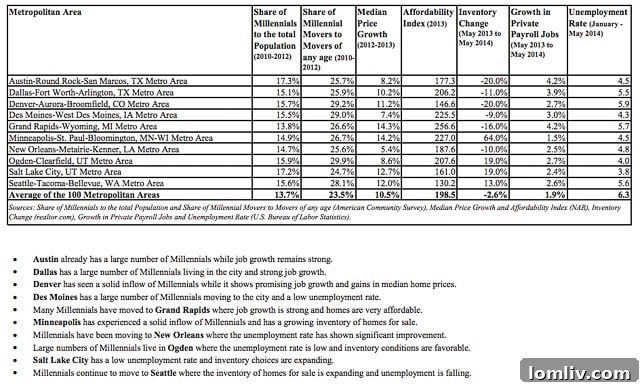
While the undeniable allure of established, high-profile cities often exerts a strong pull, comprehensive NAR research suggests that the most promising and sustainable opportunities for millennial first-time homebuyers frequently reside in burgeoning metro areas. These cities offer a compelling combination of robust job growth, dynamic population trends, and comparatively more attainable housing markets. Specifically focusing on 100 metro areas characterized by a substantial millennial presence, NAR identified specific regions poised for a significant surge in first-time buyers as economic conditions continue to improve. Within the rapidly expanding landscape of Texas, Austin and Dallas have emerged as particularly standout contenders, positioning themselves as potentially superior long-term values when compared to their counterparts, San Antonio and Houston.
Austin and Dallas: Magnets for Economic Opportunity and Sustainable Growth
What precisely makes Austin and Dallas so exceptionally attractive to the millennial demographic? The answer lies fundamentally in their vibrant, diversified economies and their forward-thinking urban development strategies. Both cities consistently boast impressive job creation rates, fueled by thriving tech sectors, a rich tapestry of diverse industries, and significant corporate relocations. Austin, frequently celebrated as “Silicon Hills,” continues to draw tech giants and innovative startups, offering a plethora of high-paying jobs that, while competitive, provide a much stronger financial foundation for aspiring homeowners. Dallas, a colossal economic hub, benefits from an extensively diversified economy encompassing finance, logistics, advanced technology, healthcare, and corporate headquarters, thereby generating a broad spectrum of robust employment opportunities.
Beyond the job market, the sustained positive population trends in these cities are clear indicators of continuous growth and a steady influx of young professionals. This demographic buoyancy translates directly into dynamic communities, rich and diverse cultural scenes, and ongoing, substantial investment in critical infrastructure and appealing amenities – all of which are factors highly valued by the millennial generation. While housing prices in Austin, particularly, have experienced considerable appreciation, when viewed in relation to major coastal megacities like New York or San Francisco, they still offer a comparatively better entry point for those with strong and growing income prospects. Dallas presents a similar, often slightly more affordable, housing landscape with an eclectic range of housing options, from trendy urban lofts to spacious suburban family homes.
Contrasting San Antonio and Houston: Perceived Value vs. Long-Term Potential
It is important to acknowledge that other reputable analyses, such as those conducted by Trulia, have indeed highlighted San Antonio and Houston as “hot markets” for millennials. And for good reason: these cities often feature lower median home prices, which can make the initial step into homeownership appear more immediately accessible. San Antonio, with its rich historical tapestry, burgeoning tourism sector, and expanding cybersecurity industry, and Houston, a global energy powerhouse with a vast and incredibly varied economy, certainly offer compelling reasons for individuals and families to relocate.
However, NAR’s distinctive perspective, which places a strong emphasis on sustained job creation and favorable population trends as crucial indicators of *long-term value* and *enduring homeownership potential*, suggests a more nuanced understanding is warranted. While the sheer affordability in San Antonio and Houston might indeed be a significant immediate draw, the rate of wage growth and the overall quality of job prospects, particularly those that can comfortably support a future mortgage burden and lifestyle, may not quite match the upward trajectory and depth observed in Austin and Dallas. For discerning first-time buyers who are looking beyond just the initial purchase price and are carefully considering career progression, investment potential, and sustained economic stability over the long haul, the burgeoning northern Texas metros might ultimately present a more robust and rewarding proposition.
Beyond Texas: Promising Emerging Markets in the Midwest and West
While the vibrant Texas cities offer compelling narratives for millennial homebuyers, NAR’s insightful analysis also extends to a broader, significant trend: the increasing attractiveness of various markets throughout the Midwest and other strategic parts of the West. These regions frequently present a more balanced and appealing equation of affordability, robust job growth, and a high quality of life when compared to the hyper-competitive and often prohibitively expensive coastal giants. Cities nestled within the Midwest, for example, commonly boast significantly lower median home prices, rendering the dream of accumulating a sufficient down payment far more achievable for many. Coupled with revitalized urban cores, burgeoning tech or advanced manufacturing sectors, and a generally lower cost of living, these areas are rapidly solidifying their status as increasingly viable and desirable options for millennials eager to establish long-term roots and build equity.
The inherent appeal of these emerging markets lies in their unique ability to offer a “sweet spot” – providing excellent job prospects without the burden of extreme housing costs that characterize so many other major metropolitan areas. As millennials continue to prioritize financial stability, a strong sense of community, and an attainable lifestyle, these specific regions are highly likely to experience sustained interest and considerable growth within their crucial first-time buyer segments. This geographical diversification emphatically underscores a broader, discernible trend: millennials are increasingly willing and able to relocate strategically to find that optimal balance between economic opportunity and genuine housing affordability.
A Strategic Roadmap for Aspiring Millennial Homebuyers
For millennials who are diligently preparing to make the significant leap into homeownership, strategic and informed planning is absolutely paramount. While external market conditions and crucial geographical considerations are undeniably vital, individual personal financial preparedness remains the cornerstone of success. Here is a comprehensive roadmap to help navigate this rewarding, yet often challenging, journey:
1. Prioritize Holistic Financial Health and Consistent Savings
The most fundamental and impactful step is to meticulously build and maintain a strong financial foundation. This entails diligently saving for both a substantial down payment and the associated closing costs. Explore a variety of effective savings strategies, ranging from implementing automated transfers into dedicated savings accounts to exploring viable side hustles to augment your income. Concurrently, make a concerted effort to improve your credit score; a higher score can significantly unlock better mortgage rates and more favorable loan terms. Proactively addressing student loan debt through careful budgeting, exploring income-driven repayment plans, or even considering refinancing can also dramatically improve your debt-to-income ratio, positioning you as a more attractive and reliable borrower.
2. Develop a Deep Understanding of Your Local Market
Regardless of whether your target market is Austin, Dallas, or an emerging hub in the Midwest, conducting in-depth, meticulous market research is absolutely crucial. Strive to understand local price trends, current inventory levels, and precisely how competitive the buying landscape truly is. Maintain an open mind regarding different types of properties – condominiums and townhouses frequently offer a more accessible entry point into homeownership than single-family homes, especially in hotter, more competitive markets. Also, consider properties that might require some cosmetic updates or minor renovations, as these can sometimes be acquired at a lower initial price, allowing you to build valuable equity through strategic “sweat equity” and smart improvements.
3. Effectively Leverage First-Time Buyer Programs and Assistance
A multitude of government-backed and local programs are specifically designed and implemented to assist first-time homebuyers. FHA loans, for instance, allow for significantly lower down payments and often feature more flexible credit requirements. VA loans provide exceptional benefits and favorable terms for eligible military veterans. Additionally, numerous states and local municipalities offer valuable down payment assistance programs, grants, or advantageous loan terms for those who meet specific criteria. A knowledgeable and experienced real estate agent or mortgage lender can provide invaluable guidance in navigating these diverse options.
4. Forge a Partnership with a Trusted Real Estate Professional
As NAR President Steve Brown cogently emphasized, the expert guidance of a professional Realtor is truly invaluable. A skilled real estate agent can proficiently help you navigate the often-complex market conditions, meticulously identify properties that precisely match your budget and unique needs, effectively negotiate on your behalf, and seamlessly connect you with other essential professionals such as reputable lenders, qualified inspectors, and certified appraisers. Their extensive expertise can ultimately save you considerable time, precious money, and undue stress, particularly within a competitive and dynamic market environment.
The Future is Promising for Millennial Homeownership
The journey to homeownership for millennials is undeniably challenging, marked by a unique confluence of economic hurdles that previous generations did not confront to the same degree. Yet, the deep-seated desire for a place to truly call their own, to diligently build equity, and to firmly establish roots for their families remains incredibly potent and unwavering. As global economic conditions continue their gradual evolution and as this powerful demographic enters its peak earning and family-forming years, the demand for housing will undoubtedly experience significant growth. Markets like Austin and Dallas, with their vibrant, dynamic economies and forward-looking growth strategies, are exceptionally well-positioned to capitalize on this profound trend, offering tangible value and abundant opportunities for a new and ambitious generation of homeowners.
The question of where first-time millennial homebuyers will ultimately land is being answered on a daily basis as individuals make strategic, informed choices grounded in a careful consideration of economic opportunity, housing affordability, and an overall high quality of life. The real estate landscape is undeniably shifting, and with diligent planning, informed decision-making, and strategic guidance, the cherished dream of homeownership is becoming an increasingly attainable and exciting reality for many more millennials across the nation. What are your informed thoughts on the most effective strategies and ideal locations for this absolutely crucial generation of future homeowners?