Step back in time to the Dallas of yesteryear, a city continually evolving yet deeply rooted in its captivating past. On this first day of 2023, let’s embark on a nostalgic journey, peeling back the layers of modernity to reveal the historical tapestry of Dallas’s most cherished neighborhoods. Imagine a bustling Greenville Avenue echoing with the gentle clip-clop of horse-drawn carriages, or a tranquil Japanese pagoda in Oak Cliff, serenely accessible only by a charming footbridge. Picture a distinctive Dallas community where the raucous calls of beloved peacocks define the neighborhood’s unique character. These are just glimpses into the rich heritage that shaped the diverse and vibrant communities we know today. Through the years, daltxrealestate.com has meticulously chronicled the fascinating origins and enduring legacies of these iconic Dallas enclaves, offering a timeless perspective on how these areas came to be, and what makes them truly special. From meticulously planned developments to charming natural havens, each neighborhood tells a story of ambition, innovation, and community spirit.
Exploring Dallas’s Enduring Neighborhoods: A Historical Perspective
Dallas is a city built on stories, and its neighborhoods are living archives of these tales. Each pocket of Dallas possesses a unique DNA, a blend of historical context, architectural charm, and community spirit that sets it apart. Understanding these origins not only enriches our appreciation for these areas but also provides valuable insights into the city’s growth and development. From the visionary planning of early developers to the preservation efforts of modern residents, these neighborhoods continue to thrive, maintaining their distinct identities while embracing the future. Join us as we delve deeper into the captivating histories of some of Dallas’s most beloved districts, revealing the hidden gems and unforgettable narratives that make each one a cornerstone of our city’s heritage.
Beckley Club Estates: Where History and Peacocks Roam Free
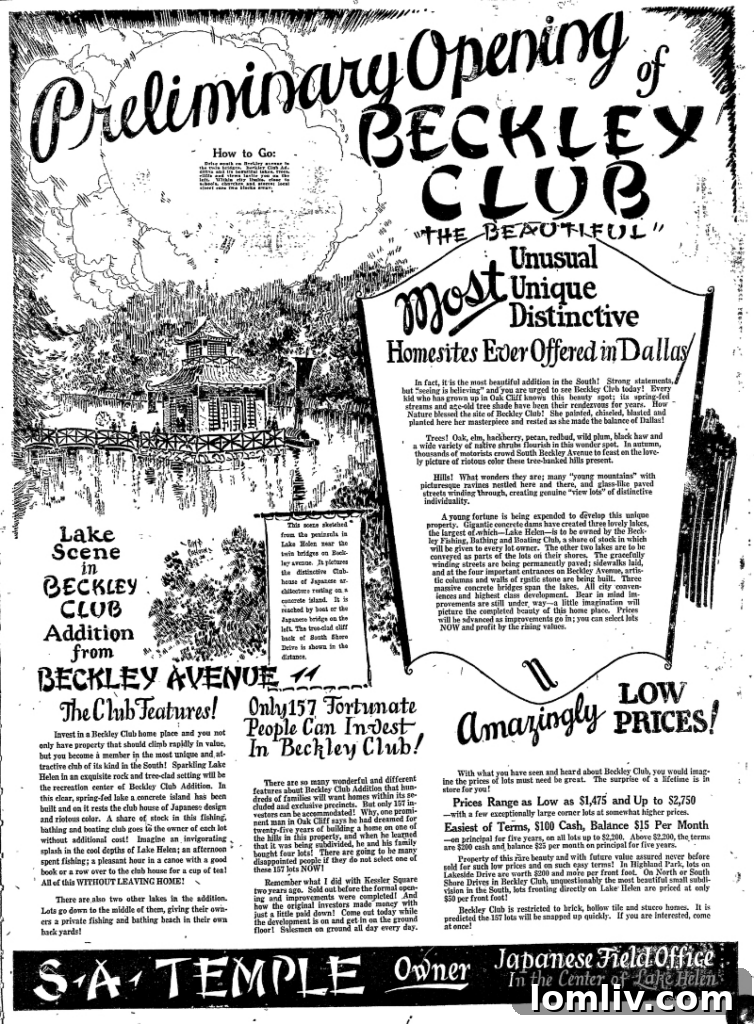
Nestled in the picturesque shadow of the Dallas Zoo, near the bustling intersection of Beckley and Illinois avenues, lies the enchanting Beckley Club Estates. This historic neighborhood, established in 1925, is a vibrant mosaic of eclectic 1920s bungalows, winding roads, and the nostalgic remnants of a grander past, including one-lane bridges that once spanned three serene small lakes. Its foundation was laid by Sydney A. Temple, the forward-thinking President of the Dallas Trust and Savings Bank, who envisioned a community unlike any other. Beckley Club Estates was designed with absolutely outstanding features for its era: three beautiful rock-bank lakes fed by the nearby Cedar Creek, meticulously paved streets shaded by premium trees, and the exclusive Beckley Fishing, Bathing and Boating Club. All residents were not just homeowners but also shareholders, receiving a share of stock and membership to this esteemed club, fostering an unparalleled sense of community and leisure.
The allure of Beckley Club Estates was undeniable, with lots ranging from 50 to 100 feet in width, priced between $1,475 and $2,750—a significant investment at the time. To complete a purchase, prospective buyers would embark on a charming journey, crossing a footbridge over Lake Helen to reach a unique Japanese pagoda, as depicted in vintage photographs. However, what truly sets Beckley Club Estates apart today, and has for decades, is its spirited community of free-roaming peacocks. These magnificent, noisy, yet utterly beloved birds have become synonymous with the neighborhood’s identity. In 2015, their unique presence garnered international media coverage when one of the oldest and most flamboyant peacock males, celebrated for his extraordinarily long tail feathers, was stolen and later triumphantly returned, cementing their status as cherished local icons. These feathered residents add an eccentric charm, reminding everyone of the neighborhood’s wild and wonderful spirit, making Beckley Club Estates a truly one-of-a-kind place to call home.
Discover more about the fascinating origins of Beckley Club Estates and the captivating story behind its famous peacocks.
Bob O’Link Drive in Lakewood: A Nod to Dallas’s Golfing Past
Among the charming, tree-lined streets of Dallas’s historic Lakewood neighborhood, few names capture the imagination quite like Bob O’Link Drive. For decades, newcomers and visitors have pondered the enigmatic figure behind this distinct street name. Was Bob O’ Link a Dallas luminary, perhaps a distinguished gentleman named Robert, fondly known as Bob to his friends? The answer, as many longtime Lakewood residents will attest, is far more intriguing and deeply rooted in the area’s recreational history. Generations of Lakewood families knew “O’ Link” intimately from 1924 until 1971, not as a person, but as a beloved neighborhood fixture that brought both joy and, at times, a touch of frustration—the challenging fairways of a golf course.
Indeed, Bob O’Link Drive was not named for a man, but for the now-bygone Bob O’Links Golf Course. This popular public neighborhood course was a significant recreational hub, built on a substantial portion of the McCommas family’s sprawling 600-acre estate, stretching majestically from Abrams Road all the way to the scenic White Rock Lake. For nearly half a century, the Bob O’Links Golf Course served as a gathering place for locals, a testament to Lakewood’s early development as a community focused on leisure and quality of life. Its sprawling greens and challenging holes were a central part of the neighborhood’s identity. When the golf course eventually gave way to further residential development in 1971, the community chose to honor its memory, preserving its quirky and memorable name on one of its most prominent streets. Today, Bob O’Link Drive stands as a charming tribute to Lakewood’s rich past, a subtle reminder of the leisurely pursuits that once defined this cherished Dallas enclave and continue to shape its unique character.
Uncover the full story behind Bob O’ Link Drive in Lakewood and the fascinating namesake that lives on in Dallas’s history.
Creekside Place: A Hidden Gem with Monumental Secrets
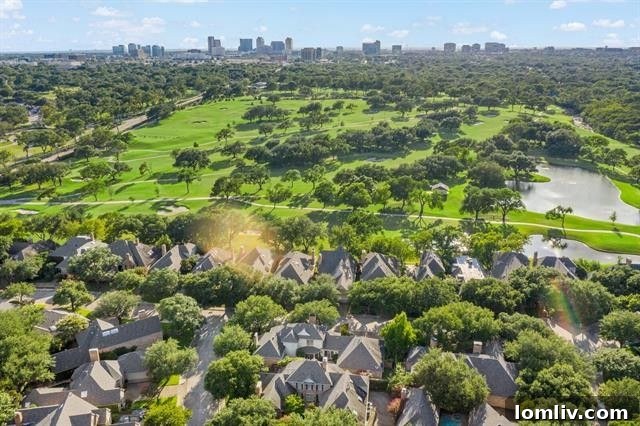
Tucked away discreetly at the crossroads of Alpha Road and Hillcrest Avenue, Creekside Place reveals itself as a tiny, yet exceptionally desirable neighborhood, comprised of custom homes predominantly built in the 1980s. This enclave of 44 residences is truly heavenly for a multitude of reasons, but perhaps the most awe-inspiring is a colossal secret weighing six tons and standing an impressive 11 feet tall. The vision for Creekside Place was brought to life by the esteemed Dallas Hill family – Mrs. Margaret Hunt Hill, daughter of the legendary oilman H.L. Hunt, and her husband, Al Hill Sr. Their impeccable choice of location set the stage for an unparalleled residential experience, as Creekside Place is exquisitely framed by the private Northwood Club golf course on one side and an expansive, privately-owned 13-acre greenbelt on the other, meticulously maintained by the homeowners’ association.
To realize their architectural ambitions, the Hills engaged the highly regarded firm of Clark and Heath to construct all but six of the homes within Creekside Place. Dale Clark, the more prominent of the duo, was celebrated across Dallas for building over 400 elegant homes, possessing a particular flair for designing grand residences that seamlessly integrated with natural greenbelts. As many long-time Dallas residents of the 1980s would recall, a “Dale Clark home” was synonymous with quality, sophistication, and a harmonious connection to nature. Beyond its architectural pedigree and verdant surroundings, Creekside Place holds an even deeper layer of intrigue. A few years ago, local historian Karen Eubank unearthed a truly fascinating and monumental discovery within this community, adding an extraordinary chapter to its already rich history. This discovery, much like the neighborhood itself, is a testament to the hidden depths and captivating narratives that define Dallas’s most exclusive and cherished residential pockets, making Creekside Place a veritable treasure trove for those seeking both luxury and an intriguing past.
Delve into the “mammoth” discovery that makes Creekside Place so uniquely special, and explore the many reasons this secluded community remains a hidden gem in Dallas.
Geneva Heights: A Timeless East Dallas Enclave
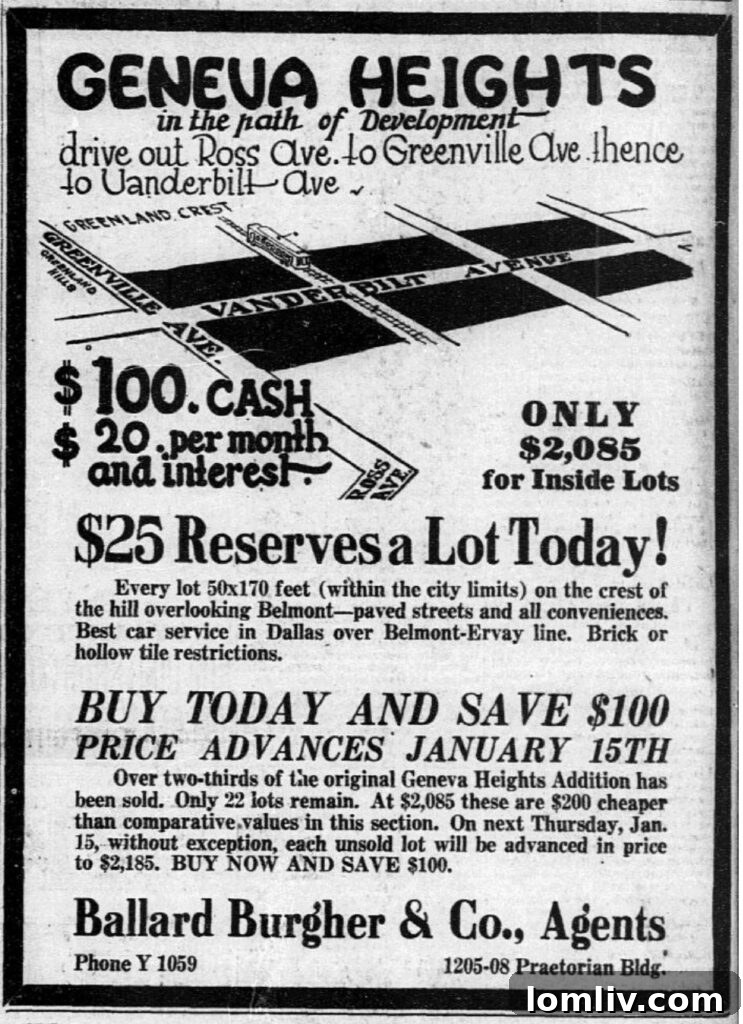
In the bustling Dallas of the 1930s, Geneva Heights was heralded as a community “in the path of development,” a promising new subdivision ideally positioned adjacent to the burgeoning Greenville Avenue. This forward-thinking development quickly distinguished itself with its commitment to quality living, boasting wide, tree-lined streets and generously deep lots—features that were highly sought after by discerning homebuyers of the era. The architectural landscape of Geneva Heights was largely defined by charming Tudor-style homes, which, upon their initial construction, represented the pinnacle of modern suburban design. These residences, primarily built in the 1920s and 1930s, exuded a timeless appeal that continues to captivate homeowners today. Over the decades, many of these architectural treasures have been meticulously updated, expanded, and lovingly restored, allowing them to embark on their third, fourth, or even fifth lives, blending historical charm with contemporary comforts.
Today, the allure of Geneva Heights remains as strong as ever, enhanced by its enviable location. This Greenville Avenue-adjacent community offers residents the ultimate convenience of walkability to an array of popular restaurants, diverse retail shops, and essential grocery stores. Yet, despite its central location, Geneva Heights maintains a serene residential ambiance, situated just far enough from the main thoroughfare to mitigate the hustle and bustle of heavy traffic. For those moments when one might find themselves caught in the flow of modern-day traffic, it serves as a wonderful opportunity to reflect on the area’s remarkable history. Imagine a time when Greenville Avenue was characterized by gravel-paved roads, and East Dallas was merely in its infancy, traversed by the Belmont-Ervay line’s quaint cable cars. Geneva Heights stands as a testament to Dallas’s incredible journey from nascent urban development to a thriving metropolis, offering a unique blend of historical gravitas and contemporary convenience that makes it an enduringly popular choice for discerning homebuyers.
Journey back to Geneva Heights’ 1930s beginnings, a time when Greenville Avenue was defined by gravel roads and East Dallas was just starting to flourish.
Lakeland Hills: A Midcentury Modern Marvel in Lake Highlands
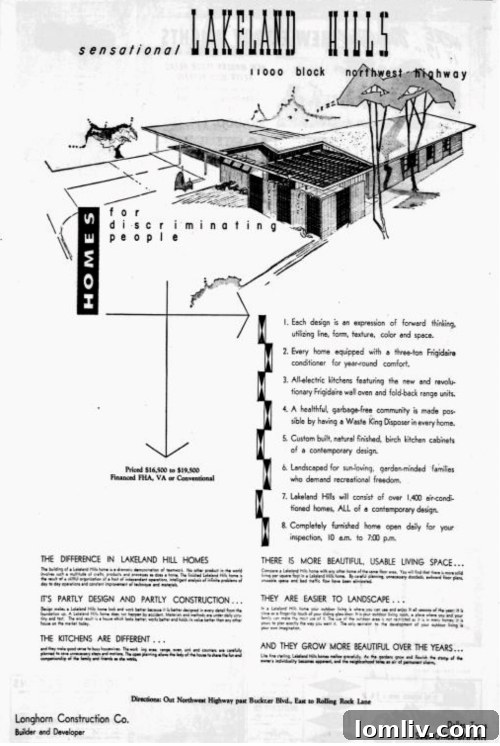
In the dynamic landscape of 1950s Dallas, a vision for modern living took shape near Northwest Highway and Plano Road, giving rise to the distinctive Lakeland Hills subdivision. This meticulously planned community quickly became a showcase for custom contemporary design, setting a new standard for residential architecture in the city. The Longhorn Construction Company, the innovative force behind Lakeland Hills, proudly advertised its addition of over 1,000 homes in northeast Dallas as “Homes for the discriminating, all of contemporary design.” This slogan perfectly captured the ethos of a neighborhood crafted for those who appreciated forward-thinking aesthetics and functional elegance.
Lakeland Hills stands out as a quintessential example of Midcentury Modern (MCM) architecture, a style celebrated for its clean lines, open floor plans, and harmonious integration with the surrounding natural environment. Each home was conceived as a unique expression of architectural innovation, where thoughtful design principles guided the use of “line, form, texture, color, and space” to create living environments that were both stylish and eminently practical. This focus on thoughtful, intentional design attracted a diverse group of residents seeking homes that reflected a modern sensibility and a commitment to a sophisticated lifestyle. Today, Lakeland Hills continues to thrive as a beloved pocket of MCM homes within the larger Lake Highlands area. Its enduring appeal lies not only in the timeless beauty of its architecture but also in the cohesive community spirit that has flourished over the decades. Residents cherish the neighborhood’s unique blend of historical significance and contemporary comfort, making Lakeland Hills a highly sought-after destination for those who appreciate the elegance and innovation of midcentury design. It remains a vibrant testament to a specific era of Dallas’s growth, where design and community were thoughtfully intertwined.
Explore Lakeland Hills in Lake Highlands and understand why its homes, each an “expression of forward-thinking, utilizing line, form, texture, color, and space,” continue to captivate design enthusiasts.
Lochwood: A Master-Planned Community with a Legendary Shopping Hub
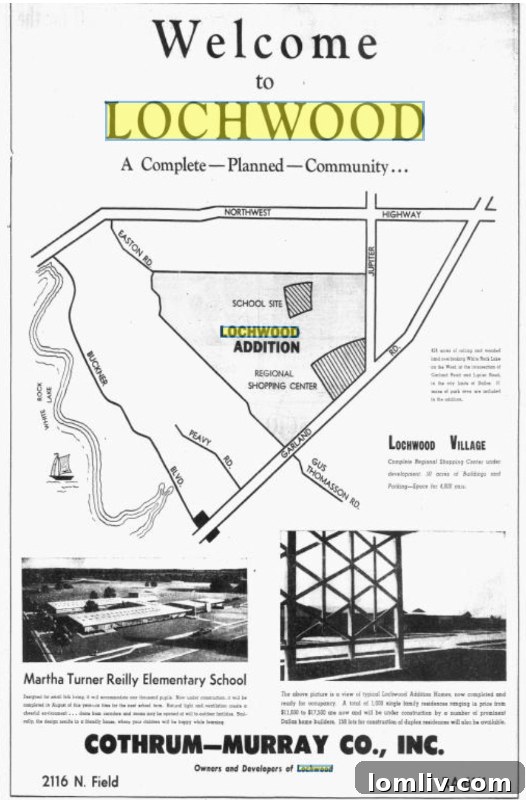
Delving into the archives of the Dallas Morning News for “Lochwood” reveals a treasure trove of articles, painting a vivid picture of a vibrant East Dallas community. While several pieces detail the Lochwood Addition, a residential neighborhood celebrated for its reasonably priced post-war homes, the lion’s share of newspaper articles, personal blogs, and historical forums overwhelmingly focus on one iconic location: the Lochwood Shopping Center, now affectionately known as White Rock Marketplace. Situated at the crucial intersection of Garland Road and Jupiter Road, the Lochwood Shopping Center was not just another retail development; it was a phenomenon.
When it first opened its doors in 1957, it was met with extensive news coverage and immense public fanfare, instantly becoming a landmark in East Dallas. What made this shopping center particularly significant was its groundbreaking design as a master-planned development conceived *in conjunction with* the Lochwood Addition of homes. This innovative approach ensured that residents had immediate access to essential services, retail, and community gathering spaces, fostering a cohesive and self-sufficient neighborhood. The Lochwood Shopping Center was no ordinary mall; it was touted as the largest open-air pedestrian mall in the entire Southwest, a grand testament to post-war American suburban planning. Its expansive design included parking facilities capable of accommodating an astonishing 4,000 cars at one time, a testament to its scale and popularity. For decades, it served as the bustling heart of the Lochwood community, a place where families shopped, friends met, and memories were made. Today, its legacy continues under the name White Rock Marketplace, but the nostalgia for the original Lochwood Shopping Center endures, a poignant reminder of a visionary development that deeply shaped the lives of East Dallas residents and remains a cherished symbol of community connection and progress.
Read more about the revolutionary open-air pedestrian mall that was once acclaimed as the largest in the Southwest, capable of parking an astounding 4,000 cars, and its lasting impact on the Lochwood community.
Munger Place: Texas’s Pioneering Deed-Restricted Neighborhood
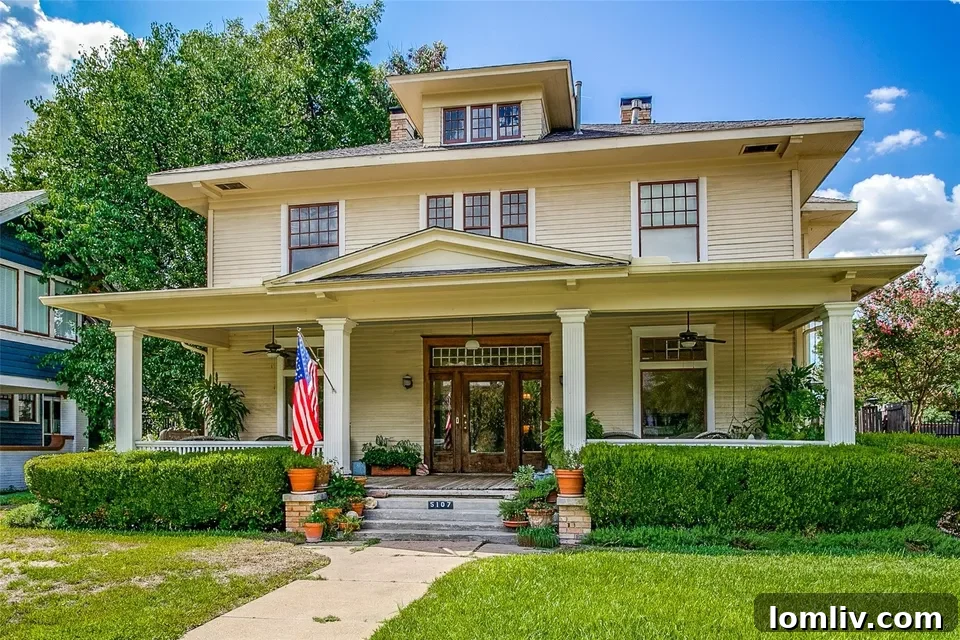
Transport yourself to the turn of the 20th century, specifically to the vibrant year of 1908. Imagine standing on a charming porch of a Junius Street home in East Dallas, listening to the hollow clip-clops of horse-drawn carriages gracefully traversing the freshly paved roads. Dallas at this time was a city brimming with new development and boundless ambition. It was within this dynamic backdrop that Mr. William Frank Knox, a distinguished railroad man for Gulf Texas & Western Railroad, sought to establish deep roots for his wife and two young children in the burgeoning Munger Place neighborhood. This new East Dallas community was remarkably ahead of its time, not merely for its aesthetic appeal but for its visionary urban planning.
Munger Place proudly holds the distinction of being the very first deed-restricted neighborhood in Texas, a testament to the foresight of its developers, the Munger brothers. Their ingenious stipulations were designed to protect property values, maintain architectural integrity, and cultivate an upscale residential environment. These groundbreaking restrictions mandated that homes must cost at least $2,000 to build (a substantial sum in the early 1900s), be required to stand two stories tall, and were strictly prohibited from facing a side street, ensuring a cohesive and elegant streetscape. Mr. Knox, recognizing the unparalleled quality and potential of this meticulously planned community, selected a generous 0.28-acre lot to build his family’s home. It was only the second residence erected on this prestigious block, which already boasted state-of-the-art amenities for its time: paved streets, sidewalks for leisurely strolls, electric street lights for nighttime illumination, and two stately Sycamore trees gracing every single lot. Munger Place represented a paradigm shift in urban residential development, a commitment to quality and community that continues to define its enduring charm and historical significance, making it one of Dallas’s most celebrated and well-preserved historic districts.
Step back in time to Junius Street, 1908, and learn more about the pioneering spirit and historical grandeur of Munger Place.
Parks Estates: A Vision of Modern Suburban Living in 1920s Dallas
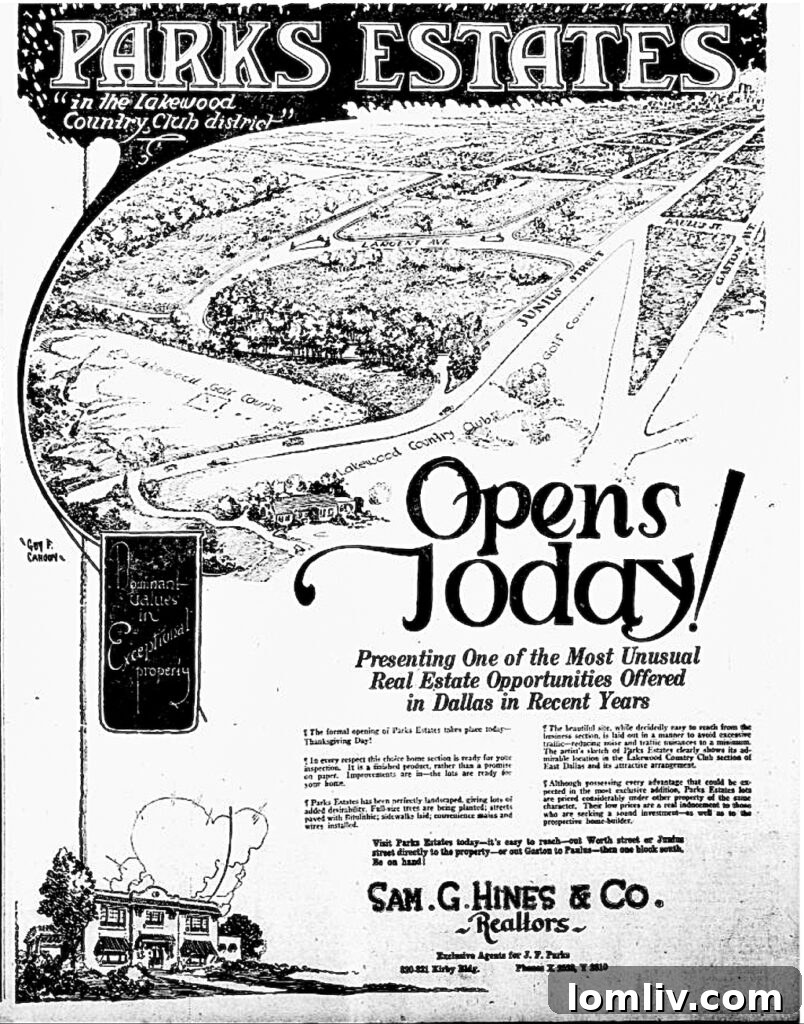
On Thanksgiving Day in 1924, a palpable excitement filled the air in East Dallas. Eager sales agents enthusiastically paced the freshly paved streets of Tremont and Largent, presenting Dallas’s newest and most promising residential addition: Parks Estates. This ambitious development, strategically neighboring the prestigious Lakewood Country Club, was heralded as “One of the most unusual real estate opportunities offered in Dallas in recent years,” a bold claim that underscored its innovative features and prime location. Parks Estates represented a paradigm shift in urban planning, offering meticulously improved lots with amenities that many other nascent neighborhoods simply lacked.
The vision behind this new community, situated around Junius and what is now Abrams Road, was one of thoughtful design and modern convenience. It boasted master-planned streets, a rarity for the time, which were specifically designed to discourage undesirable passthrough traffic. This intentional layout aimed to create a tranquil residential haven, fulfilling a promise made in a 1924 Dallas Morning News advertisement: “The beautiful site is laid out in a manner to avoid excessive traffic, reducing noise and traffic nuisances to a minimum.” Beyond its intelligent street design, Parks Estates also pioneered the inclusion of underground utilities, a revolutionary feature that ensured a clean, aesthetically pleasing landscape free from overhead wires. These forward-thinking amenities, combined with its enviable location adjacent to one of Dallas’s most exclusive clubs, made Parks Estates an irresistible proposition for would-be homebuyers. Indeed, residents from across Dallas came out in droves, captivated by the promise of a superior quality of life in a community that epitomized modern suburban living. Parks Estates remains a testament to early 20th-century Dallas’s commitment to thoughtful development, offering a blend of historical charm and enduring desirability that continues to attract discerning residents today.
Uncover the modern-day features that made Parks Estates so revolutionary in the 1920s and why eager home buyers flocked to this visionary East Dallas community.