The Urban Holdout: When Redevelopment Leaves an “Orphan” Property in Uptown Dallas
In the dynamic landscape of urban development, a recurring question emerges for property owners: when every lot around you is earmarked for redevelopment, what’s the optimal strategy? In a quaint single-family neighborhood, waiting might seem like a lucrative gamble, with each sale and subsequent rebuild potentially increasing the value of your untouched parcel. However, in a bustling commercial district, this waiting game often carries a significant price, rather than a guaranteed reward. The fine line between strategic patience and missed opportunity becomes strikingly clear in areas undergoing rapid transformation, such as the vibrant Uptown Dallas corridor.
This article delves into the fascinating and often challenging world of “holdout” properties, parcels of land that resist absorption by larger commercial developments, creating unique urban islands. We’ll explore the economic pressures, strategic decisions, and the sometimes-stark realities faced by these properties and their owners, using a prominent example in Uptown Dallas to illustrate the complexities involved.
Uptown Dallas: A Hotbed of Transformation and Development
Uptown Dallas stands as a prime example of a neighborhood that has undergone immense transformation over the past few decades. Evolving from a collection of older homes and light commercial spaces, it has become one of the most sought-after urban cores in Texas. Characterized by its luxurious high-rise apartments, upscale retail, diverse dining options, and a dense concentration of businesses, Uptown continuously attracts significant investment and development. This rapid growth, while indicative of a healthy real estate market, inevitably leads to situations where smaller, older parcels find themselves surrounded by ambitious new projects, creating a peculiar tension between past and present.
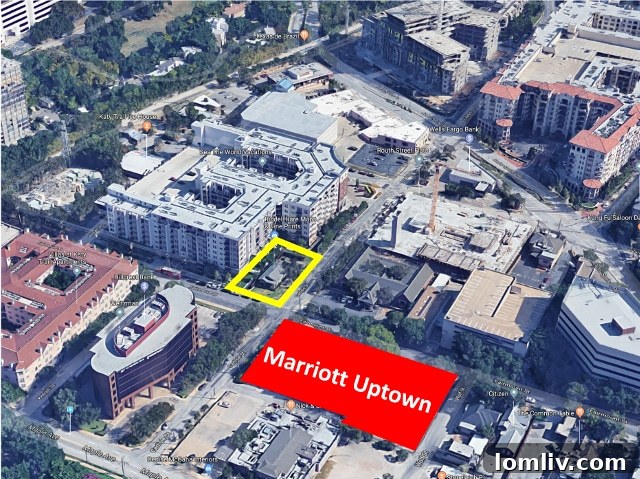
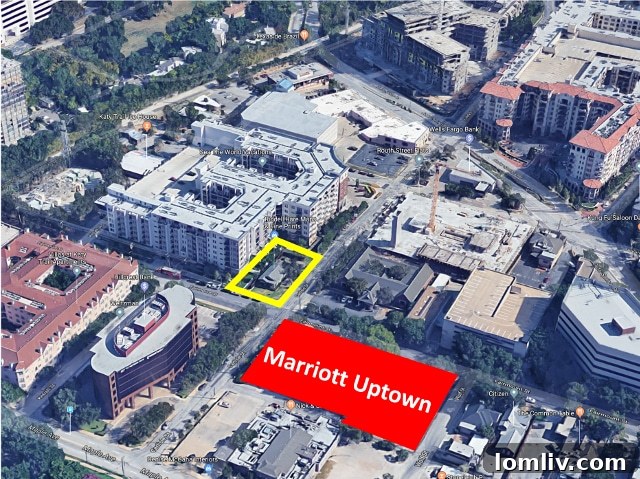
One such scenario, starkly visible in the image above, features a lone lot remarkably surrounded by the imposing structure of the Gables Uptown Trail apartment building. This particular parcel, now a poignant urban relic, has a history. It’s well-known in Dallas real estate circles that Gables, a prominent developer, made strenuous efforts to acquire this Uptown property long before the Gables Uptown Trail complex was completed and came online in 2011. Despite those concerted efforts, the property remained independent, leading Gables to build its sprawling development literally around it, leaving the smaller lot as an unexpected gap in an otherwise continuous facade of modern architecture.
The Tale of Two Holdouts: A Marriott and an Art Gallery
The story of holdout properties in Uptown Dallas is not unique to the Gables example. Another compelling instance unfolded with the development of a new Marriott hotel, currently under construction by Alamo Manhattan. When this significant project was initially announced, it too faced a similar challenge: a single holdout property stubbornly occupying a crucial corner of what was planned as a half-block parcel. This particular holdout was an old house that had been imaginatively repurposed into an art gallery, embodying a fragment of Uptown’s eclectic past amidst plans for its gleaming future.
Ultimately, Alamo Manhattan, renowned for its strategic urban developments, successfully persuaded the owners of the art gallery to sell. Their convincing argument highlighted the inevitable reality: remaining as an isolated, tiny, and ultimately un-developable lot, completely surrounded by a towering commercial hotel, would offer little benefit or future potential to the owners. This strategic acquisition allowed Alamo Manhattan to proceed with a contiguous and integrated development, showcasing the pragmatic side of urban real estate negotiations where the long-term viability of a small, isolated parcel often outweighs sentimental or speculative attachments.
3104 Fairmount Street: An “Orphan” or a “Unicorn”?
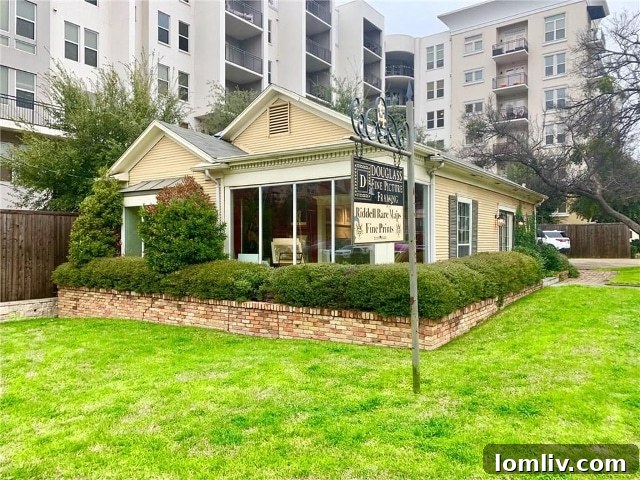
These past examples provide crucial context for a more recent and currently active case: the highlighted holdout lot that has just come onto the market. Located kitty-corner from the aforementioned Marriott development, at the prominent intersection of 3104 Fairmount at Carlisle Street, this property encapsulates the core dilemma of urban holdouts. Spanning 5,968 square feet, the lot currently hosts a charming 1,534-square-foot home, originally built in 1945. Today, this vintage structure serves as home to a framing and rare maps business, a testament to the diverse and often quirky commercial uses that sometimes find refuge in these older, character-filled buildings.
The property is listed with Patrick Harris of Briggs Freeman for an asking price of $2.2 million. While the listing link provided directs to an Ebby site, it underscores the property’s availability and the considerable value placed on its unique position in Uptown. Interestingly, the listing also entertains a build-to-suit arrangement, alongside owner financing options, indicating a flexible approach to finding the right buyer and the right development concept for this challenging parcel. Such flexibility often points to the complexities involved in marketing a property that doesn’t fit conventional development molds.
A Fanciful Reminder of Uptown’s Past
Now commercially zoned, the house at 3104 Fairmount stands as a tangible and fanciful reminder of what Uptown Dallas used to embody. Before the arrival of numerous car dealerships, the occasional tarot card reader, and certainly prior to its most recent, aggressive push towards gentrification and high-density development, Uptown possessed a distinct character. There are now precious few of these bygone reminders scattered across the area, making each one a significant piece of local history. These structures offer a physical connection to the neighborhood’s evolution, highlighting the rapid pace at which Dallas transforms itself.
Navigating the Challenges: The “Orphan” Perspective
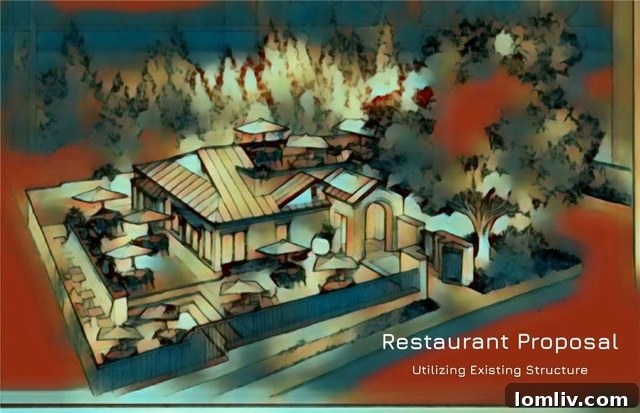
The listing presentation for 3104 Fairmount understandably highlights its excellent proximity to the new Marriott hotel and other Uptown amenities. One particularly imaginative image even reimagines the existing house as a charming restaurant, with the surrounding Gables apartments seemingly softened and becoming a picturesque forest backdrop. However, beneath this appealing vision, significant practical challenges emerge that temper such optimism, leading to the “orphan” property assessment rather than the “unicorn” label. The primary hurdle, besides the artistic transformation of apartment buildings into trees, is the extremely limited parking available for such a tiny lot.
The Parking Predicament: A Major Constraint for Commercial Use
Restaurant use, a common aspirational vision for such properties, is notoriously parking-intensive, especially in a bustling urban environment like Uptown Dallas where patrons often drive. A small lot of less than 6,000 square feet simply cannot accommodate the required number of parking spaces for a viable restaurant operation, let alone for any significant commercial enterprise. This is a critical impediment to maximizing the property’s potential. The financial implications of providing adequate parking are staggering:
- Underground Parking: While a common solution for new developments in dense urban areas, implementing underground parking on such a minuscule lot would be fabulously expensive. The excavation, structural reinforcement, ventilation, lighting, and necessary ramping and turnarounds would consume a disproportionate amount of the development budget, making the project financially unfeasible given the limited space and potential revenue.
- Above-Ground Parking: Constructing above-ground parking would necessitate putting the entire building on stilts, requiring costly elevator access and dramatically altering the aesthetic and accessibility of any proposed structure. This solution also struggles with the limited footprint, as ramping and efficient space utilization become nearly impossible.
Noise, Integration, and Market Realities
Beyond parking, another critical consideration is noise. Given that the property is situated cheek-by-jowl with the Gables Uptown Trail apartment building, any outdoor-enabled business, particularly a restaurant or bar, would face constant issues with noise complaints from residential neighbors. This significantly limits the types of businesses that could realistically operate here without causing friction or facing operational restrictions. The need for harmonious integration with surrounding residential properties places additional constraints on development options.
Furthermore, the surrounding major players—Gables and Marriott—appear to have little use for this parcel now. Gables has already built its structure around it, indicating no current expansion needs in that direction. The Marriott, while perhaps having some valet parking capacity in its larger footprint, likely views its current arrangement as complete. This means that any acquisition would be from a new, independent developer, rather than a strategic buyout from an adjacent behemoth, further complicating the property’s sales prospects.
The “Unicorn” Perspective: Is There Hidden Value?
Despite these significant challenges, the listing agent’s portrayal of the property as a “unicorn” is not entirely unfounded, though perhaps optimistic. The term “unicorn” in real estate often refers to a property that possesses incredibly unique characteristics that make it stand out from the rest, potentially offering extraordinary value or development opportunities that are not immediately obvious. In this context, the “unicorn” argument might hinge on several factors:
- Unparalleled Location: It is in Uptown Dallas, one of the hottest real estate markets in the country. Proximity to major commercial hubs, luxury residences, and popular trails is a undeniable draw.
- Scarcity: Small, undeveloped or under-developed parcels in prime Uptown locations are exceedingly rare. This extreme scarcity could theoretically drive up demand from a buyer with a highly specialized vision.
- Historical Charm: The existing structure, with its 1945 vintage, offers a unique historical aesthetic that could appeal to a niche boutique business looking to create a distinctive brand identity in a sea of modern glass and steel.
- Flexible Financing: The availability of owner financing and a build-to-suit option suggests a willingness to work with a creative buyer, potentially lowering the initial barriers to entry for a unique concept.
However, the author’s viewpoint remains consistent: this lot may have simply “stayed too long at the party,” and now “the lights have come on.” The once-potential strategic advantage of being a holdout has transformed into a practical burden, making it an “orphan” in a neighborhood that has moved on to larger, more integrated development schemes. The practical constraints of size, parking, and neighborhood integration present formidable obstacles that even the most optimistic “unicorn” seeker would struggle to overcome without significant, unconventional investment and a highly specialized, low-impact business model.
Broader Implications for Urban Planning and Investment
The case of 3104 Fairmount Street offers valuable insights into the broader dynamics of urban planning and real estate investment in rapidly gentrifying areas. It highlights the delicate balance between preserving historical character and embracing modern development. For cities like Dallas, managing these transitions effectively involves balancing economic growth with community needs and historical preservation efforts.
This situation also implicitly touches upon the ongoing debate championed by movements such as the YIMBY (Yes In My Backyard) movement. YIMBY advocates push for increased housing density and development to combat affordability crises and enhance urban vitality. From a YIMBY perspective, a small, underutilized parcel in a prime urban location represents a missed opportunity for higher density or more efficient land use. However, the practicalities of developing such small, isolated lots often clash with the grand visions of large-scale urban planners.
Ultimately, the saga of 3104 Fairmount serves as a compelling case study on the critical timing of real estate decisions in hyper-evolving urban environments. It’s a reminder that while holding out can sometimes yield exponential rewards, waiting too long can transform a potential goldmine into a challenging, isolated “orphan” property, whose future requires not just capital, but immense creativity and strategic foresight.

About the Author: The author specializes in high-rise developments, HOA complexities, and renovation projects within the real estate sector. A deep appreciation for modern and historical architecture, balanced against the evolving landscape shaped by movements like YIMBY, informs the unique perspective offered in their writing. The National Association of Real Estate Editors has recognized this distinctive voice with multiple accolades, including three Bronze awards in 2016, 2017, and 2018, and two Silver awards in 2016 and 2017. For those with a compelling story to share or even a whimsical marriage proposal, feel free to reach out via email at [email protected]. While a presence on Facebook and Twitter might be elusive, the invitation to look remains open.