Dallas’s Urban Crossroads: Navigating Growth, Traffic, and Infrastructure Debates
Dallas, Texas, stands at a pivotal moment in its urban development, a vibrant metropolitan hub grappling with complex challenges ranging from housing density to critical infrastructure. Across the city, various factions are passionately debating the future of their neighborhoods and the very arteries that define Dallas life. These discussions highlight a community actively shaping its identity amid rapid growth and evolving urban ideals.
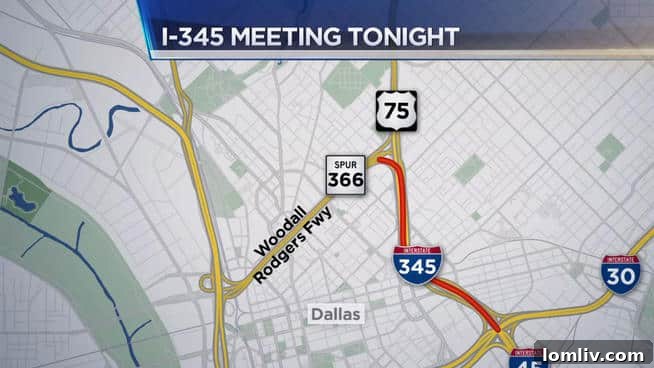
In the heart of Downtown Dallas, urban planning advocates are vigorously campaigning for the demolition of a compact yet critical elevated highway, Interstate 345. They contend that this segment of infrastructure acts as a physical barrier, stifling downtown’s urban vibrancy, fracturing neighborhood connectivity, and occupying valuable land that could be repurposed for much-needed housing and commercial spaces. This proposed teardown sparks intense debate about urban density and revitalization, questioning whether removing a highway could unlock downtown’s full potential.
Conversely, just north of the affluent Park Cities, at the intersection of Preston Hollow and University Park, an entirely different battle over housing density is unfolding. Here, a large residential community is staunchly opposing the construction of a proposed luxury apartment complex comprising 220 units. This development would replace existing, aging residential structures built in the 1950s. The opposition is widespread; “No” signs are prominently displayed from Forest Lane in the north to Midway Road in the west. Homeowners, whose properties range from modest $300,000 ranches to sprawling $3 million-plus estates, express deep concerns about exacerbating traffic congestion and disrupting the cherished tranquility of their neighborhoods. Their commitment to preserving their community’s character is so strong that they have collectively hired a seasoned attorney to represent their interests before the Dallas Plan Commission. Even prominent figures like former mayor Laura Miller have weighed in, advocating for changes in city council representation to better address community concerns.
Further east, near the scenic White Rock Lake, another development proposal has ignited local resistance. Investors are exploring the possibility of constructing a restaurant on parkland situated at the northern end of the lake, just off Mockingbird Road. Despite these initial overtures being exploratory, public feedback has been overwhelmingly negative. This backlash is particularly fierce in a neighborhood renowned for its vigilant protection of its beloved urban lake. This community previously mobilized two years ago to successfully halt a plan to clear a meadow at Winfrey Point, preventing its conversion into a commercial parking lot. The message from Lakewood residents is clear: don’t compromise White Rock Lake.
The Indispensable Role of Dallas Highways: A Way of Life
Beyond these localized skirmishes, a broader question looms over Dallas: what about our highways? These vast networks of concrete and steel are more than mere transportation routes; they are integral to the Dallas identity, serving as fundamental markers for navigation and community definition. Phrases like “we are east of Central, south of Walnut Hill” or “we live north of LBJ” are commonplace, underscoring how deeply interwoven our highways are into the fabric of daily life. This reliance stems from the very nature of Dallas as a sprawling metropolis where personal vehicles are often essential for mobility. Newcomers quickly learn that navigating Dallas effectively without a car is a significant challenge, making the accessibility and efficiency of its highway system paramount.
Despite this pervasive reliance, many Dallas real estate professionals and homeowners remain surprisingly unaware of the ongoing discussions surrounding the potential removal of Interstate 345. This lack of widespread knowledge highlights a critical disconnect between urban planning debates and public awareness. While the debate surrounding I-345 has garnered attention in specific circles, a comprehensive public understanding of its implications is still developing.
Drawing parallels to other major cities, the potential traffic impacts of removing a key highway segment become a central concern. San Francisco, for example, famously tore down parts of its elevated freeways following the Loma Prieta earthquake. While this opened up valuable waterfront land, the resulting traffic congestion in the Bay Area is notorious. Similarly, Atlanta faces immense traffic challenges, often cited as one of the worst among major metropolitan areas. Drivers in Atlanta lose an average of 51 hours annually to traffic, burning an extra 23 gallons of fuel, equating to an annual cost of $1,120 per commuter. This debilitating congestion was starkly illustrated during a winter storm in January, which brought the city to a standstill, leaving hundreds of abandoned cars and a crippled transportation network.
Atlanta’s struggles are partly attributed to underfunding. Despite having the ninth-largest interstate system in the country, Georgia ranks 49th in per capita transportation funding. Coupled with an inadequate public transportation system, this leads to poorly maintained roads, frequent bottlenecks, and significant backups, reminiscent of scenarios seen on Dallas’s I-35 when multiple lanes are forced to merge for miles. A report on Atlanta’s corridors notes that “inadequate capacity and substandard interchanges have created congestion and safety issues,” further exacerbated by a lack of synchronized traffic signals – only a “small percentage” of Atlanta’s 1,300 signals are synchronized, compared to all 4,500 in Los Angeles, which are coordinated to optimize traffic flow.
Dallas roads, too, are showing signs of strain, a situation compounded by a booming population. Approximately 121,000 new residents move to the Dallas/Fort Worth/Arlington metroplex each year, further intensifying congestion. Against this backdrop of growing traffic and aging infrastructure, the question arises: does it truly make sense to demolish a vital highway like I-345 rather than investing in its repair and modernization? This is the core issue that Ed Woodson, a Dallas attorney, and Aren Cambre, a computer scientist, frequently address in local media, voicing strong opposition to the I-345 teardown. Their insights offer a critical counter-perspective to the new urbanist movement.
I-345: Public Enemy No. 1 for Dallas New Urbanists?
Patrick Kennedy, a prominent proponent of urbanist ideals, advocates for the removal of Downtown Dallas’s Interstate 345, a position echoed by the D Magazine editorial board. When this debate gained traction, particularly through D Magazine’s Front/Burner blog which featured 17 posts on the topic in 2014, many residents, including Woodson and Cambre, found themselves asking, “What exactly is Interstate 345?” Upon realizing its critical function, their immediate reaction was, “That sounds like a potentially disastrous idea.”
Subsequent investigation by these critics has only solidified their initial conclusion. They argue that much of the evidence presented by Mr. Kennedy and his allies is misleading and ultimately unhelpful in making an informed decision about Dallas’s complex infrastructure needs. Furthermore, they believe that Mr. Kennedy’s broader agenda extends beyond merely improving downtown traffic and involves a more radical vision for Dallas’s urban landscape.
What is I-345? An Essential Link
Interstate 345 is an elevated freeway positioned on the eastern flank of Downtown Dallas, serving as a direct connector between US 75 (North Central Expressway) and I-45. In essence, it functions as a crucial segment of a continuous freeway network stretching from Galveston all the way to the Oklahoma border. Despite its vital role, I-345 is not typically identified by its numerical designation on road signs, existing primarily as an administrative identifier within the larger interstate system.
The freeway traces the edges of several key Dallas districts, including Deep Ellum, the Arts District, and the Farmer’s Market. It is an indispensable route for anyone traveling between US 75 and I-45, or between US 75 and I-30 east of downtown. Given its age and constant use, I-345 is currently in need of approximately $100 million in repairs, with the Texas Department of Transportation (TxDOT) planning to commence these vital maintenance projects in the near future. This planned investment underscores its continued operational importance.
Why the Push to Tear Down I-345? The New Urbanist Vision
The primary argument put forth by those advocating for the demolition of I-345, as understood by its opponents, is rooted in the belief that downtown Dallas’s highway loop—comprising Woodall Rogers, I-345, I-30, and I-35E—acts as an urban “noose.” This metaphorical noose is seen as strangling downtown’s immediate vicinity, preventing robust residential and commercial development. Proponents theorize that removing I-345 would liberate downtown’s eastern side, opening it up to significant, high-density, mixed-use development. This new growth, they argue, would transform Dallas into a “world-class” city and generate substantial new tax revenue.
Furthermore, the theory posits that I-345 is predominantly used for through-traffic, meaning vehicles passing *through* downtown rather than stopping there. Consequently, its removal is expected to have only minimal traffic impacts. The assumption is that through-traffic would simply exit affected highways before reaching downtown, rerouting to alternative roads such as surface streets, Northwest Highway, I-635, George Bush Tollway, Ledbetter, and other arterial routes. To the extent that traffic opts to flow through city streets between US 75 and the southern highways (I-30 and I-45), this is viewed not as a problem but as a catalyst for further economic growth in the newly developed area, with busy streets translating into more customers for local businesses. For a full articulation of Mr. Kennedy’s arguments, his website, www.anewdallas.com, serves as the primary resource.
However, a more cynical interpretation, offered by critics like Woodson and Cambre, suggests that Mr. Kennedy and his fellow new urbanists harbor a fundamental disapproval of how North Texans currently live their lives. From this perspective, the I-345 teardown is perceived as a means to force residents closer to a specific “utopian urban-ideal lifestyle.” While Kennedy may offer assurances that Dallas can achieve a new urban downtown without significant adverse impacts on the wider population, his critics contend that such a claim is fundamentally flawed. They further suspect that Kennedy himself may not fully believe this, positing that for some new urbanists, inflicting traffic inconvenience on others is not an unintended side effect, but rather an intentional “feature” of their design for urban transformation.
Dissecting the Short Answer: Critical Questions and Unsubstantiated Claims
Upon closer examination of the core arguments for I-345’s demolition, several critical questions immediately arise. Will the traffic impacts truly be minimal? Is the teardown absolutely necessary for Dallas to achieve “world-class city” status? And does a genuine “noose” truly encircle downtown, preventing development? From the perspective of Woodson and Cambre, the answers to these questions are, respectively, “no“, “that begs the question,” and “we don’t know.”
Traffic Impacts: A Flawed Comparison?
The “A New Dallas” website references five specific examples of freeway demolitions in the United States to support its case for tearing down I-345. These examples are presented as evidence that such demolitions can occur with minimal traffic disruption while simultaneously spurring valuable new development. However, even if one accepts the development benefits as described by Mr. Kennedy, a critical analysis reveals that none of these cited examples bear any remote similarity to the unique situation presented by I-345 in Dallas.
The Embarcadero Freeway (San Francisco)
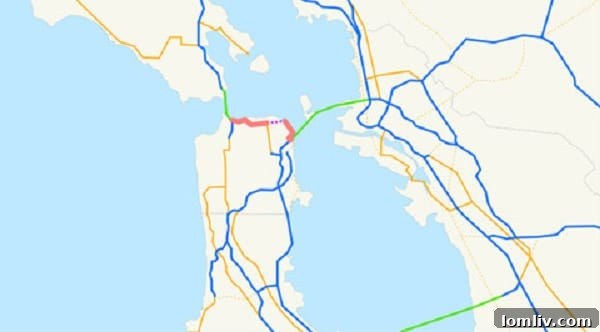
The Embarcadero Freeway in San Francisco, prior to its partial collapse, was intended as an extension of I-480, connecting the Bay Bridge to the Golden Gate Bridge. However, it was controversial from its inception and ultimately aborted mid-construction. The red dots on the original map illustrate the significant portion of the freeway that was never built. This meant that cars traveling on the incomplete freeway were forced onto surface streets for roughly a mile, bridging the gap between the two fragmented segments of the completed freeway. Crucially, even at its peak, the Embarcadero carried only half the daily vehicle count of I-345. Therefore, Mr. Kennedy’s comparison of I-345 to an incomplete freeway with substantially lower traffic volumes is inherently misleading and fails to acknowledge the vastly different functional roles of these two pieces of infrastructure.
Perhaps of interest to Dallas politicians, a public referendum to remove the Embarcadero Freeway was defeated prior to the earthquake. After the earthquake, the Mayor championed its removal without another referendum, only to be subsequently voted out of office – a potent reminder of the political risks associated with such contentious urban planning decisions.
Central Freeway (San Francisco)
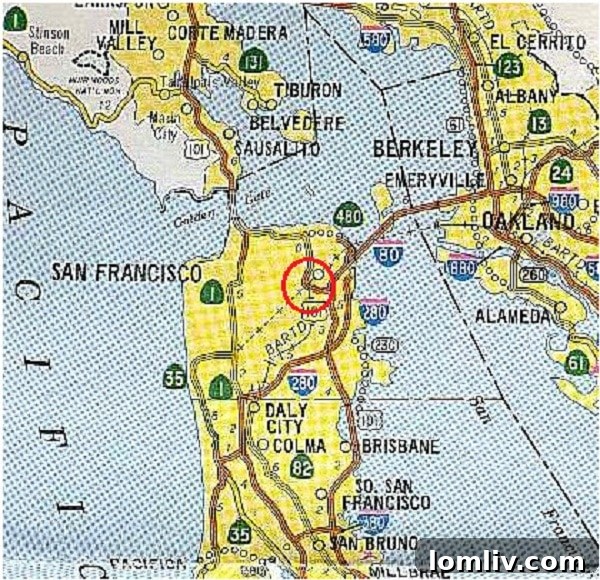
The Central Freeway, circled in red on the map below, represents another San Francisco case study often cited. It’s important to note that the portion of CA 101 extending north from the Central Freeway spur is not a traditional highway but rather a surface road. Like the Embarcadero, the Central Freeway was originally planned to extend further north and connect with the Embarcadero but was never fully completed due to controversy and mid-construction abortion. Its removal followed significant damage from the Loma Prieta earthquake. Prior to demolition, this spur functioned as a “highway to nowhere,” a truncated route that simply directed cars onto surface streets less than a mile south of its original terminus. Mr. Kennedy’s attempt to equate the demolition of an incomplete, dead-end freeway with his vision for I-345, which is a fully integrated and heavily trafficked connector, again represents a fundamental mischaracterization of the operational context.
Park East Freeway (Milwaukee)
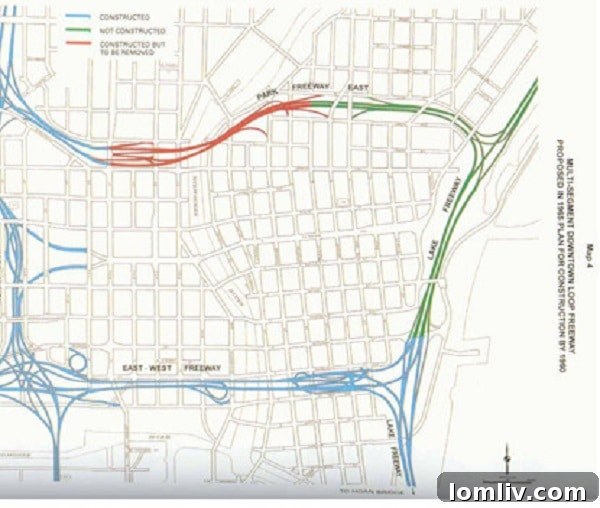
The pattern of incomplete freeways continues with the Park East Freeway in Milwaukee. The demolished section is shown in red on the map, while the green portion indicates a segment that was never constructed. This marks the third instance where Mr. Kennedy draws a comparison between I-345 and an incomplete, “dangling” freeway that abruptly terminated at surface streets. The critical distinction here is that I-345 is a fully operational, integrated, and high-volume link within a major metropolitan highway system, unlike these fragmented or never-completed urban expressways.
Harbor Drive (Portland)
Unlike the previous examples, Harbor Drive in Portland was actually completed before its demolition. However, Portland’s experience does not provide strong support for the argument to dismantle highway “nooses” around downtowns. As the map below illustrates, downtown Portland, much like downtown Dallas, is still encircled by a network of freeways. Driving in Portland post-Harbor Drive removal continues to involve navigating these significant highways, unequivocally demonstrating that removing one segment did not eliminate the city’s broader traffic challenges or its reliance on the surrounding freeway system.
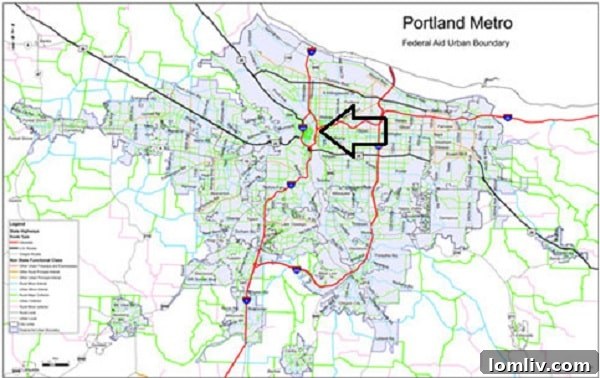
The former location of Harbor Drive within Portland is highlighted in red in the image below.
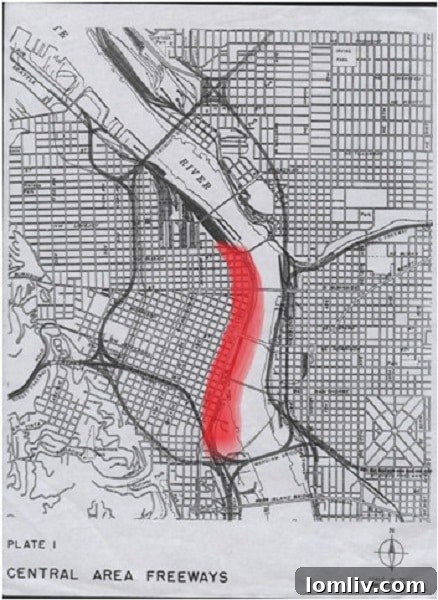
Harbor Drive uniquely bisected the downtown Portland loop and occupied prime riverfront real estate. Crucially, its removal only proceeded *after* traffic levels on that specific segment had significantly declined, primarily due to the opening of the Fremont Bridge, which provided an alternative route. Therefore, the demolition of Harbor Drive was a consequence of reduced necessity, rather than a proactive measure to alleviate congestion on a heavily used primary connector. Its removal did not disrupt the major flow of traffic in the city by severing a direct link between two critical freeways, making it fundamentally different from the proposed I-345 teardown.
West Side Highway (New York City)
Although cited by Mr. Kennedy as the “West Side Highway,” a more precise description for the demolished structure would be the “West Side Elevated Highway.” This aging, poorly designed elevated roadway, incapable of handling modern commercial traffic, was eventually closed in 1973 following a partial collapse. Critically, it was *replaced* by a new, modern, at-grade urban highway, which was completed in 2001. This case study’s relevance to the I-345 debate is highly questionable. The fact that a replacement was built, and the 28-year gap between the closure of the old highway and the completion of its modern successor, renders any direct comparison of “before and after” traffic flow statistics largely meaningless. It illustrates a reconstruction project, not a pure demolition without replacement.
Interstate 345 (Dallas): A Unique and Indispensable Artery
The functional role and traffic volume of I-345 in Dallas are dramatically different from all the case studies presented by Mr. Kennedy. The map below illustrates the major highway network within the I-635 loop in Dallas, providing a clearer context of I-345’s critical position.
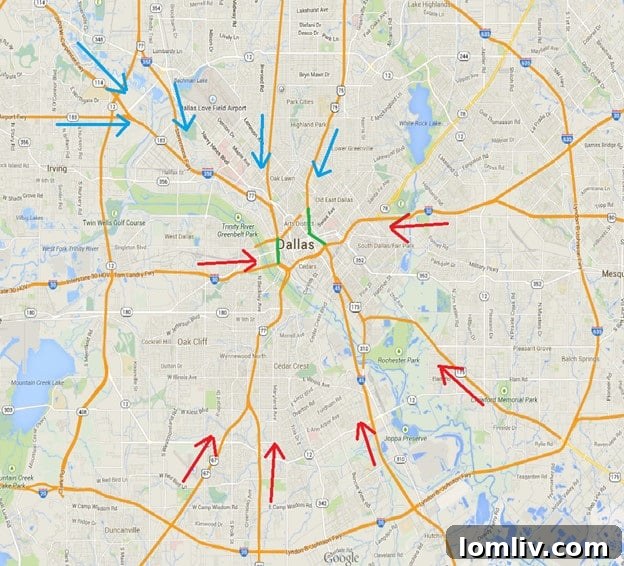
In Central Dallas, a total of five major “Northern” freeways—I-35E, US 75, Texas 114, Texas 183, and the Dallas North Tollway (indicated by blue arrows)—converge and feed traffic into the downtown loop. Similarly, six “Southern” freeways—I-30 from both east and west, I-45, US 67, US 77, and US 175 (indicated by red arrows)—connect into the downtown loop. These two extensive groups of freeways are interconnected by the two critical sides of the downtown loop itself (highlighted in green): I-345 on the east and I-35E on the west.
These two routes, I-345 and I-35E, function as indispensable choke points for traffic flowing between Dallas’s vast northern and southern freeway networks. The overall capacity of the entire highway system is directly limited by the capacity of these two crucial connectors. Their vital function is unequivocally demonstrated by the enormous volume of traffic that flows through them daily. If I-345 were to be removed, any traffic that didn’t miraculously “disappear” or manage to reroute onto the outer loops (Loop 12, I-635, Bush Turnpike) or local surface streets would be inevitably funneled through the notorious Mixmaster—the complex intersection of I-30 and I-35E, along with its adjacent freeway segments.
For anyone who regularly drives in Dallas, this prospect is nothing short of terrifying. The Mixmaster is already severely congested, routinely causing peak-hour backups on all freeways leading into and out of downtown. Shifting even a fraction of I-345’s substantial traffic volume to the Mixmaster would exacerbate conditions to an unbearable degree, impacting not only through-traffic but also the hundreds of thousands of daily commuters traveling into and out of downtown. To make matters worse, a significant portion of the Mixmaster is slated to undergo a three-year reconstruction as part of the “Horseshoe” project, during which conditions are projected to deteriorate even further. Common sense dictates that even if the eventual demolition of I-345 were considered, such a project should logically be staged to occur *after* the completion of these critical Mixmaster upgrades, not before or during.
This unique situation, coupled with the staggering 200,000 cars traveling on I-345 each day according to TxDOT’s 2012 traffic counts (or Mr. Kennedy’s more optimistic but inaccurate figure of 160,000), is vastly dissimilar to anything found in Mr. Kennedy’s cited case studies. Quantitatively, even the Embarcadero Freeway, the largest example he presented, only experienced approximately 100,000 cars per day. The qualitative differences are even more pronounced, leading critics to seriously question the integrity and honesty of attempting to rely on such inapt comparisons. Given Mr. Kennedy’s apparent intelligence, the most charitable assumption is that he is fully aware of these discrepancies but chooses to overlook them in pursuit of his broader agenda.
The debate surrounding I-345 is not merely about concrete and asphalt; it’s about the very soul of Dallas, balancing growth, accessibility, and quality of life for its rapidly expanding population. The next phase of this discussion will undoubtedly delve deeper into the vision for what constitutes a “world-class city” and how Dallas can achieve it without sacrificing the essential functionality of its urban core.