

As the holiday season draws near, the festive spirit often brings with it the inevitable reality of rising expenses. From gifts to travel, and perhaps most notably, the elaborate spreads that grace our tables, costs can quickly accumulate. Among these, the Thanksgiving feast stands out as a quintessential American tradition, a time for gratitude, family, and, of course, a bountiful meal. But beyond the joy of gathering, a pertinent question often lingers in the minds of many: how do these seasonal expenditures stack up against our ongoing financial commitments, particularly something as fundamental as housing?
In a creative and insightful exploration of this very question, ApartmentList, a prominent name in the housing market, introduced a unique metric: the “Turkey Index.” This ingenious index, conceived in 2016, aimed to quantify housing affordability by posing a relatable and somewhat whimsical query: how many Thanksgiving dinners would the average American need to forgo or host to cover their monthly rent? It’s a compelling way to visualize the economic realities of housing costs across different U.S. cities, using a universally understood symbol of American holiday spending.
The Turkey Index goes beyond mere numbers; it translates abstract financial data into a tangible, easy-to-grasp concept. Imagine the sheer volume of turkeys, the mountains of mashed potatoes, and the countless slices of pie required to equal one month’s rent. This methodology not only highlights the stark differences in the cost of living from one city to another but also brings a touch of humor and accessibility to what can often be a daunting subject – housing affordability. For many, the increasing cost of groceries, especially during peak holiday seasons, makes the connection between food bills and rent even more poignant.
To construct this insightful index, ApartmentList followed a clear and robust methodology. First, they leveraged their extensive database of hundreds of thousands of rental listings across the United States. This allowed them to accurately calculate the median price of a two-bedroom apartment in various cities, a common and representative dwelling size for many households. This median price serves as the baseline for the housing cost component of the index.
Next, they needed a standardized cost for the Thanksgiving dinner itself. For 2016, the nationwide average price of a complete Thanksgiving dinner, inclusive of essential items such as a turkey, savory stuffing, creamy mashed potatoes, and a delicious pie, was estimated at $51.50. This figure represented a modest 1.6% increase from the previous year, signaling the gradual but steady rise in food costs. To ensure accuracy and relevance for each specific locale, this national average dinner price was then carefully adjusted using a city-specific grocery cost index. This crucial step accounted for the fact that a basket of groceries in, say, New York City, would naturally cost more than the same basket in a smaller, less expensive market.
Finally, to arrive at the Turkey Index for each city, ApartmentList performed a simple yet powerful calculation: the median two-bedroom apartment rent was divided by the city-adjusted cost of a single Thanksgiving dinner. The resulting number revealed how many of these festive meals were equivalent to one month’s rent in that particular urban area. This innovative approach offers a fresh perspective on the cost of living, making it relatable to a broad audience by linking it to a beloved national holiday.
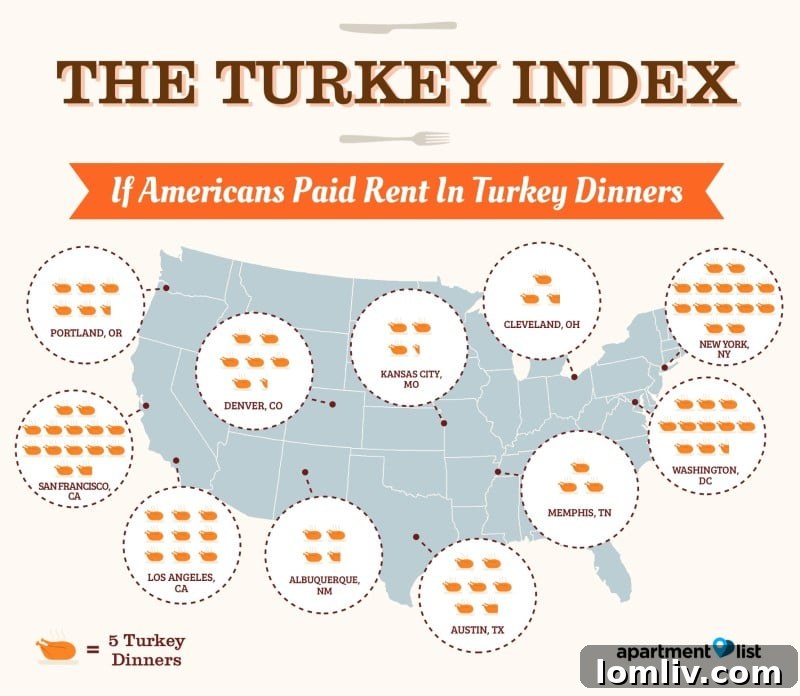
So, how did American cities stack up when their housing costs were measured in Thanksgiving dinners? The results, based on the 2016 analysis, offered a telling snapshot of the nation’s housing landscape. Unsurprisingly, some of the country’s most bustling and desirable urban centers topped the list, underscoring the severe housing affordability challenges prevalent in these high-demand markets. New York City, a global financial and cultural hub, emerged with the highest Turkey Index, requiring a staggering 70 Thanksgiving dinners to cover the monthly rent for a two-bedroom apartment. Imagine the sheer quantity of gravy, cranberry sauce, and pumpkin pie needed to reach that figure – it’s a vivid illustration of the immense financial hurdle residents face in the Big Apple.
Following closely were other economic powerhouses and desirable coastal cities. San Francisco, renowned for its booming tech industry and picturesque landscapes, demanded 68.7 turkey dinners. Washington, D.C., the nation’s capital, came in at 51.8 dinners, reflecting its robust job market and high demand for housing. Los Angeles, the sprawling entertainment capital, required 44.7 turkey dinners. These numbers not only highlight the premium associated with living in these vibrant metropolises but also emphasize the substantial portion of income that residents must allocate to housing, often leaving less for other essential expenses and discretionary spending. The lifestyle in these cities, while often offering abundant opportunities, comes with a significant financial commitment when it comes to rent.
On the opposite end of the spectrum, the Turkey Index revealed cities where housing was considerably more attainable, offering a breath of fresh air for those seeking more budget-friendly living arrangements. Cleveland, Ohio, presented one of the most affordable options, requiring only 13.1 Thanksgiving dinners to cover a two-bedroom apartment’s rent. This stark contrast vividly illustrates the diverse economic conditions and housing markets that exist across the country. Memphis, Tennessee, another city known for its rich cultural heritage and more accessible cost of living, demanded a mere 15.1 turkey dinners. Albuquerque, New Mexico, known for its unique Southwestern charm, was also on the lower end, asking for a modest 17.7 Thanksgiving feasts. These cities often attract individuals and families looking for greater purchasing power and a slower pace of life, where the dream of homeownership or simply affording rent feels more within reach.
The insights extend further, providing a regional breakdown that helps contextualize housing costs in rapidly growing states. For instance, in the Lone Star State, specific cities offered varying degrees of affordability. Those in Dallas, a major economic center in Texas, would need to shop for approximately 28.3 belt-busting turkey dinners to pay their monthly rent. Houston, another sprawling Texan metropolis with a strong energy sector, required 32 chances to “gobble ’til you wobble” – meaning 32 full Thanksgiving spreads. Austin, known for its vibrant tech scene, live music, and progressive culture, clocked in at 33.6 spreads, reflecting its increasing popularity and subsequent rise in living costs.
These Texas figures showcase the dynamic nature of housing markets even within the same state. While generally more affordable than coastal giants, the rapidly expanding economies and populations in Dallas, Houston, and Austin are gradually pushing up housing prices, making these cities less of a bargain than they once were. The Turkey Index serves as a fun yet effective reminder of how much residents in these growing hubs are committing to housing each month, turning a holiday metaphor into a powerful economic indicator.
Ultimately, the Turkey Index from 2016 was more than just a playful comparison; it was a clever way to highlight a critical socioeconomic issue – housing affordability. It transformed complex rental market data into an accessible and memorable narrative, prompting individuals to think differently about what their rent truly costs. Whether you reside in a city where rent demands an entire flock of turkeys or just a few modest birds, this index offers a compelling perspective on the financial realities of housing across the diverse landscape of the United States. It encourages a deeper conversation about urban planning, economic development, and how we can work towards making housing more accessible for everyone, ensuring that the burden of rent doesn’t overshadow the joy of life’s simple, abundant pleasures, like a shared Thanksgiving meal.
The study also implicitly touched upon the rising grocery costs, a topic that continues to resonate today. The 1.6% increase in the average Thanksgiving dinner price from the previous year, though seemingly small, is part of a larger trend that impacts household budgets year-round. When combined with ever-increasing rent, these factors paint a clear picture of the financial pressures faced by many Americans. Creative metrics like the Turkey Index provide not only data but also a relatable context, making the abstract challenges of the economy tangible for everyone.
In conclusion, ApartmentList’s Turkey Index from 2016 offered a deliciously digestible insight into the state of housing affordability across the U.S. By cleverly juxtaposing the cost of a beloved holiday feast against monthly rent, it provided a memorable and thought-provoking analysis. It served as a timely reminder that while we gather to give thanks for our blessings, the economic realities of housing continue to be a significant consideration for millions of Americans, turning a simple meal into a powerful symbol of urban living costs and financial planning.