

In a week marked by fluctuating economic indicators and evolving market sentiments, two prominent reports on the U.S. real estate landscape presented seemingly contradictory narratives. On one hand, Realtor.com optimistically declared a rebound in the luxury housing market, questioning the very notion of a recession within this high-end segment. Conversely, ATTOM Data Solutions unveiled findings suggesting a nationwide increase in home affordability. This apparent dichotomy—where the wealthy seem to be opening their checkbooks while the average homebuyer finds relief in smaller payments—raises pertinent questions about the true state and future direction of the real estate sector. Understanding these contrasting viewpoints requires a deeper dive into the methodologies and focus areas of each report, revealing a more nuanced picture of market segmentation and the diverse impacts of recent economic shifts.
The juxtaposition of a luxury market surge with improved affordability might initially appear counterintuitive. However, these reports, when examined individually and then collectively, illuminate the complex interplay of factors currently shaping housing trends across different income brackets and geographical regions. This article aims to unpack these findings, analyze the underlying data, and explore the broader implications for buyers, sellers, and the overall economic recovery. From the aspirational searches of luxury seekers to the tangible financial metrics of affordability, we will navigate the intricate landscape of the contemporary U.S. real estate market, seeking clarity amidst conflicting headlines.

Realtor.com: Navigating the Digital Footprint of Luxury Housing
Realtor.com, a leading online real estate platform, bases its market analysis largely on digital engagement metrics, such as website searches and clicks. Their methodology, while providing valuable insights into consumer interest and sentiment, often reflects the vagaries of online behavior rather than immediate transactional realities. While tracking increases and decreases in search activity can signal market health, particularly in specific segments, it’s crucial to acknowledge the potential disconnect between casual browsing and committed purchasing. The “lookie-loo” phenomenon, where individuals explore high-end properties for inspiration or entertainment rather than serious buying intent, can significantly skew these digital engagement figures. To fully validate Realtor.com’s assertions, one would ideally need to correlate these clicks with actual purchase data and track the conversion journey, including the time it takes from initial search to a completed sale.
Realtor.com’s recent “Luxury’s Back” headline predominantly highlighted a surge in search activity within upscale suburban markets. These areas, often located outside major former COVID-19 epicenters like New York City and Los Angeles, include locales such as The Hamptons, Greenwich, Connecticut, key New Jersey counties bordering New York City, and Palm Springs near Los Angeles. This observed trend is highly reflective of the shifting priorities among affluent homebuyers. The experience of living through lockdowns in densely populated, cramped urban environments has undeniably amplified the appeal of spacious suburban living, especially with the accelerated adoption of remote work models. The desire for more square footage, private outdoor spaces, and a change of scenery has driven significant interest in these luxury suburban enclaves.
While this migration pattern is understandable, the long-term impact on previously less affected regions is a pressing question. For instance, as Texas navigates its own unique public health challenges, it remains to be seen if Dallas’s outer suburbs and exurbs will witness similar benefits from an influx of buyers seeking space and a change of pace once current viral concerns subside. Looking at New York City itself, Realtor.com’s report noted that prices for luxury properties had “remained steady.” This ‘steadiness’ is, in fact, an improvement, given the multi-year declines experienced in the city’s luxury market, largely attributed to an oversupply of newly constructed high-rises prior to the pandemic. The market is showing signs of stabilization rather than a dramatic boom, which is a different narrative than what the headline might suggest.

Conversely, certain remote luxury destinations have experienced a slowdown in search activity. Places like Honolulu, Key West, Florida, Pebble Beach, California, and various Colorado ski towns have seen reduced interest. These locations often require extensive travel, with Honolulu, for example, being a minimum six-hour flight from the mainland U.S. Such inaccessibility makes them less attractive for those seeking immediate, drive-able escapes or second homes during periods of uncertainty. In the case of Honolulu, which typically refers to the entire island of Oahu, the slowdown can also be attributed to local policy changes, particularly the crackdown on Airbnb and short-term rentals in the preceding year. This regulatory shift meant that many homeowners who relied on short-term rental income to cover their mortgages were financially challenged, reducing buying activity unrelated to the pandemic. Despite this, segments of the Honolulu market continue to thrive, exemplified by a recent cash sale of a unit in a Honolulu building that closed in under two weeks for over the asking price ($965,000 for 540 square feet), indicating that ultra-motivated or cash-rich buyers remain active.
A closer examination of Realtor.com’s language also reveals an interesting perspective on market shifts. A 9.5 percent decline in April luxury property clicks was termed a “plummet,” while a subsequent 7.3 percent increase in May, signaling a return to a new normal, was described as “shooting up.” Yet, a more significant 15.6 percent drop in overall listings was simply a “drop,” and a 25 percent increase in selling time—from 71 to 89 days—was merely noted as “taking a bit longer.” This choice of terminology highlights the subjective interpretation of data and how framing can influence perception of market severity or recovery. For Dallas, Realtor.com reported that million-dollar-plus property listings decreased by 24 percent in May, with asking prices down 2 percent year-over-year. However, searches for such properties only fell by 2 percent, suggesting that while fewer ultra-luxury properties were coming to market, buyer interest remained relatively robust. This disparity could also imply that a few highly expensive listings were simply withheld from the market, disproportionately affecting the overall listing count. It is crucial to remember that the $1 million-plus market in Dallas constitutes less than 2 percent of the total market, making it particularly susceptible to skewed statistics from even a small number of properties.
ATTOM Data Solutions: Unpacking Home Affordability in Challenging Times
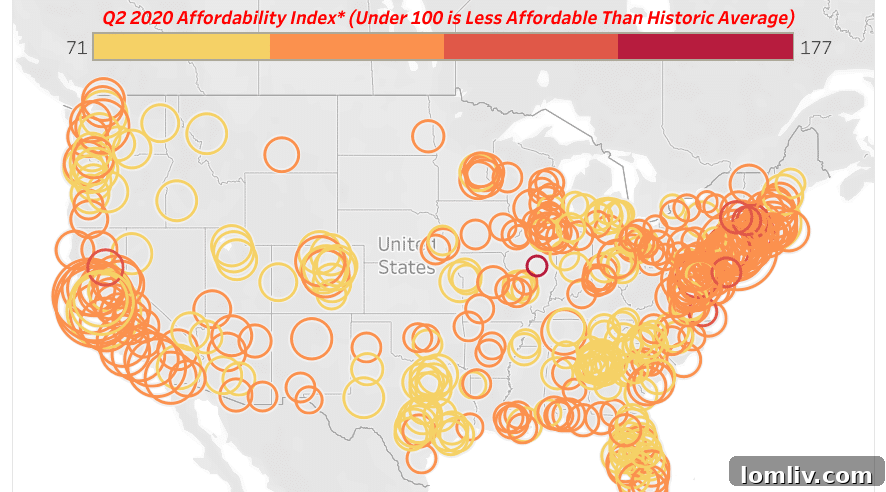
In contrast to Realtor.com’s luxury-focused, search-driven analysis, ATTOM Data Solutions’ Q2 U.S. Affordability Report offers a broader, more granular perspective on homeownership accessibility for the average American. True to its title, this report zeroes in on “affordability,” meticulously measuring 406 counties across the nation, each with a population exceeding 100,000 and reporting more than 50 housing unit transactions. ATTOM’s definition of affordability extends beyond just home prices and mortgage payments. It integrates a comprehensive suite of financial components, including prevailing wage growth, property taxes, and insurance costs, offering a holistic view of the financial burden associated with homeownership. This method provides a more robust and realistic assessment of what it truly takes for an average family to afford a home.
The report calculates affordability by considering the median-priced home in a given county, factoring in a standard 3 percent down payment, and assuming a 28 percent debt-to-income (DTI) ratio allocated for housing expenses. This required income is then weighed against the average local wages, essentially providing a ratio of what an average resident earns versus what it costs to comfortably own a home in their area. This detailed calculation reveals a significant shift: in the second quarter, 200 of the 406 analyzed counties were deemed more affordable compared to the previous year, a notable improvement from the mere 126 counties that were considered affordable before. ATTOM attributes this positive trend primarily to two key drivers: increases in average wages and the sustained decline in mortgage rates. These factors have collectively contributed to lowering the monthly cost of homeownership for many, even in the face of some level of price appreciation. This confluence of lower interest rates and modest wage growth creates a rare “small win-win” scenario for both buyers benefiting from reduced monthly payments and sellers seeing continued, albeit tempered, price stability.
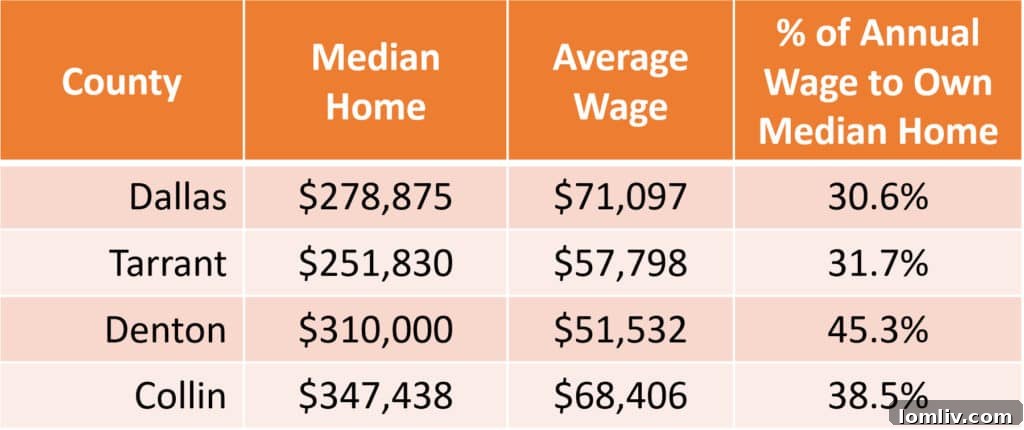
However, despite these improvements in overall affordability, ATTOM’s report also casts a cautionary shadow. A significant 74 percent of average wage earners would still need to allocate more than 28 percent of their gross wages towards housing expenses. This figure, exceeding the conventional DTI threshold often used by lenders as a benchmark for financial comfort, places a substantial portion of the population at greater financial risk. It highlights the persistent challenge of housing affordability, even in markets showing improvement. For instance, in Dallas County, a median-priced home of $278,875 would demand 30.6 percent of an average annual wage of $71,097. The situation is even more pronounced in neighboring Denton County, where 45.3 percent of average wages would be required for housing costs. While these figures are not ideal, they pale in comparison to the nation’s least affordable spot: Marin County, California, just north of San Francisco, where a staggering 109.4 percent of average annual wages would be needed to purchase a home. At the other end of the spectrum, places like Decatur, Illinois, offer extreme affordability, requiring just 10.4 percent of a salary for a home, albeit often in areas with fewer economic opportunities or amenities, illustrating the stark trade-offs in the housing market.
This comprehensive calculation from ATTOM is particularly insightful because it integrates multiple financial components to paint a clearer picture of real purchasing power. The impact of falling interest rates and rising wages is evident; these factors collectively help mitigate the impact of rising home prices on monthly payments. This is especially relevant in markets like Dallas, which have experienced rapid price increases since the last recession. ATTOM noted an 11 percent surge in Dallas County home prices over the past year alone. While lower interest rates and increased wages cannot entirely offset such rapid appreciation, they do make a significant dent, helping to stabilize the market for many. In fact, Dallas ranks fourth nationally in terms of home prices outpacing wage increases year-over-year, underscoring the delicate balance between market growth and sustainable affordability.
A Nationwide Perspective: Resilience Amidst Uncertainty
Across the nation, the real estate market has demonstrated remarkable resilience, largely defying predictions of a catastrophic downturn. Far from a “sky is falling” scenario, reports from various regions consistently point to a crucial factor maintaining market stability: a significant drop in housing inventory for sale due to the COVID-19 pandemic. This reduced supply has, in turn, helped to keep prices firm and the time homes spend on the market relatively stable. For example, in Illinois, May closings saw a substantial 34 percent statewide decline, yet prices only dipped by a marginal 1.4 percent. Chicago itself experienced an even sharper drop in May closings at 43.6 percent, but remarkably, prices actually saw a slight increase of 0.2 percent. Furthermore, the “days on market” metric remained steady year-over-year, averaging 53 days statewide and 39 days within Chicago, indicating that while fewer homes were selling, those that did were moving at a consistent pace.
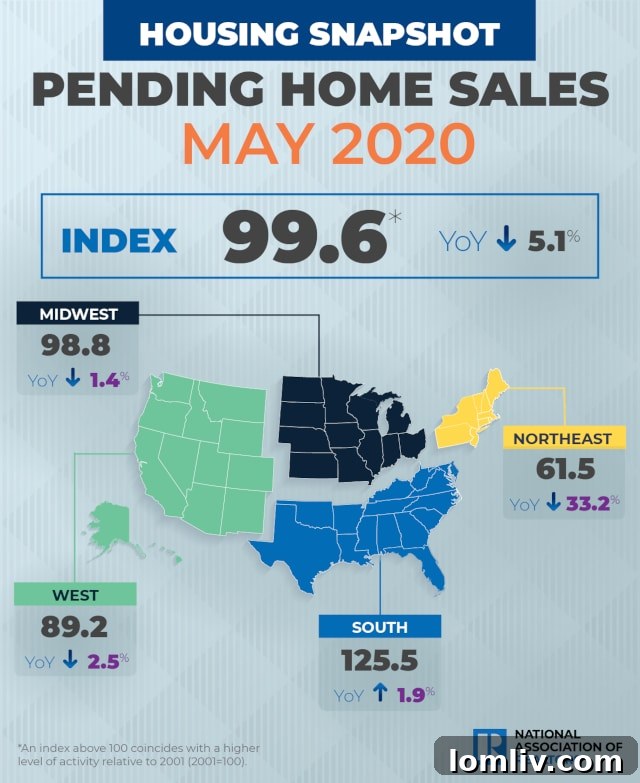
Adding to this picture of resilience, an update from the National Association of Realtors (NAR) on June 29 revealed a substantial rebound in market activity for May. As states began to ease stay-at-home orders, pending home sales contracts surged by a record-setting 44.3 percent month-over-month, while new home sales also rose significantly by 16.6 percent. This powerful resurgence underscores the pent-up demand and the market’s underlying strength once restrictions began to lift. Lawrence Yun, NAR’s chief economist, expressed an optimistic outlook, stating, “The outlook has significantly improved, as new home sales are expected to be higher this year than last, and annual existing-home sales are now projected to be down by less than 10%…” This revised forecast suggests a much swifter and stronger recovery than initially anticipated, driven by low mortgage rates and a renewed sense of confidence among homebuyers who were on the sidelines during the peak of the lockdowns. The constrained inventory, combined with robust demand, continues to be a defining characteristic of the current market, contributing to price stability and even appreciation in many areas.
Unemployment: The Ultimate Market Indicator and Social Divisor
While various market indicators paint a picture of stability, particularly in the home buying and selling sectors, the true long-term health of the economy, and by extension the housing market, will ultimately be dictated by unemployment figures. Currently, interest rates, investment gains, and modest wage increases are collectively providing a stabilizing confidence to both the high-end and more affordable segments of the market. However, a persistent challenge remains in new home construction. Despite a significant dip in April, May still saw a 12 percent year-over-year decrease in new construction. This continued shortfall in new housing stock will inevitably tighten supply further, placing upward pressure on prices across various market segments. Although there has been a contraction in home sales, this is largely driven by a scarcity of listings rather than a collapse in buyer demand. Current market dynamics strongly suggest that the economic repercussions of unemployment are disproportionately impacting renters more than those who already own homes or are in a position to buy.
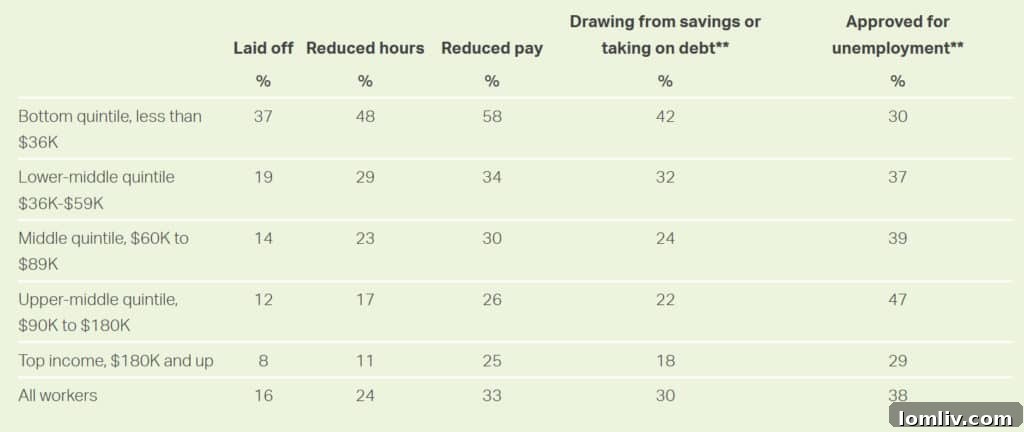
This assumption is starkly supported by recent data from Gallup this month, as illustrated in the chart above detailing the unequal distribution of economic harm from COVID-19 by income bracket. The findings are sobering: among workers earning less than $36,000 annually, a staggering 95 percent have either been laid off (37 percent) or experienced reduced pay (58 percent). Yet, only 30 percent of those laid off in this income bracket were approved to receive unemployment benefits. Contrast this with the highest income bracket, where only 8 percent faced layoffs and 33 percent suffered reduced pay. Crucially, despite significantly fewer layoffs, only one percent fewer in the highest income bracket received unemployment benefits compared to the lowest. This glaring disparity underscores a profound economic and social divide, where lower-income individuals bear the brunt of job losses and financial instability with less access to a safety net, while higher-income individuals navigate the downturn with greater financial resilience and better support systems.
Stepping out on a limb here, one can reasonably infer that as income levels ascend, so too does the likelihood of homeownership, creating a reinforcing cycle of economic security. This stark economic stratification often correlates with broader societal demographics, including racial and ethnic lines. The current economic landscape, therefore, is not merely a story of market numbers but a vivid illustration of deepening inequality. The home buying and selling market, particularly for those with stable employment and financial assets, remains surprisingly robust with several potential bright spots. However, for those of us who have retained our jobs and financial stability, navigating this period of relative market strength is often accompanied by a distinct sense of “survivors’ guilt,” acutely aware of the widespread economic hardship afflicting a significant portion of the population. This complex interplay of market resilience and social vulnerability defines the current era in real estate.