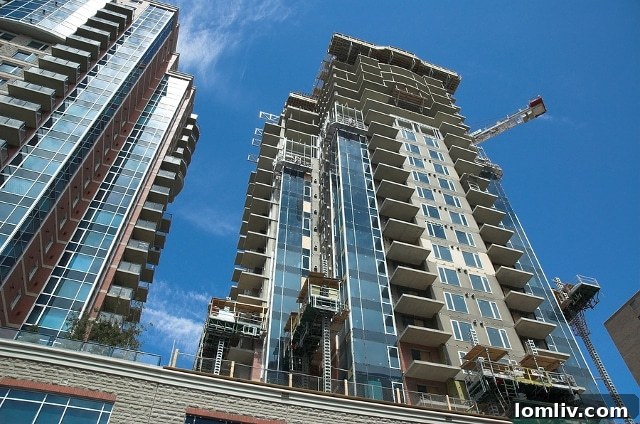
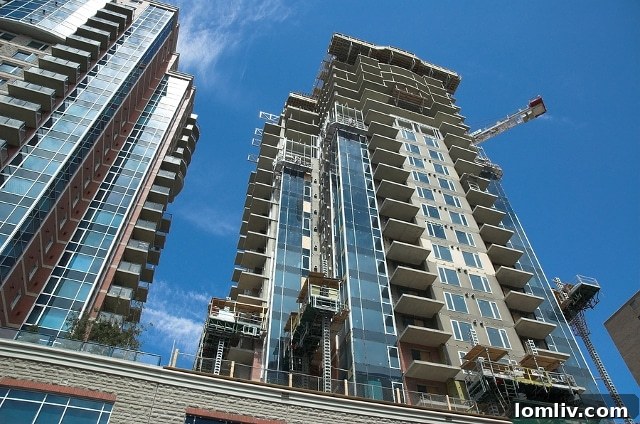
In the dynamic landscape of real estate, understanding market shifts is crucial. While our previous discussion focused on the resurgence of single-family home construction following the deficit created by the Recession, we acknowledged that the supply still falls short of meeting demand, keeping prices stubbornly high. Now, we turn our attention to another pivotal sector: multifamily construction. This segment, particularly vibrant in bustling urban centers like Dallas, is often seen as the gateway for younger generations and first-time homebuyers who are not yet ready for, or simply prefer not to pursue, a suburban lifestyle. However, even within this sector, unique challenges and market dynamics are at play, shaping the future of urban living and homeownership in Texas.
The Shifting Tides of Homeownership: Apartments Reign Supreme
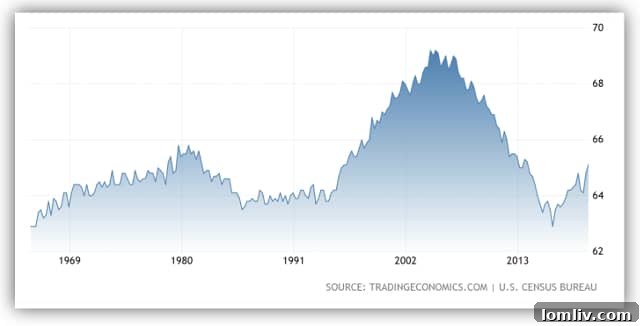
Across Texas, a distinctive trend has emerged: apartments, rather than condos, dominate the multifamily housing market. This shift largely stems from the profound impact of the 2008 financial crisis and subsequent recession, which fundamentally altered consumer confidence and housing preferences, pushing many towards renting. The chart above provides a compelling historical overview of homeownership rates, tracing back several decades. It reveals a period of relative stability between 64 and 66 percent until the mid-1990s. During this time, a confluence of political rhetoric and government programs actively encouraged homeownership, leading to a significant spike to roughly 69 percent as the housing bubble inflated. However, this artificial high was unsustainable, and rates dramatically collapsed to approximately 63 percent in the wake of the crisis, only beginning to meaningfully rebound around 2015.
This data underscores a critical insight into the housing market’s sensitivity: even seemingly minor fluctuations in homeownership rates—a mere six percentage points between the low of 63 percent and the peak of 69 percent—can trigger colossal ripple effects across the entire residential sector. These shifts influence everything from housing demand and construction volumes to property values and rental market dynamics. The journey of homeownership in America, particularly in growth markets like Dallas, is a complex narrative influenced by economic cycles, policy decisions, and societal preferences. The post-Recession era, characterized by cautious financial behavior and tightening credit markets, solidified renting as a viable, often necessary, alternative for millions, especially in the absence of affordable ownership options.
Cheap Money Doesn’t Always Lead to High Homeownership
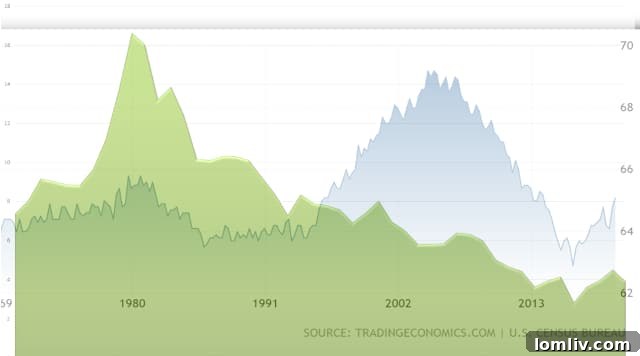
A common misconception is that readily available and inexpensive mortgage money directly translates to soaring homeownership rates. However, the accompanying chart, which juxtaposes 30-year fixed mortgage rates (green line) with homeownership rates (blue line), emphatically debunks this notion. These two critical indicators do not move in perfect synchronicity. Instead, homeownership is far more profoundly shaped by overarching economic forces that dictate personal financial stability and confidence. Factors such as economic recessions, employment stability, and real income growth play a much more significant role than interest rates alone.
Consider the stark disconnect observed in the late 1970s and early 1980s. During this period, mortgage rates skyrocketed, at one point approaching an astonishing 17 percent, yet homeownership rates simultaneously reached a peak. This counter-intuitive trend highlights the power of robust economic conditions, job security, and a general sense of financial optimism to drive home purchases, even in the face of high borrowing costs. Conversely, following a slight downturn, homeownership rates began to rebound in the mid-1990s, peaking again in 2006-2007, a period characterized by increasingly accessible and affordable credit. However, the subsequent Recession-induced collapse in homeownership rates vividly demonstrated that even historically low interest rates were insufficient to sustain ownership when widespread unemployment and overextended personal finances became prevalent. This era underscored that while cheap money might facilitate purchases, a healthy job market and sustainable personal wealth are the true bedrock of widespread homeownership. Without these foundational elements, the allure of low interest rates can quickly crumble under economic pressure, proving that affordability is a function of both borrowing costs and the ability of households to comfortably manage their debt obligations amidst their overall financial picture.
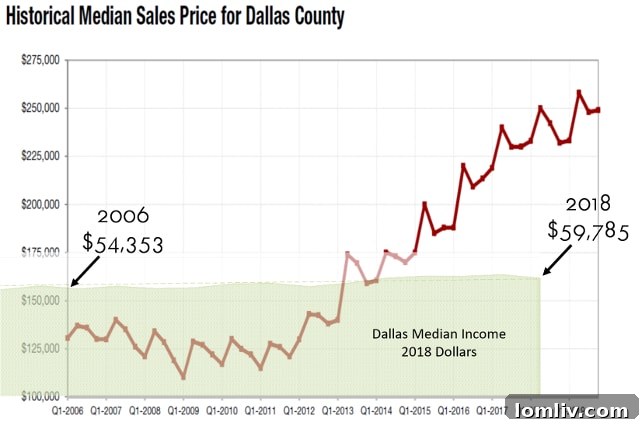
The Affordability Crisis: Stagnant Wages vs. Soaring Home Prices
Today, we can definitively state that the dramatic escalation in home prices, particularly in high-demand markets like Dallas, has been largely fueled by a prolonged period of exceptionally low interest rates. This situation becomes problematic when viewed alongside the stagnation of median incomes, which have remained essentially flat for decades. The chart illustrating median home prices against median income in Dallas County paints a stark picture of this growing disparity. While a modest median income bump of approximately $5,500 occurred between 2006 and 2018, it offered virtually no relief for housing affordability. This is because home prices began their steep ascent in 2012, propelled by a rebounding consumer confidence and, critically, five years of severely curtailed homebuilding activity.
To put this into sharper perspective: in 2006, the median home price in Dallas County was roughly twice the median income. Astonishingly, today, that ratio has nearly doubled, reaching almost four times the median income. This widening gap creates an immense barrier to entry for many potential homebuyers. In this environment, mortgage interest rates face severe limitations on how much they can realistically increase. Any significant hike would necessitate either robust and sustained wage growth—a phenomenon largely absent for the past three decades—or a substantial collapse in housing prices. Given that a dramatic collapse in property values is undesirable for homeowners, lenders, and the broader economy, we find ourselves in a precarious situation. The market is essentially treading water, with homeowners benefitting from appreciation while prospective buyers are sidelined by unaffordable prices and stagnant wages. Building a greater variety and volume of housing, particularly in the entry-level and mid-range segments, remains an essential part of the solution to alleviate this pressing affordability crisis and restore balance to the Dallas real estate market.
The Plight of First-Time Buyers and the Elusive Condo Market
The combination of rapidly rising home prices—driven by a persistent short supply—and the relentless stagnation of wages has effectively pushed a significant portion of the population out of the homeownership market. This reality is particularly acute for younger, first-time buyers who often carry the additional burden of substantial student loan debt. For this demographic, renting is frequently the only viable alternative to the unappealing prospect of moving back into their parents’ homes. The dream of owning property in a vibrant city like Dallas often remains just that—a dream, deferred indefinitely by economic realities.
In theory, condominiums could present a compelling answer for some of these buyers. Their typically smaller sizes and, consequently, lower price points could make homeownership more accessible. Unfortunately, the Dallas market currently offers very few such options. The limited condo inventory available often comes with seven-figure price tags, placing them firmly out of reach for the majority of first-time or even second-time homebuyers. The best many of these aspiring homeowners can hope for is a larger, and invariably more expensive, townhouse—a compromise that still often stretches their financial capabilities.
Is Dallas Preparing for Tomorrow’s Condos Today?
The scarcity of reasonably-priced condos in Texas, and particularly in Dallas, is not accidental; it’s deeply rooted in the state’s regulatory environment. I’ve previously highlighted how specific Texas regulations effectively deter condo construction. A key deterrent is the requirement that developers of multifamily projects must indemnify buildings against construction defects for a full 10 years. While intended to protect consumers, this stipulation has created a significant disincentive for developers. It has led to scenarios where condo Homeowners Associations (HOAs), just shy of the 10-year mark (e.g., at 9 years, 11 months), suddenly discover a litany of alleged defects—some legitimate, others potentially spurious—for which they demand compensation. This extended liability period transforms every condo project into a “10-year time bomb” for developers, creating immense financial risk and uncertainty. Consequently, developers overwhelmingly opt to build apartments, where a single owner (the developer or a subsequent institutional investor) maintains control over the property, simplifying defect resolution and liability management. This structure often allows them to negotiate more favorable insurance terms or even secure exemptions from the stringent 10-year policy, making apartments a far more predictable and profitable venture.
This long-standing regulatory landscape has often led me to ponder, in conversations with developers, a fascinating question: will any of the numerous new apartment blocks—especially the two dozen or so high-rise apartment towers recently completed or currently under construction across Dallas—eventually convert to condos once they cross the 10-year ownership threshold? If historical homeownership rates continue their gradual return and Dallas continues to attract new residents from traditionally condo-rich markets, a strategic conversion could make significant economic sense, particularly after an apartment building’s original construction costs have likely been amortized or paid off. Such a conversion would unlock a new segment of the market and potentially offer a lucrative exit strategy for developers or long-term investors.
Lessons from Chicago: The Cyclical Nature of Multifamily Assets
To seek answers, one might look to more mature, condo-heavy markets, such as my hometown of Chicago. I vividly recall the 1980s, a period when many charming, older 1920s walk-up apartment buildings were extensively converted into condos, meeting a surging demand for urban homeownership. Fast forward to today, and the market has swung in the opposite direction. Residents in reasonably-priced condos are now finding themselves battling a wave of forced sale “de-conversions” where entire condominium buildings are bought out by developers and reverted back into rental apartments. In some ironic twists, the very same 1920s apartment buildings that transitioned to condos in the 80s are now being re-converted back into rental units, illustrating the cyclical nature of multifamily assets based on market demand and investment strategies.
The high-rise space is equally susceptible to these market forces. Many 1960s and 1970s buildings, now decades old, face significant challenges. Often, their HOAs are underfunded, unable to cover the escalating costs of major maintenance, repairs, and necessary modernizations. In such situations, a developer offering to buy out the entire building is often seen as a “white knight”—a welcome solution to a looming financial crisis for the existing condo owners. This dynamic underscores that in markets with a more established condo inventory, buildings frequently vacillate between apartment and condo status, adapting to prevailing economic conditions, investor appetite, and residential preferences.
Dallas’s Future: A Decade-Long Condo Vacuum?
Dallas has certainly seen its share of such transformations, even if on a smaller scale compared to Chicago. Iconic properties like The Shelton in Preston Center have undergone multiple metamorphoses, transitioning from apartments to condos, back to apartments, and then again to condos. The Athena began its life as apartments, while The Renaissance, originally conceived as apartments, strategically converted to condos even before its grand opening. Even 3883 Turtle Creek, with its storied history, started as HUD housing before its eventual upscale reincarnation.
Given these precedents and the evolving market dynamics, I foresee some of Dallas’s current high-rise apartment towers eventually converting to condos later in this decade. While this prospect might be viewed as good news for the long-term diversity of Dallas’s housing stock, it simultaneously presents a significant, decade-long vacuum of reasonably-priced condo products for eager first-time buyers. This limited supply in a high-demand market will inevitably exert upward pressure on prices, maintaining them at elevated levels for the foreseeable future. This situation creates a distinct challenge for Dallas’s urban planning and affordability goals.
Ultimately, this extended analysis explains why condo prices in Dallas are likely to remain prohibitively high for quite some time. Unlike the single-family market, which is showing signs of self-correction, the growing demand for condos in urban Dallas is not being adequately met by new construction. This supply-demand imbalance is predominantly a consequence of Texas’s unique and often restrictive regulatory environment concerning multifamily liability. Furthermore, the minimal new condo construction that does occur is almost exclusively targeted at the ultra-luxury buyer, leaving a vast segment of the market—including young professionals and first-time homeowners—without accessible ownership options. Addressing this fundamental disconnect between demand and supply, spurred by regulatory reform and innovative development strategies, will be critical for the sustainable growth and equitable access to housing in the Dallas metropolitan area.