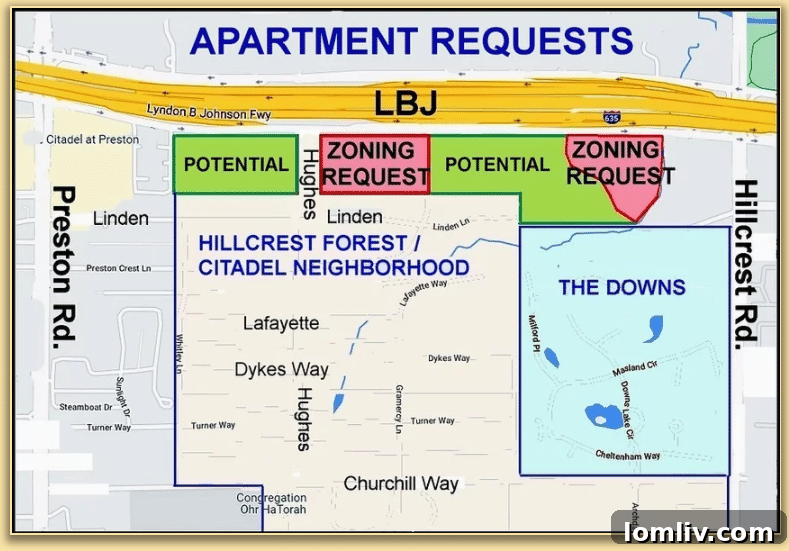
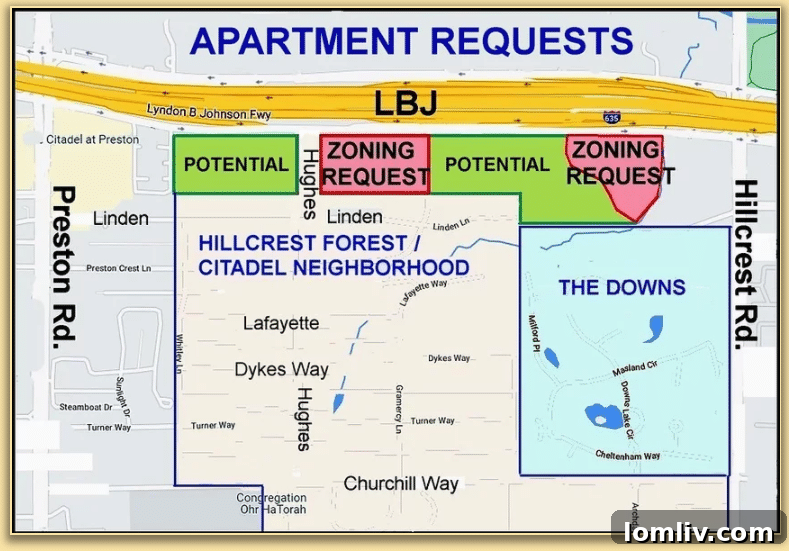
The evolving landscape of urban development often creates a delicate balance between progress and preservation. In Dallas, this dynamic tension is currently playing out in the vibrant LBJ/Preston Hollow area, specifically concerning the proposed development along the LBJ Corridor. For longtime residents like Bruce Wilke, who has called Dallas’ Hillcrest Forest neighborhood home for nearly four decades, the discussion is not about opposing growth outright, but ensuring it is responsible, compatible, and respects the existing community fabric.
As president of the Hillcrest Forest neighborhood association, Wilke articulates the profound concerns shared by many of his neighbors. While acknowledging the need for new development, residents are acutely worried about the potential for increased noise pollution, a surge in cut-through traffic, the architectural incompatibility of large structures next to single-family homes, and the far-reaching precedent that could be set by constructing seven-story apartment complexes directly adjacent to established residential areas along the critical LBJ Corridor. This ongoing debate highlights a common challenge in rapidly growing cities: how to integrate new housing and commercial spaces without eroding the quality of life for existing communities.
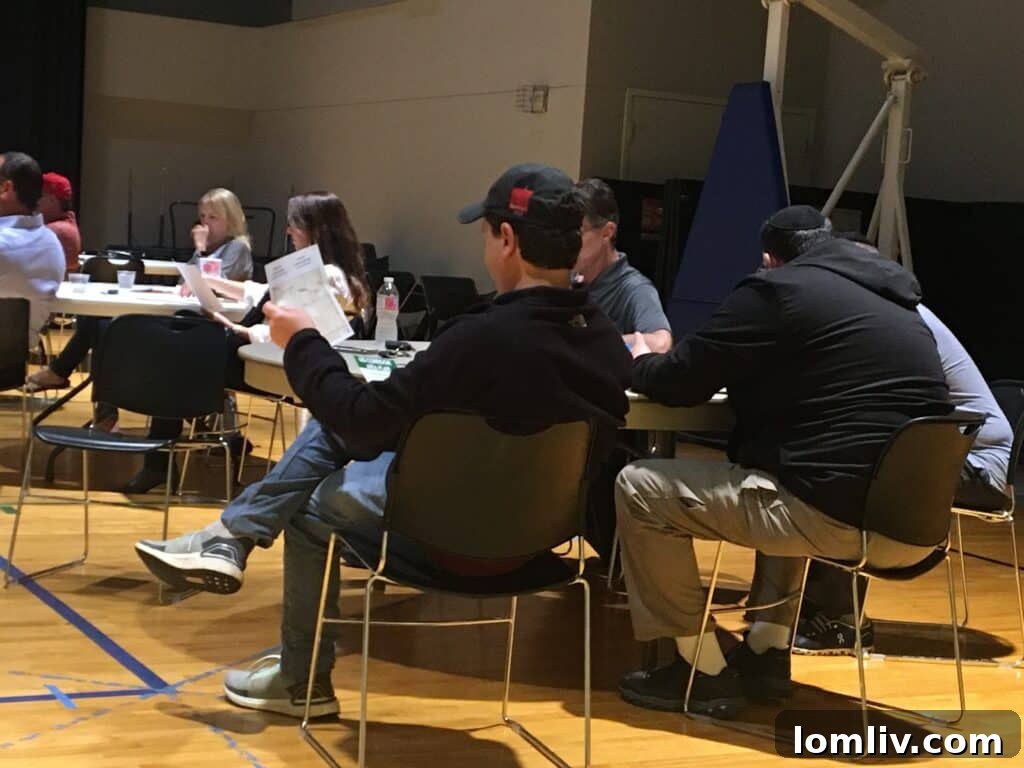
The path to open dialogue on this significant issue has been fraught with challenges. Wilke was among approximately 70 frustrated residents who gathered for a public meeting on the topic. The assembly, held at King of Glory Lutheran Church, was abruptly halted after merely 20 minutes of discussion due to the activation of tornado sirens, forcing attendees to disperse. This disruption followed a previous public meeting where the room booked by consultants proved too small to accommodate all interested residents, leading to about 30 people being turned away. Wilke succinctly captured the community’s frustration, stating, “Tonight, there were over 70 people there — I counted — and the tornado siren goes off. This was the second time that our Hillcrest Forest residents have tried to participate and left frustrated.” The community is now urged to return to King of Glory, located at 6411 LBJ Freeway, Dallas, on Tuesday, March 22, at 6 p.m., to resume these vital discussions, hoping for an uninterrupted forum.
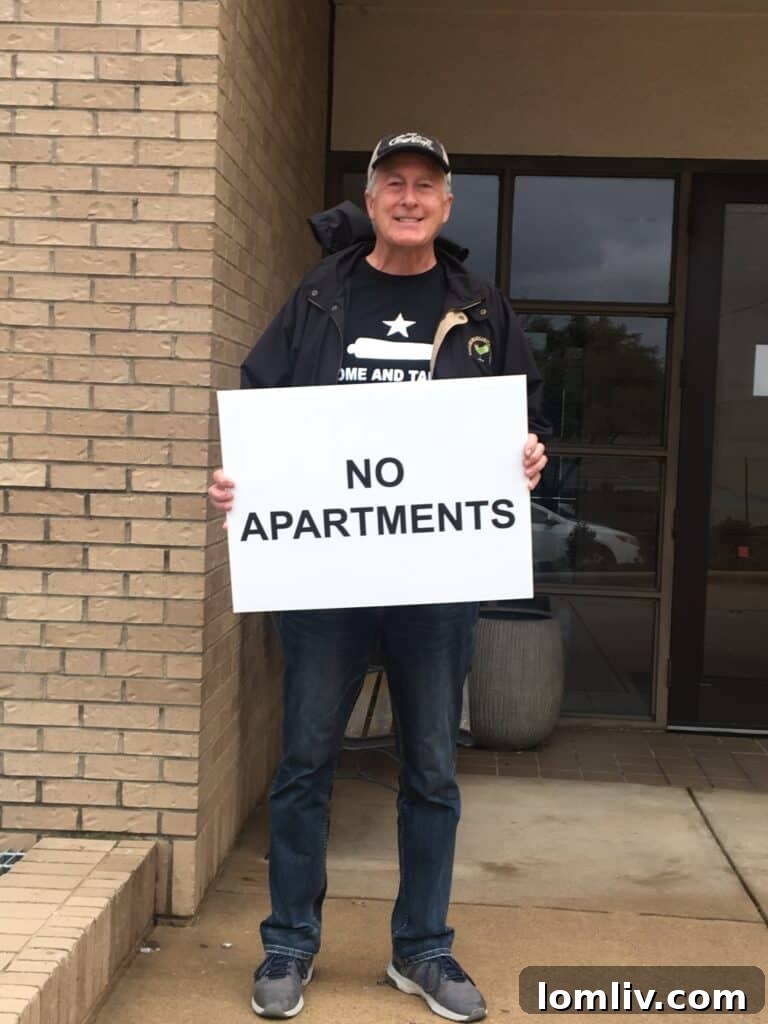
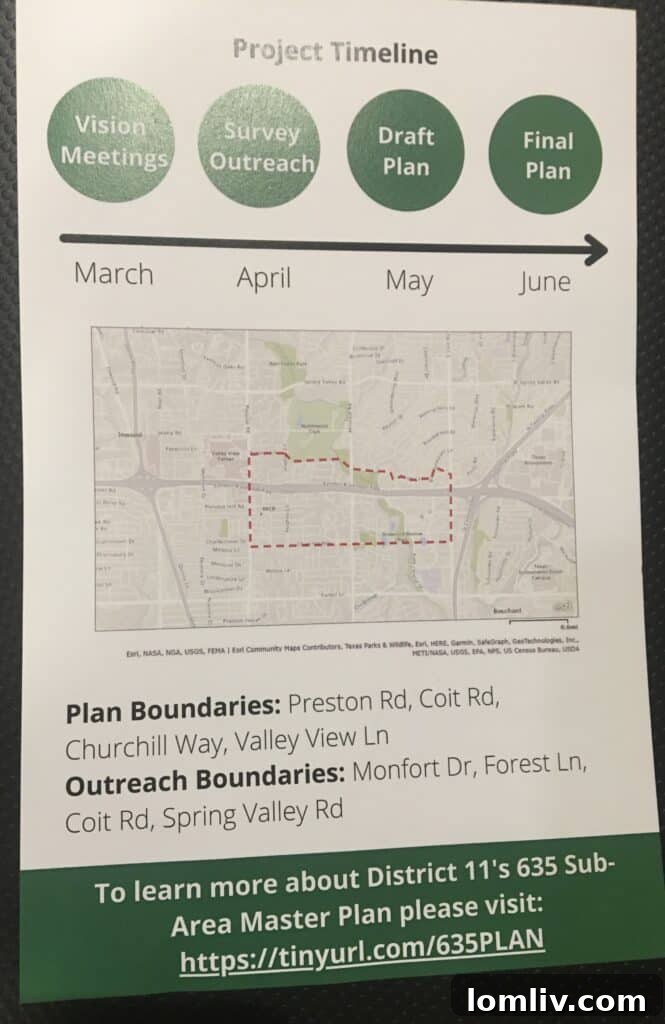
During the brief window for questions at the Monday meeting, a recurring theme emerged among residents: the funding mechanism behind the team of planning consultants. Evelyn Mayo of Rayo Planning, the firm spearheading the study, repeatedly explained that her company was selected by Dallas City Councilwoman Jaynie Schultz and is funded by members of a steering committee dedicated to studying development within the corridor. However, the exact breakdown of who is contributing how much remains unclear, fueling suspicion among residents. Many are convinced that developers, specifically RD Investment Properties (affiliated with the Related Group), are shouldering the substantial $115,000 cost of the LBJ corridor study, which is anticipated to be completed this summer. This perceived lack of transparency regarding funding sources only adds to the community’s apprehension about the objectivity and ultimate recommendations of the study.
For those seeking deeper historical context and independent analysis on this developing story, Candy Evans, a resident of the nearby Hillcrest Estates, has conducted extensive research on this topic, published after last week’s initial meeting. Her insights provide a valuable independent perspective on the complexities and implications of potential rezoning and high-density development along the LBJ Corridor.
Understanding the Neighborhood’s Stance on Development
At the heart of the community’s concerns lies the specific site being considered for these high-rise apartments. This 7.5-acre parcel, currently occupied by three modest two-story office buildings, is nestled amidst approximately 1,800 established homes. These residences include million-dollar-plus properties in prestigious neighborhoods such as Hillcrest Forest, The Downs, and Hillcrest Villas. The proximity of the proposed development is a major flashpoint. Wilke emphasizes the direct impact on neighboring homes, stating, “Our board is concerned about the single-family homes that back up to the offices. They’re literally 15 feet away from our homes.” This close proximity makes any significant change in height or density a direct threat to the privacy, sunlight, and overall residential character of these properties.
Currently, a formal rezoning proposal is not before the Dallas City Council or planning commission, making it somewhat premature to fully assess how seriously residents’ input is being weighed. The consultants assert that the primary objective of the ongoing study is to anticipate future zoning needs by developing a plan that reflects the types of properties and community amenities residents truly desire. This proactive approach aims to guide future development rather than reacting to individual rezoning requests. Wilke clarifies the current stage of engagement: “We’re not engaged with the city, but with urban planning consultants in a corridor study. When that’s finished, the proposal will then go to the planning commission and city council. It’s only then that we’ll engage with the city council.” This sequence underscores the importance of residents making their voices heard during this early study phase, as it is intended to shape the proposals that will eventually reach official decision-making bodies.
Key Objections: The Sticking Points in High-Density Development
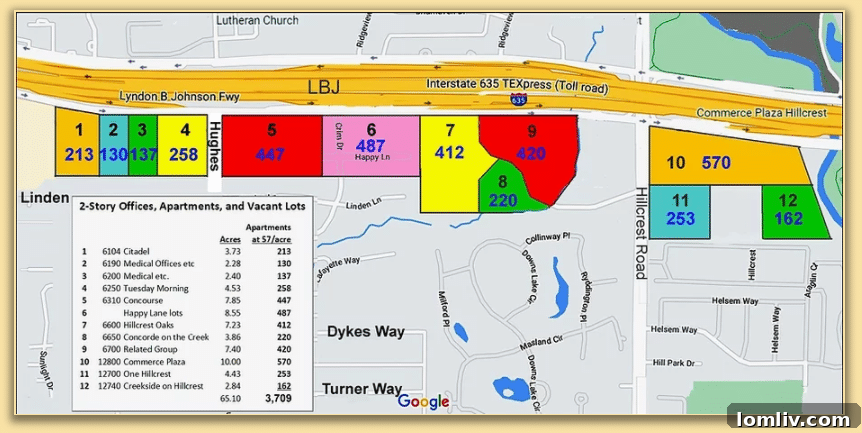
The specifics of the Related Group’s proposal highlight several critical “sticking points” for the community. The plan envisions buildings soaring to 110 feet in height, complete with a massive seven-story parking garage. This high-density scheme suggests up to 57 apartments per acre on the 7.5-acre site, potentially resulting in more than 400 new apartment units. The sheer scale of this proposal clashes dramatically with the existing zoning. As Wilke explained, the site’s current “neighborhood office” zoning designation imposes a strict 30-foot height limit, mirroring the limits applied to single-family homes in the area. “Neighborhood offices are considered to be a relatively low-impact office use,” he noted. “If five-to-seven-story apartments were built there, a lot of people would consider that to be incompatible.” This incompatibility extends beyond mere aesthetics, impacting light, privacy, and the overall feel of the neighborhood.
Beyond the physical structure, a significant concern is the inevitable increase in cut-through traffic. With hundreds of new residents, apartment dwellers are highly likely to use the adjacent residential streets as shortcuts to access the myriad retail and restaurant options in the wider area. Wilke articulated this natural inclination: “Naturally they’re going to want to take the shortest route rather than go a mile out of their way.” The implications for existing infrastructure are substantial. Hughes Lane, identified as a major entrance and exit for the neighborhood, would bear the brunt of this increased traffic, raising questions about safety, congestion, and the wear and tear on residential streets never designed for such volumes. This would fundamentally alter the quiet, residential character of the neighborhood, transforming serene local roads into busy thoroughfares.
Furthermore, residents face the prospect of a dramatic increase in noise and activity, shifting from the predictable, limited hours of office operations to a 24-hour, seven-day-a-week cycle of residential life. This constant hum of activity—from vehicle movements to increased pedestrian traffic and general urban noise—threatens to disrupt the tranquility that residents currently enjoy, potentially diminishing their quality of life and even impacting property values. The transition from a low-impact commercial setting to high-density residential use poses significant challenges for maintaining residential peace and quiet.
Perhaps the most alarming concern for many residents is the potential for such an approval to set a dangerous precedent. Should this proposal for high-rise apartments be approved, it could open a “Pandora’s box” for future development in the area. Wilke explains the cascading effect: “Once the first developer gets to build apartments, the next developer can come in and say they want the same zoning rights.” This could trigger a wave of similar rezoning requests along the entire south side of the LBJ Corridor, potentially transforming the area into a dense, high-rise environment far removed from its current character. In fact, if the entire south side of LBJ were to be rezoned to allow for such density, Wilke estimates it could lead to the construction of more than 3,000 apartment units, fundamentally altering the entire region.
Ultimately, as Bruce Wilke passionately states, the entire debate boils down to a fundamental issue of “quality of life.” Residents are not simply against development; they are advocating for the preservation of their strong, stable neighborhood and its inherent value. “We want a strong, stable neighborhood. We don’t want to negatively affect the quality of life in our neighborhood,” Wilke concludes. The decisions made regarding the LBJ Corridor development will have profound and lasting impacts on the future of Hillcrest Forest and surrounding communities, making the ongoing discussions crucial for all stakeholders involved in shaping Dallas’ urban future.