Exploring Dallas High-Rise Demographics: Finding Your Perfect Urban Community
Dallas’s vibrant high-rise landscape offers a unique tapestry of urban living, each building boasting its own distinct character shaped significantly by its resident demographics. Beyond the allure of stunning views and modern amenities, understanding the age makeup and ownership patterns within these vertical communities is crucial for prospective buyers. This isn’t merely about finding a home; it’s about finding a community that aligns with your lifestyle, values, and expectations for building management and future growth.
In a previous exploration of Dallas’s dynamic high-rise populations, we delved into the characteristics of buildings predominantly inhabited by younger residents. A key takeaway from those discussions was the prevalence of non-homestead owners – sometimes as high as 75 percent in younger developments. This distinction between homestead (primary residence) and non-homestead ownership (secondary homes or investment properties) provides invaluable insight into the collective mindset of a building’s residents and their potential responses to change and investment in common areas.
The Impact of Non-Homestead Ownership on High-Rise Dynamics
Non-homestead ownership isn’t a monolithic concept; it encompasses diverse motivations, each influencing a building’s social and financial ecosystem. Owners who claim a home as a second shelter often approach building improvements with a different perspective than primary residents or pure investors. They may be more amenable to supporting (or at least not obstructing) upgrades, potentially due to less financial constraint or a desire to maintain a high-quality retreat. Their primary residence elsewhere often means their immediate daily budget isn’t tied to every incremental HOA fee increase, making them potentially more flexible.
Conversely, owners of investment or rental properties typically operate with a more cautious, spreadsheet-driven mindset. While they are keen to protect their investment and ensure its rental viability, their decisions are often guided by return on investment and cost-efficiency. This can sometimes lead to reluctance regarding significant capital improvements that may not immediately translate into higher rental yields, potentially delaying necessary modernizations or enhancements that could otherwise benefit the entire community and future property values.
A striking contrast emerges when comparing ownership patterns in Dallas’s oldest high-rise populations. Here, non-homestead ownership rates are significantly lower, ranging from a mere 13 to 29 percent. This demographic variance is compounded by building age: the “youngest” of the older buildings, such as 1984’s Claridge, stands apart from the overwhelming majority constructed in the 1950s and 1960s. These seasoned structures often house long-term residents who have aged in place, fostering a different sense of community and decision-making culture.
Interestingly, some foundational high-rises from the 1950s-1960s era, such as Preston Tower, “21,” and Turtle Creek North, don’t fit neatly into the “oldest category” due to their higher average of non-homestead, predominantly rental, units. This high proportion of rentals can obscure the true age makeup of the owner-occupied population. The smaller, more affordably priced units in these buildings often attract smaller investors, making them prime candidates for rental portfolios rather than second homes. For instance, at the time of this analysis, a substantial 67 percent of MLS listings at Preston Tower were rentals, and “21” showed 50 percent, highlighting a different kind of investment profile within these older structures.
Dallas’s Enduring High-Rise Communities: The Oldest Populations
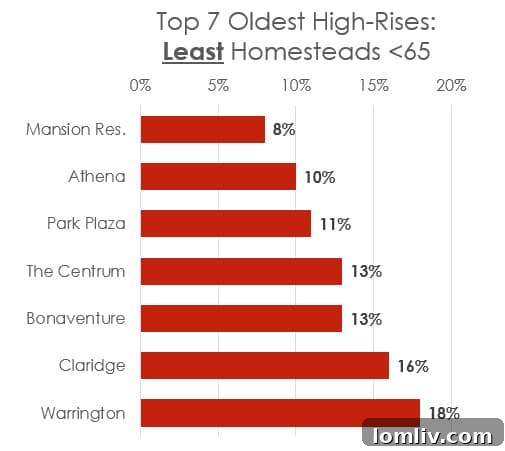
At the opposite end of the spectrum from Dallas’s youngest, most dynamic high-rises like SOCO Lofts, we find communities that proudly wear their age with grace and stability. The Park Plaza stands out as a prime example, where a remarkable 76 percent of residents claim both homestead and over-65 exemptions on their property taxes. Coupled with a mere 11 percent of homestead owners under 65, Park Plaza unequivocally earns the title of Dallas’s oldest high-rise population. This impressive stability is further underscored by just 13 percent of units being owned by non-homesteaders, indicating a strong, entrenched owner-occupant community.
A close second in this venerable category is The Athena, boasting 70 percent homestead ownership over 65, alongside 10 percent under 65, and a 20 percent mix of second home/rental units. While demographically similar to Park Plaza, The Athena differs in building size, unit renovation levels, and purchase prices. With 142 units, The Athena is more than triple the size of Park Plaza, suggesting a potentially larger and more diverse social fabric within its older demographic. However, Park Plaza units command a premium, costing approximately 20 to 25 percent more per square foot than The Athena.
It’s worth noting that around 2001, Park Plaza underwent significant renovations, offering updated units that felt more like a conversion than original 1982 finishes. I distinctly recall being advised that wood or tile floors were only permissible in ground-floor units, a practical consideration to mitigate the “clickity-clack” of high heels in a multi-story environment. This 15-year-old renovation history likely contributes to Park Plaza’s higher price points compared to The Athena, regardless of whether the property falls within Highland Park or a general Dallas ZIP code. This historical investment in modernization explains a significant portion of the cost differential between the two buildings.
For buyers prioritizing a vibrant community of older neighbors, The Athena potentially offers the best value. Based on unscientific, yet insightful, DCAD counts, the ratio of female “casserole-wielders” to “aging playboys” appears to be roughly three to one, hinting at a lively and established social scene. For renovators with vision and patience, combined with favorable actuarial tables and a plethora of outdated units ripe for transformation, The Athena presents itself as a building uniquely poised for strategic gentrification. Its solid foundation and established demographic make it an appealing canvas for those looking to infuse modern luxury into a classic structure, potentially yielding significant returns as the building modernizes while retaining its community spirit.
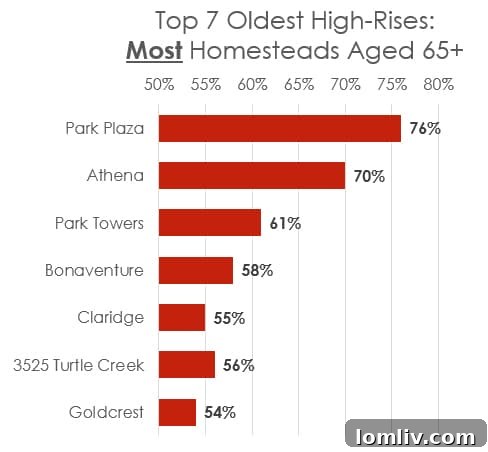
Another intriguing case is the Mansion Residences. While “only” 42 percent of its owners claim both homestead and 65+ exemptions (and 8 percent claim under-65 exemptions), a substantial 50 percent of units are owned by non-homesteaders. Given their multi-million dollar price tags, these are almost certainly second (or even seventh) homes for incredibly affluent individuals, where the owner’s age likely skews into the 65+ bracket. With only 24 units, it’s not a large development, meaning just 12 units are non-homesteaders, 10 are 65+ homesteaders, and 2 are under-65 homesteaders. In such a small community, even a couple of demographic shifts could dramatically alter these population ratios, highlighting the fragility of statistical analysis in boutique buildings.
The Ideal Blend: All Things in Moderation for High-Rise Harmony
Just as Goldilocks discovered, balance is often the key to contentment, a principle that holds especially true in high-rise communities. The ideal urban dwelling fosters a dynamic environment where the exuberance of youth is tempered by the wisdom of experience. This blend encourages proactive, long-term planning over short-sighted indolence, ensuring that common problems are addressed swiftly and cost-effectively, rather than allowed to fester into critical, expensive crises. You certainly don’t want a co-owner board playing musical chairs with urgent issues, hoping they’ll miraculously disappear before the next meeting.
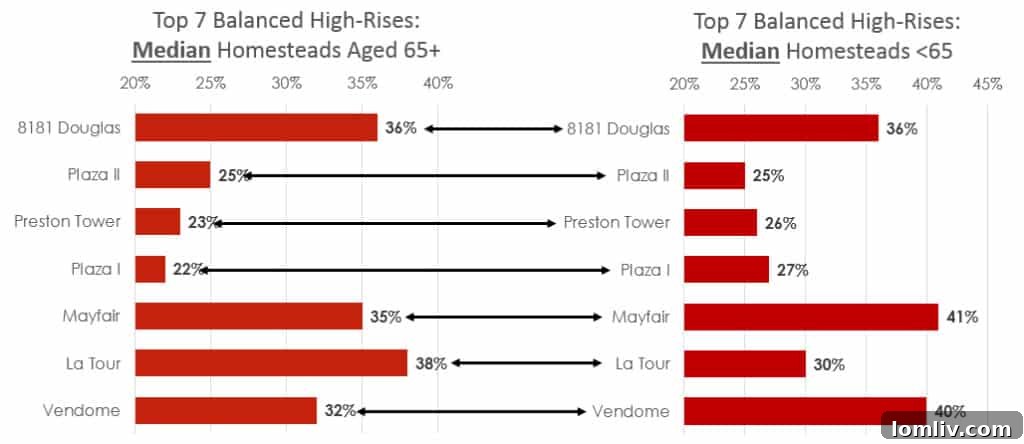
In the quest for demographic equilibrium, 8181 Douglas initially appears to take the prize. However, with just 14 units, its small sample size makes statistical validation challenging. A single sale or two could swiftly tip its delicate balance, making it an unreliable model for broader application. Following this, Preston Tower, Plaza I, and Plaza II exhibit a seemingly balanced distribution of homestead owners across age groups. Yet, their nearly 50 percent non-homestead ownership skews the true picture, as many of these units are rentals, introducing a different set of community dynamics.
This leaves us with Mayfair, La Tour, and Vendome – buildings that genuinely embody demographic balance in Dallas. La Tour, with a 68 percent owner-occupancy rate, boasts the lowest among these three, which is still remarkably high. Mayfair and Vendome impress further with 76 percent and 72 percent owner-occupancy, respectively. This high level of owner-occupancy typically translates to a more engaged community, with residents more invested in the long-term well-being and maintenance of their shared home.
Furthermore, these three exemplary buildings are positioned in the high-middle tier of the high-rise market in terms of selling prices. This strategic pricing contributes significantly to their demographic balance, appealing to a wider range of buyers who find them both aspirational and attainable. This means that while some buyers might “stretch” their budgets to reside in these prestigious buildings, others feel they are making a wise investment without “settling” for something below their expectations. This broad appeal fosters a naturally diverse and stable community, ideal for those seeking a harmonious urban living experience.
Key Learnings: The Interplay of Age, Economics, and High-Rise Living
One of the most profound observations regarding Dallas high-rises is the significant correlation between owner age and building age, particularly at the extreme ends of the demographic spectrum. This suggests a powerful “aging in place” phenomenon, where residents grow older alongside their beloved homes and communities. This creates a natural cycle where new buyers are often drawn to buildings with similarly-aged residents, fostering a sense of belonging and shared life stages. This innate desire for social congruence holds true whether you’re in your twenties or your nineties, with the exception, perhaps, of those engaged in “trophy spouse” pursuits.
Consider SOCO Lofts, currently characterized by a low ratio of older to younger owners. One might speculate that in three decades, it could transform into a retirement village. However, this is doubtful. Given its distinct industrial loft style, which inherently targets a younger, more contemporary buyer demographic, SOCO Lofts is unlikely to age in the same manner as more traditionally styled buildings. Its architectural identity and unit configurations are less conducive to the needs and preferences of an exclusively senior population, suggesting a perpetual attraction for a youthful, dynamic cohort.
Conversely, buildings like Mayfair and Vendome are poised to attract a higher proportion of older buyers in the coming decades. This projection stems from the natural progression where younger buyers will gravitate towards even newer, cutting-edge developments, while many of Mayfair and Vendome’s current residents will continue to age comfortably in place. Their established reputation for quality and community will likely continue to draw discerning, often affluent, older buyers seeking stability and sophisticated living.
When Economics Take a Backseat: Age as the Defining Factor
An intriguing pattern emerges when analyzing the oldest and youngest high-rise buildings: they often fall into the middle-income bracket. Notable exceptions include the luxurious One Arts Plaza in the “youngest” category and the historic Claridge in the “oldest.” When the economic playing field is relatively level—meaning home prices are comparable—the age demographic of residents becomes an even more heavily weighted factor in defining a building’s unique personality and future trajectory.
Younger populations naturally expect and demand cutting-edge ideas and a broader integration of technology into their living spaces, though their ability to fund these innovations might sometimes be a tempering factor. In stark contrast, older, long-term populations, often less immersed in contemporary technology and potentially less exposed to the latest amenities offered in newer buildings, might resist proposed improvements. This resistance often stems from a fear of increased expenses and an entrenched “it’ll do” mentality, particularly if they perceive current facilities as adequate. This inherent generational divide invariably leads to differing personalities within buildings and necessitates varied amenity packages to attract and retain specific buyer profiles.
It’s a universal truth that people vote for things that hold personal meaning. A state-of-the-art gym, for instance, is invaluable to a 30-something but largely irrelevant to most 70-somethings. Conversely, meticulously maintained flower beds can become a casus belli—a cause for conflict—among older residents who prioritize aesthetic details and communal pride, while for younger residents, such features are often an “auto-pilot” item, appreciated but not a core driver of their living experience or HOA engagement.
The Unfolding Narrative of Dallas’s Newest High-Rises
This discussion has largely focused on established high-rise communities, deliberately less emphasis placed on the newest crop of developments. This is primarily because their populations are still in a state of flux, in the process of settling and solidifying their demographic identities. Buildings constructed during the boom leading up to the recession often faced unique challenges, resulting in a significant number of units becoming economically forced rentals. Properties purchased at peak prices that subsequently lost value, particularly evident in areas like Victory Park, were frequently converted into rentals as underwater owners and, at times, even developers sought to mitigate losses by transitioning out of direct ownership.
However, the real estate market is dynamic. There’s a strong expectation that in the coming years, many of these “forced rental” units will revert to owner-occupied status as market conditions stabilize and property values recover, allowing for sales that reflect initial investments or new market demand. This shift will undoubtedly re-shape the demographic and community fabric of these newer buildings.
An enduring exception to this trend is the Ritz Residences. This ultra-luxury development consistently attracts affluent multi-home owners who, for tax and lifestyle reasons, are unlikely to claim the Ritz as their primary residence. Its intrinsic value proposition is tied to luxury, service, and prestige as a secondary or tertiary home, not necessarily as a full-time homestead. This building stands apart because it typically has very few, if any, rental units to begin with, maintaining an exclusive owner-occupant profile from its inception.
Finally, the absolute newest high-rises, those built after the official conclusion of the recession, are still too nascent to offer definitive population ratios. With a substantial number of unsold units still on the market, their long-term demographic character remains to be fully defined. However, based solely on their elevated asking prices, one can confidently conclude that their eventual owner-occupants will be individuals of significant wealth, establishing another distinct segment within Dallas’s diverse high-rise landscape.
Summary: Holistic Considerations for High-Rise Homebuyers
Choosing a high-rise home in Dallas involves far more than just evaluating cost, location, or unit size. While these are critical factors, understanding the demographic makeup of a building’s residents is equally vital. It’s not about buying a home solely based on your neighbors’ ages, but rather recognizing how age can profoundly influence community attitudes towards building maintenance, the embrace of change, and the prioritization of amenities. The collective age of owners also plays a crucial role in the economic stability and long-term viability of the building’s infrastructure. If a significant structural problem arises, and the majority of owners are financially constrained or unwilling to fund necessary repairs properly, you could inadvertently be setting yourself up for larger, more costly problems down the line.
Ultimately, a high-rise is a shared investment and a communal living experience. Insights into its demographics offer a window into its personality, its financial health, and its future trajectory. By considering these often-overlooked aspects, buyers can make more informed decisions, ensuring their urban dwelling aligns perfectly with their lifestyle and expectations for a thriving community. And yes, perhaps these insights also offer an unofficial guide for single senior men seeking new social connections in Dallas’s most established high-rise communities – you may never be lonely or hungry again!

Connect With Us: Share Your High-Rise Stories!
Do you have a fascinating HOA story from your high-rise experience? Perhaps a unique piece of high-rise history from Dallas that deserves to be told? Realtors, is there a listing in need of a visionary renovation, or one that stands out as a shining example of successful community living, that you’d like to feature? We’re always eager to hear from our readers and industry professionals. You can even host a Candy’s Dirt Staff Meeting and share your insights!
Feel free to reach out to Jon via email at [email protected]. (And yes, marriage proposals are now legally accepted!)