High-Rise Demographics Part 2: Unveiling the Age & Economic Profile of Dallas Condo Ownership
In the first part of this comprehensive series, we delved into the fundamental data points high-rise buyers should meticulously consider before investing in their “castle in the sky.” Specifically, we touched upon unit prices, the average resident age, and income levels as crucial indicators. The underlying rationale for such an in-depth analysis is to ascertain whether a particular building truly aligns with a buyer’s lifestyle philosophy, financial expectations, and long-term investment goals. While these metrics offer valuable preliminary insights, they certainly don’t paint a complete picture. A truly informed buyer would also engage directly with the building management of any prospective high-rise to gain a deeper understanding of its unique personality and, critically, its financial health. However, much like deciphering employment references, where discretion often trumps candidness, such conversations often require a shrewd ability to “read between the lines” to uncover the full truth.
Understanding the age demographic of a high-rise community is paramount. Younger buyers, for instance, might exhibit greater openness to embrace change, engage in proactive maintenance, and fund modern improvements within the building. Yet, paradoxically, they might also be navigating economic constraints, especially if they are further from their peak earning years. This creates an interesting dynamic: buildings with a significant proportion of owners in their 20s and 30s could face similar economic paralysis to those predominantly owned by residents in their 70s and 80s. The key distinction lies in motivation; the younger demographic might possess an enthusiastic desire to implement new initiatives and upgrades but lack the collective financial capacity, whereas an older demographic might prioritize stability and resist extensive capital improvements.
So, how does a discerning buyer pinpoint that elusive “sweet spot” age range in a Dallas high-rise? The answer lies in a meticulous examination of specific data, allowing us to move beyond assumptions and truly understand the demographic pulse of these vertical communities. Let’s dive deeper into the methodology and uncover Dallas’s “youngest” high-rise buildings.
Calculating the Demographic Pulse: Identifying Younger High-Rise Communities
To accurately identify the “youngest” high-rise buildings in Dallas, we employ a multi-faceted approach, leveraging publicly available data to build a comprehensive demographic profile. Relying on just one metric can be misleading, as nuances often reveal a different story. Our methodology involves triangulating three distinct measurements to gain a clearer, more granular understanding of a building’s ownership age and residency patterns.
The Homestead Exemption: A Primary Age Indicator
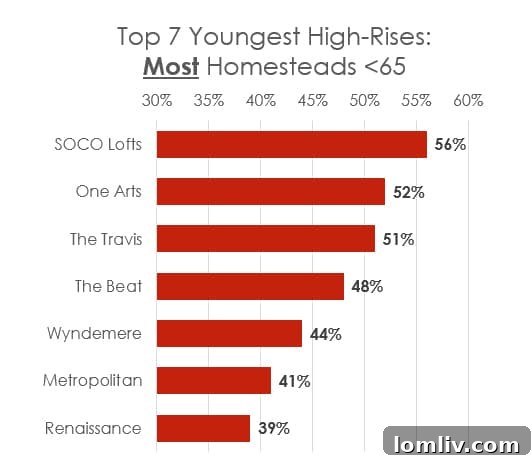
The first and most direct metric in our quest is identifying buildings with the most homesteads (primary residences) NOT claiming the “Over 65” exemption. This exemption, a common property tax benefit, is typically utilized by homeowners aged 65 and older on their primary residence. Therefore, a high percentage of homestead owners who do *not* claim this exemption strongly suggests a younger-than-65 demographic. For many buyers, this initial filter might be sufficient to narrow down their search. However, as we will explore, there is additional nuance to be gained from combining this with other measurements to form a truly informed opinion.
The “Over 65” Factor: Refining the Age Spectrum
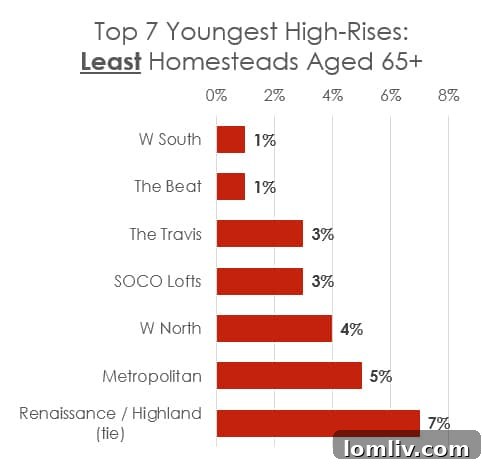
To add another layer of detail, we also scrutinize buildings based on the lowest percentage of owners claiming both the homestead and “Over 65” exemptions. This measurement provides a crucial refinement. For example, a building might have many homesteads not claiming the “Over 65” exemption, but if it also has a significant number who *do* claim it, the overall age profile might be more mixed. By focusing on the lowest percentage of “Over 65” homesteads, we can more confidently identify communities where the majority of primary residents are indeed under the age of 65. Our analysis, as depicted in the charts, reveals that SOCO Urban Lofts, for instance, not only boasts the most homestead owners under 65 but also exhibits one of the lowest percentages of owners claiming the “Over 65” exemption, suggesting a genuinely younger owner-occupied base.
Unveiling Non-Homestead Ownership: The Hidden Layer of Demographics
The final, and perhaps most revealing, measurement to consider is the percentage of owners who do not designate their unit as a primary residence—what we refer to as non-homestead owners. This category represents either second homes or investment units, primarily rentals. In the case of SOCO Urban Lofts, a significant 41% of owners do not consider it their primary residence. The reasons for this can vary: an owner might have a more valuable primary residence elsewhere, resulting in a larger tax break by claiming homestead there (perhaps a suburban home for a couple who use their city pad on weekends), or the unit is simply an investment property acquired purely for rental income.
The presence of a high percentage of non-homestead units introduces a crucial variable into our demographic assessment. While rental units are not inherently detrimental to a building’s health, a substantial rental pool can significantly mask the true age distribution of the ownership. This obfuscation makes it challenging to accurately predict age-related actions, such as collective decisions regarding maintenance, upgrades, or financial assessments. For instance, tenants, particularly those closer in age to “dorm living,” might have different priorities or less vested interest in the long-term upkeep of the property compared to owner-occupants. Coincidentally, at the time of this analysis, SOCO Urban Lofts had five units for purchase and two for rent, which translates roughly to a 40% rental to 60% homestead ratio. While it’s unlikely that all 41% of non-homestead units are rentals, given the comparatively lower overall prices for units at SOCO, it’s a reasonable assumption that a substantial percentage are. It’s also less probable that empty-nesters from distant locales like Wichita Falls would choose an urban loft as a Dallas “crash pad,” further leaning towards the rental hypothesis.
NOTE: Rental units are not inherently negative. Each tenant brings a different dynamic to the community. However, high proportions of non-homestead units (encompassing both second homes and rentals) can obscure the true age distribution of the ownership. This masked age distribution, in turn, can make it less accurate to predict collective decisions and actions, particularly those related to the building’s financial health and long-term maintenance strategies. Discerning buyers must be aware of this hidden layer when evaluating a high-rise community.
Spotlight on Dallas’ Youngest High-Rise Buildings
By synergizing these three critical data points – the percentage of homestead owners under 65, the percentage over 65, and the percentage of non-homestead ownership – we can now unveil the high-rise buildings in Dallas that truly resonate with a younger demographic profile. Each building presents a unique blend of these factors, offering distinct lifestyles and investment implications.
SOCO Urban Lofts: The Starter Urban Pad
After crunching the numbers, SOCO Urban Lofts emerges as the quintessential “youngest building” in terms of ownership demographics within Dallas. With a striking 56% of owners under 65 years old, a mere 3% aged 65 and older, and a significant 41% non-homestead ownership, SOCO embodies a vibrant, youthful urban living experience. Given its attractive price points, typically ranging from $175 to $220 per square foot, it is highly likely that these units serve as starter condos for young professionals and “swingles” under 40. Even with a substantial rental pool, it is probable that the tenants mirror this energetic age range, contributing to a dynamic community atmosphere. However, the exact age profile of the owners behind the “hidden” 41% non-homestead units remains unknown. Many of these units might have originally been purchased by owners who, facing market shifts or personal changes, opted to convert them into rentals, especially during periods when the market was less robust.
One Arts Plaza: The Urban Millionaire’s Retreat
Moving up the spectrum, One Arts Plaza represents a more balanced, albeit still relatively youthful, demographic profile, securing the number two spot. Here, 52% of homestead owners are under 65, 25% are over 65, and a comparatively modest 23% constitute second home/rental ownership. The significant difference in unit costs at One Arts Plaza, which can be as much as five times more per square foot than SOCO, suggests a different kind of buyer. At this price point, it’s reasonable to infer a higher proportion of second home ownership rather than purely investment rentals. One Arts Plaza is typically the domain of the 40- to 60-year-old urban millionaire – individuals who appreciate luxury, culture, and a prime location within the Dallas Arts District, often maintaining other residences but valuing a sophisticated city dwelling.
The W Residences: A Tale of Two Towers and Market Impact
The W Residences, comprising both South and North towers, present an intriguing and somewhat “odd duo” from a demographic standpoint. Both towers exhibit exceptionally low ownership in the over-65 category (a mere 1% for the South tower and 4% for the North tower). However, what makes them unique is their enormous proportion of non-homestead owners – 71% for the South tower and an even higher 75% for the North tower. These figures represent the highest non-homestead percentages in the city, second only to Highland’s 78%. Given the luxury price points typically associated with The W Residences, one would ordinarily expect a sizable number of affluent second homeowners. However, the economic recession severely impacted property values in Victory Park, including The W Residences. This downturn likely compelled many unit owners to convert their properties into rentals to mitigate losses or generate income. This hypothesis is supported by current market data, with approximately 60% of South tower listings and 56% of North tower listings being available for rent, indicating a significant transient population within these luxury high-rises.
The Remaining Contenders: A Blended, Dynamic Landscape
The remaining high-rise buildings in our analysis – including The Beat, Travis, Wyndemere, Metropolitan, and Renaissance – tend to exhibit similar demographic patterns. Each of these buildings typically features approximately 45% to 55% rental/second home ownership (likely leaning more towards rentals, depending on the specific building’s price point and location). They also boast higher-than-average ownership percentages for individuals under 65 years old, coupled with sub-10% figures in the over-65 category. Collectively, these buildings will generally attract a younger, more dynamic, and potentially more transient ownership and resident base. For buyers, this signifies a community that is likely vibrant and evolving, but also one where a significant portion of residents may have shorter-term stakes in the building’s future.
The Crucial Link: Demographics and Building Governance
The paramount objective behind this meticulous research into high-rise demographics is not to advocate for homogeneous populations or to create arbitrary divisions based on age or income. This is not about fostering a “Young State” versus “Old State” segregation. At its core, the principle holds true regardless of age or affluence: good neighbors are good neighbors. Rather, the fundamental point of this analysis is to gain insight into a building’s collective mindset, particularly concerning how the high-rise is managed, maintained, and how its financial decisions are made. This understanding is critical for any prospective buyer looking for a sustainable and harmonious living environment.
Financial Health and Long-Term Vision
Consider a brand-new high-rise: for its first decade, major infrastructure replacements are rarely a concern. However, as the years accumulate, the inevitable wear and tear demand increasing attention. Essential components such as HVAC systems, roofing, plumbing, and exterior facades will require significant capital for replacement and refurbishment. This is where the demographic profile becomes crucial. Do a majority of the condo owners share a similar philosophy regarding the proactive handling of these substantial expenses? A building dominated by a younger, perhaps more financially constrained, demographic might face challenges in approving significant special assessments for major repairs, prioritizing lower HOA fees over robust reserve funds. Conversely, an older, fixed-income majority might also be resistant to large, unexpected outlays. This dynamic directly impacts a building’s long-term financial health and its ability to maintain its value and structural integrity.
Maintenance Philosophy: Prioritizing Needs vs. Wants
Another critical aspect is the collective maintenance philosophy. Do you envision living in a building where the majority prioritizes aesthetic “pretty things” – lavish common areas, updated amenities – over fundamental structural repairs and core infrastructure problems? Or would you prefer a community that systematically addresses critical issues, even if less visibly appealing? This distinction can have profound implications for a building’s longevity and your personal investment. For instance, a building that consistently “refuses to fill the cavity,” metaphorically speaking, preferring to defer costly “root canal” repairs, is essentially pushing significant financial burdens and potential structural risks onto future owners. Such deferred maintenance often leads to exponentially higher costs and more complex problems down the line, affecting everyone’s property values and peace of mind.
Community & Lifestyle Expectations
Beyond finances and maintenance, demographics also shape the community and lifestyle expectations within a high-rise. Younger residents might seek vibrant social events, shared co-working spaces, and pet-friendly policies, while older residents might prioritize quiet enjoyment, accessibility features, and robust security. A disconnect in these expectations can lead to friction within the HOA and a less harmonious living environment. Understanding the predominant demographic helps a buyer assess if the building’s existing culture and future trajectory align with their personal preferences.
Short of individually interviewing every single owner – an impractical and likely unsuccessful endeavor – a buyer must skillfully infer these crucial insights from all available data. In this context, a thorough analysis of owner age distribution, the general unit cost, and the percentages of non-homestead ownership offers a robust general direction, guiding buyers towards communities that truly match their needs and expectations.
Next week, we will conclude this illuminating trio of columns by shifting our focus to Dallas’s oldest and most demographically balanced high-rise building ownership structures, providing a complete spectrum of insights for discerning urban dwellers.
Remember: Do you have a compelling HOA story to tell? Perhaps a fascinating piece of Dallas high-rise history you’d like to share? Real estate professionals, do you have a listing that’s either a renovation gem or a shining example of perfection that you’d like to feature? How about hosting a Candy’s Dirt Staff Meeting? We’re always eager to hear from our community. Feel free to shoot Jon an email. (Marriage proposals are also accepted, they’re legal now!). Connect with us at [email protected].