The vibrant city of Dallas stands at a critical juncture, facing significant financial hurdles that demand innovative solutions for sustainable urban development. With an ever-growing population and ambitious goals for progress, the margin for error in fiscal management is razor-thin. Simply maintaining our foundational infrastructure, such as city streets, requires an estimated $900 million dollars just to bring them up to a satisfactory standard. This monumental cost doesn’t even begin to cover the extensive list of other essential public services Dallas provides, including public safety, code compliance, parks and recreation, and countless other municipal operations, all of which require substantial and sustained financial resources to function effectively.
Traditionally, discussions around addressing such significant fiscal deficits often revolve around two primary, often contentious, strategies: raising taxes or cutting essential public services. While these approaches have their place in responsible fiscal management, they frequently overshadow a more proactive, sustainable, and often overlooked alternative: optimizing our existing resources through efficient and productive land use strategies. This critical perspective, when properly understood and implemented, holds immense potential to unlock new revenue streams, enhance the city’s overall financial health, and foster equitable growth without placing undue burden on its residents or compromising vital services.
Understanding the city’s financial backbone is paramount for any meaningful discussion on its future. According to the 2016 City Budget, property tax emerges as the single largest contributor to the general fund, accounting for almost 50 percent of its total revenue. Despite this substantial inflow, the allocation for critical areas remains severely strained. For instance, roughly 8 percent of the general fund, an amount totaling approximately $90 million, was earmarked for the streets department. A sobering reality within this allocation is that only about half of that sum is dedicated specifically to crucial maintenance and repair efforts. At this current rate, based on 2015 standards and financial projections, it would take an astounding two decades just to bring our city streets to an acceptable condition, a timeline that is clearly unsustainable for a modern, thriving metropolis.
The consequences of this systemic underinvestment in vital infrastructure are far-reaching and increasingly evident across the city. As our infrastructure continues its slow but steady decline, particularly with streets exhibiting visible signs of deterioration and disrepair, the quality of life for residents is directly impacted, and the efficiency of public services is severely compromised. Concurrently, pressing issues like embarrassingly abysmal police response times highlight the systemic pressures facing public safety, often exacerbated by a chronic lack of sufficient funds and the indirect costs associated with navigating poorly maintained urban environments. These intertwined challenges underscore the urgent need for a more strategic and holistic approach to municipal finance, one that looks beyond simple budgetary adjustments and delves into the fundamental productivity of the city’s most valuable and often underestimated asset: its land.
This Productive Land Use Series aims to shed crucial light on this vital topic by meticulously examining annual property tax revenue at the neighborhood level across Dallas. Given that land is arguably the city’s foundational and most enduring resource, this series will rigorously investigate how we currently utilize our valuable land and, more importantly, explore actionable avenues through which we can dramatically enhance its efficiency and revenue-generating potential. To facilitate a clear, objective, and comparative analysis that transcends anecdotal evidence, the base unit of measurement throughout this entire study will be the acre. This standardized metric allows us to precisely quantify the financial productivity of diverse communities and property types within Dallas, offering an invaluable, apples-to-apples comparison that is often missing in broader, less data-driven discussions about urban growth and fiscal health.
Leveraging a wealth of publicly available data, including invaluable visual insights from Google Earth for contextual understanding and detailed financial specifics from the Dallas County Appraisal District (dcad.org), we will undertake a deep dive into specific structures and various development models across different Dallas neighborhoods. While a vast amount of data exists and could be analyzed, for the initial phase of this critical analysis, we will focus on several key metrics for each property under review: the total acreage of the parcel, the estimated annual taxes paid (a critical measure of direct contribution), the even more critical figure of city taxes collected per acre, the overall total taxes collected per acre (encompassing all taxing entities involved), and the age of the building. These specific and transparent data points will form the bedrock of our empirical investigation, providing a robust, fact-based framework for understanding the economic output and efficiency of Dallas’ diverse land uses.
In this comprehensive series, our unwavering commitment is to provide a hard, empirical look at the financial realities underpinning our City’s fiscal health. Our approach is deliberately analytical and objective, consciously suspending political discourse, historical biases, and cultural nuances in an earnest effort to present the data in its rawest, most undeniable form. We acknowledge that delving into granular numbers and dissecting financial productivity might, at times, feel like “eating your vegetables” in a diet often rich in qualitative discussions about urban life. Nevertheless, for Dallas to strategize effectively for its long-term prosperity, ensure equitable development, and secure a vibrant, financially stable future for all its residents, it is absolutely essential that we understand, with clarity, precision, and a commitment to data, the fundamental mechanisms by which a city generates wealth, sustains its growth, and effectively funds its essential services. This foundational understanding is not merely an academic exercise; it is a vital prerequisite for informed policy-making and truly sustainable urban development.
To commence our detailed exploration into productive land use and its direct impact on Dallas’s financial landscape, let’s begin with a fundamental and ubiquitous component of Dallas’ urban fabric: typical single-family dwellings, examining their contribution to the city’s coffers on a per-acre basis.
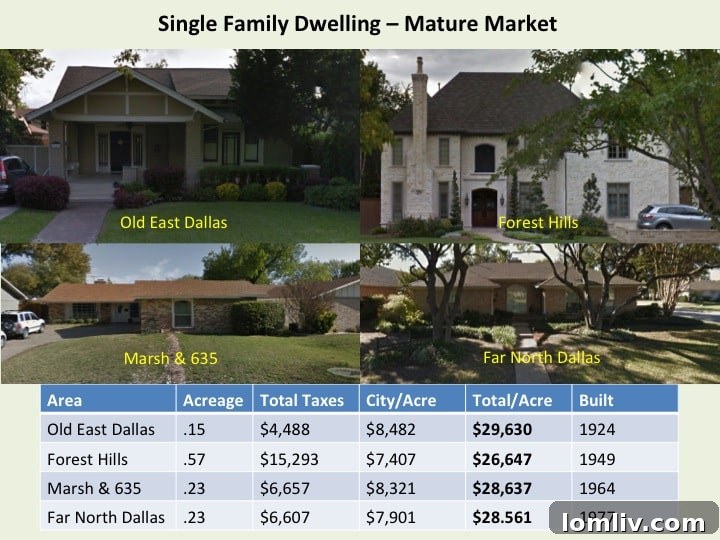
Our initial rigorous analysis of single-family residences reveals a fascinating and instructive pattern. While this segment of the study encompasses a diverse array of individual houses – varying significantly in age, size, and specific location across numerous Dallas neighborhoods – a remarkably consistent trend emerges regarding their financial output. The total taxes yielded per acre for these well-performing properties generally fall within a remarkably similar range, irrespective of superficial differences. This empirical observation strongly suggests that a stable, well-maintained single-family neighborhood, characterized by consistent property values, ongoing private and public community investment, and desirable amenities, will typically perform at an annual rate of approximately $30,000 per acre in total tax revenue. This estimated figure will serve as a crucial benchmark, providing a valuable standard against which we can objectively measure the productivity of other land uses and identify areas of both strength and significant potential improvement across the entire city. It represents a baseline economic contribution that underscores the importance of fostering stable residential communities.
This benchmark of $30,000 per acre annually for well-performing single-family areas is not just an arbitrary number; it represents the foundational economic contribution that a healthy, established residential neighborhood offers to the city’s general fund. These neighborhoods typically benefit from consistent infrastructure upkeep, access to quality schools, low crime rates, and a steady demand for housing driven by desirability, all of which collectively contribute to stable or appreciating property values. Understanding this standard allows us to contextualize the performance of other development types and critically analyze how different zoning and urban planning decisions either meet or fall short of this foundational level of fiscal productivity. It highlights the direct and undeniable link between effective land use planning and sustained municipal revenue generation, laying the groundwork for more informed and strategic urban development discussions in Dallas.
However, the narrative of single-family productivity is not uniformly positive across all of Dallas. What happens when a single-family neighborhood deviates from this established benchmark and fails to achieve such productive financial performance, despite outward similarities to its more prosperous counterparts?
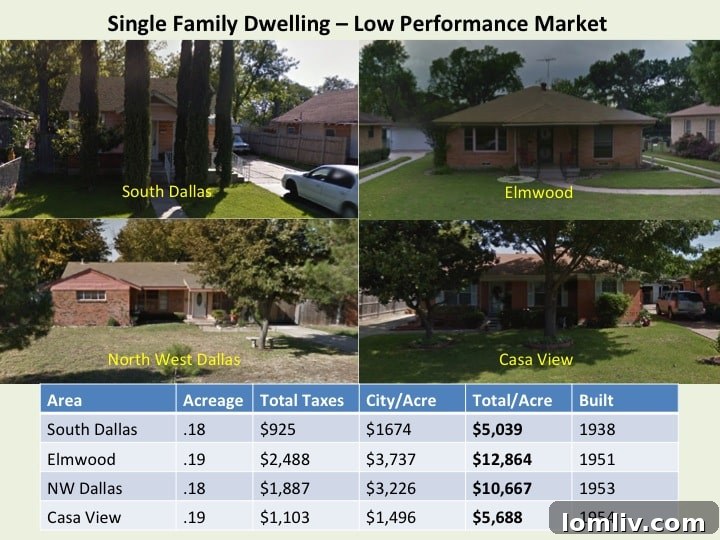
Our data clearly illustrates a stark and concerning contrast: in under-performing single-family neighborhoods, both the total taxes paid by individual properties and, more critically, the total taxes collected per acre are considerably lower than those generated by their better-performing counterparts. These areas, unfortunately, yield only a fraction of the tax revenue generated by the more stable and consistently maintained neighborhoods we just examined. Interestingly, many of the houses within this under-performing set are situated at roughly comparable distances from downtown Dallas, were constructed within the same historical era of the 20th century, and often exhibit very similar architectural styles to properties in more productive areas. This striking similarity in physical and historical characteristics, coupled with a significant disparity in financial output, strongly points to underlying, often socio-economic, factors beyond mere age or location that critically influence land productivity and overall neighborhood vitality.
The reasons behind this underperformance are multifaceted, deeply complex, and demand careful consideration. They often include a combination of factors such as pervasive deferred maintenance, a persistent lack of consistent private and public investment, evolving neighborhood demographics that impact demand, or perhaps a perceived decline in desirability due to limited access to essential amenities, declining school quality, higher crime rates, or other socio-economic dynamics. Understanding these intricate nuances is absolutely crucial because a collection of underperforming neighborhoods can collectively create a significant and unsustainable drag on the city’s overall financial health, requiring more public services and infrastructure support while contributing significantly less revenue per acre. Identifying and proactively addressing these complex issues through targeted urban planning initiatives, strategic investment strategies, and community engagement becomes paramount for fostering equitable growth and improving the long-term fiscal sustainability of all Dallas communities, ensuring no neighborhood is left behind.
Moving beyond the traditional single-family model, let’s explore the next incremental level of urban density that often represents an initial, yet significant, step towards more concentrated residential development within a city’s footprint: the duplex.
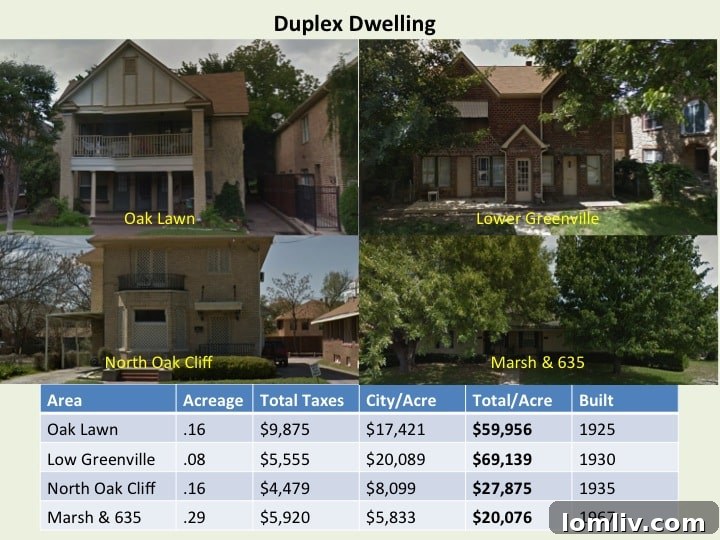
When meticulously analyzing the financial performance of duplexes within Dallas, our findings reveal a strong and undeniable correlation between their economic output and the inherent desirability and established value of the surrounding area. This suggests a critical insight for urban planning: simply increasing density by adding more housing units to a given plot of land is not, by itself, a guaranteed strategy for substantially boosting tax revenue. Instead, the ultimate financial success of a duplex development, in terms of its tax contribution per acre, is deeply and inextricably tied to its urban context. When density is thoughtfully introduced in an already attractive and well-regarded area—often characterized by excellent amenities, robust public transportation links, strong community engagement, and a vibrant local economy—it can potentially double the value and, consequently, the tax yield of the property. The increased demand and higher property values inherent in desirable locations mean that adding more housing units effectively capitalizes on an already strong and appreciating real estate market.
Conversely, the data indicates that introducing density in an area that is not currently considered desirable, perhaps due to a lack of amenities, poor infrastructure, or other socio-economic challenges, may have a negligible effect on, or even fail to significantly improve, the property’s financial performance per acre. This underscores a crucial point for Dallas’s future urban planning and land use policies: density purely for the sake of density is not necessarily a strategy that yields the city a high return on investment or sustainable growth. The focus should fundamentally shift from merely adding units to thoughtfully integrating higher density into areas where it either complements existing strengths or where strategic and sustained improvements are actively being made. This proactive approach necessitates prioritizing thoughtful urban planning that considers the entire neighborhood ecosystem, high-quality architectural design that enhances the streetscape, and targeted infrastructure investments. These elements, when combined strategically, can transform even the smallest plot of land into a highly valuable asset for the city, generating substantial and sustainable tax revenues that contribute directly to Dallas’s long-term financial stability, improved public services, and overall prosperity.
Now, let us turn our attention to even larger-scale residential developments, specifically focusing on substantial multifamily complexes comprising at least 300 units. These large-scale projects represent a significant commitment of both land and capital within the urban fabric, and their financial productivity per acre holds substantial implications for the city’s overall revenue stream, housing availability, and long-term urban planning strategies.
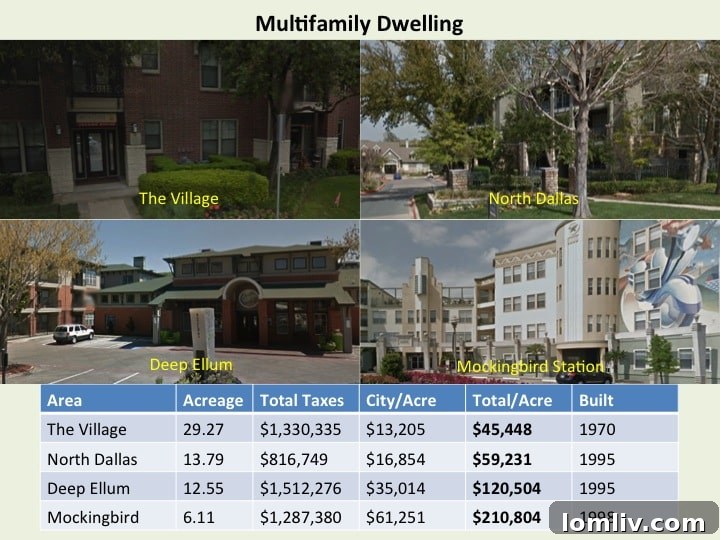
Echoing the compelling trend observed with duplexes, our in-depth analysis of large multifamily developments powerfully reinforces the principle that their financial productivity is profoundly and directly influenced by the inherent desirability and strategic advantage of their location. The more attractive, amenity-rich, and well-connected an area, the stronger the economic case and the higher the tax yield per acre for higher density residential development. For example, the prominent multifamily developments strategically situated in prime locations such as Deep Ellum and Mockingbird Station stand out as highly successful paradigms. Their direct adjacency to key DART Rail lines, vibrant entertainment districts, and employment hubs makes them exceptionally financially productive and highly desirable residences. Residents in these areas benefit from unparalleled access to efficient public transit, diverse employment centers, a plethora of dining options, and rich cultural activities—crucial factors that consistently command higher rents and, consequently, lead to higher property valuations and superior tax contributions per acre for the city.
However, the data also provides a critical and nuanced perspective that challenges conventional thinking. While sprawling apartment complexes may indeed be an efficient method for physically housing hundreds, if not thousands, of people, they are not necessarily the most efficient use of urban space in terms of long-term fiscal returns per acre, especially as these extensive developments age. Older, less strategically located, or poorly maintained large multifamily complexes can see their per-acre tax contributions decline significantly over time, potentially falling short of the productivity achieved by well-managed, thoughtfully designed, and denser developments in highly desirable areas. This highlights a crucial distinction for Dallas’s future growth: simply increasing the number of units does not automatically translate to optimal land use efficiency or sustained financial benefit. Therefore, sustainable urban planning for Dallas must consider not just the initial density, but also the longevity, the unwavering quality of design, the seamless integration with surrounding infrastructure, and the ongoing desirability of these large-scale residential projects to ensure their continued and robust contribution to the city’s financial health for decades to come.
The profound insights garnered from meticulously examining single-family homes, duplexes, and large multifamily developments offer a foundational and indispensable understanding of how different residential land uses directly contribute to Dallas’s revenue streams. These findings unequivocally underscore the undeniable and intricate link between strategic location choices, thoughtful architectural and urban design, the cultivation of community desirability, and ultimately, the tangible economic productivity per acre. These initial data-driven observations challenge us to think critically beyond conventional, often outdated, urban planning models and to courageously embrace data-driven strategies that are specifically designed to maximize the fiscal potential and societal benefits of every single parcel of land within our dynamic city.
In the highly anticipated next installment of this vital series, we will expand our rigorous investigation to include the critical financial productivity of commercial spaces. These businesses, whether they are standalone establishments or integral components of larger mixed-use developments, play a pivotal and often transformative role in shaping the unique character, influencing the economic vitality, and directly impacting the desirability of the residential areas surrounding them. We will delve into pressing and often debated questions such as: How do commercial strip centers, a ubiquitous and often taken-for-granted feature of many urban landscapes, truly affect a neighborhood’s economic vitality and its overall tax contribution to the city? Furthermore, how well do the oldest commercial developments in our dynamic city perform financially in today’s rapidly evolving market, and what lessons can be drawn from their longevity or decline? By thoroughly exploring these complex questions with empirical data, we aim to provide a comprehensive and holistic view of Dallas’s entire land use ecosystem and to equip policymakers, community leaders, and residents alike with the essential knowledge and actionable insights needed to foster a more prosperous, equitable, and sustainable future for all of Dallas.