Turtle Creek, a prestigious artery through the heart of Dallas, has long been revered as one of the city’s most iconic and desirable boulevards. Even predating the construction of the opulent Sheppard King mansion in the 1920s, its charm and elegance were undeniable. Unlike many other affluent streets characterized by sprawling single-family estates, Turtle Creek distinguished itself by embracing residential high-rises from the 1960s onward, becoming a magnet for those seeking breathtaking views and a simplified, luxurious lifestyle. This unique blend attracted a diverse group, from executives and empty-nesters downsizing from larger homes to individuals simply captivated by the allure of elevated living. Yet, despite its storied past and undeniable appeal, recent years have cast a shadow over this celebrated corridor, transforming it into what many now refer to as Dallas’s boulevard of broken developer dreams.
The Unfulfilled Promise: A Graveyard of Pitched Projects Along Turtle Creek
The landscape of Turtle Creek is currently dotted with prime parcels of land that tell a tale of ambitious visions, grand announcements, and ultimately, stalled aspirations. These sites, once slated for some of Dallas’s most exclusive luxury high-rises and mixed-use developments, now largely remain undeveloped, serving as a stark reminder of the complexities inherent in urban development, even in a booming market like Dallas. The sheer number of these unfulfilled projects raises questions about market dynamics, financing hurdles, and perhaps, a touch of misfortune.
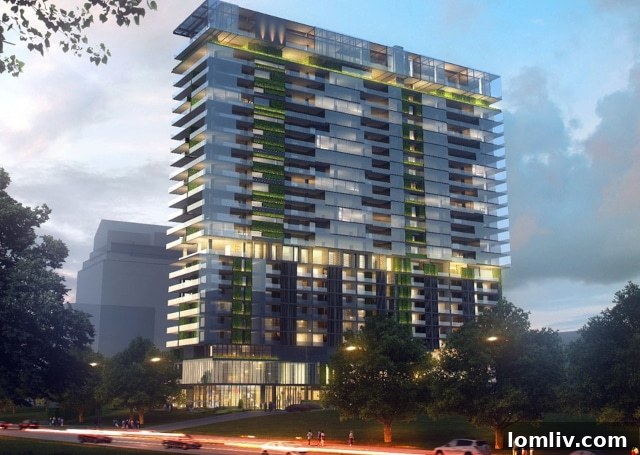
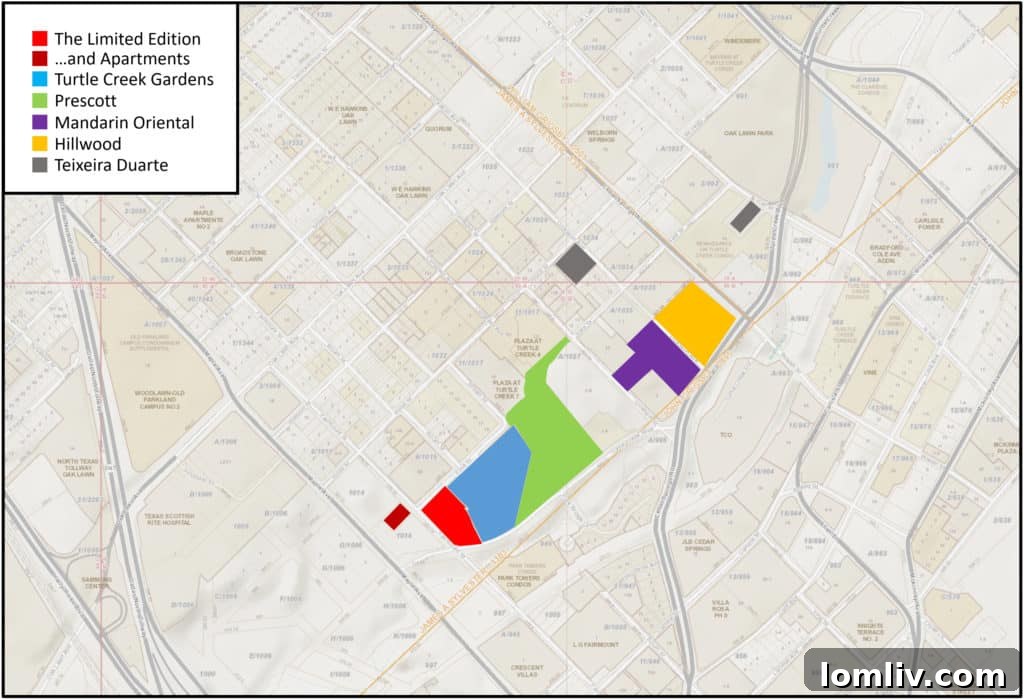
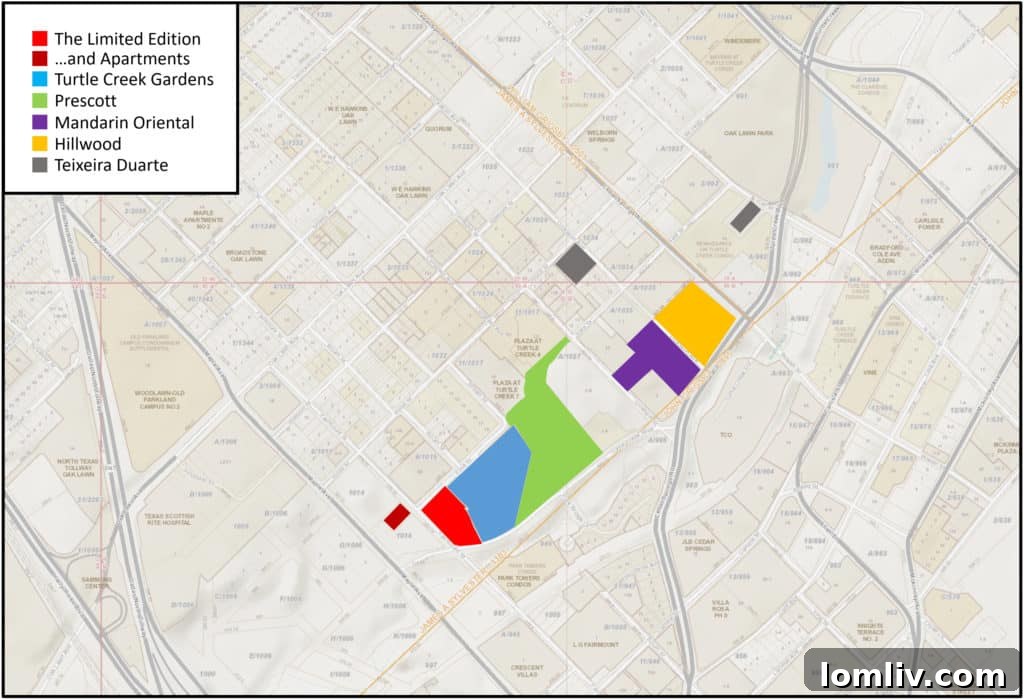
One prominent example is Canadian developer Great Gulf’s ambitious project, the Limited Edition at Turtle Creek and Fairmount, visibly marked in red on the accompanying map. This development was initially heralded as the epitome of ultra-luxury high-rise living, promising unparalleled amenities and sophisticated residences. Despite years of intense marketing efforts, aimed at showcasing its exclusive “ultra-ness,” the project struggled to secure a sufficient number of pre-construction contracts. Consequently, the site, envisioned as a pinnacle of Dallas luxury, remains an empty lot, a testament to the challenges of even the most aspirational ventures. Adjacent to this, and also under the ownership of Great Gulf, is a smaller, darker red parcel earmarked for a planned apartment building. This project too has failed to move beyond the planning stage, the land lying fallow, awaiting a future that seems perpetually postponed.
Further along this significant stretch of Turtle Creek lies the property known as Turtle Creek Gardens, depicted in blue. This expansive site has witnessed a protracted saga of proposed developments and subsequent collapses. In recent years, at least two developers have engaged in advanced negotiations for the property, both ultimately failing to finalize the acquisition. The primary stumbling block, as reported by sources close to the deals, was the developers’ inability to secure the necessary funding to close the sale, let alone commence construction. This pattern highlights a critical vulnerability in the luxury development market: even with high demand for premium locations, the sheer capital required to initiate and complete such projects can be an insurmountable barrier.
Next to Turtle Creek Gardens and situated to the left of the iconic Mansion on Turtle Creek is the site of the old Republic Bank building, marked in green. This location gained significant attention when, just last year, Prescott successfully secured the site. Their ambitious plan involved a trio of high-rises: one dedicated to modern office spaces, another featuring luxury apartments, and a third combining a lavish hotel with high-end condominium units. The visible progress began dramatically last September when the venerable old bank building was imploded in a singular, spectacular event. Yet, since that explosive beginning, the site has remained dormant, with no further construction activity. This halt after such a decisive start adds another layer of intrigue to Turtle Creek’s development woes, suggesting that site preparation is often just the first, albeit dramatic, step in a much longer and more complicated journey.
The aspirations for Turtle Creek also extended to the luxury hospitality sector with the proposed Mandarin Oriental project, located at Turtle Creek and Gillespie, on the opposite side of The Mansion, and identified in purple. This highly anticipated development was envisioned to include a world-class hotel alongside condominium units that were expected to set new records for luxury pricing in Dallas. The Mandarin Oriental brand is synonymous with unparalleled elegance and service, making its proposed arrival a significant indicator of Turtle Creek’s potential as a global luxury destination. However, this project, like so many others, has found itself trapped in a state of indefinite postponement, failing to materialize beyond its initial grand announcement.
Adjacent to the Mandarin Oriental site, at the intersection of Cedar Springs and Turtle Creek (orange on the map), another promising venture, the planned Hillwood office building, has also stalled. While Hillwood candidly stated from the outset that construction would only commence once anchor tenants were secured, it appears that over the past three years, the market conditions or specific tenant requirements have not aligned. This highlights the crucial role of pre-leasing and tenant commitment in launching large-scale commercial developments, particularly in a competitive office market.
Compounding this narrative of stalled progress are two additional projects, marked in grey, located adjacent to Turtle Creek. These were spearheaded by the Portugal-based firm Teixeira Duarte, representing their inaugural foray into the North American development market. Unfortunately, corporate financial challenges compelled the company to abandon these ventures and subsequently sell off their valuable parcels. This serves as a reminder that even international investment, often seen as a catalyst for major projects, is not immune to broader economic headwinds or internal corporate restructuring.
In total, these various announced developments encompass approximately 15 acres of prime Turtle Creek real estate. Despite their grand designs and the substantial investment implied, none have managed to break ground in recent years. This creates a perplexing paradox: an area of immense desirability and lucrative potential, yet one seemingly resistant to new construction. The only major project that appears to be successfully moving forward in the vicinity of Turtle Creek, perhaps ironically, is the Toll Brothers high-rise at Welborn and Congress. This project, which faced its share of controversy, has been steadily rising, a solitary beacon of progress amidst a sea of stalled aspirations.
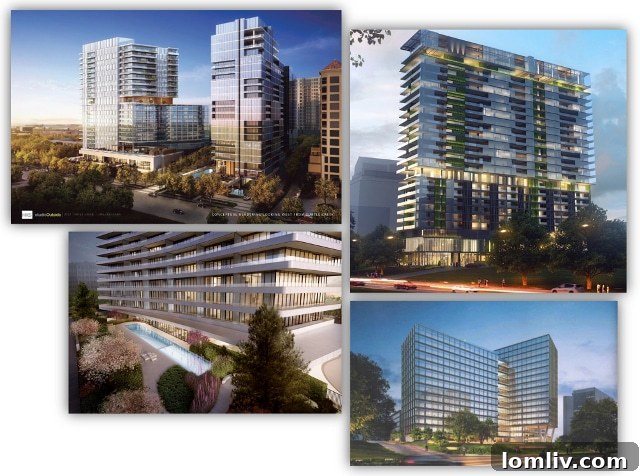
Behind the Stalls: A Deeper Dive into Turtle Creek’s Development Challenges
The recurring pattern of stalled luxury developments along Turtle Creek isn’t merely a series of isolated incidents; it points to a confluence of complex factors that challenge even the most experienced developers and well-heeled investors. One significant hurdle often lies in the intricate dance of financing. Ultra-luxury projects typically require substantial upfront capital, and in a market where pre-sales might be slower than anticipated, securing construction loans becomes increasingly difficult. Lenders often demand a high percentage of units under contract before releasing funds, a benchmark that has proven elusive for many Turtle Creek projects.
Market timing also plays a crucial role. While Dallas generally experiences robust growth, the niche ultra-luxury market can be sensitive to economic shifts, investor confidence, and even geopolitical events, which can affect the pool of high-net-worth buyers. Furthermore, community opposition, while not always the primary cause of a project’s failure, can certainly add layers of complexity, cost, and delay. Turtle Creek’s affluent residents are known for their active engagement in preserving the character of their neighborhood, often leading to protracted battles over zoning, density, and design, adding unpredictable variables to a developer’s timeline and budget.
The very prestige of Turtle Creek also contributes to its challenges. Land values are exceedingly high, pushing project costs skyward. To justify these costs, developers must aim for unprecedented levels of luxury and price points, which, in turn, narrows the potential buyer pool. This creates a delicate balance: innovate to stand out, but don’t price yourself out of a still discerning market. The generous zoning often granted to these parcels, intended to encourage high-density, high-value projects, sometimes fuels overambitious proposals that are difficult to execute financially or aesthetically without significant community friction.
Recent Developments: Glimmers of Hope or Further Complications for Turtle Creek?
Amidst the narrative of stalled projects, recent weeks have brought updates concerning two of these significant sites, offering a glimpse into the ongoing struggle to unlock Turtle Creek’s development potential.
Turtle Creek Gardens: A Risky Refusal?
The 4.5-acre Turtle Creek Gardens property, a perennial fixture in the stalled development discussions, is once again on the market. Cushman & Wakefield has been retained to market the site, marking at least the third attempt to bring this prime parcel to fruition. In a surprising turn of events, sources indicate that at least one developer, reportedly with cash in hand, offered to purchase the property for a sum equivalent to the last failed sale. However, this offer was rejected. The ownership, it is understood, believes that the market has shifted, and their property is now worth considerably more. While the precise parameters of that second offer remain somewhat unclear, the first offer was widely rumored to be in the region of $43 million – translating to approximately $10 million per acre, a staggering sum for undeveloped land in Dallas.
The decision to refuse a substantial, cash-backed offer in pursuit of a higher valuation carries inherent risks. With a broker now involved, the challenge of surpassing the last direct offer, while also accounting for broker’s fees, becomes significantly more complex. Indeed, the previously interested cash buyer is said to have balked at the new terms. This situation illustrates a high-stakes gamble on future market appreciation, potentially alienating viable buyers in the present. One entity that might be undeterred by the added costs and broker’s fees is Houston-based Hines, a major player in high-rise development. Hines is currently working on the Maple Terrace high-rise, a by-right project that avoids contentious compromise, suggesting a preference for straightforward acquisitions. Given the similar lot size of Turtle Creek Gardens to the neighboring Prescott trio, a successful deal would likely involve the construction of at least two, if not three, new luxury high-rises, dramatically altering the immediate skyline.
From an outside perspective, the adage “twice burned, thrice take the outstretched hand full of cash” might seem like a prudent strategy. This situation echoes other instances in Dallas where property owners, such as the Preston Place owners in PD-15, have patiently (or perhaps stubbornly) waited for their “next better offer,” sometimes to their detriment. The question for Turtle Creek Gardens now is whether this strategy will finally yield a successful development or prolong its status as a highly valuable, yet unrealized, asset.
The Mandarin Oriental Saga: Preserving the Past, Jeopardizing the Future?
The proposed Mandarin Oriental project also saw renewed activity last week. JMJ Development, the firm behind this ambitious undertaking, appeared before the City Plan Commission (CPC) seeking approval to re-present their plans. Zoning regulations in Dallas stipulate a two-year moratorium before a developer can revisit a zoning case once it has passed the city council, preventing immediate re-applications after initial approvals. JMJ’s desire to significantly “re-diddle” their original plans necessitates a complete restart of the complex approval process, a move that raises eyebrows given the initial effort required to secure approvals.
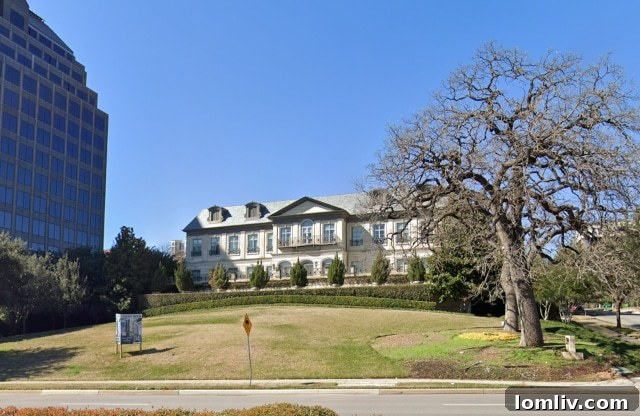
The original plan involved demolishing the 2004 French Chateau office building, constructed by John Eulich, to make way for a striking 235-foot tower. This tower was designed to house the luxurious Mandarin Oriental hotel on its lower floors, topped by an exclusive collection of MO-branded condominiums. However, the revised plans indicate a new architect has found a way to preserve the chateau. While the chateau is undeniably grand and boasts a luxurious interior, its status as a historic building, at only 16 years old, is questionable. It stands more as a “folly” of a single developer’s vision rather than a piece of Dallas’s architectural heritage. The challenge of seamlessly integrating its distinct “Beverly Drive” exterior into a contemporary design that propels Turtle Creek into the next century seems an architectural feat fraught with difficulty.
The decision to preserve the chateau is particularly perplexing given the concessions already made to gain initial zoning approval. The original tower design received generous zoning support, navigating successfully through the Oak Lawn Committee, the Plan Commission, and the City Council. Crucially, it also secured approval, at the eleventh hour, from the formidable local resident gauntlet – a powerful consortium of Turtle Creek’s moneyed and influential residents who successfully demanded that no entrance or exit be placed on Gillespie Street. Gaining consensus from all these diverse entities, especially the high-profile and influential neighbors, was an arduous and delicate task. To petition to return to square one, unless a completely new and compelling rationale exists, seems a strategically bewildering choice.
Further concerns arise regarding City Council member David Blewett. Already facing local discontent over issues like Reverchon Park, he might be inclined to placate residents by supporting a less ambitious project. The political calculus often dictates avoiding alienating one’s wealthiest constituents. However, given that this “ship has sailed” regarding prior controversies, the question remains whether he would risk further ire by being summoned to “The Mansion’s woodshed” twice over a contentious development. This political dimension adds another layer of uncertainty to the Mandarin Oriental project’s future.
Adding to the project’s woes, the Dallas Morning News reported in April that Chinese investors in other JMJ projects were actively seeking to force the firm into bankruptcy due to missed payments. This financial instability casts a long shadow over JMJ Development’s capacity to execute a project of the Mandarin Oriental’s scale and luxury. Following Thursday’s Plan Commission meeting, inquiries were sent to both JMJ Development and Mandarin Oriental’s PR representatives. Abbey Nayor of Mandarin Oriental confirmed that “Mandarin Oriental was still attached to the project,” but after an initial seeming unawareness, she offered no further comment on the recent developments. Similarly, JMJ media representative Melanie Bonvicino acknowledged the inquiry but did not provide a response by press time. This silence only fuels speculation and reinforces the precarious nature of this high-profile project.
The Broader Implications for Dallas Real Estate and the Future of Turtle Creek
The persistent stalling of these grand developments on Turtle Creek has significant implications that extend beyond the immediate disappointment of unrealized projects. For Dallas’s luxury real estate market, it signals a potential bottleneck where prime land, despite its intrinsic value, struggles to translate into tangible, high-value assets. This could impact investor confidence, making future large-scale projects in equally desirable but challenging areas more difficult to finance. Developers might become more risk-averse, favoring smaller, less ambitious projects, or those with fewer regulatory and community hurdles.
From an urban planning perspective, these vacant or underutilized parcels represent missed opportunities for economic growth, increased tax revenue, and the creation of vibrant, mixed-use communities. While preservation is vital, the indefinite stagnation of key sites can hinder the natural evolution and modernization of a city’s most prestigious districts. The saga of Turtle Creek also highlights the immense power of local advocacy groups and the political complexities involved in urban development. Balancing developer ambitions with community desires and political realities is a delicate art, and the current state of Turtle Creek suggests that this balance has yet to be struck effectively.
Between all these tracts, there is the potential for roughly a dozen new high-rises to transform the Turtle Creek skyline, occupying approximately 15 generously zoned acres. Yet, the question remains: why can no one seem to get any of them out of the ground? Is Turtle Creek truly cursed, or is it simply a microcosm of the intricate, often frustrating challenges inherent in developing ultra-luxury properties in a highly scrutinized and sought-after urban environment? The answers will dictate whether this fabled boulevard can finally move beyond its current status as Dallas’s most beautiful, yet unfulfilled, boulevard of dreams.