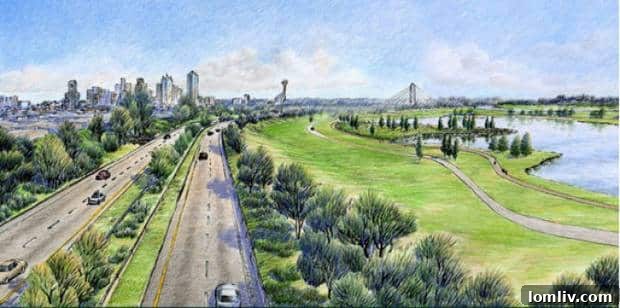
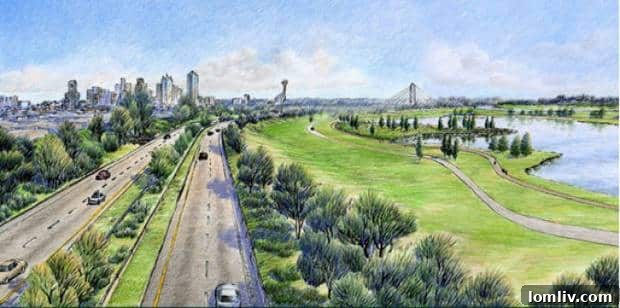
Dallas finds itself at a pivotal crossroads, grappling with one of the most contentious urban development proposals in recent memory: the Trinity Tollway. This ambitious, yet deeply divisive, project aims to construct a major thoroughfare along the serene Trinity River bed, a decision that many fear would irrevocably split the city into distinct north and south segments. As a keen observer of Dallas real estate and urban planning, my primary objective this year is to comprehensively assess the sentiment within the real estate community regarding this critical issue.
The debate gained significant momentum with a closed-door briefing orchestrated by State Senator Royce West. On a recent Thursday, Senator West extended invitations to a select group of prominent city leaders, gathering them at the Urban League of Dallas on Lancaster Road. Notably, this meeting was strictly off-limits to the press, including even the esteemed Dallas Morning News. Senator West justified the exclusion by stating the meeting was solely for his personal informational briefing, intended to better inform his responses to constituent concerns. This move immediately sparked questions about transparency and public engagement in a project of such immense civic importance.
The concept of transparency is paramount in any major public infrastructure undertaking, and its absence here has fueled considerable skepticism. Public trust is built on open dialogue and clear communication, especially when decisions have far-reaching implications for urban landscapes and community livelihoods. When discussions are held behind closed doors, it inevitably raises concerns about accountability and whether all voices are being truly heard and considered.
The roster of attendees for this exclusive briefing was a who’s who of regional movers and shakers. Among the presenters were Senator West himself, along with key figures like Michael Morris, the Transportation Director for the North Central Texas Council of Governments (NCTCOG), City of Dallas Assistant City Manager Jill Jordan, and City of Dallas Transportation Program Manager Keith Manoy. Representing state and regional transportation authorities were Kelly Selman, Deputy Engineer for the Texas Department of Transportation (TxDOT) Dallas District, and Elizabeth Mow, NTTA Executive Director of Infrastructure. Also present was Bob Meckfessel, former president of the Dallas AIA, a respected voice deeply committed to Dallas’s architectural integrity. Significantly, Meckfessel, once a proponent of the toll road, has now publicly shifted his stance to opposition, reflecting a growing unease even among those initially inclined to support the project.
The list of invited guests was equally formidable, featuring Dallas Mayor Mike Rawlings, former Dallas City Manager Mary Suhm, and several Dallas City Council members, including vocal critics Scott Griggs and Philip Kingston, alongside Vonciel Jones Hill and Dwaine Caraway. Dallas County Commissioners John Wiley Price and Elba Garcia, Farmers Branch council member Ana Reyes, West Dallas developer Monte Anderson, and urban planner Patrick Kennedy were also on the list. Representatives from both the North Texas Tollway Authority (NTTA) and the Texas Department of Transportation were present, as well as real estate investor Philip Wise and State Representative Raphael Anchia, who has been actively polling his constituents on the matter. Approximately 30 to 35 individuals attended, though notable absences included Mayor Mike Rawlings, Council members Griggs and Kingston, Commissioners Price and Garcia, and Philip Wise (whose partner, Barry Hancock, attended in his stead). These absences, particularly from elected officials representing areas directly impacted, further underscore the perception of an incomplete or selectively curated discussion.
The proposed Trinity Toll Road, a 9-mile stretch intended to connect Irving and northwest Dallas with South Dallas, has rapidly escalated into one of the city’s most fervent controversies. It has become a dominant topic of discussion, overshadowing even typical cocktail party chatter about fluctuating home values. Senator West has been a consistent supporter of this $1.5 billion project. However, he has also publicly stated, across various media reports, that he would reconsider his support and potentially oppose the highway if a majority of his constituents express opposition, or if comparable highway capacity improvements are implemented elsewhere near downtown Dallas. This conditional stance presents a nuanced political tightrope walk for the senator, balancing constituent representation with long-standing regional infrastructure plans.
Following the briefing, Senator West conveyed to the Dallas Morning News that his personal perspective on the project remained unchanged. This declaration, coming after a meeting where, from various accounts, proponents largely dominated the discussion, further complicates the public’s understanding of his decision-making process.
Reports from the meeting suggest that the majority of the time was dedicated to presentations enthusiastically endorsing the project. The supporters dedicated nearly two hours to elaborating on their plans for the Trinity Tollway. It was described as an essentially five-lane highway, with three main lanes in each direction, complemented by two substantial shoulders on each side – effectively creating a five-lane one-way capacity when factoring in the shoulders. Proponents emphasized that the design would include direct access points connecting the Trinity Tollway to all other major area freeways in its vicinity, promising seamless integration into the existing Dallas transportation network.
However, the Trinity Tollway is merely one piece of a much grander, and arguably more unsettling, vision. Even for those with a nascent suspicion that a toll road might not be the optimal solution, the full scope of the proposal introduces an even larger concern: the Jefferson Memorial Bridge. This colossal structure is envisioned as a gigantic freeway flyover, controversially framed as a “memorial”—perhaps to Thomas Jefferson or the historic Jefferson Boulevard. The staggering cost of constructing this bridge would be an addition to the already substantial expenses of the Trinity Tollway itself. The plan necessitates the demolition of the existing Jefferson Bridge to make way for the Trinity Tollway’s exit ramps. The new Jefferson Memorial Bridge would then ascend as a prominent highway fly-over spanning the Trinity River, directly dissecting the historic Oak Farms Dairy site. It is essentially conceived as a mini-freeway, seamlessly connecting the Trinity Tollway to I-35. The proposed alignments, gleaned from Dallas City staff, reveal the immense scale and complexity of this interwoven infrastructure. One need only imagine the intricate network of ramps and elevated roadways to conjure an image of “spaghetti” – a tangled, overwhelming mass of concrete.
According to Michael Morris of NCTCOG, the Jefferson Memorial Bridge is not just an ancillary component; it is absolutely critical to the entire project, deemed essential for its fundamental functionality and implementation. He asserted that its design and necessity adhere to “standard transportation model 101.” This perspective highlights a car-centric planning philosophy that seems increasingly at odds with contemporary urban development trends.
A glaring omission from the lengthy presentations by the project’s proponents was any meaningful discussion of critical urban planning concepts such as “living and working in the same area” or the promotion of walkability. The entire premise appears to be rooted in a perpetual reliance on automobile commuting, rather than fostering dense, mixed-use communities where residents can easily access employment, services, and recreation by foot or public transit. This oversight raises fundamental questions about the project’s alignment with modern, sustainable urban growth principles. Perhaps these more nuanced considerations are reserved for a mythical “Part II” of the discussion, but their absence from the initial briefing is deeply troubling for those advocating for a more holistic approach to Dallas’s future.
Adding a surreal twist to the proceedings, there was even talk of repurposing the Trinity River toll road as a “parkway” on weekends. Unbelievably, my sources confirm that the idea of hosting actual street parties directly on the tollway was seriously floated. The notion of “having a party on a highway” vividly encapsulates a profound disconnect between the project’s proponents and the lived realities and aspirations of urban residents seeking green spaces, accessible public areas, and genuine community engagement, not a temporary repurposing of a massive concrete structure.
For roughly an hour and forty-five minutes, the Trinity Tollway supporters presented their case. Councilwoman Vonciel Jones Hill was among those who delivered a pitch, focusing primarily on facilitating commutes for residents to job centers in the Hospital District and the Stemmons Corridor. Her explicit statement, “ALL I CARE ABOUT IS GETTING PEOPLE UP TO THEIR JOBS IN THE HOSPITAL DISTRICT AND THE STEMMONS CORRIDOR,” sparked considerable debate. This narrow focus, critics argue, overlooks the vital imperative of fostering wealth creation and economic opportunity directly within the southern communities she represents. It raises pertinent questions: Is Parkland Hospital the sole viable employer for her constituents? Are job prospects limited to healthcare, or are residents of her district capable of pursuing diverse professional paths? To understand the broader implications of this commuter-centric approach, one might consult urban planner Patrick Kennedy’s incisive analysis of the “pleasant grove commuter” phenomenon, which offers a critical perspective on the long-term sustainability and equity of such transportation strategies.
Once we absorb the nuances of that discussion, we can move forward. Bob Meckfessel, a respected voice in Dallas architecture, requested a mere two to three minutes to speak. He delivered his remarks with a noticeable reservation, perhaps feeling outmatched by the prolonged pro-tollway presentations. He countered Michael Morris’s assertion that the tollway aligned with the “Dallas Balanced Vision Plan,” stating emphatically that it did not. Meckfessel passionately advocated for prioritizing the creation of jobs and nurturing entrepreneurship within the southern sector itself, rather than solely focusing on transporting residents to employment elsewhere. He also underscored the dramatic shifts Dallas has experienced over the past 15 years, suggesting that original plans might no longer align with current needs or opportunities.
While not explicitly stated at the meeting, it’s crucial to acknowledge the broader socioeconomic context. In this country, the average net worth of black individuals stands at approximately $6,000, starkly contrasted with the average Caucasian net worth of $190,000. This profound disparity highlights the urgency of implementing strategies that genuinely foster wealth growth within underserved communities. Examining the revitalization of Harlem real estate, from its state 30 years ago to its vibrant present, offers a compelling case study. It demonstrates how focused, community-centric investment can dramatically transform an area, creating enduring economic value and social equity.
My initial assessment, gathered from multiple sources at the meeting, is that the Trinity Tollway, in its current iteration, will do little to stimulate sustainable real estate development or wealth creation within Dallas’s southern sector. Instead, it risks perpetuating a cycle of residents commuting out of their neighborhoods, enduring the wear and tear of daily travel on a new, expensive highway. Perhaps the considerable funds allocated for the Trinity Tollway could be far more effectively deployed by directly investing in essential infrastructure improvements within the southern sector – enhancing existing roads, upgrading water and sewage systems, and bolstering public transit options. Consider President Obama’s proposal for two years of free community college education; while I personally believe such initiatives could be enhanced with a year of public service, they exemplify the kind of direct investment in human capital that yields tangible benefits. Why not create robust incentives for businesses to establish roots in the southern sector, thereby generating local jobs and fostering economic activity directly where it’s needed most? Such an approach would naturally lead to a demand for new apartments and housing, creating a self-sustaining cycle of growth and prosperity.
Indeed, the sheer cost of constructing the Trinity Tollway is staggering. With the same financial investment, every child residing south of I-30 could be afforded a four-year university education at institutions like the University of North Texas – a testament to the immense opportunity cost associated with this highway project.
My second, and equally firm, conclusion is that Dallas’s southern communities desperately require an influx of commerce and investment *into* the area, not a design that facilitates an exodus *away* from it. How do we achieve this vital shift? I invite open dialogue and diverse perspectives in the comment section below. Dallas’s current population growth hovers near zero, with much of the regional expansion occurring in the northern exurbs – Plano, Frisco, Prosper, and beyond. This growth was undoubtedly fueled by the Dallas North Tollway (DNT). This historical precedent, however, leads to a critical question: Have we become so fixated on the “Tollway equals personal wealth” paradigm that we are blinded to alternative, more equitable models of urban development?
I leave you with two powerful words: BISHOP ARTS! The Bishop Arts District stands as a resounding success story, organically built by local entrepreneurs who cultivated its unique charm and vibrant character. True hipness and coolness in a neighborhood emanate from within, catalyzed by a few bold local visionaries willing to take risks, initiate change, and capture the collective imagination. It is only then that external investors, drawn by genuine authenticity and thriving local economies, begin to flow in, creating a powerful ripple effect of prosperity. Just yesterday, I spent time with apartment investors in another part of town – small, local business owners who began by acquiring and improving one building at a time. This bottom-up, community-driven model, focused on incremental, sustainable development, is precisely what South Dallas needs to truly flourish. If not, I urge you to offer alternative visions.