The landscape of American infrastructure funding is undergoing a monumental shift, presenting an unprecedented opportunity for urban centers like Dallas to revolutionize their public transportation systems. On December 15, then-President-elect Joe Biden announced the nomination of Pete Buttigieg as Transportation Secretary. This appointment signaled a renewed federal commitment to robust infrastructure investment, a promise underscored by the proposed increase to the Federal Transit Administration (FTA) budget. Dedicated to urban public transportation, the FTA’s estimated 2021 budget of $14.5 billion was slated for a remarkable boost. As part of President Biden’s ambitious $1.9 trillion COVID-19 aid package, the FTA was penciled for an additional $20 billion, more than doubling the budget allocated for public transit initiatives across the nation. This significant federal largesse creates a once-in-a-generation window for cities to embark on transformative projects that were previously deemed fiscally impossible.
As anticipated in discussions earlier last year, a Democratic administration was poised to prioritize and invest substantially in infrastructure development. Now, with the funding mechanisms in place, the critical question for Dallas Area Rapid Transit (DART) and city planners becomes: What should Dallas prioritize first to maximize this historic investment?
Dallas’s Future Demands a Comprehensive Subway System
The vision for Dallas’s public transit system is unequivocally clear: its future must be built underground. This assertion is not merely an opinion but an observation borne from the blueprint of every truly global, forward-thinking metropolis. Consider any major city renowned for its efficiency, connectivity, and urban vitality – from London to Tokyo, New York to Paris – and you will find an extensive, well-integrated subway network at its core. These cities don’t just have subways; they continually expand them, understanding that subterranean transit is the lifeblood of urban mobility. No thriving city has ever decommissioned a subway line due to lack of use; on the contrary, the demand for underground transit only grows with urban density and economic activity.
Dallas, with its burgeoning population and expanding economic footprint, is long overdue for a robust underground system. The proposed D2 subway line, which connects existing DART light rail lines through downtown, is poised to become a funded reality, with significant federal contributions already earmarked. This project, while crucial, should not be viewed as an end but as the vital first seed planted for a much larger, more ambitious subway network. It’s time to think beyond D2 and envision D3, D4, D5, and as many extensions as Dallas can strategically implement to capitalize on this extraordinary influx of federal funding.
This period represents a once-in-a-generation opportunity for Dallas to secure significant federal resources for public transportation. Such federal largesse for transit has not been seen since the era of President Lyndon B. Johnson’s Great Society initiatives, which led to the creation of the Department of Transportation and subsequently the Federal Transit Administration. Missing this chance would be a profound misstep, leaving Dallas to grapple with increasing congestion and a lagging transit infrastructure for decades to come.
Strategic Subway Expansion: D3, D4, and Beyond
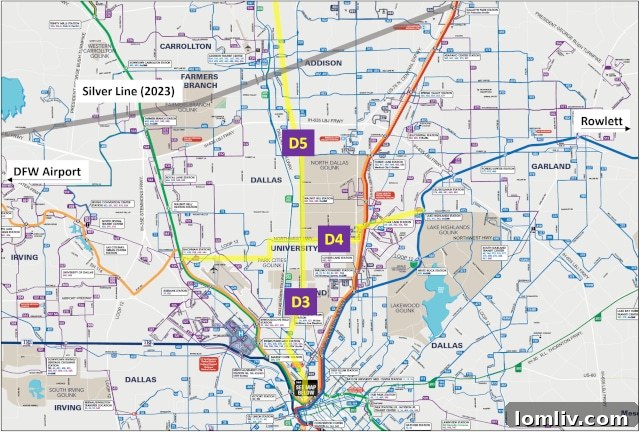
Once the foundational D2 project is underway, the subsequent phases of subway expansion, which we can conceptualize as D3, D4, D5, and so on, become a strategic imperative. The primary objective is to create a comprehensive underground network that addresses the city’s unique geographical and developmental challenges. For instance, in northern Dallas, a critical need exists for a subway line running between the Central and Stemmons freeways. The challenge in this area is its established, built-out nature, where land acquisition for surface infrastructure is prohibitively expensive and disruptive. This precisely underscores why going underground is not merely an option but a necessity.
The proposed D3/D5 segment is a particularly long and vital route, logically divided into phases due to budgetary and logistical considerations. South of Northwest Highway, we can identify the initial phase as D3, designed to serve the immediate high-density areas. The portion north of Preston Center would be D5, distinct from D4, which holds its own strategic importance as an east-west connector.
D3: Unlocking Connectivity in Dallas’s Dense Urban Core
The route for D3 is almost self-evident, driven by the existing concentrations of residential density and thriving commercial hubs. The goal is to connect these high-traffic areas, providing seamless access for thousands of potential daily riders. There’s no denying the significant population and business density in areas like Oak Lawn, Uptown, and West Village – prime candidates for subway connectivity.
The D3 line should logically begin at the underground D2 Metro Center station, ensuring direct integration with other existing and future train lines. From there, it would extend north, reaching key destinations such as the Crescent Court. This segment alone would serve a vast number of commuters and residents, while also offering crucial connectivity with the McKinney Avenue Trolley, effectively linking the subway to the popular West Village district. Furthermore, with several new high-rise developments currently in planning or early construction phases, there is an invaluable opportunity to proactively secure space for ground-level station entrances (pop-ups) and integrate subway infrastructure requirements directly into the underground plans of these new buildings. This forward-thinking approach can drastically reduce future costs and disruptions.
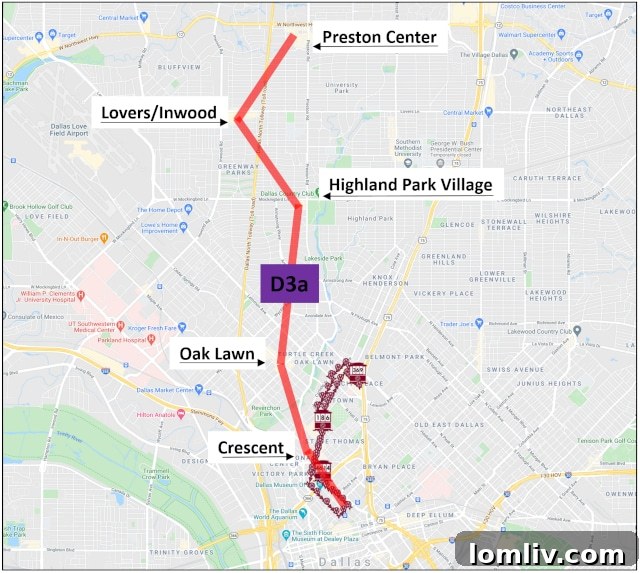
Continuing north, the D3 line would move into the vibrant Oak Lawn and Cedar Springs area. Station placement here could involve strategic partnerships with ongoing or future developments, such as the Streetlights development at Lemmon Avenue and Cedar Springs, or the Ablon/Caven venture on Cedar Springs, or even the strategically located Hillwood property at Cedar Springs and Turtle Creek. These are prime locations offering substantial rider bases and opportunities for integrated development.
Further north, a stop serving Highland Park Village could be strategically placed across Mockingbird Road, utilizing the adjacent surface parking lot. This presents an ideal negotiation point to secure space for both the subway pop-up and potentially integrate additional underground parking. While some resistance might be encountered from affluent communities, the long-term benefits of enhanced accessibility and reduced surface traffic would ultimately prevail. Should significant community resistance arise, alternative alignments or bypasses can be explored, but the connectivity remains paramount.
The route would then meander towards the busy intersection of Inwood Road and Lovers Lane. Similar to Highland Park Village, leveraging existing commercial parking lots for station integration and potentially burying additional parking along the route could mitigate surface impacts and enhance rider convenience.
Next on the D3 trajectory is Preston Center. The existing, often unsightly central parking garage presents a compelling case for transformation into a modern transit hub, serving both the dense office towers and surrounding residential areas. An underground station with a discreet ground-level entrance could be integrated, with the added benefit of burying all existing parking and topping it with a much-needed public park, vastly improving the urban fabric of the area.
Finally, the D3 line would extend further north, identifying a strategic location to service the bustling Galleria area and future developments in what is envisioned as Midtown Dallas. These areas offer ample land for acquisition and represent significant growth corridors. The ultimate goal for this northern extension would be to connect seamlessly with the in-process Silver Line, creating a truly integrated regional network.
D4: Bridging East and West with a Vital Subway Connector
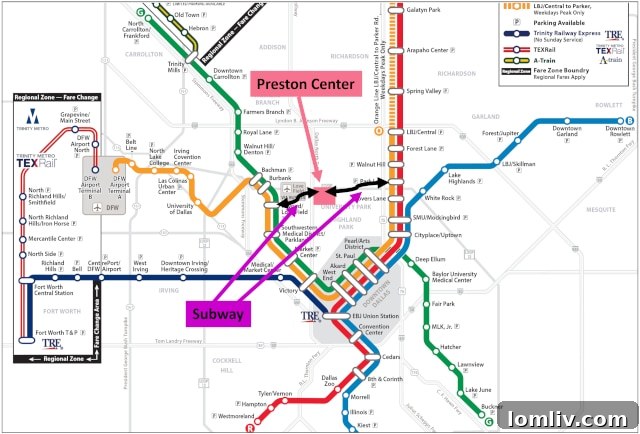
While Dallas has historically excelled at facilitating east-west vehicular movement, its public transportation network currently lacks a robust and efficient east-west subway connection. This deficiency forces many commuters to travel through the congested downtown core, even when their origin and destination lie outside it. As highlighted recently, a dedicated east-west subway line is not merely a convenience but a strategic necessity to truly unlock the potential of DART’s existing eastern and western lines.
The envisioned D4 line would serve as this critical east-west connector, linking key hubs such as the Park Lane/North Park station directly with Preston Center and Love Field Airport. The benefits of such a line are multi-faceted. It would enable riders from the eastern suburbs to seamlessly transfer to the Orange Line without navigating downtown, providing direct access to major destinations like Dallas-Fort Worth International Airport, Grapevine, Denton, and North Richland Hills. Conversely, it would allow riders from the western and northern suburbs to reach eastern destinations like Rowlett with vastly improved efficiency. This line would dramatically reduce travel times, alleviate pressure on downtown infrastructure, and significantly enhance regional connectivity, making Dallas a more accessible and attractive city for residents and businesses alike.
Equitable Expansion: Prioritizing Southern Dallas Connectivity
It might be easy to assume that the focus on northern Dallas’s density means neglecting other vital parts of the city. However, Southern Dallas presents a distinct set of challenges and, surprisingly, certain advantages when it comes to subway expansion. While northern Dallas grapples with the high cost of land acquisition in built-out areas, Southern Dallas offers more opportunities for strategic development and equitable access.
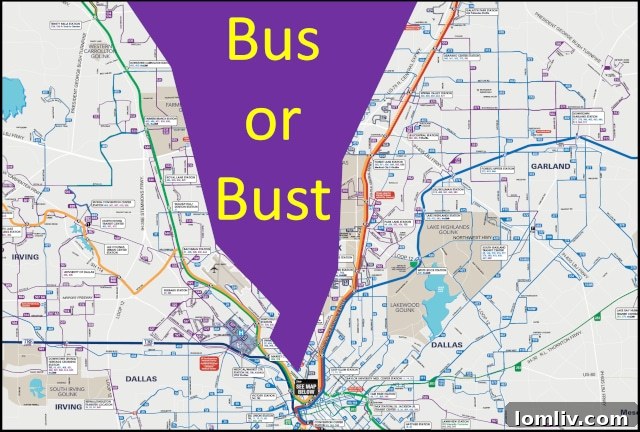
As illustrated by current transit maps, existing DART service generally extends further north than south. Addressing this imbalance is crucial for bringing in underserved southern suburbs, though multi-municipality negotiations can be complex and protracted. Despite this, Southern Dallas does not suffer from the extensive “V-shaped wasteland” of service gaps seen in some northern areas without the proposed D3 and D4 lines. However, as the region develops and existing services become more robust, Southern Dallas will undoubtedly require its own dedicated east-west connector, similar to the proposed D4, to ensure comprehensive and equitable access across the entire metropolitan area. The immediate priority, in a humble and unqualified opinion, should be to extend existing north-south lines further apart to cover more ground, paving the way for future localized east-west connections that serve specific community needs.
DART: The Time for Ambitious Plans is Now
While the intricacies of urban planning and subway engineering lie outside the scope of casual observation, the glaring gaps in Dallas’s public transportation service are evident to any resident or visitor. What is equally clear is the current landscape of unprecedented federal funding, akin to an open purse ready to invest in transformative projects. Dallas finds itself at a pivotal moment, strikingly similar to the 1960s – the last era when federal coffers were so generous towards public works. Had Dallas seized that opportunity to develop a comprehensive subway system then, the city we know today would be fundamentally different, more efficient, and more connected.
This is not merely about adding a few more stops; it’s about forging a legacy. The city’s leadership, DART officials, and community stakeholders must not squander this rare chance. It is an urgent call to action: develop bold, visionary plans for an underground subway network that truly serves the Dallas of tomorrow, not just the Dallas of today. The transformative potential for how residents move throughout the city, for economic development, and for environmental sustainability is immense.
To delay or to think incrementally would be a profound error. If it takes another half-century for such a significant funding bonanza to re-emerge, many of us will be long gone, and the same complaints about inadequate infrastructure will undoubtedly persist. The time for Dallas to secure its subterranean future is now, ensuring that current and future generations benefit from a truly world-class public transit system.