The Ad That Sparked a City-Wide Conversation: Diversity, Real Estate, and Resilience in Houston
In an era where discussions around diversity and inclusion are more prevalent than ever, the seemingly simple act of depicting a modern family in an advertisement can still ignite unexpected controversy. Back in 2015, Houston, a vibrant and diverse metropolis, became the backdrop for such a debate when Houstonia Magazine featured a real estate ad that, for a select few, pushed the boundaries of societal acceptance.
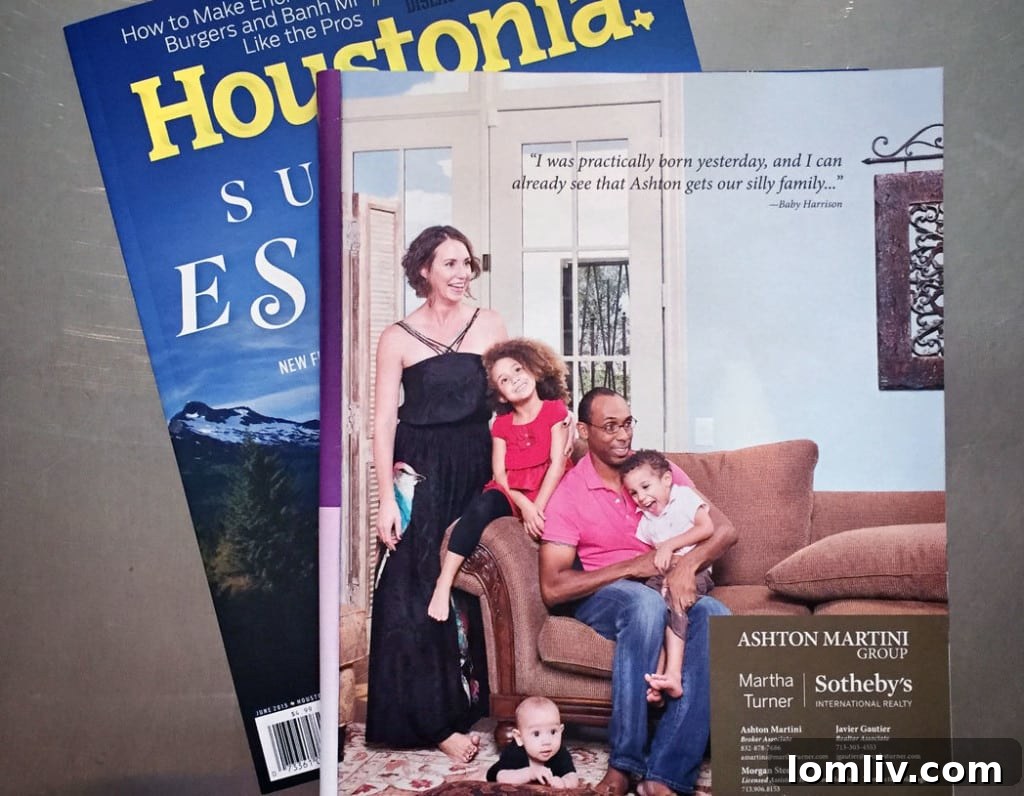
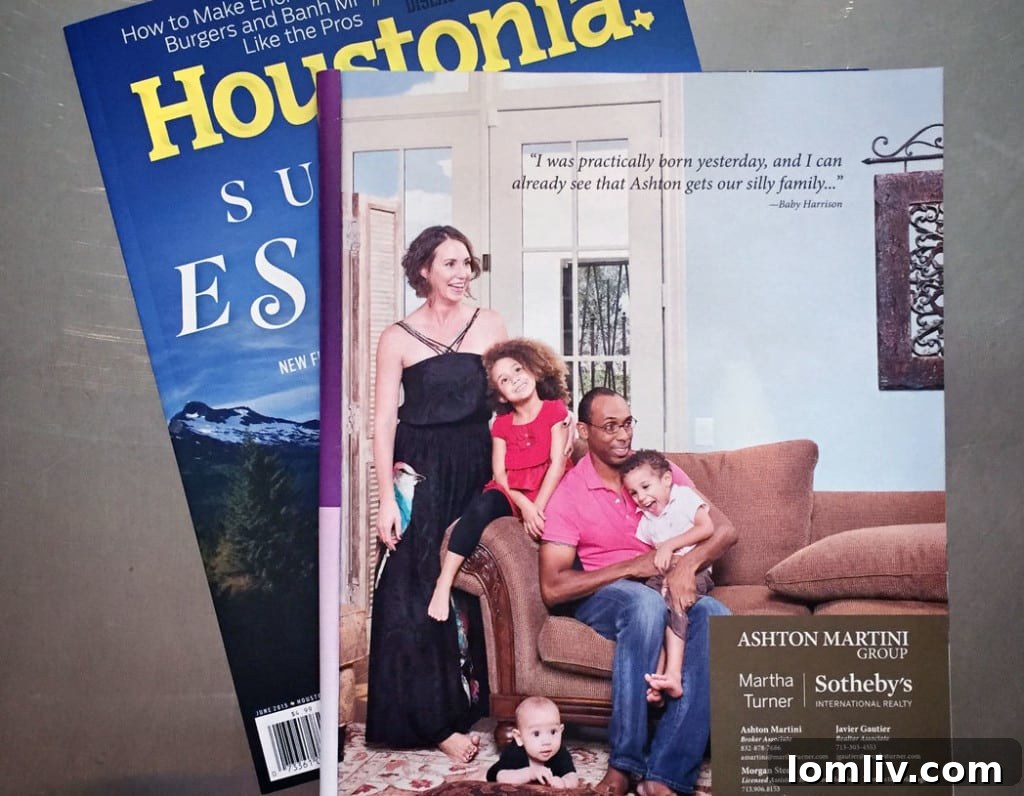
The advertisement, placed by the Ashton Martini Group of agents at Martha Turner Sotheby’s International Realty, showcased a beautiful, seemingly typical family relaxing in the comfort of their home. What made this particular ad, expertly captured by photographer Chris Skiles, a point of contention for a small segment of the magazine’s readership was the composition of the family: a white mother, a Black father, and their three charming biracial children. For some, this loving portrayal of an interracial family was deeply unsettling, leading to formal complaints that underscored lingering prejudices in society.
Reader Reactions: Unveiling Uncomfortable Truths
The year was 2015, and the general consensus among forward-thinking individuals was that conversations around mixed-race families should be celebratory, reflecting the rich tapestry of modern demographics. However, the reactions to the Ashton Martini Group’s ad served as a stark reminder that deeply ingrained biases persist. Scott Vogel, the editor-in-chief of Houstonia Magazine, recounted the first notable complaint that arrived in an email to the advertiser.
The ad, you may recall, featured a family of five Houstonians—a husband and wife, and the couple’s three children—relaxing in the living room of their home. To the lion’s share of our readership, one imagines, such a tableau must have looked almost aggressively typical. Perhaps they observed that the husband is black, the wife is white, and the couple’s three adorable children biracial, but that’s all it was for most, an observation.
Not so Dr. Tomball, who on May 26 sent an email to the Ashton Martini Group registering his disapproval. The note, which I have seen, carries the subject “Disgusting Ad,” and explains: “Your ad in the June Houstonia magazine is DISGUSTING! I will not put this magazine in my reception area! If you care to discuss this,” the note concluded, “I am available.”
This “Dr. Tomball,” a physician from the Houston suburb of Tomball, was not just mildly displeased; his email conveyed outright “disgust.” The implied threat of refusing to display the magazine in his waiting room, a common practice for publications, highlighted the extent of his disapproval. Curiously, when Houstonia reportedly attempted to contact him for a discussion, he proved unavailable, raising questions about the sincerity of his offer to “discuss this.”
A week later, another complaint surfaced, this time from an unnamed resident of the Memorial area, who identified himself only as “Fred.” This caller expressed similar sentiments, stating that while he typically enjoyed Houstonia, he “just can’t go for racial mixing.” His concern extended to children potentially seeing the ad and “getting it into their heads that this is okay.” In a defiant act, he claimed to have discarded the June issue directly from his mailbox to the trash. Yet, despite his strong objections, he declined to cancel his subscription, still counting himself among the magazine’s fans. This contradictory stance underscored a common phenomenon: individuals wishing to silence voices of progress without fully disengaging from the platforms that host them.
A Magazine’s Defiant Stand for Diversity
In the face of these complaints, Houstonia Magazine and its editor-in-chief, Scott Vogel, chose not to yield. Instead, they took a firm and public stance against racial prejudice. Vogel’s response was not merely to ignore the critics but to confront them directly. He unequivocally stated that the magazine was happy to remove these individuals from their subscriber list, sending a clear message: bigotry had no place within their readership.
Further solidifying this position, Scott Vogel penned a powerful op-ed for The Washington Post titled, “Here’s what I did when racists complained about an interracial family in my magazine.” This article not only brought national attention to the incident but also served as a compelling declaration of the magazine’s commitment to reflecting the true diversity of its city, regardless of the backlash. This move garnered significant positive publicity and reinforced the idea that media outlets have a crucial role to play in advocating for social justice and challenging outdated norms.
Examining Journalistic Ethics and Anonymity
While applauding Houstonia’s bold stand, some questions naturally arose regarding the handling of the complaints, particularly the anonymity of “Dr. Tomball.” The initial report noted that the doctor had sent an email, implying his identity was known to the magazine. In an age where public figures face scrutiny for problematic behavior, the decision not to name the physician, especially one expressing such overt prejudice, raised eyebrows. The comparison to figures like Minnesota dentist Walter Palmer, who faced global condemnation for his hunting actions, highlights a potential inconsistency in how public figures are held accountable.
The author of this piece, for instance, expresses skepticism: “Maybe my BS meter needs tuning, but I think it’s curious they do not name the physician they have slugged ‘Dr. Tomball.’ I mean, if he sent an email, which Vogel says he saw, they have his name, right?” This perspective touches upon the complex balance between journalistic privacy and the public’s right to know, especially when the issue at hand involves social commentary and alleged discrimination. It also subtly questions the authenticity or completeness of the narrative, hinting that sometimes, even well-intentioned institutions might navigate such situations with a degree of calculated ambiguity.
The Agent’s Perspective: Ashton Martini’s Unwavering Commitment
At the heart of the advertising controversy was Ashton Martini, the real estate agent whose group placed the ad. His initial interactions with the author revealed a busy professional navigating multiple demands. Despite initial reluctance and terse responses due to a packed schedule, Martini eventually provided a statement that clearly articulated his position and values. The author’s persistence, a hallmark of good journalism, ultimately yielded crucial insights.
This has been my statement to other outlets:
Houston is a diverse city and therefore, so is my clientele. This ad features a real family who are my clients and have become friends. While I never intended for it to be controversial, the response has started a conversation and I am happy to be part of it. I applaud Scott Vogel and Houstonia for their stand, and I can only hope that we are fostering a more accepting and tolerant younger generation.
Martini’s statement is a testament to his commitment to authenticity and diversity. He emphasized that the ad featured a “real family” who were his clients and had become friends—a detail that humanizes the ad and grounds it in genuine relationships rather than mere tokenism. His acknowledgment that Houston is a diverse city and his clientele reflects that reality speaks volumes about his professional ethos. Furthermore, his support for Scott Vogel and Houstonia’s stand, and his hope for fostering “a more accepting and tolerant younger generation,” position him as a proactive advocate for social change within the business community.
A Legacy of Innovation Within Tradition
The Ashton Martini Group operates under the prestigious umbrella of Martha Turner Sotheby’s International Realty, an institution long associated with the quintessential Houston lady herself, Martha Turner. Known for her impeccable style and sophisticated approach, Martha Turner epitomizes a traditional, high-end real estate experience. The firm’s reputation is built on elegance and established practices.
In this context, Ashton Martini emerges as a dynamic force, pushing the boundaries within a respected, traditional framework. His personal and professional profile underscores his innovative spirit. With a string of accolades including the NRG 20 Under 40 award in 2013 and recognition as one of the top 250 real estate agents in Texas, Martini’s success is undeniable. His honors at Martha Turner Sotheby’s International Realty—Top Ten Producing Agent, Most Listings, and Most Seller Transactions—demonstrate his prowess in a highly competitive market.
Beyond his sales achievements, Martini’s philanthropic endeavors reveal a deeply compassionate individual. He founded the Martha Turner Sotheby’s International Realty MS150 team, raising over $100,000 in two years for multiple sclerosis research. He also trains for marathons to raise money for the Alzheimer’s Association and supports Friends For Life, a no-kill animal adoption and rescue organization, donating a portion of his commissions to charity. These commitments paint a picture of a leader who integrates strong ethical values and community service into his business model, making his stand on diversity in advertising all the more authentic.
This blend of business acumen, philanthropy, and a willingness to challenge norms makes Martini a compelling figure in the Houston real estate scene. He clearly embodies a new generation of real estate professionals who are not afraid to use their platforms to reflect and champion societal progress.
The Evolving Landscape of Real Estate Advertising
The incident with the Houstonia Magazine ad is not an isolated one in the realm of real estate advertising pushing boundaries. Throughout history, certain real estate professionals have utilized their marketing strategies to provoke thought, generate discussion, or simply stand out in a crowded market. The author recalls an earlier instance involving Dallas broker Clay Stapp, who famously distributed unique “gifties” at an opening party, including a condom. This anecdote serves as a reminder that the desire to be memorable, sometimes controversially so, is not new to the industry.

Such marketing tactics, whether humorous, provocative, or socially charged, underscore the power of advertising to do more than just sell a product or service. They can reflect cultural shifts, challenge prevailing attitudes, and even influence public discourse. In the case of the Ashton Martini ad, it inadvertently became a lightning rod for conversations about race, acceptance, and the role of media in shaping perceptions.
Looking Ahead: The Future of Inclusive Real Estate Marketing
The controversy surrounding the Houstonia Magazine ad ultimately served as a powerful lesson for both the real estate industry and media outlets alike. It highlighted the ongoing need for diverse representation in advertising, not just as a matter of political correctness, but as an accurate reflection of our increasingly multicultural societies. Cities like Houston, Dallas, and countless others across the globe are melting pots of different cultures, ethnicities, and family structures. Advertising that mirrors this reality is not only more inclusive but also more relevant and effective in reaching a broad audience.
The central question that emerged from this incident, and one that remains pertinent today, is: who will be the next trailblazer? Which broker in other major cities, like Dallas, will bravely “push the envelope” with an ad that truly embodies modern diversity? And which publication will possess the courage and integrity to publish such an ad, knowing full well the potential for push-back and complaints from those resistant to change?
The experience of Houstonia Magazine and the Ashton Martini Group demonstrates that standing firm against prejudice, even from a small minority, can lead to significant positive impact. It signals to younger generations that acceptance and tolerance are not just ideals, but actively championed values. As the real estate market continues to evolve, embracing and celebrating diversity in all its forms through advertising will be crucial, not only for business success but for fostering a more equitable and understanding society. It is a challenge that creative agencies, real estate firms, and media partners must collectively address, ensuring that our visual narratives reflect the beautiful and varied world we inhabit.