In the digital age, few pastimes have captured the collective imagination quite like “Zillow surfing.” What began as a quirky, relatable sketch on Saturday Night Live, comparing the act of endlessly scrolling through real estate listings to swiping on a dating app on a lonely Friday night, has evolved into a widespread cultural phenomenon. This captivating form of digital escapism, where individuals visually explore strangers’ homes and fantasize about their own furniture fitting into grand, luxurious, or simply unique spaces, has only grown in popularity, long past the initial stay-at-home orders that likely fueled its early surge.
The numbers behind this trend are truly staggering. Zillow, the leading online real estate marketplace that meticulously compiles MLS data for potential home buyers, reported an astonishing more than 9 billion visits to its website and app in 2020 alone. This incredible volume of traffic underscores the deep-seated human curiosity and desire for connection, even if that connection is purely through the digital window of a meticulously photographed living room. Zillow surfing isn’t just about finding a home; it’s about dreaming, exploring, and engaging with the concept of “home” in ways that transcend the traditional real estate transaction.
The Allure of Digital Window Shopping: More Than Just Homes
Why has Zillow surfing become such an ingrained habit for millions? The appeal lies in a complex blend of psychological factors. At its core, it’s a form of escapism, offering a momentary reprieve from daily routines and responsibilities. It allows users to step into a fantasy world, imagining themselves living in a sprawling mansion with an infinity pool, a charming cottage nestled in the woods, or a sleek urban loft with panoramic city views. This “house porn” aspect, as it’s often humorously dubbed, taps into our innate desire for beauty, luxury, and the promise of a different, perhaps better, life.
Beyond pure fantasy, Zillow surfing also fulfills a deep sense of curiosity. We are inherently interested in how others live, what their spaces look like, and the stories their homes might tell. It offers a guilt-free peek into private lives, satisfying a voyeuristic impulse without any actual intrusion. For many, it’s also a source of inspiration, sparking ideas for home décor, renovation projects, or even future aspirations. It allows individuals to passively research market trends, understand neighborhood dynamics, or simply keep abreast of architectural styles, all without the pressure of an impending purchase. The platform’s user-friendly interface, high-quality images, and immersive virtual tours make the experience incredibly engaging, drawing users deeper into an endless scroll of possibilities.
Beyond the Screen: When Digital Exploration Becomes Physical
While Zillow surfing predominantly occurs in the digital realm, a significant portion of enthusiasts take their exploration a step further, crossing the boundary from virtual viewing to physical presence. Zillow’s own surveys reveal compelling insights into this behavior. A remarkable 75 percent of respondents admitted to engaging in Zillow surfing specifically to seek out unique, odd, or extraordinarily luxurious homes – the epitome of “house porn.” This isn’t about practical home hunting; it’s about pure entertainment and curiosity, an appreciation for the extraordinary.
Even more intriguing is the statistic that 83 percent of users surf Zillow purely “just to look around,” without any immediate plans to secure a pre-approval letter or enter the market. Their motivation is simple exploration. What truly raises eyebrows, however, is the segment of Zillow surfers who transition from digital lookie-loos to real-life visitors. Approximately 45 percent have actually toured a home in person, with no genuine intention of even humoring a real estate agent with an offer. This phenomenon presents a unique challenge for real estate professionals, who must discern between genuine leads and those merely seeking an in-person extension of their digital escapade. For these physical explorers, the motivation often remains curiosity, a desire to validate the online images, or simply to experience a moment of luxury or novelty firsthand, transforming a digital fantasy into a tangible (albeit temporary) reality.
The Compelling Grip: Understanding Zillow Surfing Habits
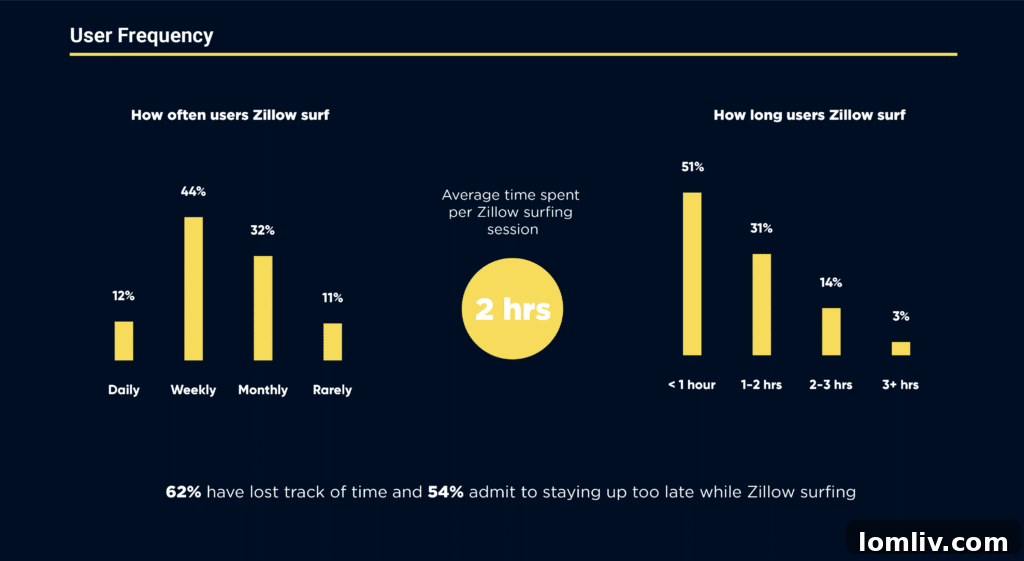
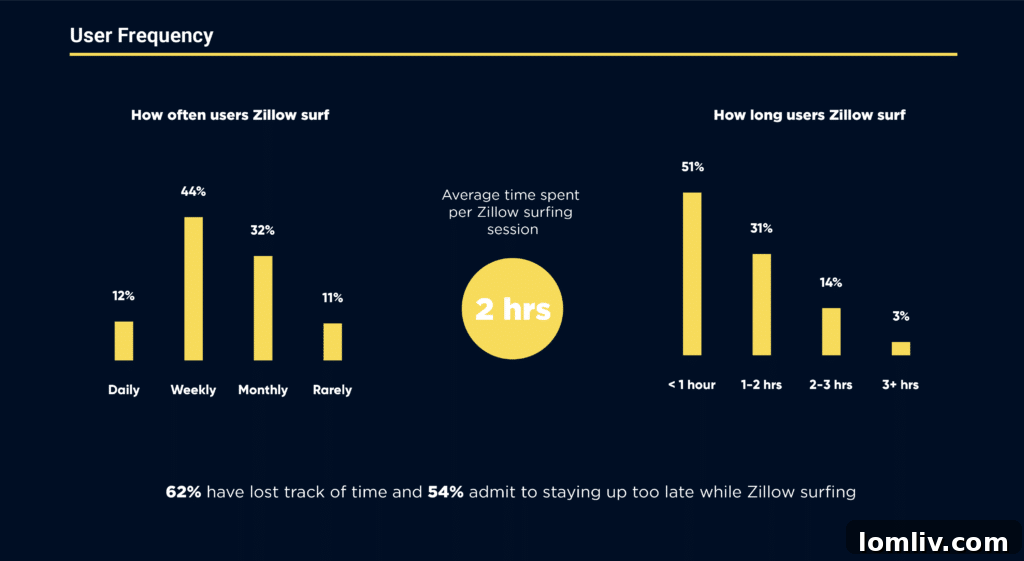
One might logically assume that constant exposure to real estate listings would eventually lead to boredom or a depletion of interesting content. Yet, the data suggests otherwise, indicating a deeply ingrained and persistent habit. More than half of Zillow’s respondents confessed to using the platform on a weekly basis, demonstrating its consistent appeal as a source of entertainment and distraction. These dedicated surfers aren’t just glancing at a few listings; on average, they commit two hours at a time to their virtual home explorations. This prolonged engagement points to a highly immersive experience, one that can easily make time slip away unnoticed.
Perhaps unsurprising to anyone who has ever fallen into the rabbit hole of online content, a significant 62 percent of respondents admitted to losing track of time while mindlessly swiping through listings. This “flow state” or hyperfocus is characteristic of many digital activities, where the endless stream of new content, coupled with visually stimulating images and the thrill of discovery, creates a compelling loop that’s difficult to break. This behavior shares similarities with other forms of digital “addiction,” such as endless scrolling on social media or binge-watching streaming services. The constant dopamine hits from discovering a stunning kitchen or an imaginative backyard design keep users hooked, transforming a casual browse into a regular, time-consuming ritual. The platform’s design, optimized for seamless navigation and visually rich content, further contributes to this deep immersion, making it effortless to spend hours virtually wandering through countless properties.
From Dreams to Intrusions: The Dual Nature of Zillow Engagement
The expansive world of Zillow surfing naturally branches into two distinct, yet often intertwined, activities: “Zillow dreaming” and “Zillow snooping.” Both illuminate different facets of human psychology – one aspirational, the other voyeuristic.
Zillow Dreaming: Crafting Fantasies and Shifting Priorities
Zillow dreaming is essentially daydreaming amplified by “house porn.” It’s the act of envisioning a future life, decorating imagined rooms, planning hypothetical renovations, and constructing elaborate fantasies around properties that may never be within reach. This form of escapism can be incredibly potent, offering a mental vacation from the stresses of everyday life. However, this deep immersion can come at a cost to real-world interactions. A striking 28 percent of respondents candidly admitted to ignoring what their partner was saying because they were engrossed in Zillow surfing. Perhaps even more telling, a significant 26 percent confessed to choosing Zillow surfing over intimacy or sex. These figures, while humorous, highlight the pervasive nature of digital distractions and their potential to subtly reshape our priorities and impact our closest relationships, pulling attention away from the present moment and into a virtual world of aspirational living.
Zillow Snooping: Peeking Behind the Neighbors’ Curtains
The darker, more controversial side of Zillow engagement is “Zillow snooping,” a practice that taps into our inherent curiosity about the lives of others. This involves actively searching for the homes of acquaintances, friends, neighbors, or even colleagues to gather private information. In many regions, property sales prices are publicly disclosed, fueling this data-driven voyeurism. For instance, 62 percent of Zillow’s respondents admitted to looking up a friend’s home on the platform specifically to ascertain its purchase price. This desire for comparative information often stems from a mix of social curiosity, status checking, or simply a need to understand the financial landscapes of those around them.
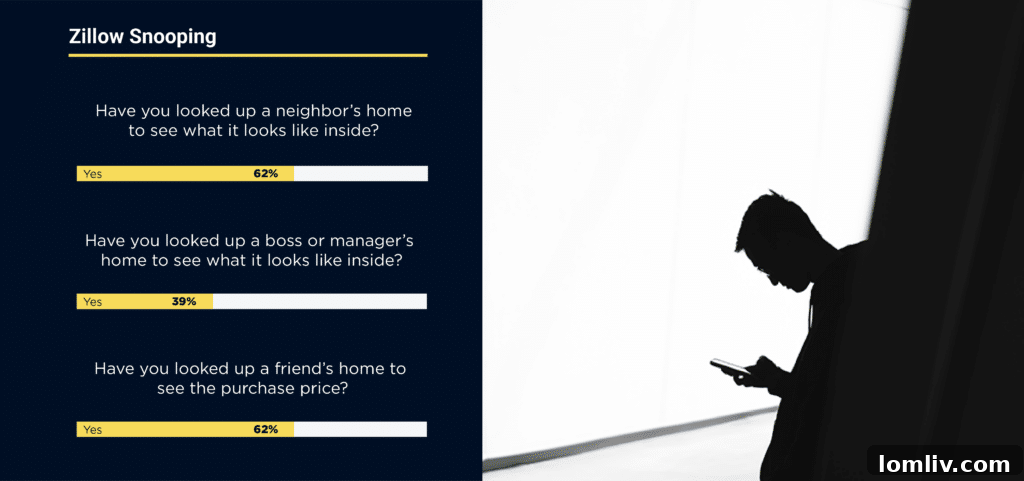
Even in areas like Texas, where the sales price of a home is not publicly disclosed, the desire to “snoop” remains strong. An identical 62 percent of respondents in Zillow’s survey reported looking up a neighbor’s home to see what it looked like inside. This speaks to a fundamental human curiosity about the private spaces of those in our immediate vicinity – a modern equivalent of peeking through curtains, but without the social awkwardness or legal ramifications. What’s even more fascinating and perhaps a bit unsettling is the revelation that 39 percent of respondents used Zillow to snoop on the homes of their boss or manager. This particular brand of voyeurism hints at a desire to understand hierarchy, lifestyle, and perhaps even gain an edge in workplace dynamics by uncovering details about superiors’ personal lives. Zillow, in this context, transforms from a real estate tool into a powerful instrument for social comparison and information gathering, blurring the lines between public data and private boundaries.
The Future of Real Estate Exploration: Blurring Lines
The pervasive phenomenon of Zillow surfing has irrevocably altered the landscape of real estate, pushing the industry to adapt to evolving consumer behaviors. Platforms like Zillow are no longer just marketplaces; they are entertainment hubs, dream generators, and sources of endless curiosity. The emphasis has shifted significantly towards high-quality visuals, immersive virtual tours, and detailed property descriptions to cater to both serious buyers and casual surfers alike. Real estate agents are finding themselves needing to be more technologically adept, embracing 3D walkthroughs, drone footage, and interactive floor plans to capture the attention of a digitally savvy audience.
The line between genuine home hunting and recreational browsing continues to blur. While Zillow surfing may seem like a frivolous activity, it undoubtedly shapes perceptions of value, influences aesthetic preferences, and subtly educates a vast audience about market conditions. It keeps real estate at the forefront of public consciousness, fostering a continuous engagement that might eventually convert a “surfer” into a “buyer.” As technology advances, we can expect even more sophisticated tools that enhance this digital exploration, making it even more addictive and integrated into our daily lives. Whether it remains primarily an escape or increasingly leads to genuine transactions, Zillow surfing has cemented its place as a defining cultural activity of the 21st century.
Are you still Zillow surfing, getting lost in the endless scroll of dream homes, or have you transitioned to pounding the pavement on the Open House circuit? We’d love to hear about your real estate exploration habits in the comments below!