

Understanding the Surge: A Deep Dive into US Home Price Trends and Affordability Challenges
The U.S. housing market continues to captivate attention with its relentless upward trajectory, presenting both opportunities and significant challenges. As widely anticipated and corroborated by numerous reports, national home prices witnessed an extraordinary 20.9 percent year-over-year increase in March, according to the latest CoreLogic Home Price Index (HPI) Report. This remarkable surge is not just a statistic; it reflects a profound shift in the housing landscape, making the dream of owning a home increasingly difficult for many Americans. This unprecedented appreciation underscores the complex interplay of demand, supply, and evolving economic factors that are currently shaping the real estate sector.
This substantial growth in March marked an 11 percent acceleration from figures reported in March 2021, setting a new benchmark for the nation’s housing market. Indeed, it represents the highest 12-month growth recorded in the U.S. index since the series began tracking data in 1976. Such a historical milestone highlights the unique conditions propelling the market. Furthermore, March symbolized the 122nd consecutive month that home values have risen, illustrating a sustained period of appreciation that has outpaced many economic indicators. This prolonged upward trend has created a wealth effect for existing homeowners but has simultaneously intensified the affordability crisis for first-time buyers and those looking to move up the property ladder.
Navigating Future Trends: What the CoreLogic Forecast Suggests for US Home Prices
Looking ahead, the CoreLogic forecast provides a crucial glimpse into the anticipated trajectory of home prices. Experts predict a month-over-month increase of 1.2 percent from March 2022 to April 2022, signaling a continuation of modest growth in the immediate term. More critically, the year-over-year forecast from March 2022 to March 2023 anticipates a 5.9 percent increase. While still a significant gain, this projection represents a notable cooling compared to the blistering pace of appreciation observed in the preceding year. This expected deceleration is largely influenced by two major factors: the steady rise in mortgage rates and the growing strain on housing affordability, which together are beginning to temper the frenzied demand.
The anticipation of annual gains slowing to approximately 6 percent by next March is a key indicator for all market participants. For prospective homebuyers, this moderation could offer a glimmer of hope, suggesting that future price increases might be more manageable, albeit still substantial. For current homeowners and sellers, it implies that while property values will continue to appreciate, the extreme bidding wars and rapid sales witnessed over the past two years might become less prevalent. This market adjustment is a direct consequence of broader economic policy, particularly the Federal Reserve’s efforts to curb inflation through interest rate hikes. These hikes directly impact the cost of borrowing, which, in turn, influences buyer purchasing power and the overall dynamics of the real estate market.
The Escalating Cost of Borrowing: Mortgage Rates and Their Impact on Homeownership
One of the most significant headwinds impacting the housing market’s trajectory is the rapid escalation of mortgage rates. Frank Nothaft, chief economist at CoreLogic, underscored the gravity of this shift, stating that in April, 30-year fixed mortgage rates averaged nearly 2 percentage points higher than they were just one year earlier. This seemingly incremental rise in interest rates translates into a substantial increase in the actual monthly cost of homeownership for the average buyer. To illustrate the profound impact, Nothaft noted that with the significant growth in home prices, the monthly principal and interest payment required to purchase the median-priced home in April 2022 was approximately 50 percent higher compared to April of the previous year. This dramatic increase in monthly housing expenses is creating formidable barriers for countless families striving to achieve homeownership.
The journey of mortgage rates has been a central narrative in recent financial discussions. According to Freddie Mac, interest rates for a 30-year fixed mortgage reached 5.10 percent last week (referring to the period outlined in the original report). Crossing the 5 percent threshold for these rates is often perceived as a psychological barrier for many homebuyers, marking a distinct departure from the historically low rates that characterized the peak of the pandemic-fueled housing boom. These elevated borrowing costs directly reduce the amount of home a buyer can afford, effectively shrinking their purchasing power even in a stable price environment. This crucial dynamic is a primary force behind the projected moderation in home price appreciation, as fewer buyers can comfortably qualify for loans or manage the higher monthly payments for homes at their current valuations. The ripple effect of these rates extends beyond individual buyers, influencing market liquidity and overall transaction volumes.
An Unprecedented Affordability Crisis: Payment-to-Income Ratios Soar
The dual impact of rapidly appreciating home prices and surging mortgage rates is pushing housing affordability to an unprecedented breaking point. Black Knight’s latest monthly Mortgage Monitor Report starkly illustrates this growing crisis, indicating that even a modest 5 percent increase in home prices would push home affordability to its worst record level. This grim assessment underscores the precarious financial situation confronting many prospective buyers. As of April 21 (according to the report), the payment-to-income ratio for homeowners reached 32.5 percent. This figure is alarmingly close to the record high of 34.1 percent recorded in July 2006, a period notoriously associated with the lead-up to the global financial crisis and subsequent housing market collapse.
The payment-to-income ratio serves as a vital metric, revealing the proportion of an average household’s income allocated to mortgage payments. A climbing ratio signifies that housing costs are consuming an ever-larger share of household budgets, leaving less disposable income for other essential expenditures, savings, and investments. The current proximity of this ratio to the 2006 peak understandably raises significant questions and concerns about market stability and sustainability. While it is imperative to acknowledge that current lending standards are considerably more stringent than they were in the mid-2000s, the sheer financial burden on homeowners and potential buyers remains immense. This scenario makes it increasingly challenging for first-time buyers to enter the market and for growing families to upgrade their living situations. The affordability squeeze is not merely an economic indicator; it represents a profound social and generational challenge, impacting wealth accumulation, economic mobility, and the broader social fabric.
Regional Hotbeds and Cooler Zones: A Look at Diverse US Housing Markets
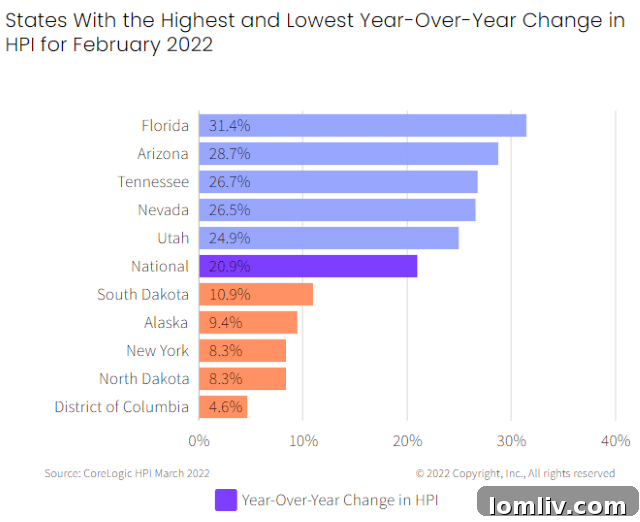
While national trends offer a macro-level understanding, the U.S. housing market is, in reality, a mosaic of highly diverse regional conditions. Mirroring broader metro-level trends, Florida and Arizona emerged as the states with the highest year-over-year home price gains, reaching an impressive 31.4 percent and 28.7 percent respectively. These Sun Belt states have consistently attracted robust population migration, driven by factors such as burgeoning job opportunities, more favorable climates, and often, a comparatively lower cost of living than established traditional economic hubs. Within Florida, the city of Tampa particularly stood out, recording the highest year-over-year home price increase among the nation’s 20 largest metro areas at an astounding 32.5 percent. This exponential growth in specific regions reflects concentrated demand, often coupled with limited available housing inventory and strong investor interest.
Conversely, not all regions experienced the same intensity of price appreciation. On the lower end of the price-growth spectrum, the New York and Washington metro areas saw comparatively more modest increases of 9.9 percent. While still representing significant growth, this pace pales in comparison to the surges observed in the Sun Belt. This noticeable disparity can be attributed to several contributing factors, including already high baseline prices in these established urban centers, different underlying economic growth patterns, and potentially a degree of out-migration during the pandemic as remote work options became more widespread. Understanding these regional variances is paramount for both buyers and investors, as market conditions can differ dramatically even within the same state or across adjacent metropolitan areas. This localized nuance underscores the critical importance of conducting thorough local market analysis when making significant real estate decisions.
Dissecting Market Dynamics: Price Tiers and Broad-Based Appreciation
To provide a more granular and comprehensive understanding of market performance, CoreLogic employs a meticulous analysis across four individual home-price tiers: low, low-to-middle, middle-to-moderate, and high price. These tiers are precisely calculated relative to the median national home sale price, offering invaluable insights into how different segments of the market are performing. What is particularly striking from the March data is that home price growth accelerated uniformly across all four price tiers. Every single tier experienced an increase ranging between 21.5 percent and 21.8 percent in March 2022. This broad-based and synchronized acceleration across the entire pricing spectrum strongly indicates that the current housing market boom is not confined to just luxury properties or entry-level homes; rather, it is a pervasive phenomenon impacting virtually all segments of the residential real estate market.
This widespread appreciation suggests a deeply rooted and pervasive imbalance between supply and demand that is influencing homes at every price point. It implies that while affordability challenges are most acutely felt at the lower and middle tiers due to income constraints, the underlying demand is robust enough across the board to consistently push prices higher without significant distinction. Such a synchronized increase in value across all tiers makes it inherently challenging for buyers looking to either move up or down the property ladder, as the relative cost of homes remains elevated regardless of their specific budget segment. This detailed segmentation by CoreLogic offers invaluable insights into the comprehensive nature of the current housing market expansion and the persistent, broad-based upward pressure on home values, reinforcing the idea that the entire market is experiencing a significant uplift.
Looking Ahead: What’s Next for the US Housing Market?
The inherently dynamic nature of the U.S. housing market necessitates continuous and rigorous monitoring and analysis. CoreLogic, a preeminent provider of property information, analytics, and data-enabled services, will continue to offer crucial insights into these evolving trends. Their next HPI report, which will feature comprehensive data for April, is eagerly anticipated and scheduled to be issued on June 7. This upcoming report will be closely watched by industry professionals, policymakers, economists, and prospective homebuyers alike, as it promises to provide updated figures on home price appreciation and, critically, further clarity on the ongoing impact of continued interest rate hikes and broader economic conditions. These meticulously compiled reports serve as indispensable tools for understanding market momentum and making informed, strategic decisions in an environment characterized by rapid change and significant financial implications.
The current confluence of soaring home prices, accelerating mortgage rates, and strained affordability paints an undeniably complex picture for the U.S. housing market. While the pace of price growth is projected to moderate, the fundamental challenges of limited inventory and robust demand show no signs of immediately abating. As the market continues to evolve and adapt to new economic realities, staying thoroughly informed through reliable data sources like the CoreLogic HPI Report will be absolutely paramount for anyone involved in or directly impacted by the real estate sector. The journey towards a more balanced, sustainable, and accessible housing market remains a significant national discussion, requiring ongoing vigilance and thoughtful consideration from all stakeholders.
For further insights into regional market dynamics and related topics, consider exploring additional discussions:
Are People Moving to Dallas Because of Our Climate?