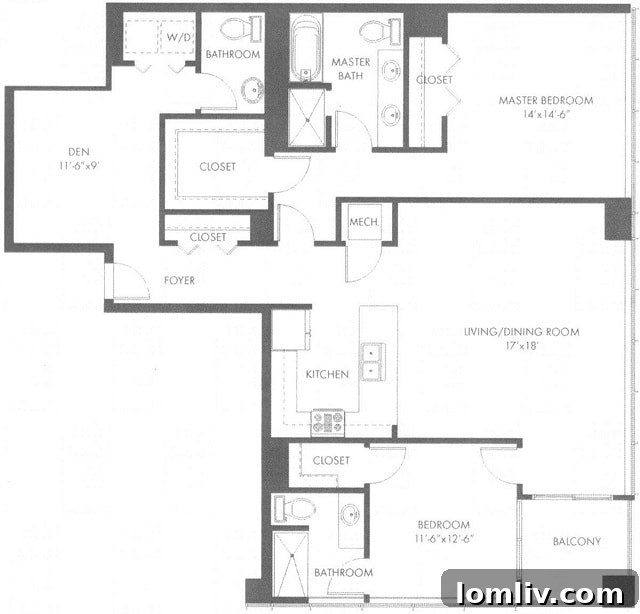
Embarking on the journey to find the perfect high-rise condominium can be an exhilarating yet often perplexing experience. As a newcomer to the world of vertical living, I distinctly recall an unspoken intuition guiding my preferences for one floor plan over another. Sometimes the reasons were glaringly obvious: a unit too compact, an intrusive structural pillar, insufficient storage, or an undesirable low-level floor. Yet, even when all practical aspects seemed relatively balanced, certain units resonated more deeply than others. This subtle but profound distinction often lies in an underlying architectural principle: the concept of “thick” versus “thin” floor plans.
Understanding “Thick” and “Thin” Condo Floor Plans
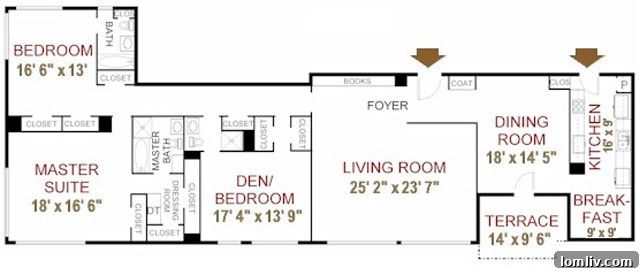
At its core, the “thickness” of a condo unit can be quickly gauged by measuring the distance from the front door to the exterior windows. This seemingly simple metric holds significant sway over the perception and functionality of a living space. It’s not merely about the raw measurement but rather how many rooms or distinct functional areas are accommodated within that depth. Consider a unit where the distance from the entrance to the windows spans 30 feet. While this might sound substantial, if that 30 feet must house a living room, dining area, kitchen, and a bedroom, the space will inevitably feel constrained and lacking in natural light penetration. Such an arrangement would allocate a mere 7 feet of “thickness” per room—barely wider than a typical walk-in closet—regardless of the unit’s overall width. This compression profoundly impacts the flow, usability, and ambiance of each individual area.
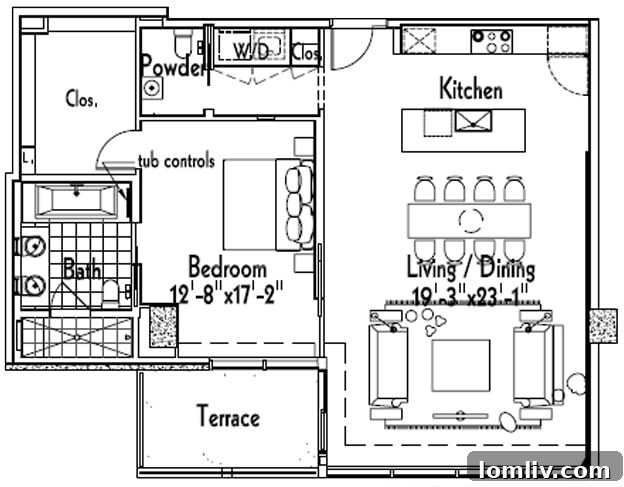
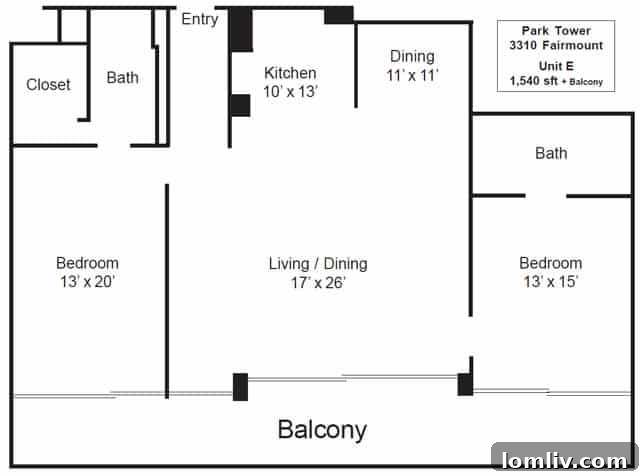
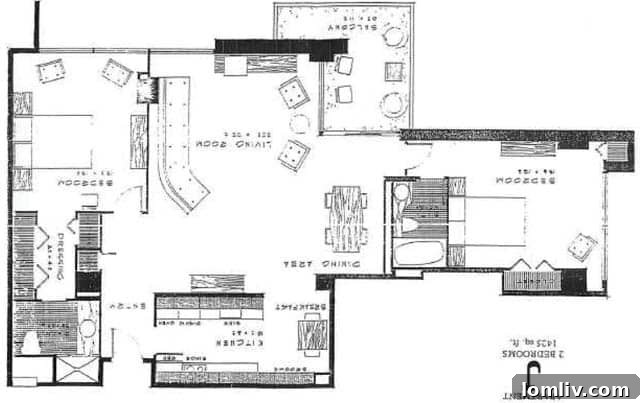
The image above beautifully illustrates how approximately 32 feet of “thickness” can comfortably integrate kitchen, living, and dining areas without creating a cramped “thin” sensation. This particular 1,212-square-foot condominium radiates a remarkable sense of spaciousness, largely thanks to its thoughtful depth. Conversely, a unit might be only one-room thick but exceptionally long. As long as the single-room thickness is adequate, these units can also offer remarkably spacious rooms, emphasizing that both depth and width contribute to the overall perception of generosity.
The true significance of “thick” versus “thin” high-rise floor plans emerges when these dimensions are considered in relation to each other and the overall layout. For instance, a unit’s “thinness” might be less noticeable in designs featuring split bedroom configurations, where a central living area separates bedrooms on opposite sides. However, “thinness” can become a more pronounced issue in layouts where all rooms are stacked sequentially in one direction, such as a combined kitchen/living area followed by multiple bedrooms. These linear arrangements can often feel like a long corridor, limiting direct natural light to deeper parts of the unit.
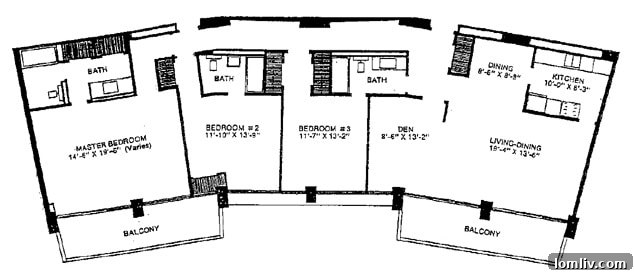
The ultimate “a-ha” moment often strikes as you physically navigate the space. Condos characterized by extreme length tend to necessitate a long back hallway to connect the individual rooms, creating a more segmented living experience. In stark contrast, units boasting a multi-room thickness often cultivate traffic patterns that are more reminiscent of a traditional single-family home, promoting a seamless flow between larger, more open communal areas. This creates a distinct difference in how residents interact with and move through their home.
Exploring Advanced Floor Plan Concepts: Combination and Merged Units
Some innovative floor plans cleverly blend both “thick” and “thin” characteristics within a single unit. For example, you might encounter a “deep” unit where the living, dining, and kitchen areas are arranged in a single, thick row. This then transitions into a section with stacked bedrooms, typically found in corner units that benefit from multiple window exposures. These hybrid designs often excel at providing exceptionally generous living spaces, frequently paired with medium-sized bedrooms. Personally, I find this balance appealing; as someone who primarily uses a bedroom for sleeping, an enormous master suite with a dedicated seating area seems less practical. While a simple bench at the foot of the bed for convenience is ideal, sprawling bedrooms often raise questions about their true utility in an urban setting.
The complexities of “thick” and “thin” layouts become even more pronounced when considering the ambitious project of combining multiple units. Merging adjoining units in a “thin” building will generally result in an extremely elongated space, often likened to a “shotgun” house. While this can offer unique design opportunities, it often means sacrificing depth for length. Conversely, uniting units within a “thick” condominium building presents its own set of intricate design challenges. Instead of merely extending a hallway, architects and designers must often reconfigure entire room layouts or devise creative new hallway solutions to integrate the newly acquired spaces effectively. For example, connecting to an adjacent unit might require shrinking existing guest bedrooms to carve out a new access corridor, fundamentally altering the original footprint.
The Indispensable Role of Windows in High-Rise Design
While these observations might seem elementary, it’s crucial to remember that high-rise condominiums are fundamentally different from single-family homes. For those unaccustomed to urban vertical living, there might be an unsettling sense that something is “off” with a layout, without a clear understanding of why. Even homeowners accustomed to extensive ranch-style homes might mistakenly believe their experience translates directly to condos. However, the architectural principles governing these structures diverge significantly, primarily due to the availability—or lack thereof—of windows and natural light.
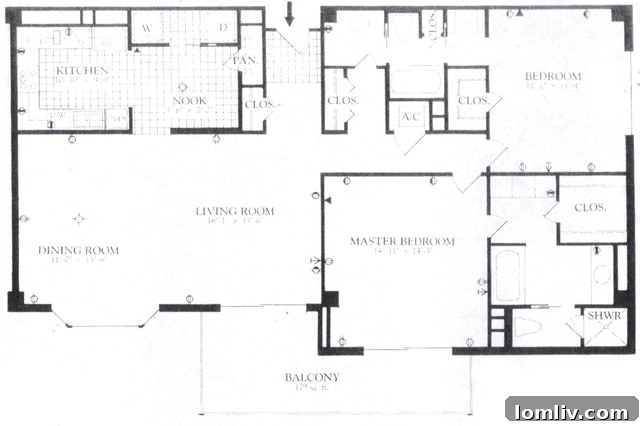
In a traditional free-standing home, architects enjoy a near 360-degree canvas for window placement when designing a typical rectangular structure, allowing for ample natural light and cross-ventilation. High-rise condos operate under far more stringent constraints. Many standard units will feature only a single face of windows, dramatically limiting light and views. Corner units offer the advantage of two windowed walls, while more architecturally complex buildings—those with more than four distinct corners or unique curvatures—can sometimes provide units with three windowed walls. Units occupying an entire endcap of a building, often penthouse residences, typically boast three or more faces of windows, offering panoramic views and abundant light.
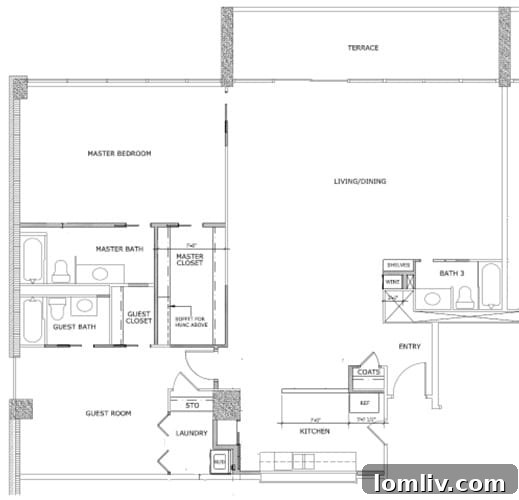
The strategic placement and sheer number of windows are paramount, as they directly dictate the feasibility and placement of bedrooms. Legally, all bedrooms must include an exterior window to provide a means of egress in case of emergency. While many homeowners repurpose windowless “offices” or “dens” into bedrooms, it’s critical to understand that these spaces do not legally qualify as bedrooms without a window and often a closet. There are rare exceptions, often involving innovative designs where at least one wall of a room does not fully extend to the ceiling. This allows for light and air circulation, thus circumventing the “windowless” classification and permitting the space to be legally designated as a bedroom. For instance, some units in The Haven condos in Oak Lawn feature second bedrooms designed with walls that stop short of the ceiling, fulfilling the necessary egress requirements.
Finding Your Ideal High-Rise Home: What’s Right for You?
Ultimately, the “right” floor plan for you is a deeply personal choice that you’ll instinctively recognize. When actively searching for condominiums, particularly in high-rise environments, it is imperative to explore a diverse array of buildings and floor plans. Don’t limit your search to contemporary structures; investigate buildings of various ages. Architectural and construction technologies, along with prevailing floor plan philosophies, have evolved significantly over time. You might discover an unexpected comfort and appeal in a building from an earlier era. My own personal experience echoes this sentiment: I ultimately purchased a unit in a location and building type I least anticipated.
Speaking from personal preference, I gravitate towards “thick” or combination floor plans. I value the expansive feel of generous living spaces and the minimal necessity for long, confining hallways. There’s an inherent architectural symmetry and balance in these layouts that appeals to me, a preference I recognized intuitively even before fully comprehending the “thick” versus “thin” concept. My current home, for instance, is essentially a 45-foot square, offering an open and integrated living experience. Interestingly, I recently met a couple who successfully combined four smaller units in a “thin” building, and they absolutely adore their unique, elongated space. This highlights the diverse preferences and creative possibilities within condo living.
Dallas’ Unofficial Thick and Thin Condo List
While I haven’t had the opportunity to explore every single high-rise building in Dallas, I’ve compiled an unofficial list based on my extensive experience and professional observations. This list is by no means exhaustive, but it serves as a valuable guide. As you tour these buildings, you might experience an illuminating moment where your own feelings about a space perfectly align with these classifications, helping you articulate your preferences.
- Thin Floor Plans: These units are often characterized by their longer, more linear layouts and generally have fewer rooms deep from the exterior windows. Examples include the W Residences, The Centrum, The Beverly, Preston Tower, La Tour, “21”, Turtle Creek North, Mayfair, and One Arts Plaza.
- Thick Floor Plans: These condominiums typically offer greater depth from the entrance to the windows, allowing for more expansive and often multi-functional living areas. Buildings known for “thick” layouts include The Vendome, The Claridge, Athena, The House, The Stoneleigh, Park Towers, Metropolitan, and Plaza I & II.
- Combination Floor Plans: These units cleverly blend aspects of both “thick” and “thin” designs, often found in unique corner units or those with multiple window exposures that allow for diverse room arrangements. Notable examples are The Warrington, The Ritz, and 3525 Turtle Creek.
It’s important to note that this categorization can be further complicated by the fact that even within the same building, different floor plans can exhibit varying degrees of “thinness” or “thickness.” “Combination” units, in particular, often benefit from being corner units or having three windowed faces, which provides architects with greater flexibility to design diverse and appealing layouts that wrap around the building’s structure.
Summary: Making Informed Decisions in High-Rise Living
In conclusion, when embarking on the exciting journey of purchasing a condo, especially in a high-rise, dedicate ample time to genuinely understand which specific floor plan characteristics resonate with your lifestyle and preferences. By meticulously fine-tuning what truly works for you – from the subtle nuances of depth and width to the critical placement of windows and the resulting natural light – the decision-making process will become significantly clearer and more confident. This thoughtful approach ensures you find a home that not only meets your needs but truly feels right.
Remember: High-rises, HOAs, and renovation trends are my areas of expertise. I also have a keen appreciation for modern and historical architecture, always viewing them through the lens of movements like YIMBY. If you’re interested in hosting a Candysdirt.com Staff Meeting event, I’m your go-to person. In 2016, my writing was honored with Bronze and Silver awards from the National Association of Real Estate Editors. Have a compelling story to share or perhaps a marriage proposal to orchestrate? Feel free to reach out to me via email at [email protected].