

Unlocking Home Value: The Definitive Impact of Staging on Today’s Real Estate Market
DALLAS, TX — In the dynamic landscape of real estate, understanding what truly sways buyers and empowers sellers is paramount. The National Association of REALTORS® (NAR) Research Group has recently unveiled its comprehensive 2025 survey findings, shedding crucial light on the multifaceted influence of home staging. This seminal report, derived from insights provided by 1,266 REALTORS® nationwide, meticulously examines how professional home presentation shapes perceptions, impacts sale prices, and accelerates market timelines from both buyer and seller standpoints. Beyond traditional staging techniques, the study also delves into the growing influence of popular home improvement television shows and evolving family dynamics, painting a vivid picture of contemporary home buying expectations. While the survey’s response rate of 2.5% (from nearly 50,000 surveyed) suggests a focused subset, its findings offer valuable strategic insights for agents, sellers, and buyers navigating the competitive housing market, with a margin of error of ±2.75%.
The Undeniable Influence: How Staging Captivates Buyers
For decades, home staging has been whispered about as a potent, almost magical, tool for sellers seeking an edge. Now, this latest NAR research provides concrete data to solidify its reputation as an indispensable strategy. The report reveals a striking consensus: an impressive 60% of buyers’ agents unequivocally stated that staging significantly impacts most buyers’ perceptions of a property “most of the time.” An additional 26% acknowledged its persuasive power, even if not universally. This means that for a vast majority—an overwhelming 86%—of potential homebuyers, a professionally staged property makes a tangible difference in their initial impression and overall interest. Only a small minority, 12%, believed staging had no discernable impact, underscoring its widespread effectiveness.
The essence of staging goes far beyond mere aesthetics. As Dr. Jessica Lautz, NAR’s esteemed Deputy Chief Economist, astutely explains, “Staging isn’t just about pretty pillows and fresh flowers. It’s about helping people see themselves living in that space. Our research shows 83% of buyers’ agents agree—it makes it easier for buyers to visualize a property as their future home.” This psychological aspect is critical; staging transforms an empty house or a cluttered personal space into an aspirational lifestyle vision, allowing buyers to emotionally connect with the property. It removes distractions, highlights architectural features, and creates a welcoming atmosphere, thereby reducing the mental effort buyers need to project their own lives into the space. This emotional resonance often translates directly into higher offers and quicker sales, making the investment in staging a strategic business decision rather than a mere decorating expense.
Strategic Staging: Prioritizing Rooms for Maximum Impact
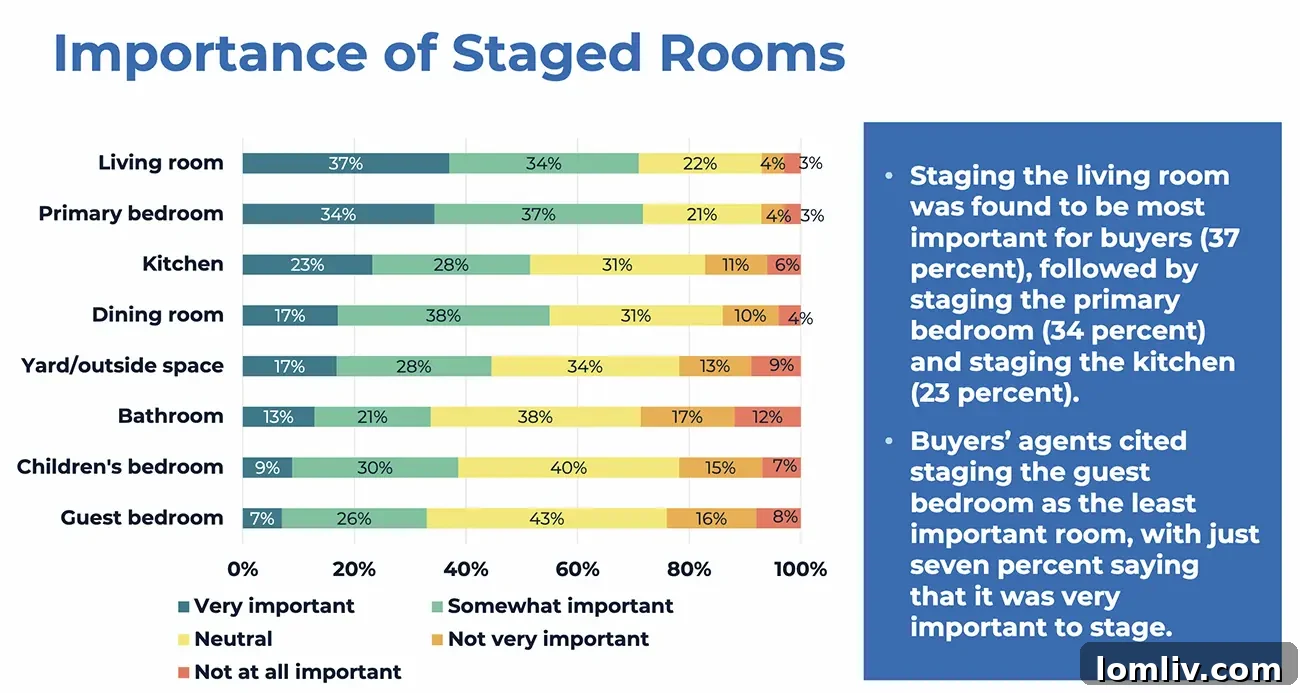
When it comes to deciding which areas of a home warrant the most attention during staging, the NAR report establishes a clear hierarchy based on buyer perception and agent recommendations. The living room stands out as the undisputed champion, with a significant 37% of agents identifying it as the most critical space to stage. This makes perfect sense, as the living room is often the heart of social activity and the first impression buyers get of the home’s potential for comfort and entertainment. Following closely, the primary bedroom garners 34% of agents’ votes, emphasizing its role as a personal sanctuary and a key decision-making space. A well-staged primary bedroom helps buyers envision a tranquil retreat, essential for emotional connection. The kitchen rounds out the top three at 23%, reflecting its status as a central hub for daily life, cooking, and gathering. A pristine, functional, and inviting kitchen can be a deal-maker.
Conversely, other rooms register as far less impactful. Guest bedrooms and children’s rooms, while important for family living, are not seen as primary staging priorities. This insight allows sellers and agents to allocate their staging budgets most effectively, focusing resources on the spaces that are proven to generate the strongest positive responses from potential buyers. Strategic staging in these key areas ensures that every dollar invested works harder to enhance the property’s appeal and marketability, drawing buyers in with compelling visual narratives in the most frequently used and emotionally resonant areas of the home.
The Financial Equation: Staging’s Tangible Return on Investment
The benefits of home staging extend well beyond mere aesthetic appeal; they translate directly into tangible financial gains for sellers. The NAR survey data highlights a clear economic advantage: 17% of buyers’ agents reported that staging successfully nudged offers up by 1–5% compared to similar unstaged homes. While 41% saw no direct effect on price, the potential for even a modest increase—say, 3% on a $500,000 home—equates to an additional $15,000, a sum that can significantly impact a seller’s bottom line. This potential upside is a powerful incentive, encouraging sellers to invest in professional staging services.
Furthermore, staging proves to be a powerful catalyst for faster sales. Thirty percent of sellers’ agents observed a noticeable decrease in days on market for staged properties, with an additional 19% reporting a significant acceleration in the sales timeline. This means nearly half of all sellers who stage their homes can expect them to spend less time on the market. A quicker sale translates into reduced carrying costs (mortgage payments, utilities, taxes, insurance) and less overall stress for the seller. Only a minuscule 4% of agents felt staging actually prolonged a sale, suggesting its overwhelmingly positive impact on market velocity.
The commitment to staging, however, varies among sellers’ agents. Only 21% report staging every listing, while 10% strategically reserve it for properties that are proving challenging to sell. A majority—51%—lean towards recommending decluttering and minor repairs as sufficient preparatory steps, eschewing full-scale staging. For those who do opt for professional services, the median spend is $1,500. This figure drops considerably to $500 when agents take a more hands-on approach, utilizing their own resources and expertise. Brandi Snowden, NAR’s Director of Member and Consumer Survey Research, underscores the practical considerations, stating, “Quality of design and price are the top factors when picking a staging company. It’s a business decision, not just an aesthetic one.” This perspective reinforces that staging is an investment calculated for measurable returns, demanding careful consideration of both cost and potential benefit.
Beyond the Physical Space: The Influence of TV and Family on Buyer Expectations
Today’s homebuying journey is shaped by more than just fresh paint and strategically placed throw blankets. The media, particularly the ubiquitous home-buying television shows, now wields an outsized influence on buyer expectations. The NAR report indicates that nearly half (48%) of agents observed their clients expecting properties to mirror the impeccably styled homes seen “on TV.” More alarmingly, 58% of agents reported that buyers expressed disappointment when the reality of a home fell short of these idealized portrayals. As one survey respondent candidly admitted, “TV has set a standard that’s often unattainable. Buyers come in with expectations that just don’t match the real world.” Indeed, a significant 73% of agents confessed that TV shows had directly impacted their business by fostering unrealistic or heightened expectations among their clientele, creating a challenging dynamic to manage.
Despite this media sway, REALTORS® are not simply mimicking television trends. A substantial 77% of agents confirmed they are not influenced to stage homes exactly as seen on TV. “We have to balance what sells with what’s feasible,” explained another agent, emphasizing the practicalities and individual character of each property. “Not every home can—or should—look like a set.” This highlights the agent’s crucial role in bridging the gap between fantasy and reality, guiding buyers through practical considerations while still leveraging effective staging techniques.
Beyond media, family dynamics are also playing an increasingly pivotal role in the home purchase decision. The survey reveals that a median of 23% of buyers brought non-purchasing family members to viewings, indicating a collective decision-making process. Moreover, 40% of buyers consulted family members during the purchase process, even if those relatives would not be residing in the home. Dr. Lautz notes, “It’s a multigenerational decision for many,” reflecting shifts in cultural values, financial support, and the desire for familial input on such a significant life investment. This trend requires agents to broaden their communication strategies and understand the extended network influencing their clients’ choices.
The Modern Buyer: Informed, Yet Facing Obstacles
Today’s buyers are entering the market with a clearer vision than ever before. A significant 79% already know precisely where they desire to live, and 76% have a distinct “ideal home” in mind even before commencing their property search. This preparedness, largely fueled by online research and digital tools, means agents are often engaging with a highly informed, albeit potentially opinionated, clientele. However, this readiness does not always translate into an easy journey. The process itself remains daunting: 42% of buyers anticipate it will be difficult, and for a disheartening 38%, the reality proves even harder than they initially imagined. This underscores the continued importance of skilled REALTORS® who can expertly navigate complex markets, manage expectations, and provide invaluable guidance through what can be a challenging, emotional, and financially significant endeavor.
Other Noteworthy Market Insights and Buyer Behaviors:
- Investment and Remodeling Trends: The report reveals a growing appetite for property investment and customization. 27% of agents report an increase in buyers planning to flip homes for profit, while a substantial 42% note a rise in those looking to purchase properties specifically for extensive remodeling. This highlights opportunities for agents specializing in investment properties or those capable of connecting buyers with renovation resources.
- Showings and Virtual Tours: While 61% of buyers don’t arrive with a fixed number of homes they expect to see, for those who do, the median expectation is eight in-person showings complemented by 20 virtual tours. This emphasizes the critical role of high-quality online presence and comprehensive virtual experiences in the initial stages of a buyer’s search.
- Aligning Expectations with Reality: Encouragingly, 55% of agents indicate that buyers’ expectations regarding the number of homes they will view before making a purchase are generally aligned with current market realities. This suggests that despite the influence of media, many buyers possess a realistic understanding of the available inventory in their desired areas.
Conclusion: Bridging Fantasy and Reality in a Evolving Market
In conclusion, the National Association of REALTORS®’ latest report firmly establishes home staging as an enduring and powerful tool for enhancing property appeal, accelerating sales, and potentially boosting offers. Its impact on living rooms, primary bedrooms, and kitchens remains particularly potent, influencing buyer perception and emotional connection. However, the real estate landscape is undeniably evolving, driven by new influencers. Today’s buyers arrive at the table not only with clear intentions but also with expectations shaped by meticulously curated television shows and the often-decisive input of family members. For REALTORS®, the challenge and opportunity lie in skillfully navigating this complex environment: effectively leveraging traditional staging techniques while simultaneously managing media-fueled expectations and understanding the broader familial influences at play. By adeptly bridging the gap between aspirational fantasy and market reality, real estate professionals can continue to guide their clients towards successful outcomes, one perfectly presented property at a time.