Unlocking the Legacy: A Comprehensive Guide to Your Texas Property’s Chain of Title
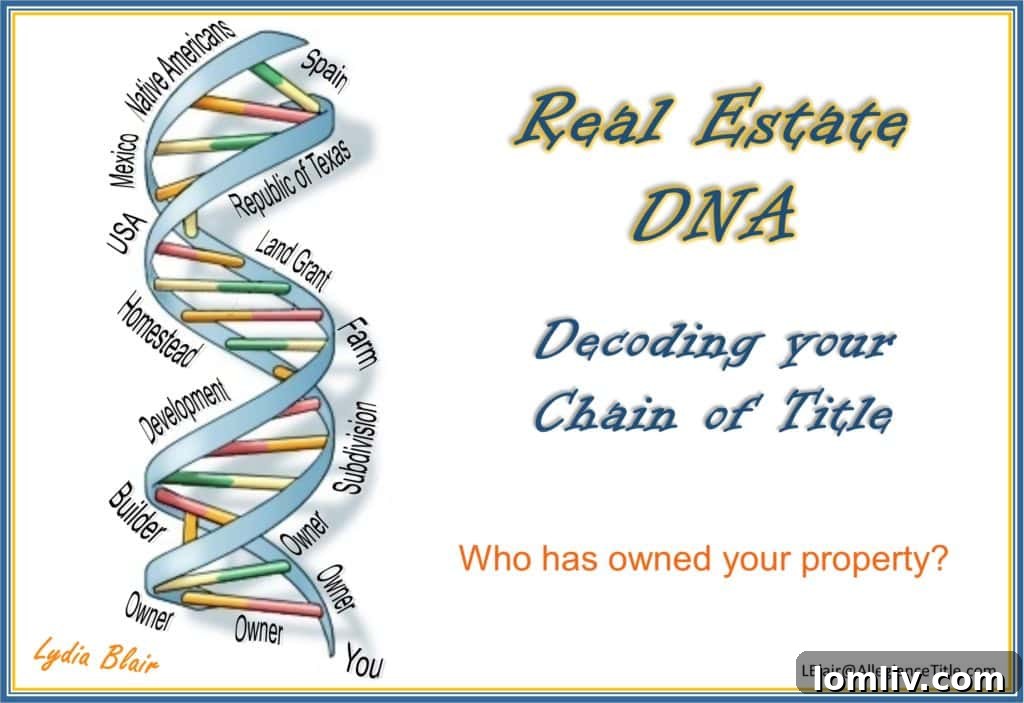
Have you ever paused to consider the rich tapestry of history woven into the very land beneath your Texas home? Who held the deed to your property a century ago, or even two centuries past? While your current dwelling might be a relatively modern structure, the land itself carries a much longer story. Before the advent of modern developments and subdivisions, someone else undoubtedly called your parcel of earth home, just as you do today. To truly understand the essence of your property, we must delve into its historical “DNA,” tracing its ownership lineage back through generations.
The Ancient Roots of Texas Land: From Indigenous Tenure to Sovereign Grants
The concept of property ownership, as we understand it today, is a relatively recent construct in the grand timeline of human history. Approximately 500 years ago, the diverse indigenous peoples of Texas, including the Caddo, Apache, Comanche, Karankawa, and many others, inhabited these lands. Their cultures often held a communal view of land and resources, where territories were utilized for sustenance and dwelling but not “owned” in the Western sense of exclusive, transferable title.
The formal legal ownership of your Texas property, from a European perspective, originates from one of four sovereign entities: the government of Spain, Mexico, the Republic of Texas, or the State of Texas. Each transition marked a significant shift in how land was surveyed, claimed, and granted, laying the foundation for modern property rights.
Public Texas Land Grants: The Genesis of Modern Ownership
The history of private land ownership in Texas truly began with the issuance of land grants. Spanish grants to individuals commenced around 300 years ago, primarily to incentivize settlement and establish control over vast territories. Following Mexico’s independence from Spain, Mexican land grants continued this tradition, often to empresarios who facilitated the immigration of settlers into regions like Texas.
Approximately 200 years ago, after achieving independence, the Republic of Texas embarked on its own ambitious program of land distribution. To fund its fledgling government and encourage further settlement, the Republic began selling land grants at an incredibly low price—often just 50 cents an acre—through its General Land Office (GLO). The GLO, established in 1837, became the repository for all land records, a role it continues to fulfill to this day.
When Texas was annexed by the United States, it retained control over its public lands, a unique provision compared to other states. This meant the State of Texas continued to manage its own land grants until the vast majority of available public land had been sold or allocated by around 1900. Consequently, the earliest documentation for your property ownership can frequently be traced back to these original land grants from either the U.S. or Texas governments.
The homesteaders who initially acquired title to these lands, perhaps 150 years ago, were often farmers or ranchers. They carved out livelihoods from the expansive Texas landscape, developing the land for agricultural purposes. Over time, as populations grew and economies evolved, these large tracts were often subdivided and sold in smaller parcels, or as substantial blocks to developers anticipating future growth. This process transformed the vast wilderness into the structured communities we recognize today.
If your property is located in a developed area, especially within the Dallas/Fort Worth metropolitan area, it was almost certainly part of a new development or subdivision within the last century. During this process, the land would have been assigned a specific subdivision name, along with a unique lot and block number. These details were meticulously filed with the respective county clerk’s office, creating a precise record of the property’s configuration. You can think of properties within the same subdivision as sharing a common ancestral “plat,” forming a closely related family tree of land parcels.
The Enduring Path of Ownership: Understanding Property Transfers and Deeds
Every time your Texas property has changed hands over the last 150 years or so, a critical document—the deed—was meticulously filed and recorded with the county clerk. The county clerk’s office serves as the central archive for all property transactions, maintaining comprehensive indexes of sellers (grantors) and buyers (grantees) to facilitate the tracing of ownership history. Each deed is a vital link in your property’s chain of title, confirming its legal transfer.
Central to any deed is the legal description of the property. This description is far more crucial than a simple street address. While a street address provides a convenient identification for postal services and navigation, a legal description precisely defines the exact boundaries and dimensions of the property being bought or sold. It uses specific measurements, references to surveys, and official plat records to delineate the precise parcel of land, removing any ambiguity. Without an accurate legal description, a deed is legally insufficient to transfer ownership.
The Indispensable Role of Title Companies and Title Searches
Before any property transaction can be finalized and title insurance issued, title companies undertake a rigorous process known as a title search. This comprehensive investigation delves deep into the ownership history of the property, examining all recorded documents related to it. While a title agency performs a historical review, their primary concern isn’t the “genealogy” of your land for curiosity’s sake. Instead, they are laser-focused on identifying any legal issues that could affect current or future ownership.
A thorough title search aims to uncover potential clouds on the title, which could include:
- Liens: Unpaid debts attached to the property, such as mechanic’s liens, tax liens, or judgment liens.
- Encumbrances: Any claim or liability against the property that affects its value or restricts its use, such as easements (rights of way), covenants, conditions, and restrictions (CC&Rs), or unreleased mortgages.
- Errors in Public Records: Mistakes in recording deeds, incorrect legal descriptions, or improper indexing.
- Missing Heirs: Issues arising from probate where an owner has passed away without a clear will or identified heirs.
- Forged Documents: Instances where a deed or other instrument affecting title was fraudulently created.
- Boundary Disputes: Ambiguities or conflicts regarding the property lines.
The findings of a title search directly influence the issuance of title insurance, which protects both the buyer and the lender from financial losses resulting from defects in the title. Understanding this distinction is key: a title company’s search is a legal diligence process, safeguarding against future claims, rather than a historical research project driven by mere curiosity.
Tracing Your Property’s Ancestry: How to Build a Chain of Title
Despite the complexities, it is entirely possible to meticulously trace the chain of title for your property, creating an exhaustive list of every individual or entity that has ever held ownership, extending all the way back to the original land grant filed with the General Land Office. While professional companies specialize in this service, and the process can indeed be costly, undertaking this fascinating journey yourself is achievable, though it requires considerable time and dedication.
Where to Look: Navigating Texas Property Records
The primary repository for property records in Texas is the county clerk’s office in the county where the property is located. These records are meticulously organized and often indexed by volume and page number within the county map records or deed records. A typical legal description, the backbone of a property’s identity, might read something like this:
Lot 10A, Block 122, of XYZ Addition to the City of ABC, Dallas County, Texas, according to the plat thereof recorded in Volume 1967592, Page 1674, of the Map Records of Dallas, County Texas.
This precise identifying information—the “DNA” of your property—provides the starting point for your research. Here’s a step-by-step guide to tracing your chain of title:
- Start with the Current Owner: Begin at the most recent point in time. Visit the county clerk’s office (many now offer online search portals, but old records may require an in-person visit) and locate the deed for the current owner. You’ll typically use the “grantee” (buyer) index to find their name.
- Identify the Previous Grantor: Once you locate the current owner’s deed, it will clearly state who sold the property to them—the “grantor.” This is the previous owner in the chain. Note their name and the recording information (volume and page number) of their deed.
- Search for the Previous Grantor’s Acquisition: Now, using the previous owner’s name, switch to the “grantee” index (since they were the buyer in that transaction). Locate the deed where *they* acquired the property. This deed will, in turn, name *their* grantor.
- Repeat the Process: Continue this iterative process. Each deed will lead you to the next previous owner, allowing you to systematically move backward through time, deed by deed, until you reach the earliest recorded transaction.
- Utilize Plat Maps and Abstracts: For properties within subdivisions, consult plat maps (subdivision maps) which provide a visual layout of lots, blocks, and streets, often referencing the original survey. For very old or rural properties, you might encounter “abstracts of title,” which are summaries of all recorded instruments affecting a piece of land.
- Be Prepared for Challenges: You may encounter challenges such as archaic handwriting, damaged records, or inconsistencies in names or legal descriptions. Persistence and careful cross-referencing are essential.
With patience, meticulous record-keeping, and a detective’s mindset, you can successfully navigate the archives of your county clerk’s office. This journey allows you to explore your property’s complete ancestry, revealing a fascinating lineage of stewardship and transfer that connects your home to its very first recorded owner. It’s an empowering experience that deepens your connection to your Texas land and its enduring story.