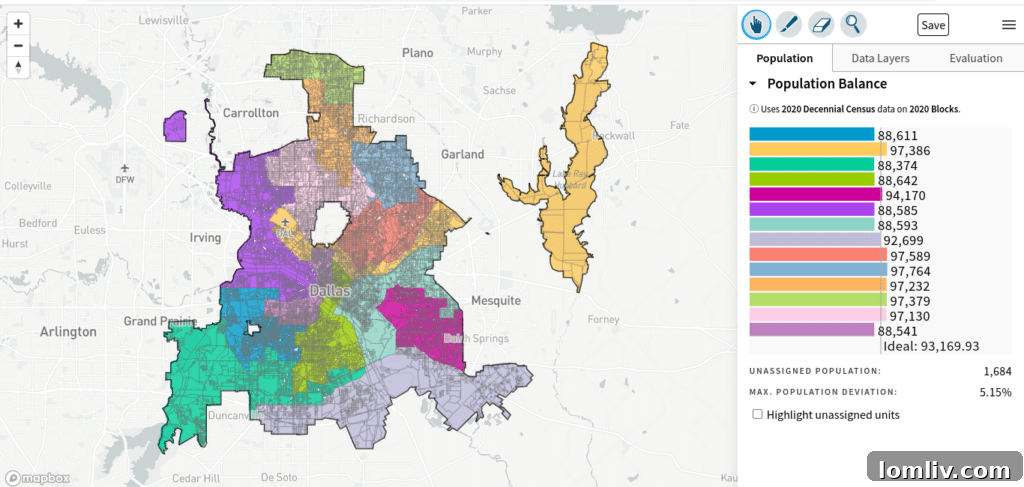
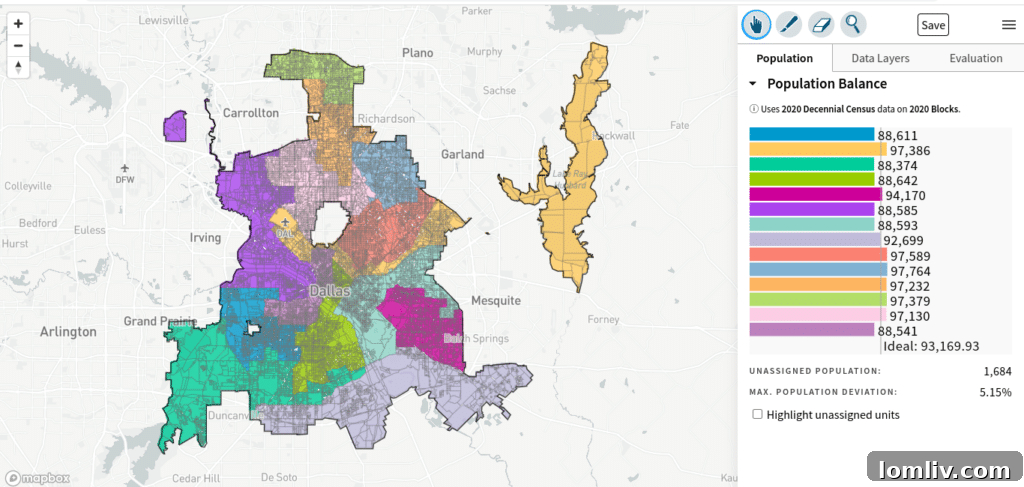
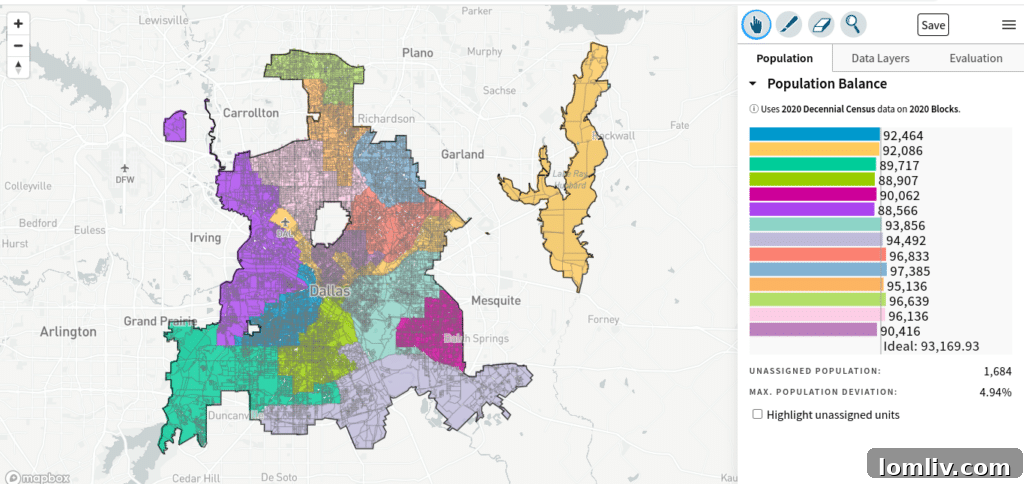
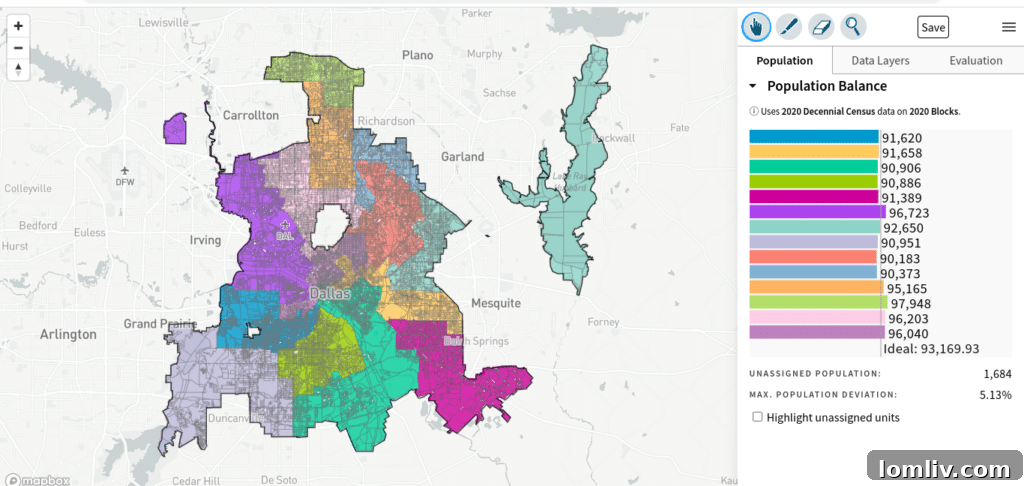
The future political landscape of Dallas is on the cusp of significant transformation as the city’s Redistricting Commission narrows its focus to two crucial maps. These potential blueprints will define the electoral boundary lines for Dallas’s 14 city council districts for the next decade, fundamentally shaping local governance and community representation. Following an extensive period of public input and rigorous review, the commission is poised to make a pivotal decision. The final selection of the preferred map is tentatively scheduled for a dedicated day-long workshop on May 10, to be held in the hallowed chambers of the Dallas City Council. Once the commission reaches its consensus, the chosen map will be formally presented to the Mayor, as confirmed by Redistricting Commission Chairman Jesse Oliver, marking a crucial step in this decennial process.
Understanding the Imperative of Dallas Redistricting
Redistricting is a constitutionally mandated process, undertaken every ten years in the United States following the national census. Its primary objective is to rebalance the population across electoral districts, ensuring that each district contains roughly the same number of residents. This demographic adjustment is vital for upholding the principle of “one person, one vote,” thereby guaranteeing equitable voter representation. In Dallas, the City Council-appointed commission members have diligently engaged with the public, conducting numerous meetings to gather community feedback. Furthermore, various community representatives have been instrumental in drawing and submitting proposed new maps, reflecting diverse community perspectives on ideal boundary lines. The ultimate validity of these new maps hinges on their approval by both the Dallas City Council and the U.S. Justice Department, underscoring the legal and ethical scrutiny inherent in the process.
Advocates for fair redistricting consistently emphasize the profound importance of this process. When executed properly, redistricting serves as a cornerstone of democratic integrity, directly influencing the efficacy of citizen representation. It aims to actively counteract inequitable representation and the practice of gerrymandering. Gerrymandering, a term deeply rooted in American political history, is defined as the manipulation of electoral district boundaries to give one political party or group an unfair advantage. This often involves concentrating the voting strength of an opposing party into a few districts, thereby minimizing their overall impact, while spreading the favored party’s strength across many districts to secure majorities. The current redistricting effort in Dallas seeks to rectify past imbalances and prevent such partisan or discriminatory practices from undermining local democracy.
The Persistent Shadow of Gerrymandering in Dallas’s Past
The historical context of Dallas’s electoral districts reveals a challenging past marked by allegations of gerrymandering. Several community representatives argue that previous district maps severely disadvantaged minority voters, particularly Black and Hispanic communities. These maps, they contend, often fragmented traditionally cohesive neighborhoods, scattering their populations across multiple districts. This strategic division, known as vote dilution, effectively diminished their collective voting power and influence in local elections. Bill Betzen, a retired social studies teacher and a veteran observer of Dallas politics, recounted his experiences. He presented the City of Dallas redistricting map version COD-038 for the Commission’s consideration last month, reflecting on a long battle for fair representation.
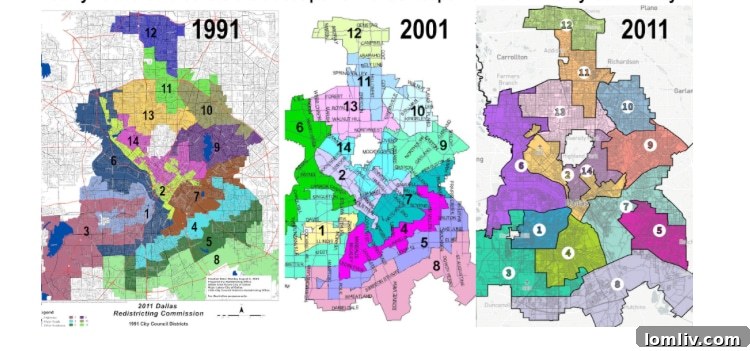
Betzen highlighted the significant shift to single-member districts in 1991, a hard-won victory after a two-decade struggle. Unlike multi-member districts, where several officeholders represent a larger area, single-member districts are represented by just one officeholder, theoretically promoting more direct accountability. Historically, Dallas utilized at-large members until the 1970s, when the U.S. Supreme Court declared such systems discriminatory and unconstitutional due to their tendency to dilute minority votes. However, Betzen noted that even after this change, the 1991 district map was still designed to weaken minority leaders, making them dependent on external funding for campaigns in complex, gerrymandered districts. He dedicated hundreds of hours to the 2011 redistricting cycle, striving to eliminate these unfair practices. While acknowledging some success despite resistance from the City Council, Betzen emphasized the ongoing need for vigilance.
A crucial aspect, Betzen argued, is the importance of drawing lines that allow current office-holders to remain eligible for re-election within their existing districts. This continuity, he believes, is vital for ensuring consistent and effective representation for communities. Despite this, he acknowledged the inevitability and normalcy of change, stating, “Beyond that, change is normal.” Texas Rep. John Turner (D-Dallas) offered a comparative perspective, suggesting that the redistricting process at the local level appears more efficient and less partisan than at the state level. “Nobody likes this process,” Turner admitted, “But at the city level, it’s not partisan; you have a commission designated to oversee it, and you have a lot more time for review.” Turner, who is not seeking re-election partly due to redistricting drawing his home out of his current District 114 (which includes Lake Highlands, Hamilton Park, Preston Hollow, and Midway Hollow), underscores the personal impact of these boundary shifts. However, critics of the current Dallas redistricting process contend that it has been far from seamless. Many residents reportedly remained unaware of the process until it was well underway, and those without English proficiency or internet access faced significant barriers to staying informed and participating effectively.
Preserving Community Identity: The “If It Ain’t Broke…” Philosophy
At an April 11 public hearing, a significant theme emerged among several redistricting commissioners and residents: the desire for minimal disruption to existing district boundaries. This sentiment, often summarized by the adage “don’t fix what’s not broken,” reflects a strong preference for continuity and the preservation of established community identities.
District 10 Commissioner Alan Walne, representing Northeast Dallas, articulated his priorities clearly. He emphasized the importance of maintaining racial diversity, keeping current neighborhoods intact, and preserving the cherished “small-town feel in a big city” that characterizes areas like Lake Highlands, Texas. Walne explained, “What you see are very minor tweaks because you don’t have huge population differences that need to be adjusted.” His approach suggests that for districts with relatively balanced populations, minor adjustments are preferable to radical redrawing.
Commissioner Jonathan Neerman of District 12 echoed a similar conservative approach. He noted that the overwhelming feedback from his constituents centered on the request to avoid splitting key community organizations, specifically the Campbell Green Homeowners Association and Highlands North Homeowners Association. This translates to not using Campbell Road as the proposed southern boundary near Coit and Campbell roads in Far North Dallas, thereby respecting existing community cohesion.
District 13 Commissioner Barbara Brown Larkin reported that her residents similarly desired no changes to their boundary lines whatsoever. Homeowners’ associations in her district expressed a strong preference for consistency, particularly concerned with retaining private schools and economic diversity within District 13, which notably includes the Private School Corridor home to institutions like Jesuit, Ursuline, Hockaday, and St. Marks.
District 14’s Vocal Stand for Stability
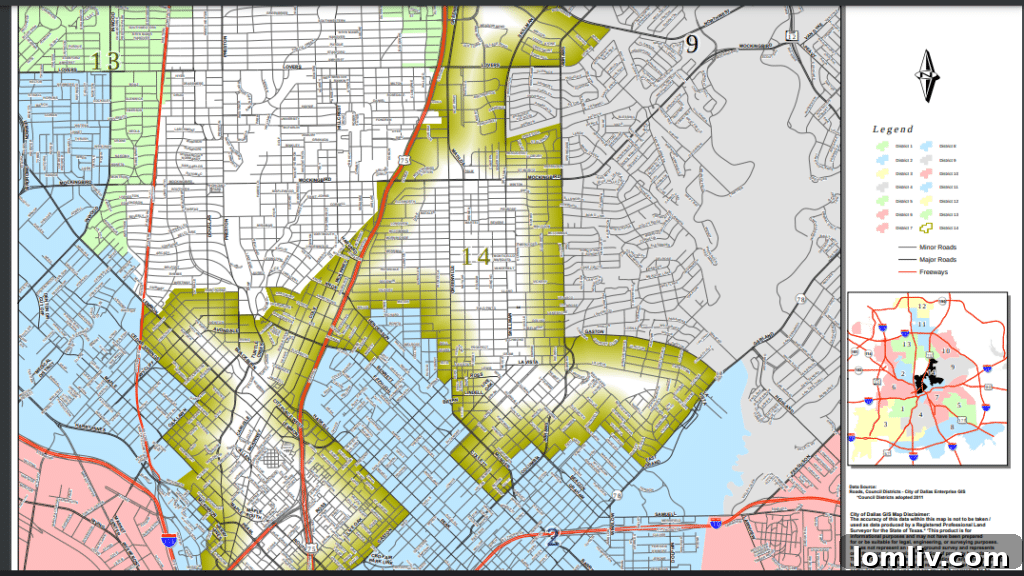
Perhaps the most vocal opposition to radical boundary changes came from residents of District 14. This vibrant district encompasses Lower Greenville, East Dallas, and portions of Uptown and Downtown, areas known for strong community engagement. At the April 11 public hearing, thirteen homeowners from District 14 signed up to address the commission, united in their support for maps COD-026 and COD-029. While Map 026 advanced for further consideration and was ultimately revised into Map 041, Map 029 was not carried forward. Both maps were originally submitted by landscape architect Melanie Vanlandingham, a key figure in the debate.
Olive Talley, a resident of Prospect Avenue in District 14, passionately articulated the community’s stance: “Some of the maps that have been presented suggest a radical redrawing of our boundaries. I don’t think that’s necessary, and I actually think it’s wrong. Your work directly impacts people’s lives. There’s no reason to carve us up and every reason to keep us intact. When District 14 is strong, the city is strong.” Her statement powerfully captures the deep emotional connection residents have to their established communities and the fear of dislocation.
The Hollywood/Santa Monica Neighborhood Association in East Dallas actively mobilized its residents, encouraging them to voice support for what is now Map 041. In an April 20 email, the association informed residents of the redistricting’s long-term implications: “While our neighborhood, along with several other conservation and historic districts, is currently located in District 14, the district needs to ‘lose’ approximately 10,000 residents to meet the 93,000-resident threshold that is the target population for each district. As a neighborhood on the outskirts of District 14, there is potential for Hollywood/Santa Monica to be removed from our current district.” This highlights the complex challenge of balancing population requirements with maintaining community integrity.
Ed Zahra, a long-time Valencia Street resident of District 14 since 1974 and a board member of the Hollywood/Santa Monica Neighborhood Association for over 41 years, brought a wealth of experience to the discussion. With extensive involvement in Dallas’s quality-of-life initiatives, Zahra affirmed his understanding of the need for population rebalancing. However, he firmly rejected radical changes: “I understand the need to tweak our city council districts to balance them for diversity and population growth, but there is absolutely no reason to radically carve up District 14.” He praised the efforts of educated citizens who volunteered countless hours to submit thoughtfully crafted plans, emphasizing that citizen involvement is crucial in navigating the city’s bureaucracy. Zahra, also involved in discussions on short-term rentals, underscored the collective power of neighborhood groups: “The East Dallas crazy people, as a collective group, we jump in and fight. Neighborhoods these days are pretty powerful. The voices of neighborhoods don’t just get pushed aside. We’re caretakers of our neighborhoods.”
Zahra specifically criticized Map 017, one of the two final contenders, for dissecting District 14 into three parts and relocating Woodrow Wilson High School into District 9. In contrast, he lauded the approach taken by Melanie Vanlandingham and Darren Dattalo in Map 041, stating, “What Melanie and Darren [Dattalo] did on their maps is they went into each of the neighborhoods and they massaged them and took off a little here and a little there, from the bottom up.” This grassroots approach, focusing on minimal, targeted adjustments, resonated strongly with the residents seeking to preserve their community fabric.
Navigating the Intricacies: More Feedback and Diverse Perspectives
Dallas redistricting is a multi-faceted and often contentious process, challenging even for experts to condense to its bare essentials. The consistent message from residents is clear: protect their neighborhoods. This resonates with the assurances from redistricting commissioners and elected officials who continually emphasize their commitment to listening and carefully considering public feedback. However, the demographic realities of a growing city necessitate change.
Bill Betzen reiterated the fundamental goal of redistricting: “The goal of redistricting is to rebalance the populations between districts, which is dramatically necessary in Dallas.” He cited stark examples, such as District 14, which had ballooned to 106,927 residents, while District 1 in North Oak Cliff lagged at 77,916. Such disparities necessitate significant adjustments to ensure fair representation, regardless of community sentiment. Betzen championed map COD-038, believing it offered the strongest minority representation for Dallas, though it ultimately did not advance for further commission consideration.
Initially, only three maps were designated as the city’s preferred plans: COD-017, a collaborative submission from Commissioners Randall Bryant (District 8), Bob Stimson (District 1), and Roy Lopez (District 2); COD-40, presented by Commissioner Domingo Garcia (District 5); and COD-041, from landscape architect Melanie Vanlandingham and Realtor Darren Dattalo. Map COD-40 was later removed from the final list, leaving COD-017 and COD-041 as the primary contenders.
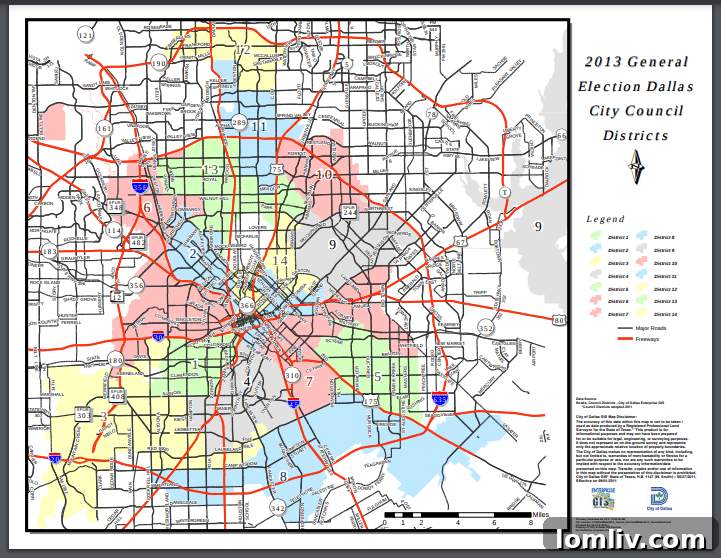
Commissioner Bob Stimson provided detailed insight into District 1, his area of representation. He explained that despite being the most compact district in the current map, District 1 is inherently divided into two distinct sections: North Oak Cliff and West Oak Cliff. Stimson highlighted the long-standing collaboration among neighborhood associations in North Oak Cliff, who have united on issues ranging from public safety and code enforcement to area revitalization. Their collective efforts have spurred significant development and redevelopment projects, including the Bishop Davis Land Use Study, the Oak Cliff Gateway, the Jefferson Street Planned Development District, and the Fort Worth Avenue Planned Development District. Moreover, these communities have proactively protected single-family residences through historic and conservation districts and various zoning overlays. In contrast, West Oak Cliff, while equally vital, is a newer area grappling with similar issues that North Oak Cliff has already addressed. These neighborhoods are currently finalizing the West Oak Cliff Area Plan with the city’s planning department, a blueprint to guide future redevelopment.
The Art and Science of Mapmaking for Fair Representation
The intricate process of drawing electoral maps often requires specialized skills and dedication. Jeff Kitner, chief operating officer of the North Dallas Chamber of Commerce, exemplifies this commitment, volunteering his expertise as a map author. He submitted three distinct proposals: COD-10, COD-37 (co-authored with professional services consultant Rudy Karimi), and COD-43. Kitner explained his motivation, stating, “District 11, where I live, is unlikely to change much, so I thought I would be in a good position to try to draw some data-based, objective maps which attempt to take into consideration many competing factors.” This objective approach, balancing numerous criteria, is crucial for fair redistricting.
Beyond the commissioners and professional consultants, many other Dallas residents actively participated, submitting their own map proposals for commission consideration. These included Sophie Kitner, James McDowell, Sarah Evans, Desi Tanner, Ryan Moore, William Hoyt, Patricia Simon, District 14 Redistricting Commissioner Norma Minnis, former District 14 Dallas City Council representative Philip Kingston, former Dallas ISD Trustee candidate Omar Jimenez, and former District 7 Dallas City Council representative Kevin Felder. This widespread community involvement underscores the democratic nature of the redistricting process and the diverse perspectives brought to the table.
Dallas residents retain the crucial opportunity to continue shaping this outcome by submitting public comments on their preferred boundary changes. Jeff Kitner emphasized the complexity of balancing competing interests: “Generally, I prefer maps which best balance the often-competing interests of maintaining a low population, having natural boundaries, keeping neighborhoods together, increasing compactness, and [those] that accurately represent the racial demographics of the city.”
Kitner observed that much of the public input tends to originate from residents of districts closer to the city center. This makes logical sense, he explained, because these areas often lack natural borders with surrounding municipalities, making their demarcation more challenging. Furthermore, districts like the current District 14 are significantly overpopulated based on recent census data, meaning some residents must inevitably be shifted into adjacent districts to achieve a more even population variance. Kitner described the task of drawing proposed new Districts 14, 2, and 1 as particularly challenging. Conversely, District 11, for example, has garnered less citizen interest because its population is already close to the target, and it benefits from logical existing boundaries such as Central Expressway and neighboring municipalities like Addison and Richardson, making significant changes less likely.
Despite the differing viewpoints and the inherent complexities, a unifying consensus emerges among those involved: the voices of Dallas residents are paramount. As Bill Betzen passionately declared, “The public must win. More compact districts will increase voter turnout and allow the public to hold their politicians more accountable.” This underscores the ultimate goal of redistricting: to foster a more accountable and representative local government.
For those seeking deeper engagement, archived footage of all public hearings on the matter, along with other pertinent documents, are readily available on the city’s dedicated redistricting website. Residents are actively encouraged to submit public comments online or attend forthcoming public hearings to contribute to this vital ongoing dialogue. Upcoming meetings are scheduled for 3 p.m. on May 7, 3:30 p.m. on May 9, and tentatively at 9:30 a.m. on May 10, all to be held at Dallas City Hall. These opportunities provide a final chance for residents to influence the boundary lines that will define their civic representation for the next ten years, ensuring that the final decision truly reflects the diverse and dynamic communities of Dallas.