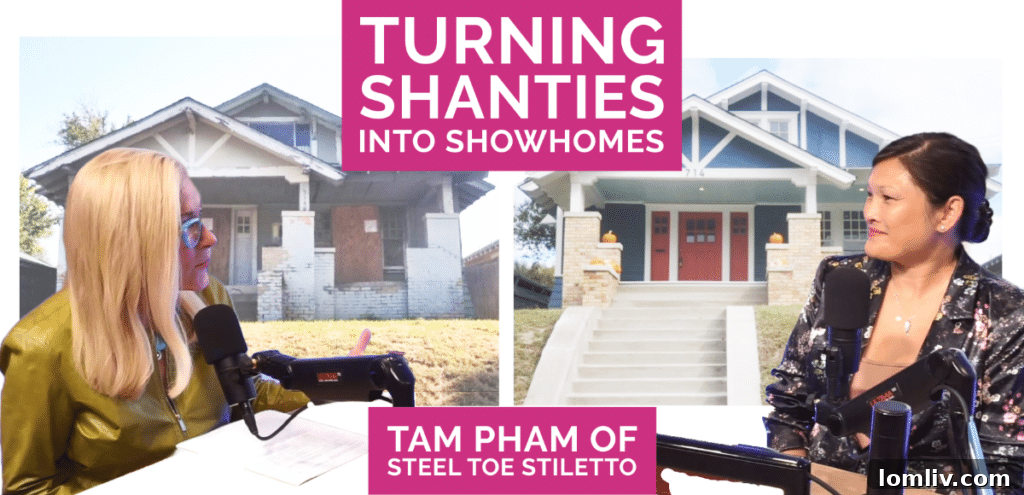
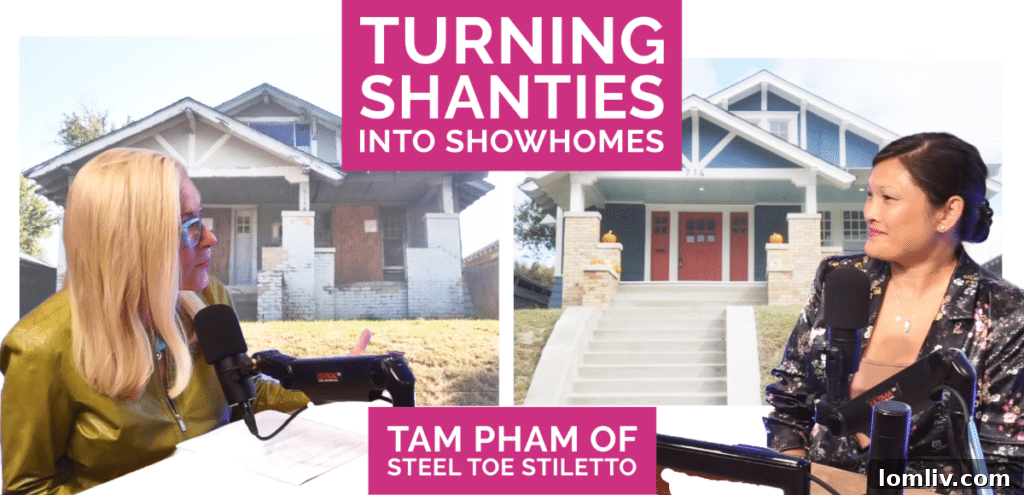
In a compelling episode of Dallas Dirt, host Candy Evans sits down with Tam Pham, the visionary founder behind “Steel Toe Stiletto,” for an in-depth exploration of historic home preservation in Dallas. This insightful interview delves into the multifaceted world of restoring Dallas’s architectural treasures, highlighting the unique blend of challenges and triumphs inherent in such ambitious projects. From navigating complex preservation guidelines to meticulously addressing structural intricacies, Pham’s extensive expertise as a seasoned general contractor shines through, offering invaluable perspectives on the delicate balance required to honor the past while seamlessly integrating modern functionality.
Tam Pham, a name synonymous with meticulous restoration and unwavering dedication, articulates her profound philosophy on breathing new life into forgotten structures. “I’ve proven over and over that I can take a shanty and turn it into a show house,” Pham states with conviction. Her work transcends mere renovation; it is a testament to the belief that every historic dwelling possesses an inherent value and a story waiting to be retold. This passion drives her to undertake projects that many others deem irreparable, transforming them into stunning examples of preserved heritage.
RELATED: See the complete transformation of a featured project
Pham’s approach to historic renovation is rooted in a deep respect for original craftsmanship and an understanding of the architectural nuances that define each era. She meticulously considers everything from foundation integrity to period-appropriate finishes, ensuring that every restoration project not only meets contemporary standards of living but also faithfully reflects the home’s historical essence. Her commitment extends beyond aesthetic improvements, embracing the structural challenges that often accompany older properties. This comprehensive strategy allows her to tackle even the most dilapidated homes, consistently exceeding expectations and setting new benchmarks for quality in historic preservation.
“I think every old home deserves to be saved,” Pham passionately asserts, underscoring her mission to prevent historically significant properties from falling victim to demolition or neglect. Her work often involves properties in established historic districts, where adherence to specific guidelines is paramount. This requires not only a keen eye for detail but also a profound knowledge of architectural history and local preservation ordinances. Pham’s ability to work within these constraints, while still infusing homes with contemporary comforts and styles, is a hallmark of Steel Toe Stiletto’s success.
About the Dallas Dirt Podcast: Dallas Dirt offers a weekly deep dive into the dynamic world of Dallas and Texas real estate. Hosted by the insightful Candy Evans, this audio and video podcast brings listeners and viewers exclusive interviews with industry leaders, market analysis, and inspiring stories of home transformation. Engage with our community by sharing your comments and suggestions at [email protected]. Dallas Dirt actively seeks local Dallas and Texas-based podcast guests who are shaping the future of real estate; PR requests and guest submissions can be directed to [email protected]. For advertising and episode sponsorship opportunities, please contact [email protected].
From Corporate Career to Historic Home Saver: Tam Pham’s Journey
The episode opens with host Candy Evans enthusiastically welcoming Tam Pham, a distinguished general contractor and the innovative founder of Steel Toe Stiletto. Candy sets the stage, highlighting the intriguing name of Tam’s company and her specialized focus on the restoration and preservation of Dallas’s beautiful homes. Tam expresses her gratitude, and the conversation swiftly moves to her remarkable career trajectory.
Tam recounts her previous life, a lengthy and successful tenure in outside sales for Fortune 40 companies across diverse, robust industries. While this career provided invaluable experience, her true passion lay elsewhere: restoring homes on the side. This sideline pursuit was far more than a hobby; it was a calling. As she explains, “It truly is. I mean, it is a labor of love and it is something I’m absolutely passionate about.” When posed with the classic “lottery win” scenario, Tam’s dream wasn’t world travel or leisure, but rather to acquire and restore as many declining homes as possible in neglected neighborhoods. This illustrates her deep-seated commitment to giving forgotten properties a second chance, even if it means more hard work rather than relaxation.
Candy astutely points out Tam’s hands-on approach, noting that she’s “getting dirty” in a field that often involves messy processes. Tam readily agrees, confirming her preference for taking on the “worst of the worst” – houses often dismissed as irreparable or slated for demolition. “I’ve proven over and over that I can take a shanty and turn it into a showhouse,” she reiterates, a mantra that encapsulates her transformative skill. Indeed, many of her restored properties have even been featured on prestigious home tours, a testament to their remarkable transformations. The ability to visualize potential where others see only decay is a critical aspect of her talent, a “vision” that transforms perceived liabilities into cherished assets.
The Junius Heights Challenge: A Case Study in Resurrection
One of Tam’s most challenging yet rewarding projects involved a particular home in the historic Junius Heights district. This estate had fallen into severe disrepair after heirs ceased payments and taxes accrued, leaving it vacant for an extended period. Tam emphasizes the detrimental effect of abandonment: “Homes should never stay vacant.” She draws an analogy to pets, noting that homes require constant care – even literal watering of foundations in Dallas’s climate. A vacant home develops a “distinctive smell,” a physical manifestation of neglect that dissipates only when life and air return to its spaces. This particular home had reached an extreme state of deterioration, making it a focal point for the city’s Office of Preservation.
Located in the revered Junius Heights, known for its beautiful, well-maintained early 1910s homes, this property stood out as an eyesore. Its condition was so dire that the initial purchaser, unaware of the historic district’s stringent guidelines, intended to demolish it and replace it with a modern, “McBox” style structure. This intent clashed directly with the neighborhood’s proud character and the city’s preservation efforts. The situation escalated to the point where the city attorney’s office became involved – a rare occurrence indicating the severity of the home’s plight and the owner’s non-compliance.
Tam was subsequently brought in by the receiver to undertake the monumental restoration. This project proved to be one of the longest and most arduous in her career. Beyond the typical challenges of ground-up restoration (foundation to roof), this house presented unique obstacles: it had been occupied by squatters, leaving behind significant damage and unsanitary conditions. Tam recalls her initial impression: “Well, probably a few expletives.” The home was dark, with boarded windows, holes in the floor, and evidence of a decade-long roof leak that had led to extensive wood damage and termite infestation. Despite these overwhelming issues, the house retained most of its original windows, albeit in poor condition, beneath the plywood coverings. The restoration also involved tearing down a poorly constructed, un-foundational addition that someone had “scabbed on” years prior, a testament to previous amateur “DIY” efforts that compromised the structure.
Tam’s vision for the house was unwavering. She believes that a home that has stood for over a century, with proper care, can endure for another hundred years. “I always see that property in its highest and best view,” she explains, highlighting the transformative power of a contractor’s vision. This deeply personal commitment to the lifespan and legacy of historic homes is what sets her work apart.
The Philosophy of Preservation: Rehab vs. New Build
The conversation shifts to a crucial dilemma faced by many homeowners: renovate an existing home or tear it down for a new build. Many builders advocate for demolition, citing higher costs and more effort in renovation. Tam, however, presents a compelling counter-argument rooted in years of experience. She firmly believes that rehabbing a home, rather than replacing it, offers superior long-term value and preserves neighborhood integrity. A renovated home will “match or really have, it’ll blend into that street,” maintaining the aesthetic coherence and historical character of the area.
The proliferation of stark, modern “white boxes” or “McBoxes” amidst traditional architecture creates a “startling” visual incongruity, which Tam argues is detrimental to overall home values in a neighborhood. She questions the longevity and aesthetic appeal of these contemporary structures in the long run, especially as they age and face the elements. In contrast, maintaining the original facade of a historic home ensures it looks “as if it had always been there,” contributing to a sense of place and enduring value. Tam observes that “people, I think, see more value per square foot over time on something that they’ve remodeled versus something that was torn down and built new.” This perspective resonates deeply with the growing appreciation for architectural heritage and sustainable building practices in Dallas.
Candy shares a poignant anecdote about a mid-century modern home in Preston Hollow, where two families spanning generations met and shared stories of growing up in the house, now undergoing renovation. Such stories highlight the intangible value of homes as repositories of memory and history, a concept gaining traction in Dallas. Both Tam and Candy agree that Dallas is increasingly recognizing and valuing its historical homes and the stories they tell, a positive turn from previous resistance to preserving old buildings. This cultural shift is creating momentum for groups dedicated to preserving Dallas’s architectural past.
Architectural Styles and the Future of Remodeling
Candy asks Tam about the types of homes most likely to be preserved in Dallas. Tam identifies styles from the early 1900s, like Tudor, Prairie, and Craftsman, as particularly strong candidates for preservation. She clarifies that Craftsman homes, popular from the early to late 1910s, derive their name from their clean style, simplification of materials, and the meticulous handiwork of the artisans who built them, marking a departure from more ornate styles. Tam’s deep knowledge of architectural history not only informs her restoration projects but also enriches the discussion on Dallas’s residential legacy.
Looking ahead, Tam envisions a future where remodeling and preservation continue to gain prominence. She sees a growing demand for thoughtful renovations that respect a home’s original character while adapting it for modern living. This approach stands in stark contrast to the trend of tearing down and rebuilding, which often erases unique architectural features and the sense of history that older homes provide. As Dallas matures, its residents are increasingly seeking homes with character, history, and a tangible connection to the city’s past, a trend that bodes well for companies like Steel Toe Stiletto.
The Origin of Steel Toe Stiletto: A Story of Strength and Standards
The conversation culminates with the intriguing story behind the name “Steel Toe Stiletto.” Tam explains that the name was born during the renovation of her first personal home. During the intense Dallas real estate market of 2006-2007, she struggled to find a cosmetic redo in desirable areas like the M Streets, as properties were receiving multiple offers well over asking price – a scenario eerily familiar to recent market trends. This challenge pushed her to take on a more substantial project than initially planned.
While working on her home, Tam encountered a contractor who was installing lumber that was visibly unleveled. Upon questioning him, he admitted his level was “in the truck” and seemed reluctant to use it. Frustrated by the lack of attention to detail and quality, Tam famously retorted, “Don’t make me stick my stiletto up your butt. Go get that level and take that whole wall down and start over.” Sharing this humorous yet firm anecdote with a friend, the friend immediately coined the phrase “Steel Toe Stiletto: kicking butt and taking names.” The name perfectly encapsulates Tam’s approach: a blend of feminine grace (“stiletto”) with the unyielding strength, practicality, and high standards of the construction world (“steel toe”). It symbolizes her determination to ensure quality, enforce standards, and fearlessly navigate a predominantly male industry. This unique brand identity not only makes her memorable but also reflects the powerful, uncompromising ethos she brings to every project.
Candy Evans expresses her excitement to feature more of Tam’s work on daltxrealestate.com, particularly a detailed before-and-after story of her Junius Heights project. She thanks Tam for her insightful contributions and extends gratitude to the audience for their interest in homes and preservation. The episode concludes with a reminder for listeners to subscribe to Dallas Dirt on various platforms and to tune in for more episodes of DFW’s hottest real estate news.
This episode, recorded at the Real News Communications Network Studios in Dallas, underscores the vital role of passionate individuals like Tam Pham in safeguarding Dallas’s architectural legacy. Her unwavering commitment to transforming dilapidated structures into beautiful, enduring homes serves as an inspiration for preservationists and homeowners alike, proving that with vision and dedication, a “shanty” can indeed become a “showhouse.”