

(Photo: Pixabay)
In the dynamic world of real estate, one question frequently dominates conversations: “When will this housing bubble burst, bringing prices down to more manageable levels?” It’s a natural concern, especially for prospective homebuyers feeling priced out of the market and current homeowners wondering about the stability of their investment.
While predicting the future with absolute certainty is beyond anyone’s grasp, a thorough analysis of current market conditions, historical data, and economic indicators can provide a much clearer picture. The term “housing bubble” often conjures images of market crashes and significant financial downturns, but understanding its true definition and comparing it to today’s reality is crucial.
So, before we speculate on a bursting bubble, let’s first establish what a genuine housing bubble entails and then examine whether the Dallas-Fort Worth (DFW) and broader Texas real estate markets truly fit that description.
Defining a Housing Bubble: More Than Just High Prices
According to widely accepted economic definitions, including the one provided by Wikipedia, a housing bubble is characterized by “a period where house prices increase dramatically, driven more and more by speculation, then house prices fall dramatically.” This definition highlights two critical components: an unsustainable surge in prices and a subsequent dramatic decline.
To elaborate, a housing bubble typically forms when investor and speculator sentiment dictates that home values will continue to rise rapidly, encouraging them to purchase properties with the expectation of quick, substantial profits. This speculative buying fuels an artificial demand, pushing prices skyward. However, these gains are often disconnected from fundamental economic factors or the intrinsic value of the homes. Eventually, this speculative frenzy collapses under its own weight, leading to a sharp and often painful drop in home values and prices.
More specifically, economists often look for quantitative indicators. A classic definition suggests that “a housing price bubble has a dramatic increase in real prices, at least 50 percent during a five-year period or 35 percent during a three-year period, followed by an immediate dramatic fall in the prices of at least 35 percent.” These metrics provide a clear benchmark against which to evaluate current market trends, moving beyond mere anecdotal observations of high prices.
The Dallas-Fort Worth Market: Price Surges vs. Bubble Indicators
When we apply this definition to the Dallas-Fort Worth area, the first part of the equation certainly seems to hold true. The DFW metroplex has unequivocally witnessed a drastic increase in both new and existing home prices over the past three to five years. This rapid appreciation has been a defining characteristic of the market, causing understandable concern among prospective buyers.
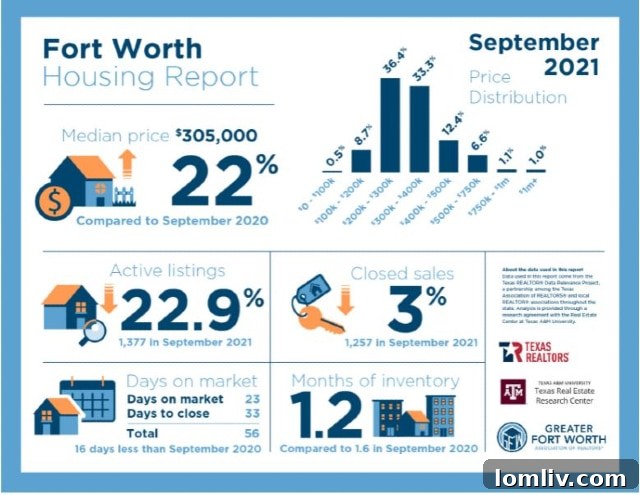
Consider the data from reputable sources like the Greater Fort Worth Association of Realtors. Their reports clearly illustrate significant growth. For instance, the median sales price for a home in Fort Worth increased by a staggering 22 percent from September 2020 to September 2021 alone. This level of price acceleration is certainly noteworthy and aligns with the initial phase of a potential bubble scenario, where values are climbing at an extraordinary pace.
However, it’s crucial to remember that high prices alone do not constitute a housing bubble. A true bubble scenario, where “the rich get richer and the masses are forced either paying too much money for a home or, having already purchased at a high price, are left with a home that has dropped drastically in value and now have a negative asset,” typically also involves another key element: an oversupply of homes.
The Missing Piece: Critically Low Inventory Levels
Here’s where the current Dallas-Fort Worth and broader Texas housing market significantly diverges from the traditional definition of a housing bubble. While we undeniably have high prices, the critical question remains: what about high inventory? This is, without a doubt, the defining factor that differentiates our current market from a speculative bubble waiting to burst.
In a classic housing bubble, prices are not only high, but there’s also an abundance of homes on the market, often built speculatively, leading to an oversupply. This combination of high prices and high inventory creates an unstable environment where demand can quickly evaporate, leaving homeowners with depreciating assets. However, the exact opposite is true for the DFW market.
Based on the very same statistics that highlight price increases, active listings have plummeted. From September 2020 to September 2021, active listings in the DFW area dropped by an astonishing 23 percent. This isn’t merely a slight dip; it represents a significant and sustained shortage of homes available for sale. This severe lack of inventory fundamentally contradicts the premise of a housing bubble.
When there are far more buyers than available homes, prices are naturally driven up by fierce competition, multiple offers, and escalating bids. This is a phenomenon of supply and demand, not speculative overvaluation. Buyers aren’t necessarily purchasing homes solely to flip them for quick profits; rather, they are often desperate to secure a primary residence in a highly competitive market where options are scarce.
Understanding the Drivers of Low Inventory
Several factors contribute to these persistently low inventory levels in Texas:
- Rapid Population Growth: Texas, especially the DFW metroplex, has been a magnet for people relocating from other states, drawn by job opportunities, a lower cost of living (compared to coastal cities), and a vibrant economy. This influx of new residents creates sustained, fundamental demand for housing.
- Construction Challenges: While new construction is ongoing, it struggles to keep pace with demand. Supply chain disruptions, rising material costs, labor shortages, and regulatory hurdles have all hampered the speed and volume of new home builds.
- Homeowner Retention: Many existing homeowners, having secured historically low interest rates on their mortgages, are reluctant to sell and then face purchasing a new home at a higher price and potentially a higher interest rate. This reduces the number of existing homes coming onto the market.
- Long-Term Investment: For many, homeownership in Texas is seen as a stable, long-term investment, further reducing the incentive to sell quickly.
These underlying factors create a market where demand consistently outstrips supply, leading to sustained price appreciation without the speculative excess and oversupply that define a bubble.
Lessons from the Past: The 2008 Housing Crisis in Texas
Skeptics might point to the last major housing downturn during the Great Recession and wonder if a similar outcome is inevitable. However, a deeper look at that period reveals a crucial distinction, especially for Texas.
The national housing crisis of 2008-2009 was indeed fueled by a classic housing bubble. It was characterized by loose lending practices (subprime mortgages), excessive speculation, and a massive oversupply of homes, particularly in states like Florida, California, Arizona, and Nevada. Banks were lending money to unqualified buyers, leading to a glut of properties and an eventual cascade of foreclosures that collapsed the market.
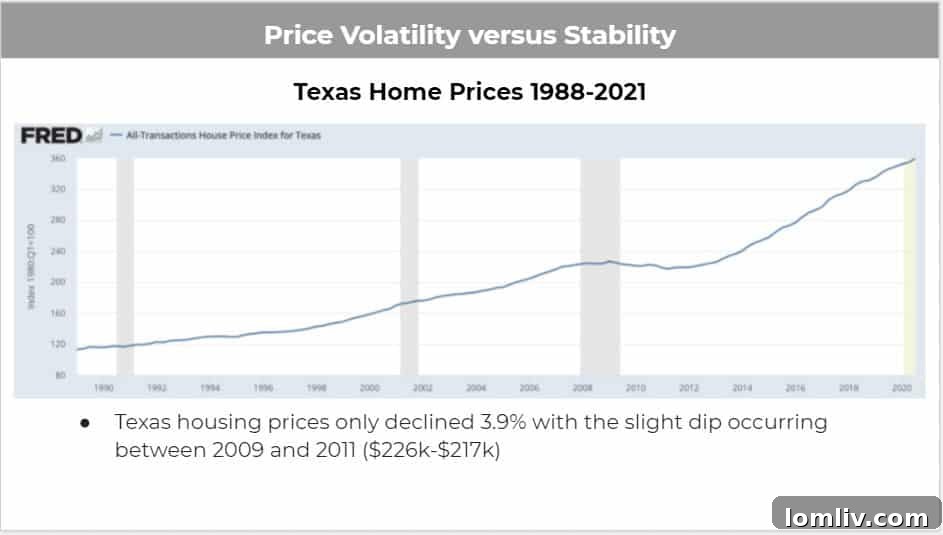
This historical perspective often leads to the question: “Isn’t it true that past experience will indicate future results?” While history offers valuable lessons, it’s critical to understand the nuances. During the last housing bubble, according to the Federal Reserve Economic Data (FRED), Texas housing prices experienced a relatively minor decline of only about 4 percent in value. This was significantly less severe than the double-digit drops seen in other parts of the country.
Why was Texas so resilient? Several factors contributed:
- Stronger Lending Regulations: Texas had more conservative lending standards than many other states, making it less susceptible to the subprime mortgage crisis.
- Diversified Economy: Texas boasted a more diversified economy, with robust sectors beyond just real estate, which helped buffer the impact of the national recession.
- Continuous Population Growth: Even during the recession, Texas continued to attract residents and businesses, maintaining a baseline level of demand for housing.
- Balanced Inventory: While other states saw a massive oversupply, Texas’s inventory levels, though higher than today, were generally more balanced, preventing a widespread glut.
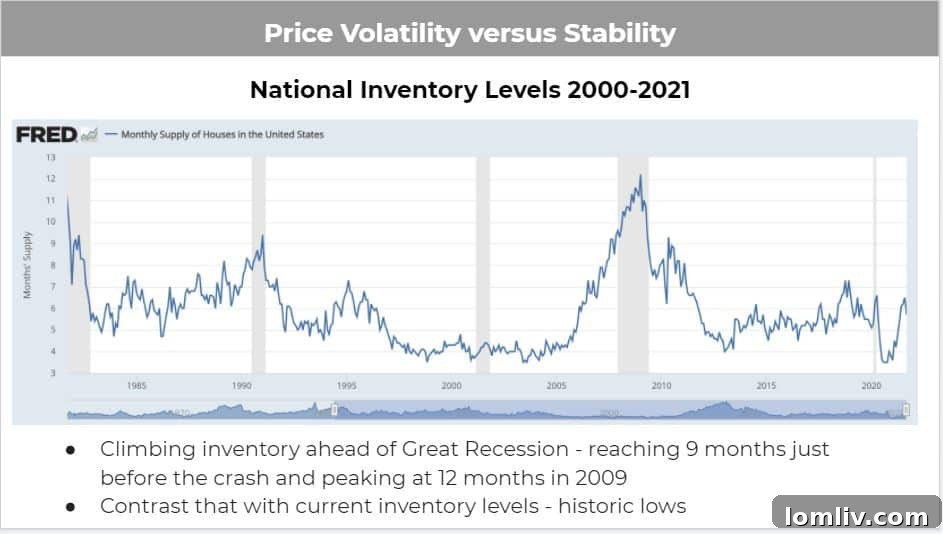
Crucially, the 2008 bubble occurred when inventory and pricing were at an all-time high in many regions. As we’ve established, we are currently *not* at an all-time high for inventory in Texas; in fact, we’re experiencing historically low levels. This fundamental difference makes direct comparisons to the 2008 national crisis largely inaccurate for the current Texas market.
Sorry, But There’s No Imminent Housing Bubble Burst
Armed with this data and a clear understanding of what constitutes a housing bubble, it becomes evident that the current Texas real estate market does not fit the criteria for an impending burst. The widespread notion of a “housing bubble just waiting to pop” is largely unsubstantiated by present economic conditions and market fundamentals.
This realization has significant implications for both prospective buyers and current homeowners.
For Prospective Homebuyers: Don’t Wait Indefinitely
If you’ve been “standing on the sidelines,” patiently waiting for a dramatic market correction, hoping to “lowball a seller” or expecting overall housing prices to significantly drop back to pre-pandemic levels, you might be in for a very long wait. The data simply doesn’t support such an outcome in the foreseeable future.
Does this mean that finding a “deal” is impossible? Certainly not. With proper education, meticulous planning, and a good deal of patience, any prospective homebuyer can still find a property priced appropriately for their budget and needs. It might require adjusting expectations, expanding search areas, or being prepared to act quickly, but with the right real estate professional guiding you, it is absolutely possible to navigate this competitive landscape successfully.
Focusing on the long-term investment rather than short-term market timing is a more prudent strategy in a fundamentally strong market like Texas. Homes continue to be a valuable asset, and even with current price levels, the potential for continued appreciation remains.
For Current Homeowners: Your Investment Remains Strong
Those who have purchased homes during this period of high prices and low inventory should take comfort in the data. Your investment is far from “in vain.” While timing the market perfectly is rare, the underlying fundamentals of the Texas economy suggest that your home purchase—even at a record-high price—is likely to continue appreciating in value over time. When current owners decide to sell in the future, they can reasonably expect to realize a favorable return on their investment.
The consistent demand, coupled with limited supply and robust economic growth, creates a stable environment for home values to grow. This isn’t speculative growth; it’s growth driven by real people, real jobs, and real economic strength.

Therefore, the prevailing narrative of an imminent housing bubble in Texas is fundamentally flawed. If you encounter individuals suggesting that prices are poised to fall dramatically soon, understand that their conclusions are likely not based on a comprehensive understanding of current market data and economic principles. They may not fully grasp the implications of an all-time low in inventory combined with an all-time high in population growth and job migration to the Lone Star State—individuals who are not only ready but also willing to invest what it takes to own a home in a thriving economy.
If you are actively in the market to purchase a home, there’s no need for fear or undue apprehension. The prevailing data strongly suggests that your purchase will likely prove to be a profitable and sound investment in the years to come. Conversely, if you’re steadfastly remaining on the sidelines, waiting for a market event (which, by all indications, is unlikely to materialize) that would drop prices back to levels seen in 2009, you might need to prepare for an extended wait. It’s advisable to invest in a comfortable cushion, as your tenure on the sidelines could span a considerable duration.