

The real estate landscape is constantly evolving, and recent shifts have prompted many in the Fort Worth and Tarrant County areas to ask a crucial question: Is the housing market finally cooling down, or is it heading for a more significant slowdown? After a prolonged period of intense competition and soaring prices, understanding the current trends and what they mean for both buyers and sellers is more important than ever. This article delves into the nuances of the Tarrant County real estate market, separating myth from reality and providing a clear, expert perspective on what to expect.
Amidst widespread discussions about economic shifts, inflation, and rising interest rates, it’s natural for speculation about the housing market’s future to intensify. While some voices predict a dramatic downturn, a closer look at local data and national economic indicators reveals a more complex, and ultimately, more optimistic picture. We’ll explore the key indicators pointing towards a more balanced market, debunk common misconceptions, and offer actionable insights for navigating these changing times. The goal is to provide clarity and reassurance, grounded in real estate expertise, ensuring you’re well-informed whether you’re looking to buy your dream home or sell your current property.
Is the Tarrant County Real Estate Market Headed for a Slowdown?
For months, the Tarrant County real estate market has been defined by unprecedented demand, fiercely competitive bidding wars, and a rapidly escalating price environment. Homes often received multiple offers within hours of listing, frequently selling well above asking price. This intense seller’s market has led many to wonder if such a pace is sustainable and, inevitably, if a significant market correction or slowdown is on the horizon. The short answer is yes, we are seeing signs of a market recalibration, but it’s crucial to understand what kind of “slowdown” this truly represents.
Let’s immediately address the most pervasive fear: a housing market crash akin to the 2007-2013 recession. To put it simply – RELAX. We are not witnessing the preconditions for a housing market collapse. The sky is not falling, and the fundamentals underpinning the current market are vastly different from those that led to the Great Recession. While the frantic pace of the past few years may be easing, this shift is more accurately described as a journey towards a more balanced and sustainable market environment rather than a precipitous decline. For buyers, this doesn’t mean “great deals” on every home, but it does signal a less frenzied purchasing experience. For sellers, it means a more strategic approach to pricing and marketing, moving away from the expectation of effortless, over-asking sales.
Understanding this distinction is vital for anyone engaged in the Tarrant County real estate market. The narrative of an impending crash, often fueled by sensational media headlines or misinformed conversations, can lead to paralysis or poor decision-making. Instead, recognizing the signs of a transition to a more normalized market allows both buyers and sellers to adapt their strategies effectively, capitalizing on the emerging opportunities that a balanced market presents. This current phase offers a chance for greater stability and predictability, a welcome change after years of extreme market volatility.
Understanding the Signs of a Balancing Market
A balanced real estate market is a state where neither buyers nor sellers hold a distinct advantage. In practical terms, this equilibrium is often quantified by the “months of inventory” – a metric that estimates how long it would take to sell all available homes on the market at the current sales pace. Historically, a market is considered balanced when there is approximately a six-month supply of inventory. This allows buyers a reasonable selection of homes and sellers a fair timeframe to achieve a good price for their property, fostering a healthy, sustainable ecosystem.
For the past few years, Tarrant County, like much of the nation, has experienced an extreme seller’s market, characterized by less than one month’s supply of inventory. Such scarcity creates immense pressure: buyers face intense competition, often needing to waive contingencies or offer significantly above asking prices to secure a home. This environment can be incredibly frustrating, leading many potential buyers to postpone their homeownership dreams due to limited choices and aggressive market conditions. Low inventory not only restricts selection but also removes much of the negotiation power typically available to purchasers, driving up stress levels and sometimes leading to buyer burnout.
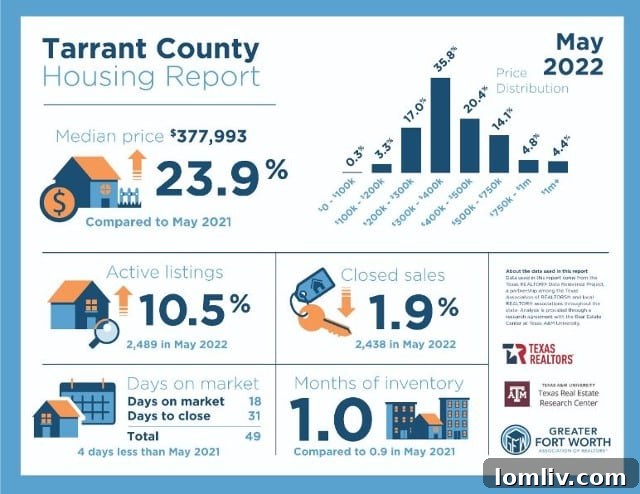
Encouragingly, recent data from the Greater Fort Worth Association of Realtors indicates a positive shift. In May 2022, Tarrant County recorded a full one month’s supply of inventory. While this number is still far from the ideal six months, it represents a significant improvement from the mere eight-tenths of a month’s supply seen in April 2022. This gain, though seemingly small, is a crucial indicator of a market gently recalibrating. Each incremental increase in inventory provides more options for buyers, slightly reduces the intense competitive pressure, and allows for a more thoughtful purchasing process. These “small gains” are foundational steps toward a more sustainable and less frantic housing market, offering a glimmer of hope for frustrated buyers and a necessary adjustment for sellers who have grown accustomed to unprecedented conditions.
Furthermore, an increase in active listings, alongside the rise in inventory months, plays a vital role in this rebalancing act. More homes on the market mean more choices for prospective buyers. This expanding selection can lead to longer market times for individual properties, as buyers no longer feel the urgent need to make snap decisions. Sellers might find that they need to pay more attention to staging, pricing, and marketing their homes competitively. This shift benefits the overall health of the market, allowing for a more deliberate transaction process that can ultimately lead to greater satisfaction for all parties involved. This move towards equilibrium fosters a more robust and resilient real estate environment for the long term.
Why Comparing 2022 to the 2007 Housing Crisis is Misguided
One of the most persistent and misleading narratives circulating today is the comparison of the current real estate market to the devastating housing crisis of 2007-2013. This comparison is fundamentally flawed and largely driven by a lack of understanding of the distinct economic and lending environments of each period. It is imperative to stop drawing parallels between these two eras, as the underlying factors are vastly different, ensuring that a similar “Great Recession” scenario is highly improbable for the current housing market.
The 2007 housing crash was primarily fueled by a catastrophic collapse in lending standards and an oversupply of homes. Lenders, driven by aggressive securitization practices, issued an abundance of “subprime” mortgages to borrowers with poor credit scores and insufficient financial verification. These included “no-doc” loans, where borrowers didn’t have to prove income, and interest-only loans, which allowed for minimal payments initially but led to payment shock later. In 2007, Adjustable Rate Mortgages (ARMs) were pervasive, with over 13 million in circulation, setting many homeowners up for significant payment increases they couldn’t afford once their fixed-rate periods expired.
Fast forward to today, and the lending landscape is vastly different. Post-2008 regulations, such as the Dodd-Frank Act, dramatically tightened mortgage underwriting standards. Today’s borrowers undergo rigorous income verification, credit checks, and debt-to-income ratio analyses, ensuring they are genuinely qualified to afford their loans. The market now features far fewer risky loan products, and the number of ARMs has plummeted to approximately 2.5 million nationwide. This shift signifies a much healthier and more stable mortgage market, with homeowners possessing stronger financial foundations and genuine repayment capabilities.
Another critical distinction lies in the balance of supply and demand. In 2007, a false demand, partly inflated by speculative buying and loose credit, combined with a heavy oversupply of homes, created a precarious housing bubble that inevitably burst. Currently, the market faces a completely opposite scenario: genuine, strong demand driven by demographic shifts, job growth, and migration to desirable areas like Texas, coupled with a persistent undersupply of homes. There is no housing bubble when demand consistently outstrips the available inventory. This fundamental imbalance, while frustrating for buyers, acts as a significant buffer against a dramatic price collapse, underpinning the market’s stability.
Therefore, if you find yourself at a social gathering and someone confidently asserts, “I’m waiting for the housing market to crash,” it’s probably best to politely disengage from that conversation. Such a statement reveals a fundamental misunderstanding of current market dynamics. Similarly, dismiss any predictions of a sudden influx of foreclosures and bank-owned homes that opportunistic buyers can “scoop up.” These scenarios, while characteristic of the 2007 crisis, are not materializing now, nor are they likely to in the foreseeable future.
One of the strongest reasons preventing a flood of foreclosures today is the substantial equity homeowners have accumulated. Unlike 2007, when many homeowners were underwater on their mortgages, years of robust appreciation mean that even if a homeowner faces financial hardship and falls behind on payments for 30, 60, or even 90 days, they almost certainly possess significant equity in their property. This equity provides a crucial safety net: instead of facing foreclosure, they can sell their home, repay their outstanding loan, and often still walk away with a considerable profit. This widespread equity acts as a formidable barrier against the wave of distressed properties that characterized the previous recession, further solidifying the market’s resilience.

Other Significant Indicators of Market Rebalancing
Beyond inventory levels, several other critical factors are influencing the current shift in the Tarrant County real estate market, signaling a move towards greater balance. One of the most frequently discussed and impactful elements is the rising interest rate environment. Currently, 30-year conventional mortgage rates are hovering around 5.75 percent. While this is a notable increase from the historically low rates of 2.3875 percent seen just a few months ago, it’s essential to maintain perspective. Any Baby Boomer will readily recount stories of securing home loans with interest rates ranging from 11 to 20 percent in decades past. From a broader historical viewpoint, current rates, while higher, remain very reasonable and certainly do not represent an insurmountable barrier to homeownership for qualified buyers.
However, this Bow Tie Realtor would argue that the overall price of homes, more so than the interest rate alone, is the primary driver of the current market slowdown. The rapid appreciation in home values has pushed many properties, even “starter homes,” well into the $300,000 range and beyond. For first-time homebuyers or those with moderate incomes, these price points, coupled with rising property taxes characteristic of the Texas market and now higher interest rates, create a significant affordability challenge. The cumulative effect of high acquisition costs, elevated property tax burdens, and increased monthly mortgage payments is effectively pricing a segment of potential buyers out of the market, reducing overall demand and contributing to a more measured pace of sales.
The affordability crisis is multi-faceted. Even with steady employment and good credit, the sheer capital required for a down payment, closing costs, and the ongoing monthly expenses can be prohibitive. This directly impacts the entry-level market, which historically serves as a vital component of real estate churn. When first-time buyers are sidelined, it slows the upward mobility for existing homeowners who might be looking to sell and upgrade. Thus, while interest rates play a role, the fundamental issue of escalated home values reaching a certain threshold where a significant portion of the buyer pool finds them unattainable is arguably a more potent sign of market recalibration.
Understanding “Price Improvements” in a Shifting Market
Another telling sign of a rebalancing market is the increasing frequency of “price improvements.” While some real estate professionals may use this softer terminology, let’s be direct: it refers to homes reducing their asking price. In a seller’s market, where demand far outstrips supply, sellers naturally aim to maximize their profit, often listing homes at the very top end of, or even slightly above, market value. Realtors, working diligently for their clients, advise on pricing strategies that reflect prevailing conditions and seller aspirations.
There’s nothing inherently wrong with this approach. If buyers are willing to pay a premium, or even overpay, to secure a home in a competitive environment, it’s a testament to market demand. However, all markets eventually reach a point where buyers collectively decide that a certain price is simply too high. This is the market “speaking.” When a property sits on the market longer than expected, or receives limited interest, it signals that the initial asking price has exceeded what the current pool of buyers is willing to pay. This is where a “price improvement” becomes a necessary adjustment to align with buyer expectations and competitive valuations.
Recent data vividly illustrates this trend in Tarrant County. In a single recent week, nearly 500 homes saw a decrease in their asking price. Concurrently, within that same week, approximately 900 new homes entered the market. This combination of increased inventory and more frequent price reductions underscores the shift. Sellers are realizing that the days of guaranteed over-asking offers might be receding, and that strategic pricing from the outset, or prompt adjustments, are becoming essential. This phenomenon is a healthy market correction, moving away from an unsustainable upward trajectory towards a more realistic and competitive pricing environment. It empowers buyers with more options and potentially more leverage, signifying a welcome return to rational market behavior.
Final Thoughts: Navigating a More Balanced Tarrant County Market
To reiterate, the sky is not falling on the Tarrant County real estate market. The fears of a dramatic housing crash, reminiscent of the 2007 era, are unfounded. While the breakneck pace of recent years is undeniably slowing, home values are not projected to drop significantly. Instead, we are observing a healthy and necessary transition towards greater normalcy and balance. This market remains, fundamentally, a strong seller’s market, but one that demands more strategic decision-making and offers more opportunities for buyers.
Waste no time engaging in arguments with those who insist we are heading into another housing crash. That scenario is highly unlikely, especially within the robust economic framework and stringent lending standards prevalent in Texas. Similarly, disabuse anyone of the notion that they will soon acquire a home for “50 cents on the dollar.” Such drastic price reductions are not on the horizon given the underlying demand and equity cushions in place.
For sellers, the advice remains clear: continue striving to achieve the best possible price for your home. You are entitled to and deserve fair compensation for your valuable asset. However, in this evolving market, it’s crucial to be realistic with initial pricing and responsive to market feedback. Overpricing can lead to longer market times and potentially force larger price reductions later. Strategic pricing from the outset, coupled with effective marketing, will be key to a successful sale.
For buyers, these shifts present encouraging prospects. You might no longer face the intense pressure to overpay significantly or waive critical contingencies just to secure a home. The increase in inventory means you’ll have more homes to choose from, allowing for a more deliberate and thoughtful search process. This newfound breathing room can lead to more favorable negotiations and ultimately, a more satisfying home purchase experience. While competitive, the market is becoming less frenzied, allowing buyers to make decisions based on value rather than panic.
Hang in there, everyone. The real estate market is adjusting, and this movement towards normalcy and a more balanced environment is ultimately beneficial for the long-term health and stability of the Tarrant County housing market. It’s a sign of a maturing market, providing a more predictable and sustainable landscape for all participants.