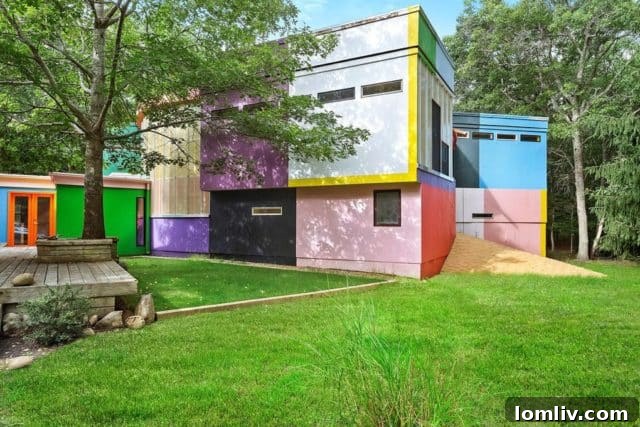
The Bioscleave House: Hamptons’ Experimental Abode Designed to Extend Life
Nestled amidst the traditional opulence of the Hamptons, a region synonymous with classic luxury and serene landscapes, stands an architectural anomaly: a house explicitly designed to challenge human complacency and, remarkably, extend life. This isn’t just another modern marvel; it’s the Bioscleave House, also known as the Life-Span Extending Villa, a profound experiment by visionary artist couple Madeline Gins and Arakawa.
This week, we delve into the extraordinary narrative of a home that pushed the boundaries of architecture, art, and even biology, inviting its occupants to live not just within its walls, but in active engagement with every uneven surface and unconventional corner. Discover how this peculiar Hamptons property became a testament to a radical philosophical belief and an unyielding artistic vision.

The Visionaries: Madeline Gins and Arakawa’s Reversible Destiny
Madeline Gins and Shusaku Arakawa were more than just artists; they were philosophers, poets, and architects who dedicated their lives to questioning the inevitability of human mortality. Their groundbreaking philosophy, termed “Reversible Destiny,” posited that by intentionally designing environments that challenge and stimulate the human body and mind, one could actively resist the aging process and potentially even reverse it. “It’s immoral that people have to die,” Gins famously told The New York Times in 2008, encapsulating the radical core of their belief.
Both Gins and Arakawa were protégés of the iconic Dadaist Marcel Duchamp, an influence evident in their work’s playful yet profound subversion of conventional norms. Their extensive body of work, spanning decades, has been celebrated and exhibited worldwide, including prestigious venues like the Guggenheim Museum. The Bioscleave House, however, stands as their most ambitious and tangible manifestation of the Reversible Destiny concept – a living laboratory. This was their singular attempt to translate decades of theoretical research into a inhabitable, experimental structure, directly engaging with the human body’s response to its environment.
“Here is a singular, rare masterwork – the only house they designed and built to test 50 years of research through this experimental, provocative laboratory.” — Jose B. DosSantos, Listing Agent with Brown Harris Stevens

Architecture as an Anti-Aging Device: Exploring the Bioscleave House’s Design
Every element within the Bioscleave House is a deliberate component of Gins and Arakawa’s experimental anti-aging strategy. This isn’t a home designed for passive comfort; it’s an immersive environment crafted to keep its occupants perpetually alert, engaged, and physically responsive. The intention was to prevent the body and mind from settling into habitual patterns, thereby improving immunity, sharpening senses, and ultimately, extending life. It was a bold hypothesis that challenged conventional notions of domestic comfort, replacing them with a constant state of playful disequilibrium.
The Terrain of Thought: Hilly Floors and Uneven Surfaces
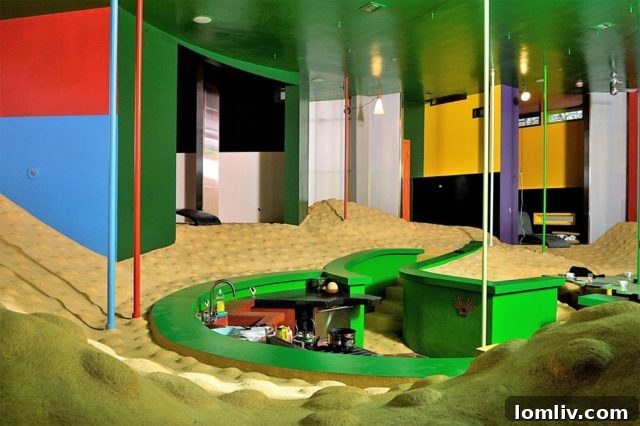
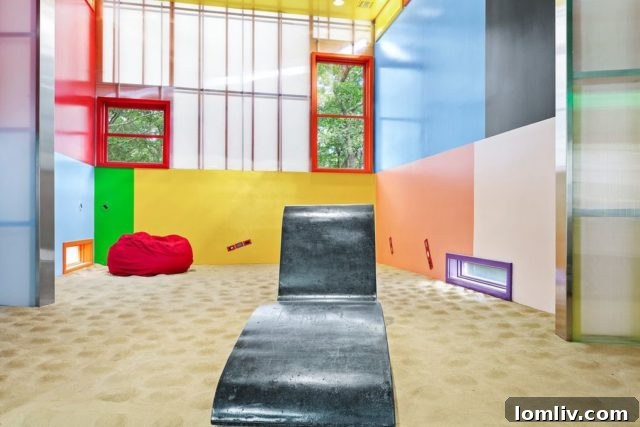
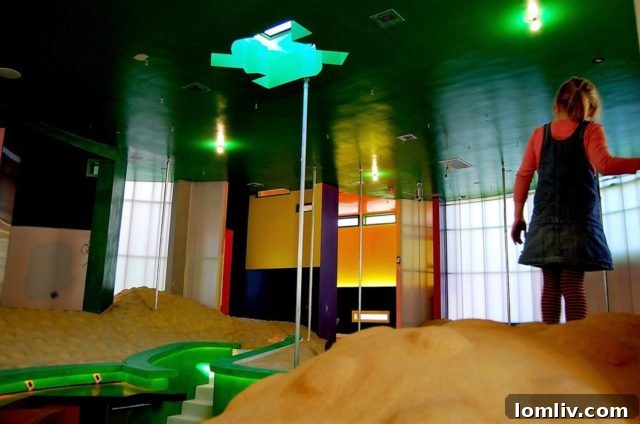
One of the most striking features of the Bioscleave House is its undulating, “bumpy” flooring. Far from the smooth, predictable surfaces of conventional homes, the floors here mimic natural, uneven terrain. Navigating the kitchen, for instance, requires constant awareness and careful foot placement. This deliberate instability forces residents to remain conscious of their balance, engaging muscles and cognitive functions that might otherwise lie dormant in a typical flat-floored dwelling. The hypothesis was simple yet revolutionary: constant physical and mental engagement through environmental challenge would prevent bodily decline, keeping occupants nimble and vital.
A Symphony of Color: Challenging Visual Habits
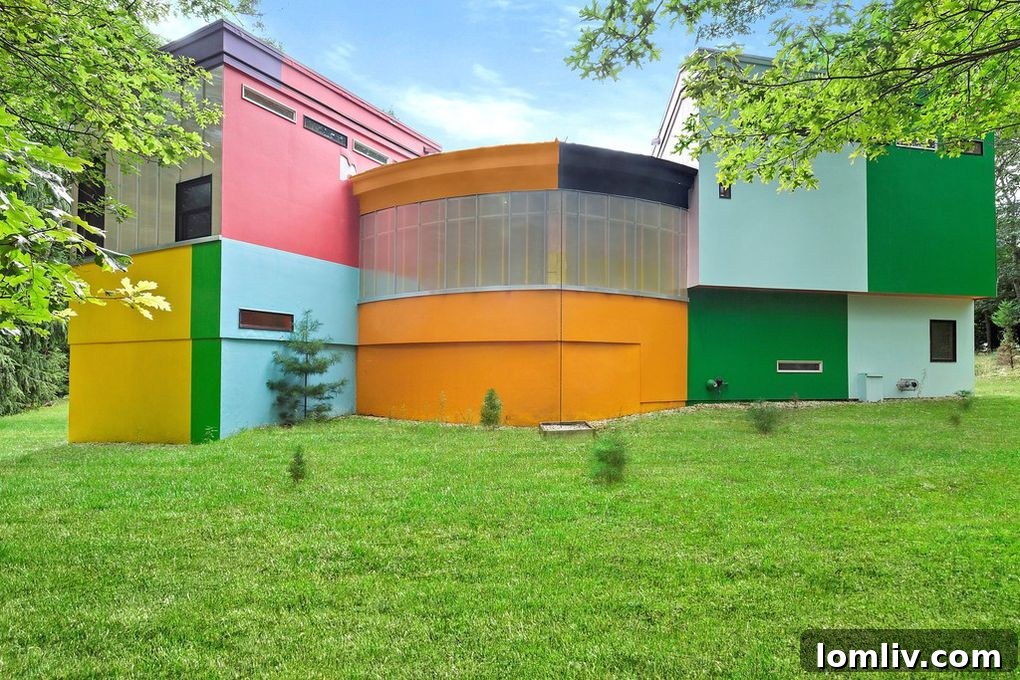
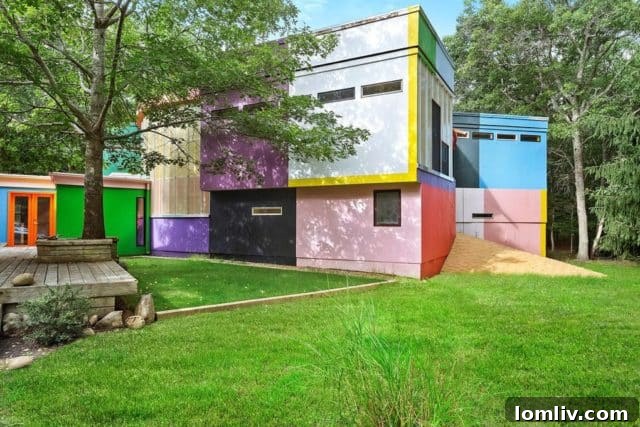
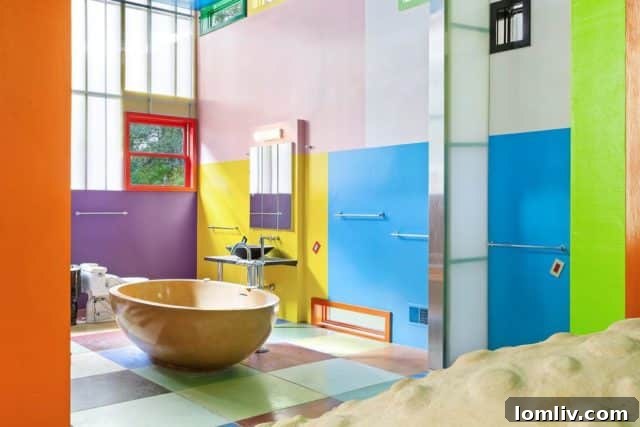
The house explodes with color, boasting an astonishing 52 different hues across its interior and exterior. These aren’t merely decorative choices; they are integral to the sensory stimulation strategy. The varied and often clashing colors are designed to prevent visual habituation, ensuring that the eye and brain are always actively processing new information. This constant sensory input, Gins and Arakawa believed, would contribute to a heightened state of alertness and mental vitality, preventing the mind from falling into passive states and encouraging continuous cognitive function.
Unconventional Interactions: Outlets, Windows, and Open Spaces
Beyond the floors and colors, the house presents numerous other “challenges” that demand active engagement. Angled electrical outlets, often placed at unusual heights, require a conscious effort to use, preventing the automaticity of daily routines. Similarly, floor-level windows compel occupants to interact with their immediate surroundings in novel ways, bending down or shifting perspectives to observe the outside world. These seemingly minor inconveniences are, in fact, intentional prompts for problem-solving and a heightened awareness of one’s physical space, sharpening senses and encouraging a dynamic relationship with the environment.
A Radical Approach to Privacy: The Absence of Doors
Perhaps one of the most radical departures from conventional living is the complete absence of doors within the Bioscleave House – not even for bathrooms or bedrooms. This open-concept design is another facet of the Reversible Destiny philosophy, aiming to break down personal boundaries and foster a constant state of awareness, even during intimate moments. While conceptually aligned with the goal of preventing mental stasis, it certainly raises practical questions about privacy and comfort. Imagine navigating daily life, including personal moments, without the traditional enclosures we’ve come to expect, constantly aware of your surroundings and others.
A Hamptons Anomaly: Construction, Challenges, and Market Journey
The journey of the Bioscleave House from concept to completion was as unconventional as its design. Commissioned in the 1990s by a homeowner seeking an extension to a small Hamptons property, the project quickly spiraled in complexity and cost. What began as an ambitious artistic endeavor ballooned into a construction challenge requiring over $2 million. The original homeowner eventually withdrew from the project due to the escalating expenses and the sheer unconventionality of the build, finding the radical vision too demanding to realize.
Undeterred, a group of dedicated professors and supporters formed a company to see Gins and Arakawa’s vision through. The house was finally completed in 2008, a testament to enduring artistic will. Yet, despite its completion, the Bioscleave House has reportedly never been permanently inhabited. It stands as a monument to an idea, rather than a home for daily living, a grand experiment perhaps too challenging for everyday occupation.
Since its completion, this unique property has made periodic appearances on the real estate market, often baffling potential buyers accustomed to the Hamptons’ more traditional offerings. It has remained on and off the market for years, sometimes listed for extended periods, currently showing 260 days on the market. Its unconventional nature, while a draw for architectural enthusiasts, presents a formidable hurdle for those seeking conventional comfort and utility.
The property today encompasses approximately 2,700 square feet, offering four bedrooms and three bathrooms. It’s composed of two connected structures: the daring “back” Bioscleave House extension and the more conventional “front” original A-frame house, providing a curious juxtaposition of architectural philosophies on a single plot.
The Ultimate Test: Did the Bioscleave House Deliver Immortality?
The grand hypothesis of the Bioscleave House and the Reversible Destiny philosophy was to defy death itself. The question naturally arises: did this architectural marvel achieve its radical goal for its creators? Did all the obstacle coursing, heightened alertness, and unconventional living arrangements truly extend the lifespans of Arakawa and Gins, granting them the immortality they envisioned?

Sadly, the answer is no. Arakawa passed away in 2010 at the age of 73 from ALS, and Gins followed in 2014 at 72 due to cancer. For context, the average life expectancy in the U.S. at that time was approximately 79 years. While their deaths do not diminish the profound artistic and philosophical statement their work makes, they do underscore the limitations of even the most ambitious architectural interventions in altering fundamental biological processes. The Bioscleave House, therefore, remains a powerful conceptual artwork rather than a literal fountain of youth.
Legacy of a Life-Span Extending Villa
Despite not achieving its literal goal of extending life, the Bioscleave House remains an incredibly significant piece of experimental architecture. It serves as a powerful reminder of art’s capacity to challenge assumptions, provoke thought, and push the boundaries of what is considered possible within built environments. It’s a testament to the belief that our surroundings deeply influence our existence, even if the ultimate claim of immortality remains elusive. The house embodies a profound dedication to questioning the status quo and imagining radically different ways of living.
The house is more than just a quirky Hamptons listing; it’s a physical embodiment of a lifelong artistic and philosophical quest. It encourages us to question our own complacency, to engage more fully with our physical spaces, and to consider how design might impact not just our comfort, but our very vitality. In a world increasingly seeking wellness and mindful living, Gins and Arakawa’s radical vision, though perhaps ahead of its time, resonates with a desire to live more vibrantly and consciously. The Bioscleave House, in its challenging and unforgettable form, continues to inspire dialogue about the relationship between humans and their constructed environments.
To delve deeper into the fascinating world and philosophy of Gins and Arakawa, you can explore the Reversible Destiny Foundation’s website. For those intrigued by the opportunity to own a piece of this avant-garde history, more details about the current listing can be found on Realtor.com.