Real estate is a foundational element of our society, influencing everything from the homes we live in and the schools our children attend, to the funding of local services and the strategic locations where businesses thrive. For individuals contemplating their first home purchase, looking to expand an investment portfolio with rental properties, or simply aiming to demystify the often-complex terminology of the property market, this comprehensive guide offers clarity and essential insights in clear, accessible language.
We will embark on a journey through the fundamental definition of real estate, explore the diverse categories of properties, meticulously detail the intricate process of a real estate transaction from initial offer to final closing, delve into various popular investment strategies—both active and passive—and provide an indispensable glossary of key terms you’re guaranteed to encounter throughout your real estate endeavors. Our goal is to equip you with the knowledge needed to navigate this dynamic sector with confidence and informed decision-making.
Understanding “Real Estate”: A Comprehensive Definition
At its core, real estate encompasses land and any permanent physical structures or improvements attached to it. This includes a broad spectrum of assets such as houses, office buildings, commercial complexes, industrial facilities, and various infrastructure developments. Crucially, real estate also involves the inherent rights associated with owning such property. In common parlance, “real estate” and “real property” are often used interchangeably, distinguishing them from “personal property” like vehicles or furniture, which are movable and not permanently affixed to land.
Ownership of real estate typically grants a “bundle of rights,” empowering the owner with privileges such as the right to occupy, use, lease, sell, or make improvements to the property. These rights, however, are not absolute and are exercised within the confines of legal frameworks, local zoning regulations, and other statutory limitations. The intrinsic value of these rights, and thus the property itself, is influenced by a confluence of factors including its geographical location, prevailing local demand, the property’s physical condition, its permitted uses under zoning laws, and broader macroeconomic forces such as interest rates and overall economic stability.
Etymology & First Use: Tracing the Origins of “Real Estate”
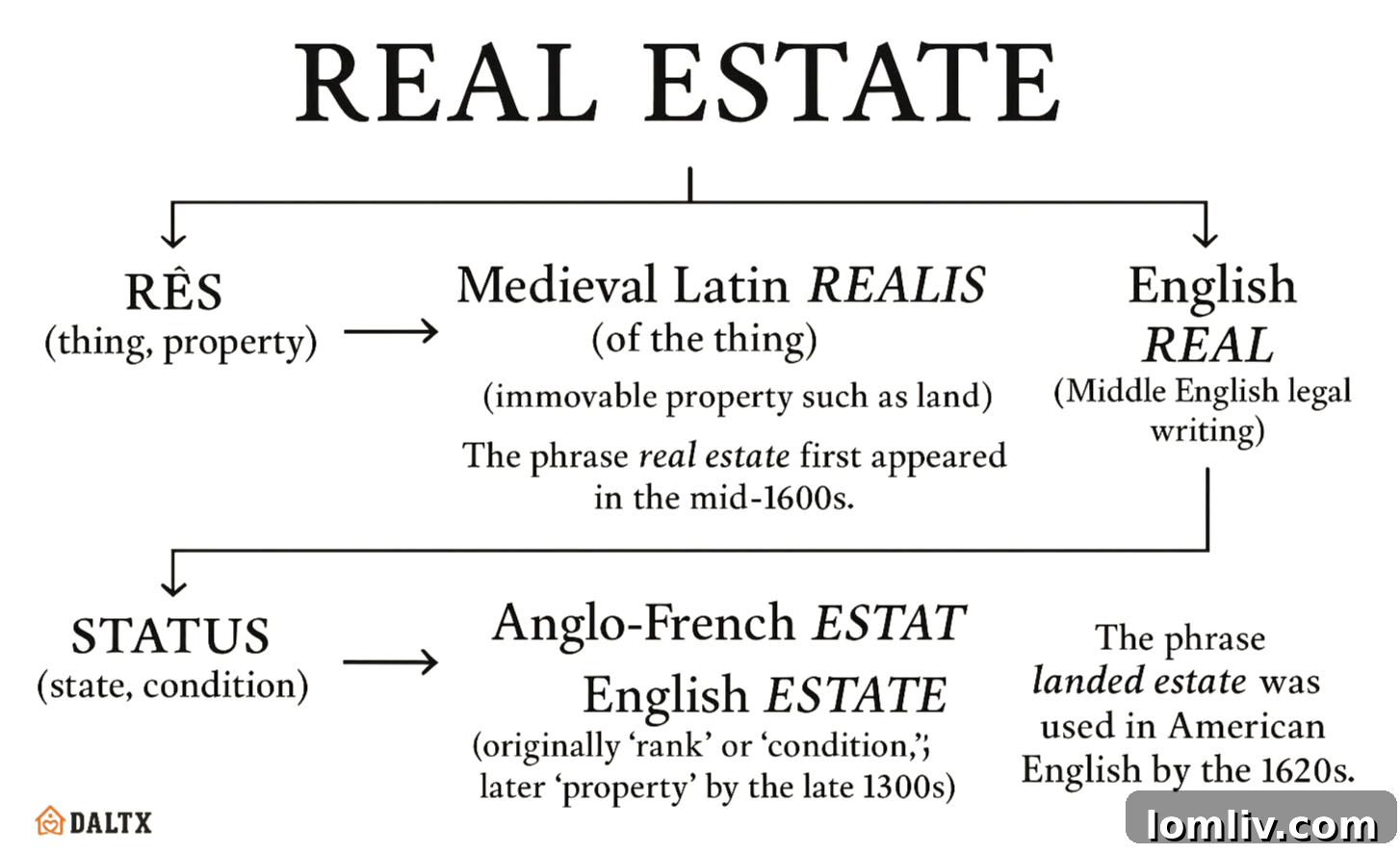
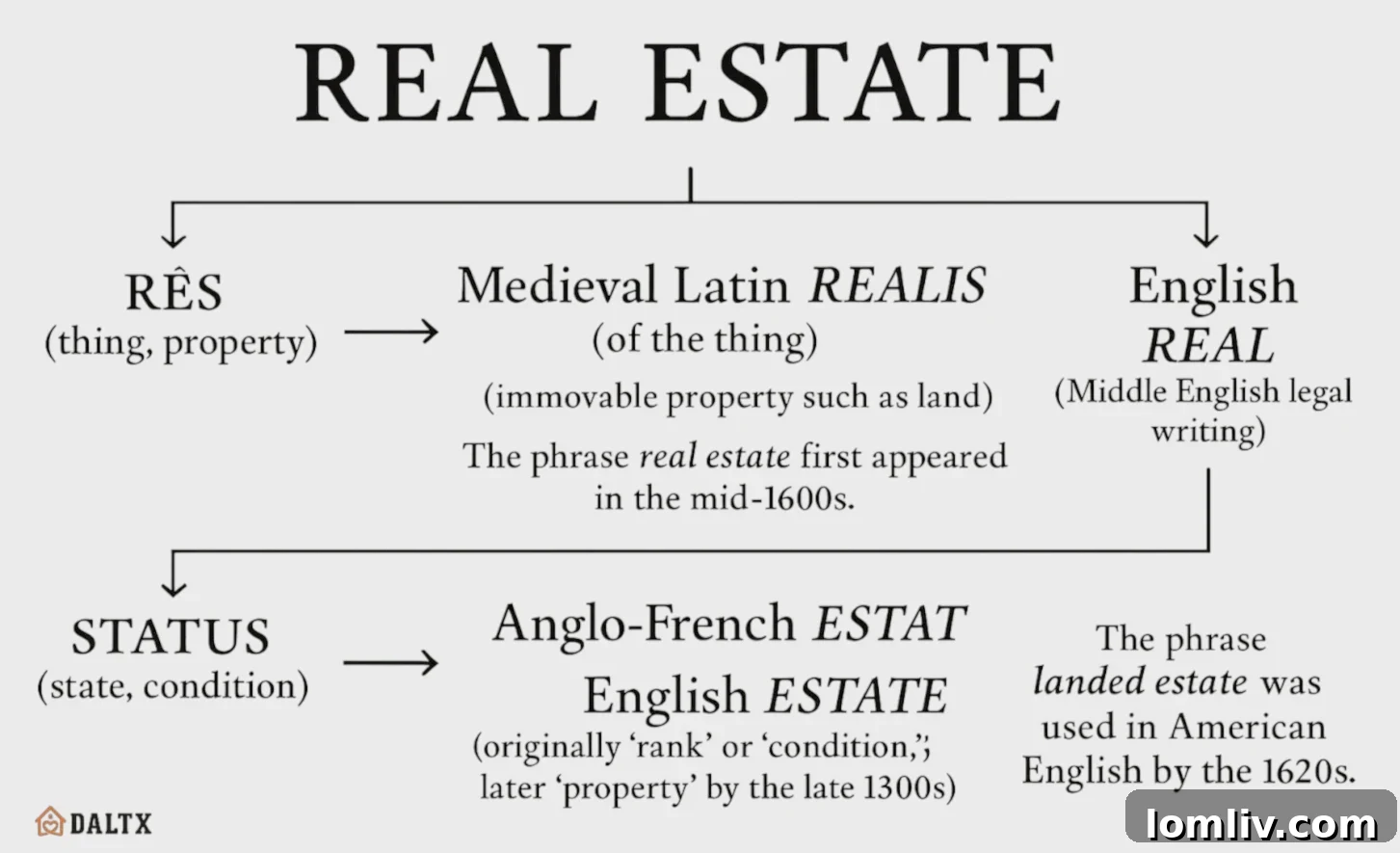
- “Real” derives from the Medieval Latin realis (“of the thing”), which in turn originates from the Latin rēs (“thing” or “property”). In English legal documents dating back to Middle English, “real” specifically referred to “things” in a legal sense, particularly immovable assets like land, in contrast to personal (movable) goods. The precise phrase “real estate” made its initial appearance around the mid-17th century.1
- “Estate” comes from the Anglo-French estat, itself derived from the Latin status, meaning “state” or “condition.” In English, it initially conveyed “rank” or “condition,” and by the late 14th century, it expanded to also signify “property.” The term “landed estate” was already in use in American English by the 1620s.2
The earliest documented use of the combined term “real estate” is typically traced back to the mid-1600s. Merriam-Webster indicates its first known use around 1642, while the Online Etymology Dictionary pinpoints it to the 1660s. Regardless of the exact year, it is evident that the term firmly entered the English lexicon during the 17th century and has maintained its precise legal connotation ever since, reflecting the enduring importance of clarity in property ownership and transactions.
The Main Types of Real Estate: A Categorical Overview
To effectively analyze the market, pursue investment opportunities, or simply comprehend property classifications, it’s crucial to understand the distinct types of real estate. Each category serves different purposes, attracts varying demographics, and operates under unique market dynamics.
- Residential Real Estate: This category includes properties designed for individual or family habitation. It encompasses a wide array of dwelling types, such as single-family homes, multi-story townhouses, condominiums (individual units within a shared complex), duplexes, triplexes, and fourplexes (buildings with two to four separate living units), as well as manufactured homes. Residential properties are typically characterized by factors like school districts, neighborhood amenities, and community appeal.
- Commercial Real Estate: Properties in this segment are primarily used for business activities and income generation. This diverse category includes office buildings, retail spaces (shopping malls, storefronts, restaurants), hotels, motels, and other hospitality properties. The value and demand for commercial real estate are often tied to economic growth, consumer spending, and business expansion.
- Industrial Real Estate: Dedicated to industrial operations, this type of real estate comprises warehouses, distribution centers, manufacturing facilities, and specialized flex spaces that can adapt to various industrial uses. Proximity to transportation hubs, access to skilled labor, and logistical efficiency are key considerations for industrial properties.
- Land: This fundamental category refers to undeveloped parcels of earth, encompassing raw land, infill lots within existing developments, vast agricultural farmlands, and sites specifically designated for future development. Investment in land is often long-term, banking on appreciation driven by population growth, infrastructure development, and changes in zoning.
- Special Purpose & Mixed-Use Properties: This flexible category includes properties with highly specific functions, such as self-storage facilities, medical clinics, hospitals, educational institutions, and religious buildings. Mixed-use developments are a modern trend, integrating residential, retail, office, and sometimes even recreational spaces into a single, cohesive project, fostering vibrant, walkable communities.
How Real Estate Truly Functions: Drivers, Players, and Processes
Grasping the underlying mechanisms of the real estate market is essential for anyone involved, whether as a buyer, seller, or investor. It starts with understanding what truly dictates value and then moves through the practical steps of a transaction.
Key Drivers of Property Value
Several significant forces collectively shape and influence property values across different markets:
- Location & Land Use Regulations: The age-old adage “location, location, location” remains paramount. Factors such as a property’s proximity to desirable amenities (schools, parks, shopping), access to public transportation, commute times, and the quality of local infrastructure play a huge role. Equally important are local zoning laws, which dictate how land can be used (e.g., residential, commercial, industrial), building density, and permissible construction types, directly impacting a property’s potential and value.
- Supply and Demand Dynamics: Like any market, real estate values are heavily influenced by the balance between available properties and interested buyers or tenants. A limited supply of homes for sale coupled with a high number of qualified buyers typically drives prices up, creating a seller’s market. Conversely, an abundance of properties and fewer buyers can lead to a buyer’s market, where prices may soften. Factors like population growth, job creation, and household formation directly impact demand.
- Economic & Financial Landscape: Broader economic conditions and monetary policy have a profound effect. Mortgage interest rates, determined by central banks and market forces, directly impact affordability and borrowing costs. Strong employment rates, local economic growth, prevailing insurance costs, and property tax policies also significantly influence a property’s carrying costs and, by extension, its market value.
Key Players in a Home Purchase Transaction
A typical home purchase involves a collaborative effort among several professionals, each playing a critical role:
- You (the Buyer) and the Seller: The principal parties, with distinct interests but a shared goal of completing the transaction.
- Real Estate Agents/Brokers: Licensed professionals who represent either the buyer (buyer’s agent) or the seller (listing agent), providing market expertise, negotiation skills, and guidance through the complex process.
- Lender: A financial institution (bank, credit union, mortgage company) that provides the necessary financing (mortgage) for the purchase.
- Appraiser: An independent, licensed professional who provides an objective estimate of the property’s market value, primarily for the lender’s assurance.
- Home Inspector: A specialist who conducts a thorough examination of the property’s condition, identifying potential issues with the structure, systems (HVAC, plumbing, electrical), and safety.
- Specialists: Depending on the inspection findings or property type, additional experts (e.g., roof inspector, sewer scope specialist, structural engineer) may be called upon.
- Title/Escrow Company or Real Estate Attorney: A neutral third party crucial for handling funds, documents, and ensuring a clear transfer of title. Their specific role and necessity can vary significantly by state or country.
The Step-by-Step Home Purchase Timeline
Navigating the home buying process can seem daunting, but it typically follows a structured sequence of events:
- Financial Preparation: Budgeting and Pre-approval
Before initiating your home search, it’s vital to establish a realistic budget. The first critical step is obtaining a mortgage pre-approval from a lender. This process involves a detailed review of your income, credit history, assets, and debts to determine the maximum loan amount you qualify for. A pre-approval letter not only clarifies your purchasing power but also significantly strengthens your offer in a competitive market, signaling to sellers that you are a serious and qualified buyer. - Property Search & Fair Pricing Determination
With your financial parameters set, your real estate agent will guide you through the property search, matching listings to your specific needs and preferences. When you find a suitable property, your agent will conduct a Comparative Market Analysis (CMA). This involves analyzing recently sold homes (comparable sales or “comps”) in the area that are similar in size, condition, and features to help you determine a fair and competitive offer price. - Crafting the Offer: Earnest Money & Contingencies
Your written offer to purchase typically includes the proposed purchase price, specific terms, and conditions. A crucial component is the earnest money deposit (EMD), usually 1-3% of the purchase price, which demonstrates your commitment and is held in escrow. Offers also commonly include contingencies, such as for financing (ensuring your loan approval), appraisal (confirming the property’s value meets the loan amount), and inspection. The home inspection contingency is particularly vital, providing a window (often 7-10 days, as specified in the contract) to thoroughly inspect the property. If significant issues are uncovered, this allows you to renegotiate terms or, if necessary, withdraw your offer without losing your earnest money. - Appraisal and Underwriting: Lender’s Due Diligence
Once your offer is accepted, the lender will order an appraisal to independently verify that the property’s value supports the loan amount. Simultaneously, the loan undergoes rigorous underwriting. Underwriters meticulously review all your financial documentation—income, assets, employment history, and debt-to-income ratio—along with detailed information about the property itself, to assess the risk and grant final loan approval. - Title Search & Escrow Management (Two Meanings)
- Escrow in the Transaction Context: A neutral third party, typically an escrow company or real estate attorney, plays a pivotal role in managing the transaction’s financial and legal aspects. They hold all funds (like the earnest money and your down payment) and critical documents until all conditions of the contract are met and the property’s title is confirmed to be clear of any liens or encumbrances. This ensures a secure and fair closing for both buyer and seller.
- Escrow Account for Post-Purchase Expenses: After purchasing the home, many mortgage lenders establish an escrow account. They collect a portion of your annual property taxes and homeowners insurance premiums with each monthly mortgage payment. These funds are then held and disbursed by the lender directly to the respective authorities when the bills are due. While convenient, some qualified borrowers may request an escrow waiver, allowing them to manage these lump-sum payments independently, though eligibility, associated fees, and regulations vary by lender, loan type, state law, and borrower financial profile.
- Closing Day: The Final Step
This is the culmination of the home-buying journey. At closing, you will sign a substantial stack of legal documents, including the promissory note and deed of trust (or mortgage). You will also pay any remaining closing costs and your full down payment. Once all conditions are satisfied, funds are disbursed, and the transaction is officially recorded with the local county, you receive the keys and officially become the homeowner.
Financing Your Home and Available Assistance Programs
Securing financing is a critical step in homeownership, with various mortgage options tailored to different financial situations:
- Common Mortgage Types: Conventional loans are popular for those with strong credit and a substantial down payment. Government-backed options like FHA loans (requiring lower down payments and offering flexible credit criteria), VA loans (for eligible veterans and service members, often with no down payment), and USDA loans (for rural properties) provide pathways to homeownership for a broader range of buyers.
- Down Payment Assistance (DPA) Programs: Many lenders and state/local programs offer DPA to help bridge the gap for buyers struggling with upfront costs. These can come in the form of grants (no repayment), second mortgages (which can be forgivable, deferred, or low-interest), or matched-savings programs. Eligibility typically involves a minimum credit score (often around 620), adherence to income limits, and completion of a homebuyer education course. Specifics vary significantly by state and program, so it’s essential to research what’s available in your area and confirm your chosen lender works with those programs.
- Home Equity Lines of Credit (HELOCs): For existing homeowners who have built up significant equity, a HELOC can be a flexible way to access funds for major renovations, debt consolidation, or other large expenses. Many HELOCs feature a “draw period” during which you can borrow funds as needed, followed by a “repayment period.” Some lenders offer options to fix the interest rate on portions of what you draw, which can be advantageous in a rising interest rate environment. However, it’s crucial to remember that your home serves as collateral for a HELOC, so careful borrowing and repayment planning are paramount to avoid risking your property.
Real Estate as an Investment: Strategies and Considerations
Investing in real estate offers a compelling blend of potential cash flow, long-term appreciation, and advantageous tax benefits. However, like any investment, it comes with inherent risks related to market fluctuations, ongoing maintenance, and regulatory changes. Here are some of the most common investment approaches favored by investors, ranging from highly involved “hands-on” methods to more “passive” options.
Hands-On Real Estate Investment Strategies
- Buy-and-Hold Rentals (Single-Family or Small Multifamily)
This classic strategy involves purchasing a property and renting it out to long-term tenants to generate consistent rental income. Success in this area hinges on understanding key financial metrics:- Net Operating Income (NOI): Calculated as the total rental income and any other income (e.g., laundry fees) minus all operating expenses (property taxes, insurance, maintenance, property management fees, but excluding mortgage payments and income taxes).
- Capitalization Rate (Cap Rate): A ratio that helps estimate the potential return on an investment property, calculated as NOI divided by the property’s purchase price. A higher cap rate generally suggests a better return, though it doesn’t account for debt service.
- Cash-on-Cash Return: Measures the annual pre-tax cash flow against the total cash invested (down payment, closing costs). It provides a more direct view of the actual return on the cash you put into the deal.
Quick Example: If a property generates $2,200/month in rent, the annual gross rent is $26,400. After accounting for a 5% vacancy allowance ($1,320) and $8,000 in annual operating expenses (excluding mortgage), the NOI is $17,080. If the purchase price was $280,000, the cap rate would be approximately 6.1% ($17,080 / $280,000). If you acquire a property with existing tenants, you immediately assume landlord responsibilities and must comply with current lease agreements and local landlord-tenant laws. Be aware that some areas have rent control or “just cause” eviction rules that can limit your flexibility.
- Short-Term Rentals (STRs) / Airbnb
STRs, popularized by platforms like Airbnb, can potentially yield higher nightly rates than traditional long-term leases, especially in popular tourist destinations or urban centers. However, this strategy comes with increased operational complexities: occupancy rates are less predictable, and operating costs are significantly higher (furnishings, utilities, professional cleanings, dedicated property management, marketing). Investors should anticipate more day-to-day involvement and, critically, thoroughly understand and comply with local STR regulations, which can vary widely and change frequently. - House Hacking
A popular entry point into real estate investing, house hacking involves living in one unit of a multi-unit property (e.g., a duplex, triplex, or fourplex) and renting out the other units or even individual rooms. The rental income helps offset or even cover the mortgage payments, effectively allowing the owner to live for free or at a significantly reduced cost. This strategy provides a practical learning experience in property management while building equity. - Fix-and-Flip / BRRRR (Buy, Rehab, Rent, Refinance, Repeat)
These strategies focus on adding value through renovations and improvements.- Fix-and-Flip: Involves buying a distressed property, renovating it, and then quickly reselling it for a profit.
- BRRRR: A long-term wealth-building strategy where you Buy, Rehab, Rent, Refinance (to pull out your initial capital), and then Repeat the process with a new property.
Success in both heavily relies on accurate After-Repair Value (ARV) estimates, meticulous rehab budgeting, precise calculations of holding costs (taxes, insurance, utilities during renovation), and a realistic project timeline to minimize unexpected expenses and maximize returns.
- Foreclosures and REOs (Real Estate Owned)
Investing in distressed properties can offer opportunities for discounted purchases.- Auctions: Properties are typically sold “as-is” to the highest bidder, often requiring cash payment or very quick financing. Due diligence can be challenging as interior inspections are often not permitted.
- Bank-Owned (REO) Homes: If a property doesn’t sell at auction, the lender repossesses it and sells it through real estate agents. These properties may still be “as-is” but often allow for inspections, making them less risky than auction purchases.
- Pre-foreclosures and Short Sales: These paths involve purchasing from owners who are behind on payments but haven’t yet lost the property to foreclosure. While potentially offering good deals, they often involve lengthy negotiation periods and lender approvals. With any distressed property, a thorough inspection (if possible) and a conservative budget for repairs are essential.
- Tax Lien Investing
Instead of buying the property itself, investors purchase a tax lien certificate when a property owner fails to pay their annual property taxes. The investor pays the delinquent taxes and then collects repayment (plus interest and penalties) from the property owner. In rare cases, if the owner doesn’t redeem the lien within a specified period, the investor may gain the right to foreclose on the property. This strategy varies significantly by state regarding rules, interest rates, and timelines, demanding meticulous due diligence. - Partnerships and Small Syndications
Collaborating with partners allows investors to pool capital, leverage diverse credit profiles, combine skills, and share the workload and risks. This approach can facilitate larger projects that might be inaccessible to a single investor. However, it’s crucial to establish clear roles, responsibilities, profit-sharing agreements, and exit strategies in writing to mitigate potential conflicts due to differing work styles or expectations. Potential partners can be found through local investor clubs, online real estate communities, crowdfunding platforms, and professional networks.
More Passive or Low-Maintenance Investment Options
- REITs (Real Estate Investment Trusts)
REITs are companies that own, operate, or finance income-producing real estate. They allow individuals to invest in large-scale portfolios of properties (like office buildings, shopping centers, apartments, or hotels) without directly owning or managing them. Investors buy shares in REITs, which trade on major stock exchanges, and receive dividends from the income generated by the underlying properties. This offers liquidity and diversification. - MBS (Mortgage-Backed Securities)
MBS are investment bonds that are backed by a pool of mortgage loans. Investors in MBS receive payments derived from the principal and interest payments made by homeowners on their mortgages. These securities essentially allow investors to participate in the mortgage market. Like all bonds, MBS carry interest-rate risk (their value can decrease if rates rise) and credit risk (the risk that borrowers will default on their loans). - Real Estate Crowdfunding & Funds
Crowdfunding platforms and real estate investment funds pool capital from multiple investors to acquire, develop, or manage a portfolio of real estate projects. This provides access to larger, often institutional-grade deals with lower minimum investments than direct ownership. It’s crucial for investors to carefully review the fine print regarding fees, lock-up periods (how long your capital is tied up), and the track record of the fund sponsor before committing funds.
Financing and Managing Risk as a Real Estate Investor
Successful real estate investing requires a strategic approach to financing and robust risk management:
- Investment Property Financing: Lenders typically view investment properties as higher risk than primary residences. Consequently, they often require larger down payments (e.g., 20-25% or more) and stronger financial reserves. If you’re considering a personal residence that you might later convert to a rental, down payment assistance (DPA) programs can be invaluable. Always confirm that your chosen lender participates in the DPA program you are targeting and understand whether the funds are a true grant or a second loan (which could be forgivable, deferred, or amortizing over time).
- Thorough Due Diligence: To mitigate surprises, conduct exhaustive due diligence. This includes professional inspections, reviewing rent rolls (for existing rental properties), examining service and maintenance records, and a comprehensive title review to uncover any liens, easements, or other encumbrances. If you decide to waive an inspection contingency (common in fast-paced or auction markets), it is imperative to allocate a significantly larger budget for potential repairs.
- Landlord-Tenant Law & Lease Agreements: If you acquire a property with existing tenants, you must honor their current lease agreements. Familiarize yourself with local landlord-tenant laws, which govern notice periods for rent increases or evictions, “just cause” eviction rules, and any local limits on rent increases. Proactively budget for potential vacancies and CapEx (Capital Expenditures) for major repairs or upgrades.
- Sustainable Operations & Property Upgrades: Strategic “green” upgrades are not merely environmentally responsible but can also enhance property value and reduce operating costs. Consider investments in energy-efficient HVAC systems, superior insulation and windows, solar panels, and water-saving fixtures. Depending on your loan type and geographical location, these improvements may qualify for energy-efficient mortgage options or various federal and state tax credits, improving your return on investment.
- Prudent Cash Management: Decide whether to maintain an escrow account for property taxes and insurance (for convenience) or request an escrow waiver (if eligible) and manage these lump-sum payments yourself. Weigh the convenience against the desire for greater control over your funds and any potential waiver fees charged by the lender.
- Capital for Improvements & Contingencies: For property renovations or unexpected expenses, a Home Equity Line of Credit (HELOC) can be a useful tool for owners who have built equity. Carefully compare variable interest rate draws with options to fix the rate on a portion of your drawn funds, particularly in periods of rising interest rates. Always confirm all fees and conversion rules with your lender before leveraging your home’s equity.
Common Terms Every Buyer, Seller, and Investor Should Know
Real Estate Terms
| Term | Explanation |
|---|---|
| 1031 Exchange | A tax-deferred strategy under IRS Section 1031 allowing investors to sell a qualifying property and reinvest proceeds into a like-kind property, thereby deferring capital gains taxes. Strict rules, including a 45-day identification period for the replacement property and a 180-day closing period, must be followed with a qualified intermediary managing the process. |
| Abandonment | The intentional relinquishment of property rights, such as an easement or lease, without formally transferring ownership. It requires both non-use and clear intent to abandon, potentially affecting legal claims to the property. |
| Abatement | A reduction or complete elimination of a property tax, assessment, or penalty. This is often granted due to errors in valuation, an overestimation of property value, or as an incentive for compliance with specific local regulations, such as environmental remediation efforts. |
| Abstract of Judgment | A court-issued summary of a judgment that, when officially recorded, creates a lien on a debtor’s property. This lien impacts the property’s title, preventing its clear transfer until the underlying debt is fully satisfied. |
| Abstract of Title | A chronological summary of all publicly recorded documents and proceedings that affect a property’s title. This includes deeds, mortgages, liens, easements, and other relevant instruments. Prepared by a licensed abstractor, it is used to verify the history of ownership and identify any potential title issues. |
| Acceleration Clause | A standard mortgage provision that grants the lender the right to demand immediate repayment of the entire outstanding loan balance if the borrower breaches specific terms of the loan agreement, such as missing payments, failing to maintain property insurance, or selling the property without the lender’s prior approval. |
| Accredited Buyer Representative (ABR®) | A professional designation awarded by the Real Estate Buyer’s Agent Council (REBAC) to real estate agents who have undergone specialized training in buyer representation. It emphasizes enhanced skills in negotiation, client advocacy, and comprehensive service for homebuyers. |
| Acre | A traditional unit of land measurement, equivalent to 43,560 square feet. It is commonly used in real estate transactions to describe the size of larger parcels of land, such as farms, undeveloped lots, or suburban properties. |
| Adjustable-Rate Mortgage (ARM) | A type of mortgage loan characterized by an interest rate that changes periodically (e.g., annually) based on a specified financial index, such as the Secured Overnight Financing Rate (SOFR). ARMs typically start with a lower initial interest rate than fixed-rate mortgages, but future rate adjustments can lead to fluctuating monthly payments. |
| Adverse Possession | A legal principle by which an individual can gain ownership of another person’s property by openly, continuously, exclusively, and hostilely occupying it for a specific statutory period (which varies by state, typically 7-20 years), without the owner’s permission. |
| Agency | The legal relationship established between a real estate agent (or broker) and their client. In this relationship, the agent acts on behalf of the client in property transactions, bound by fiduciary duties that include loyalty, confidentiality, obedience, accountability, and full disclosure. |
| Amortization | The process of gradually paying off a loan’s principal and interest through a series of regular, scheduled payments over a set period. An amortization schedule details how each payment is allocated between interest and principal, showing how the loan balance decreases and equity builds over time. |
| Annual Percentage Rate (APR) | The total annual cost of a loan, expressed as a percentage. The APR includes not only the interest rate but also other financing charges and fees, such as loan origination fees, discount points, and private mortgage insurance. It provides a more comprehensive measure of the true cost of borrowing compared to the nominal interest rate alone. |
| Appraisal | A professional, unbiased estimate of a property’s market value, typically performed by a licensed appraiser. This valuation is based on a thorough analysis of factors such as the property’s condition, location, features, recent comparable sales, and economic trends. Appraisals are crucial for mortgage lending decisions and ensuring fair pricing. |
| Appraisal Contingency | A clause included in a real estate purchase contract that allows the buyer to withdraw from the transaction (or renegotiate the price) if the property’s appraised value comes in below the agreed-upon purchase price. This protects the buyer from overpaying and the lender from over-financing. |
| Appurtenance | A right or privilege that belongs to and passes with a property, but is not necessarily a part of the physical land itself. Examples include easements, water rights, or parking spaces. Appurtenances are typically transferred to the new owner during a property sale. |
| As-Is | A term indicating that a property is being sold in its current physical condition, exactly as it stands, with no obligation for the seller to make any repairs or improvements. Buyers of “as-is” properties should conduct rigorous inspections, as these properties may have undisclosed issues but are often priced competitively. |
| Assessed Value | The value assigned to a property by a public tax assessor for the sole purpose of calculating property taxes. This value is based on various factors, including the property’s size, location, and any improvements, and it may differ significantly from the property’s fair market value. |
| Assignment | The legal transfer of a contract or a property interest (such as a lease or a mortgage) from one party (the assignor) to another (the assignee). The assignor typically remains secondarily liable unless expressly released from the original agreement. |
| Assumption | The act of a buyer taking over the seller’s existing mortgage, including its original terms and outstanding balance. This is subject to the lender’s approval and can be an attractive option for buyers seeking to secure a lower interest rate than currently available. |
| Backup Offer | A secondary offer submitted on a property that is already under contract with another buyer. A backup offer may be accepted by the seller and become the primary contract if the initial offer falls through due to unfulfilled contingencies or other issues. It requires the same negotiation and contractual steps as a primary offer. |
| Balloon Mortgage | A type of loan structure characterized by relatively low or interest-only payments for a set period, followed by one large final payment, known as a balloon payment, which settles the entire remaining principal balance. These loans carry refinance risk as the large payment looms. |
| Biweekly Mortgage | A mortgage repayment schedule where payments are made every two weeks instead of once a month. This results in 26 half-payments (or 13 full monthly payments) annually, which typically leads to significant savings in total interest paid and a shorter loan term. |
| Blanket Mortgage | A single mortgage loan that covers multiple properties or parcels of land. This type of financing is often utilized by real estate developers or investors to fund the acquisition and development of several units or lots simultaneously. |
| Bona Fide | A Latin term meaning “in good faith.” In real estate, it refers to actions, offers, or transactions conducted with honesty, sincerity, and without any intent to defraud or deceive, implying a genuine and legitimate dealing. |
| Breach of Contract | The failure of one party to a real estate contract to fulfill their obligations or terms as agreed upon, without a valid legal excuse. A breach can lead to legal remedies for the non-breaching party, such as seeking monetary damages or specific performance. |
| Break Even Point | In real estate investing, this is the financial point at which a property’s total rental income precisely equals its total operating expenses (including mortgage payments, taxes, insurance, and maintenance). At this point, the property generates neither profit nor loss. |
| Bridge Loan | A short-term loan, often with higher interest rates, designed to “bridge” a financial gap. It’s commonly used by homeowners who need to finance the purchase of a new property before their existing home is sold. Bridge loans typically have terms ranging from 6 to 12 months. |
| Broker | A licensed real estate professional who has completed advanced training and passed additional examinations beyond a standard agent’s license. Brokers are authorized to represent clients directly, manage their own brokerage, and supervise real estate agents. |
| Building Code | Local regulations enacted by governmental authorities that set minimum standards for the design, construction, alteration, and maintenance of buildings. These codes are designed to ensure the safety, structural integrity, accessibility, and public welfare of occupants. |
| Built-Up Area | Refers to the total usable area of a building, which includes all interior floor spaces, along with elements like balconies, common corridors, and utility areas. This metric is used to calculate the overall size of a property for valuation or transactional purposes. |
| Buydown | A financing arrangement where a borrower (or sometimes the seller or builder) pays an upfront fee or lump sum to the lender in exchange for a lower interest rate on the mortgage, typically for the initial years of the loan term. This reduces the borrower’s monthly payments in the early stages. |
| Buyer’s Agent | A real estate agent who exclusively represents the interests of the homebuyer in a transaction. Their responsibilities include assisting with property searches, negotiating on the buyer’s behalf, and guiding them through the entire purchase process. They are typically compensated through a portion of the seller’s commission. |
| Capital Gain | The profit realized from the sale of a property or investment, calculated as the difference between the sale price and the original purchase price (plus any documented improvements and selling costs). Capital gains are subject to taxation, with rates often dependent on the asset’s holding period (short-term vs. long-term). |
| Capitalization Rate (Cap Rate) | A key metric used by real estate investors to assess the potential profitability and return on an income-producing property. It is calculated by dividing the property’s Net Operating Income (NOI) by its current market value or purchase price. A higher cap rate generally indicates a higher potential return, though it doesn’t account for debt service or leverage. |
| Cash Flow | In real estate, cash flow represents the net income generated by a rental property after all operating expenses, including mortgage payments, property taxes, insurance, maintenance, and vacancy allowances, have been deducted. Positive cash flow indicates a profitable investment, while negative cash flow means the property costs more than it earns. |
| Certified Practising Valuer (CPV) | A professional designation primarily recognized in Australia, indicating that an individual is qualified by the Australian Property Institute to conduct detailed and expert property valuations for various purposes, including sales, taxation, and financial reporting. |
| Chain of Title | A historical record of all successive owners of a particular property, tracing ownership from the current owner back to the original source. Establishing a clear and unbroken chain of title is critical during property transfers to ensure legitimate ownership and identify any potential disputes or claims. |
| Chattels | Movable personal property, as opposed to real property. Examples include furniture, appliances, artwork, and vehicles. Chattels are not permanently affixed to the land or structure and are generally not included in a property sale unless explicitly specified in the purchase agreement. |
| Clear Title | A property title that is free from any liens, encumbrances, defects, or other legal disputes that could impair its ownership or transferability. A clear title is essential for a smooth and secure real estate transaction, assuring the buyer of undisputed ownership. |
| Closing | The final stage in a real estate transaction, often referred to as settlement. During closing, all necessary legal documents are signed, funds are transferred (including the down payment and closing costs), and ownership of the property is officially conveyed from the seller to the buyer. This process typically involves a closing agent, attorney, or title company. |
| Closing Agent | A neutral third party, often a representative from a title company or a real estate attorney, who facilitates the closing process. The closing agent ensures that all legal and financial requirements are met, documents are properly executed, and funds are correctly distributed to all parties involved. |
| Closing Costs | Various fees and expenses incurred by both buyers and sellers during the completion of a real estate transaction, paid at closing. These costs can include loan origination fees, appraisal fees, title insurance premiums, escrow fees, legal fees, and property taxes, typically ranging from 2% to 5% of the purchase price. |
| Closing Disclosure | A standardized five-page form provided to borrowers at least three business days before closing on a mortgage loan. It clearly itemizes all final loan terms, projected monthly payments, and a detailed breakdown of all closing costs, allowing borrowers to compare it against their initial Loan Estimate. |
| Code Compliance Certificate | An official document issued by a local government authority or building department, certifying that a newly constructed or renovated building complies with all approved plans, local building codes, zoning regulations, and other safety and structural standards. It is often required for legal occupancy. |
| Commercial Lease | A legally binding rental agreement specifically for properties used for business purposes, such as offices, retail stores, or industrial spaces. Commercial leases are typically more complex than residential leases and can come in various forms, including gross leases (fixed rent) or net leases (tenant pays rent plus some expenses). |
| Common Area | Shared spaces within a multi-unit property (e.g., condominiums, apartment complexes, shopping centers) that are accessible to all residents or tenants. These can include hallways, lobbies, elevators, recreational facilities (pools, gyms), and exterior grounds, typically maintained by a homeowners association (HOA) or landlord, often funded by fees. |
| Comparable (Comp) | A recently sold property that is similar in key characteristics (e.g., size, number of bedrooms, location, age, condition, features) to the subject property being valued. Comparables are essential tools used by real estate agents and appraisers to determine a property’s fair market value or an appropriate listing price. |
| Condominium | A form of property ownership where an individual owns a specific unit within a larger building or complex, while jointly sharing ownership of the common areas (e.g., exterior walls, roof, hallways, amenities) with other unit owners. A homeowners association (HOA) typically manages and maintains these common elements. |
| Contingency | A specific condition or clause included in a real estate contract that must be met or waived for the transaction to proceed. Common contingencies include those for financing approval, a satisfactory home inspection, or a property appraisal that meets or exceeds the purchase price. If a contingency is not met, the buyer may have the right to withdraw from the contract without penalty. |
| Contract | A legally binding agreement between two or more parties that outlines the terms and conditions of a real estate transaction. A valid real estate contract typically specifies the purchase price, property description, closing date, and any contingencies, and must be in writing to be enforceable. |
| Cooperative (Co-op) | A type of housing arrangement where residents do not directly own their individual units. Instead, they own shares in a cooperative corporation that holds title to the entire building. Share ownership grants the right to occupy a specific unit, and co-op boards often have strict approval processes for new residents. |
| Covenant | A legally binding promise or restriction written into a property deed or other legal document that dictates how the property can or cannot be used. Examples include restrictions on building size, architectural style, or specific land uses, often found in homeowners association (HOA) documents or planned communities. |
| Curb Appeal | The overall visual attractiveness of a property’s exterior, as seen from the street. Strong curb appeal can significantly influence a buyer’s first impression, enhance marketability, and potentially impact the property’s perceived value and speed of sale. |
| Debt-to-Income Ratio (DTI) | A crucial financial metric used by lenders to assess a borrower’s ability to manage monthly debt payments. It is calculated by dividing total monthly debt payments (including the proposed new mortgage) by gross monthly income. Lenders typically look for a DTI below a certain threshold (e.g., 43%) for mortgage approval. |
| Deed | A formal legal document that serves to transfer the ownership of real property from one party (the grantor) to another (the grantee). A deed contains a detailed legal description of the property and must be properly executed, delivered, and typically recorded with the county recorder’s office to be fully effective. |
| Deed in Lieu of Foreclosure | An agreement between a homeowner and their mortgage lender where the homeowner voluntarily transfers the property title to the lender to avoid the formal foreclosure process. This option is typically pursued after a borrower has defaulted on their loan and seeks to minimize the negative impact on their credit. |
| Deed of Trust | A legal document used in some states (instead of a traditional mortgage) to secure a real estate loan. In this arrangement, a third party (a trustee) holds the property title in trust for the lender until the loan is fully repaid. Upon repayment, the trustee reconveys the title to the borrower. |
| Default | The failure of a borrower to meet the terms and obligations of a loan agreement, most commonly by missing scheduled mortgage payments. A default can trigger various lender actions, including late fees, damage to credit, and ultimately, the initiation of foreclosure proceedings. |
| Down Payment | The initial, upfront payment made by a buyer towards the purchase price of a property. This amount is typically a percentage of the total price (e.g., 3-20% or more) and directly affects the loan-to-value (LTV) ratio, influencing mortgage terms and monthly payments. |
| Dual Agency | A situation where one real estate agent or brokerage firm represents both the buyer and the seller in the same transaction. This practice is legal in some states but requires full disclosure to and consent from both parties due to the inherent potential for conflicts of interest. |
| Dual Occupancy | A zoning designation or property characteristic that permits two separate residential units on a single lot, such as a duplex, a main house with an accessory dwelling unit (ADU), or two independent homes. This increases development flexibility and housing density. |
| Due Diligence | The comprehensive process of investigation and review undertaken by a prospective buyer (or investor) to assess the physical, financial, and legal condition of a property before committing to a purchase. This includes inspections, title searches, financial analysis, and review of contracts. |
| Duplex | A residential building that contains two separate living units, typically sharing a common wall or floor/ceiling. Duplexes are popular for generating rental income from one unit while living in the other, or for multi-generational family living. |
| Earnest Money Deposit (EMD) | A monetary deposit made by a buyer to the seller, held in an escrow account, to demonstrate the buyer’s serious intent and commitment to purchasing the property. The EMD is typically applied towards the down payment or closing costs at settlement, but may be refunded if contingencies are not met. |
| Easement | A legal right that allows one party to use a specific portion of another’s property for a particular purpose. Examples include utility easements (allowing power lines or pipes), access easements (for driveways or pathways), or shared driveways. Easements impact property use and can affect its value. |
| Eminent Domain | The inherent power of a government (federal, state, or local) to seize private property for public use, even if the owner does not wish to sell. The Fifth Amendment to the U.S. Constitution requires that “just compensation” be paid to the owner for the property taken. |
| Encroachment | The unauthorized intrusion or extension of a physical structure or improvement (e.g., a fence, building, or tree branch) onto another person’s property or onto public land. Encroachments can lead to boundary disputes and legal challenges, requiring resolution. |
| Encumbrance | Any claim, lien, liability, or restriction on a property that affects its title or limits the owner’s full use or transferability. Examples include mortgages, easements, property taxes, and restrictive covenants. Encumbrances must be disclosed to potential buyers. |
| Encumbrance Certificate | A document (primarily used in some legal systems) issued by a registrar’s office after reviewing property records. It certifies that a property is free from any specified encumbrances, such as mortgages, leases, or other legal claims, for a particular period. |
| Equity | The portion of a property’s value that the owner truly owns outright. It is calculated as the property’s current market value minus the outstanding balance of any mortgages or liens against it. Equity increases as the mortgage is paid down or as property values appreciate. |
| Escrow | A neutral third-party service that holds funds, documents, or other assets in safekeeping until all specified conditions of a transaction (e.g., a real estate purchase) are met. This ensures security for both the buyer and seller, facilitating a smooth transfer of ownership and funds. |
| Exclusive Agency Listing | A type of listing agreement where a single real estate broker is granted the exclusive right to sell a property for a specified period. However, under this agreement, the seller retains the right to sell the property independently (e.g., to a buyer found on their own) without owing a commission to the listing broker. |
| Exclusive Right-to-Sell Listing | The most common type of listing agreement, granting a single real estate broker the sole right to market and sell a property for a defined period. Under this agreement, the broker is entitled to a commission regardless of who finds the buyer (even if the seller finds the buyer independently). |
| Fair Market Value | The estimated price at which a property would trade between a willing buyer and a willing seller in an open and competitive market, assuming both parties are well-informed, acting in their own best interest, and not under undue pressure. It’s often determined through appraisals and comparable sales analysis. |
| Federal Housing Administration (FHA) Loan | A mortgage loan insured by the U.S. Federal Housing Administration. FHA loans are designed to make homeownership more accessible, especially for first-time buyers or those with lower down payments (as low as 3.5%) and less-than-perfect credit. They require mortgage insurance premiums. |
| Fee Simple | The most comprehensive and absolute form of property ownership recognized in law. It grants the owner full and unrestricted rights to use, possess, sell, or transfer the property indefinitely, subject only to government regulations (e.g., zoning, taxation) and private restrictions (e.g., covenants). |
| Fiduciary Duty | A legal obligation of trust and confidence that a real estate agent owes to their client. This duty requires the agent to act solely in the best interests of the client, encompassing loyalty, confidentiality, obedience, disclosure of material facts, accounting for funds, and reasonable care and diligence. |
| Fire Resistance Rating | A measurement of the time (in hours or minutes) that a building component (such as a wall, floor, or door) can withstand exposure to a standard fire test while maintaining its structural integrity and insulation properties. These ratings are crucial for ensuring public safety and compliance with building codes. |
| Fireproofing | The application of non-combustible or fire-resistant materials to a building’s structural components to protect them from the damaging effects of fire. This process enhances the building’s ability to resist collapse and prevents the spread of flames, crucial for meeting safety regulations. |
| Fixed-Rate Mortgage | A mortgage loan where the interest rate remains constant for the entire duration of the loan term, providing borrowers with predictable monthly principal and interest payments. This stability is often preferred by homeowners seeking consistency in their housing costs, especially over long terms. |
| Flood Certification Fee | A fee charged to determine if a property is located within a federally designated flood zone. This certification is typically required by lenders during the mortgage approval process and is usually included as part of the closing costs. |
| Flood Insurance | A specialized insurance policy that covers property damage caused by flooding. It is separate from standard homeowners insurance and is mandatory for properties located in designated flood zones if they are financed by a federally regulated or insured lender. |
| Foreclosure | The legal process by which a mortgage lender takes possession of a property and sells it, typically at auction, to recover the outstanding loan balance after a borrower has defaulted on their mortgage payments. The process usually begins after 120 days of missed payments. |
| Freehold | A type of property ownership that grants absolute and perpetual ownership of both the land and any structures on it, with no time limit on the duration of ownership. This is synonymous with “fee simple” ownership. |
| Gazumping | A practice, particularly prevalent in some competitive real estate markets, where a seller accepts an initial offer from a buyer but then receives and accepts a higher offer from a different buyer before contracts have been legally finalized and exchanged. This leaves the first buyer without the property. |
| Gearing (Leverage) | A financial strategy involving the use of borrowed capital (debt) to increase the potential return on an investment. In real estate, it refers to the ratio of borrowed funds to the equity invested in a property. Positive gearing occurs when rental income exceeds interest and operating costs, while negative gearing means costs exceed income. |
| Gross Lease | A type of commercial lease agreement where the tenant pays a fixed, all-inclusive rent, and the landlord is responsible for covering most or all of the property’s operating expenses, such as property taxes, insurance, and maintenance costs. This offers simplicity for the tenant. |
| Home Equity Line of Credit (HELOC) | A revolving line of credit that allows homeowners to borrow against the equity they have built in their home. It functions similarly to a credit card, providing flexible access to funds up to a predetermined limit, typically with a variable interest rate, and using the home as collateral. |
| Home Inspection | A comprehensive, non-invasive examination of a property’s physical condition, conducted by a licensed professional home inspector. The inspection covers major structural components and systems (e.g., roof, foundation, HVAC, electrical, plumbing) to identify any existing or potential defects, providing crucial information to the buyer. |
| Homeowners Association (HOA) | A private organization established in planned communities, condominiums, or townhouses to manage and maintain common areas and shared amenities (e.g., clubhouses, pools, landscaping). HOAs enforce rules and covenants, collecting regular dues from property owners to cover expenses. |
| Independent Contractor | A self-employed real estate professional who is hired to perform specific tasks or services for a brokerage firm, but operates with a high degree of independence. Unlike employees, independent contractors typically manage their own schedules, pay their own taxes, and are not subject to direct control over their work methods. |
| Industrial Park | A specific area of land that has been zoned and developed for industrial businesses, typically featuring shared infrastructure such as roads, utilities, and transportation access. Industrial parks are designed to enhance operational efficiency and facilitate business activities like manufacturing, warehousing, and distribution. |
| Injunction | A formal court order that either compels a party to perform a specific act or, more commonly, prohibits them from performing a specific act. In real estate, an injunction might be issued to prevent unauthorized construction, property alterations, or to protect a party’s property rights during a dispute. |
| Innocent Purchaser for Value | A legal term referring to a buyer who acquires property without knowledge of any existing claims, defects, or competing interests against the title, and who pays fair value for the property. Such a purchaser may receive certain legal protections against prior unrecorded claims or hidden defects. |
| Interest | The cost of borrowing money, expressed as a percentage of the principal loan amount. In the context of a mortgage, interest is typically paid monthly alongside the principal portion of the payment, compensating the lender for the use of their capital. |
| Latent Defect | A hidden structural or material defect in a property that is not readily discoverable through a reasonable visual inspection but is known to the seller. Sellers typically have a legal obligation to disclose such defects to prospective buyers to avoid liability. |
| Lease | A legally binding contract that grants a tenant (lessee) the right to use and occupy a property for a specified period in exchange for regular rent payments to the landlord (lessor). The lease outlines the terms, conditions, rights, and responsibilities of both parties. |
| Lease Termination | The act of ending a lease agreement before its stipulated term concludes. This can occur under various conditions, such as mutual agreement between landlord and tenant, a breach of contract by either party, or specific clauses within the lease itself (e.g., early termination fees or notice periods). |
| Lien | A legal claim or right against a property that serves as security for a debt or obligation. Common examples include mortgages (voluntary liens), property tax liens, mechanic’s liens (for unpaid work), or judgment liens. A lien must typically be satisfied or “cleared” before the property can be sold with a clear title. |
| Listing | The official advertising and marketing of a property for sale, typically by a real estate agent on behalf of the seller. Listings usually include essential details such as the property’s address, asking price, features, photographs, and contact information, often disseminated through a Multiple Listing Service (MLS). |
| Loan Origination Fee | A fee charged by a lender to cover the administrative costs associated with processing and underwriting a new mortgage loan. This fee is typically expressed as a percentage of the total loan amount (e.g., 0.5% to 1%) and is included in the buyer’s closing costs. |
| Loan-to-Value Ratio (LTV) | A financial ratio that compares the amount of a mortgage loan to the appraised value (or purchase price, whichever is lower) of the property. It is expressed as a percentage and is a key factor lenders use to assess risk, influencing interest rates and requiring private mortgage insurance (PMI) if too high. |
| Master Plan | A long-term, comprehensive planning document created by local authorities to guide the future growth and development of a specific area or community. It typically outlines policies for land use, zoning, transportation infrastructure, public services, and environmental protection, providing a framework for orderly development. |
| Mechanic’s Lien | A legal claim filed against a property by contractors, subcontractors, or suppliers who have performed work or provided materials for improvements to the property but have not been paid. This lien can cloud the property’s title and typically needs to be satisfied before a sale can be finalized. |
| Mortgage | A legal agreement that allows a borrower to obtain a loan from a lender for the purchase of real estate, using the property itself as collateral. The borrower makes regular payments of principal and interest over a set term, and the lender holds a lien on the property until the loan is fully repaid. |
| Multiple Listing Service (MLS) | A proprietary database and platform used by real estate brokers and agents to share information about properties listed for sale. The MLS facilitates cooperation among agents, enhancing property exposure to potential buyers and streamlining the sales process across different brokerage firms. |
| Negative Amortization | A loan situation where the monthly payments made by the borrower are insufficient to cover the accrued interest on the loan. The unpaid interest is then added to the principal balance, causing the total amount owed to increase over time. This is sometimes seen in certain adjustable-rate mortgages and is risky for borrowers. |
| Net Lease | A common type of commercial lease agreement where the tenant pays a base rent plus a portion or all of the property’s operating expenses. This can include single net (tenant pays property taxes), double net (taxes and insurance), or triple net (taxes, insurance, and maintenance) leases, shifting more financial responsibility to the tenant. |
| Net Operating Income (NOI) | A financial metric used to evaluate the profitability of income-generating real estate. It is calculated by subtracting all reasonable and necessary operating expenses (e.g., property taxes, insurance, maintenance, management fees, utilities) from a property’s gross rental income, before accounting for debt service (mortgage payments) or income taxes. |
| Nonconforming Use | A property use that was legal and permissible when it was established but no longer complies with the current zoning ordinances due to subsequent changes in local regulations. Such uses are often “grandfathered in” and allowed to continue, but may have restrictions on expansion or rebuilding. |
| Nondisturbance Clause | A provision in a mortgage agreement (often requested by tenants in commercial properties) that protects a tenant’s lease rights if the landlord’s mortgage goes into foreclosure. It ensures that if the property is foreclosed upon, the tenant’s lease will remain valid as long as they continue to meet their lease obligations. |
| Note | In real estate finance, the “note” (or promissory note) is a legal document that serves as the borrower’s written promise to repay a specified sum of money (the loan) to the lender under agreed-upon terms, including the interest rate, payment schedule, and default provisions. It is often secured by a mortgage or deed of trust. |
| Offer | A formal, written proposal made by a prospective buyer to a seller to purchase a property at a specific price and under certain terms and conditions. An offer becomes a legally binding contract once it is formally accepted by the seller without any material changes. |
| Open House | A scheduled event during which a property for sale is made available for public viewing without the need for individual appointments. Real estate agents host open houses to allow numerous potential buyers to tour the property simultaneously, generating interest and facilitating showings. |
| Option | A legal contract that grants a prospective buyer (the optionee) the exclusive right, but not the obligation, to purchase a specific property from the seller (the optionor) at a predetermined price within a specified timeframe. The buyer typically pays a fee for this right. |
| Owner Financing | A property sale arrangement where the seller acts as the lender, providing a loan to the buyer to purchase the property. Instead of obtaining a traditional mortgage from a bank, the buyer makes payments directly to the seller, often with more flexible terms than conventional financing. |
| PITI | An acronym representing the four primary components of a typical monthly mortgage payment: Principal (the amount borrowed), Interest (the cost of borrowing), Taxes (property taxes), and Insurance (homeowners insurance and, if applicable, private mortgage insurance). |
| Planned Unit Development (PUD) | A type of real estate development that often includes a mix of property types (e.g., single-family homes, condominiums, and sometimes commercial spaces) within a single, unified master plan. PUDs typically feature shared common areas, amenities, and are governed by a homeowners association (HOA). |
| Planning Area | A geographical region or district designated by local government authorities for future development and urban planning. These areas are typically subject to specific land use policies, zoning regulations, and infrastructure plans that guide their transformation into residential, commercial, or mixed-use spaces. |
| Points | Fees paid to a lender at closing to either reduce the interest rate on a mortgage loan (discount points) or to cover administrative costs (origination points). One point is equivalent to one percent of the total loan amount. Discount points effectively “buy down” the interest rate. |
| Pre-Approval | A conditional commitment from a mortgage lender to loan a specific amount of money to a prospective buyer. This involves a thorough review of the buyer’s credit report, income, and assets, providing a stronger indication of their borrowing capacity than pre-qualification, and making their offers more competitive. |
| Pre-Qualification | A preliminary assessment of a borrower’s potential to qualify for a mortgage loan. It is typically based on an informal review of financial information provided by the borrower (often unverified) and offers a rough estimate of affordability, but is less formal and carries less weight than a pre-approval. |
| Principal | The original amount of money borrowed for a loan, or the remaining balance of the loan, excluding any interest charges. With each mortgage payment, a portion is applied to reduce the principal balance, gradually building the borrower’s equity in the property. |
| Private Mortgage Insurance (PMI) | An insurance policy typically required by lenders for conventional mortgage loans when the borrower’s down payment is less than 20% of the property’s purchase price. PMI protects the lender against financial loss if the borrower defaults on their loan, and it can usually be canceled once sufficient equity is built. |
| Property Manager | A professional or firm hired by a property owner to oversee the day-to-day operations of a rental property. Responsibilities typically include tenant screening, rent collection, maintenance coordination, handling tenant issues, and ensuring compliance with landlord-tenant laws. |
| Quitclaim Deed | A legal document used to transfer whatever interest, if any, a grantor may have in a property to a grantee, without making any warranties or guarantees regarding the validity or clarity of the title. It is often used to clear up title defects or transfer property between family members. |
| Real Estate Agent | A licensed professional who acts on behalf of buyers or sellers in real estate transactions, working under the supervision of a licensed real estate broker. Agents facilitate property showings, negotiate offers, and guide clients through the contractual process, earning a commission upon successful sale. |
| Real Estate Owned (REO) | A property that has been repossessed by a mortgage lender (typically a bank) after a foreclosure auction failed to sell the property. REO properties are then owned by the bank and are often sold at a discount to recover losses, usually through real estate agents rather than direct auction. |
| Realtor® | A registered trademark term for a real estate agent or broker who is an active member of the National Association of Realtors (NAR). Realtors subscribe to a strict Code of Ethics and Standards of Practice, distinguishing them from non-member licensed agents. |
| Refinancing | The process of replacing an existing mortgage loan with a new one, typically to secure more favorable terms such as a lower interest rate, a different loan term (e.g., shorter or longer), or to convert equity into cash (cash-out refinance). Refinancing usually involves new closing costs. |
| Reverse Mortgage | A specialized loan for homeowners, typically aged 62 or older, that allows them to convert a portion of their home equity into cash without having to make monthly mortgage payments. The loan becomes due and payable when the last borrower moves out, sells the home, or passes away. |
| Sale Deed | A legal document that officially transfers the ownership of a property from the seller to the buyer. It contains the legal description of the property, identifies the grantor (seller) and grantee (buyer), and is executed and recorded with the appropriate local authority at the time of sale. |
| Settlement Statement | A document that provides a detailed accounting of all funds disbursed and received at the closing of a real estate transaction. While historically a HUD-1 form, it has largely been replaced by the Closing Disclosure for most mortgage transactions in the U.S., detailing all costs and credits for both parties. |
| Site Plan | A detailed engineering drawing or map that illustrates the proposed development of a parcel of land. It includes the layout of buildings, roads, parking areas, landscaping, utility lines, and other physical features, and is typically required for zoning approvals and construction permits. |
| Stamp Duty | A tax levied by various state or local governments on legal documents, particularly those involved in the transfer of property ownership. The amount of stamp duty typically varies by jurisdiction and is calculated based on the property’s sale price or assessed value. |
| Stilt Parking | An architectural design feature in which a building’s ground floor is left open, creating an elevated space for vehicle parking. Residential or commercial units are then constructed on the floors above, allowing for maximized ground-level utility, often in dense urban environments. |
| Strata Title | A system of property ownership, common in condominiums and townhouses, where an individual owns a specific unit within a multi-unit complex, along with a shared ownership interest in the common areas (e.g., land, roof, shared facilities). This form of ownership is managed by a strata corporation or HOA. |
| Subdivision | The process of dividing a larger parcel of land into multiple smaller lots or tracts, typically for the purpose of development (e.g., building residential homes or commercial properties). This process is subject to strict local zoning regulations, planning approvals, and infrastructure requirements. |
| Tax Base | The total assessed value of all taxable properties within a specific geographical jurisdiction (e.g., a city, county, or school district). The tax base is a critical component used by local governments to calculate the total property tax revenue they can collect to fund public services. |
| Tenancy in Common (TIC) | A form of co-ownership where two or more parties hold individual, undivided interests in a single property. Each tenant in common has the right to possess the entire property, and each can sell, mortgage, or transfer their individual share independently. Unlike joint tenancy, there is no right of survivorship. |
| Time Sharing | A fractional ownership model where multiple individuals purchase the right to use a property, typically a vacation home or resort unit, for a specific period each year. Owners share the costs of maintenance and management, but their usage is restricted to their allocated time slots. |
| Title | The legal right to ownership and possession of a property, granting the holder the authority to use, control, and dispose of the property within the bounds of the law. Property title is evidenced by a deed and is typically verified through a title search to ensure clarity and transferability. |
| Title Insurance | An insurance policy that protects both buyers and mortgage lenders from financial losses due to defects in a property’s title that were not discovered during the initial title search. These defects could include undisclosed liens, encumbrances, fraud, or errors in public records, and it’s typically required at closing. |
| Title Search | A comprehensive examination of public records (e.g., county recorder’s office) to investigate a property’s ownership history and identify any existing liens, encumbrances, judgments, or other claims that could affect its title. This process is crucial for ensuring a clear transfer of ownership. |
| Townhouse | A multi-level residential home that typically shares one or two common walls with adjacent units but has its own separate entrance from the outside. Townhouses often feature distinct living spaces on the ground floor and bedrooms on upper levels, and may be part of a larger planned community. |
| Trade Equity | The use of an existing asset (such as another property, vehicle, or valuable personal property) by a buyer as part of their down payment for a new real estate purchase. This reduces the amount of cash required upfront for the transaction. |
| Transfer Tax | A tax imposed by state or local governments on the transfer of real property ownership from one party to another. The tax amount is typically calculated as a percentage of the property’s sale price or assessed value and varies significantly by jurisdiction. |
| Truth in Lending Act (TILA) | A federal law designed to protect consumers in credit transactions. TILA requires lenders to disclose key terms and costs of a loan, including the Annual Percentage Rate (APR), finance charges, and total payment schedule, to ensure transparency and allow borrowers to make informed decisions. |
| Two to Four Family Property | A residential building containing two, three, or four separate housing units. For financing purposes, these properties are often treated similarly to single-family homes, making them popular for investors seeking to “house hack” or generate modest rental income. |
| Underwriting | The comprehensive process undertaken by a mortgage lender to evaluate the creditworthiness of a borrower and the risk associated with a property. Underwriters review income, assets, debts, credit history, and property appraisal to determine if the loan meets the lender’s guidelines and to set its terms. |
| Usury | The practice of charging illegally high or excessive interest rates on a loan, beyond the maximum limits established by state or federal law. Usury laws are designed to protect borrowers from predatory lending practices. |
| VA Loan | A mortgage loan guaranteed by the U.S. Department of Veterans Affairs. VA loans are available to eligible active-duty service members, veterans, and certain surviving spouses, offering significant benefits such as no down payment requirements, competitive interest rates, and no private mortgage insurance. |
| Variance | A special permission or waiver granted by a local zoning board or planning commission that allows a property owner to deviate from strict adherence to existing zoning regulations. A variance is typically granted only if the owner can demonstrate undue hardship caused by the zoning rules. |
| Walk-Through | A final inspection of a property conducted by the buyer, typically a few days or hours before the official closing. The purpose of the walk-through is to verify that the property is in the agreed-upon condition, that all personal property included in the sale is present, and that any agreed-upon repairs have been completed. |
| Wear and Tear | The normal and expected deterioration of a property and its components due to ordinary use, the passage of time, or natural environmental factors (e.g., weather exposure). It is distinct from damage caused by neglect or misuse and is often a deductible expense for tax purposes for rental properties. |
| Wrap-Around Mortgage | A form of secondary financing where a new, larger loan encompasses an existing mortgage. The borrower makes payments on the new, wrap-around loan to the seller/new lender, who then continues to make payments on the original, underlying mortgage. This can offer more flexible terms. |
| Yield | The rate of return on an investment property, typically expressed as a percentage. In real estate, it can refer to various metrics, such as the capitalization rate (Cap Rate) or cash-on-cash return, indicating the profitability relative to the property’s value or the invested capital. |
| Zero Lot Line | A zoning or design concept where a building or structure is constructed directly on or very close to one or more of the property lines. This maximizes usable land area on the lot, often resulting in minimal or no yard space on the side(s) where the building abuts the property line. |
| Zoning | Local government regulations that divide land into different districts or zones, each with specific rules governing how properties within that zone can be used (e.g., residential, commercial, industrial), building heights, setbacks, and density. Zoning aims to promote orderly development and public welfare. |
| Zoning Ordinance | Specific laws and regulations within a municipal or county’s zoning code that detail the permitted uses, building specifications (like height and size), and other development standards for each designated zoning area. These ordinances are legally enforceable and guide all construction and land use. |
| Zoning Variance | A special waiver from existing zoning regulations, granted by a local zoning board or planning commission, that permits a property owner to build or use their property in a way that deviates from the standard rules. Variances are typically granted in cases of undue hardship or unique property characteristics. |
| VA One-Time Close | A specific type of VA-backed loan that combines the financing for the purchase of land, the construction of a custom home, and the long-term permanent mortgage into a single loan with a single closing. This streamlines the process for eligible veterans building new homes. |
| Retail Space | Commercial real estate property specifically designed and used for businesses involved in the sale of goods or services directly to consumers, such as shops, boutiques, department stores, and restaurants. |
| Office Building | A commercial property primarily utilized for businesses to conduct administrative, professional, or client-facing operations. These buildings typically contain multiple office units that are leased out to various companies. |
| Industrial Property | Real estate specifically designed and zoned for industrial activities, including manufacturing, production, storage (warehousing), and distribution of goods. These properties often require specialized infrastructure and larger land footprints. |
| Mixed-Use Development | A real estate project that integrates multiple types of uses, such as residential, commercial (retail and office), and sometimes light industrial or recreational spaces, into a single, cohesive development. This approach creates vibrant, self-contained communities. |
| Build-to-Suit | A commercial real estate development strategy where a property is custom-designed and constructed specifically to meet the unique operational and spatial requirements of a particular tenant or end-user, often under a long-term lease agreement. |
| Retail Lease | A specific type of commercial lease agreement tailored for retail spaces. These leases often include clauses related to common area maintenance (CAM) charges, percentage rent (where a portion of rent is based on sales), and provisions for signage and store appearance. |
| Anchor Tenant | A major, well-known retailer or business that occupies a significant portion of space within a shopping center, mall, or commercial development. Anchor tenants are crucial for attracting customer traffic, which benefits smaller surrounding businesses. |
| Commercial Mortgage | A loan specifically used to finance the purchase, refinance, or development of commercial real estate properties, such as office buildings, retail centers, or industrial facilities. These loans typically have different terms, interest rates, and underwriting criteria than residential mortgages. |
| Architectural Design | The art, science, and practice of planning, designing, and constructing buildings and other physical structures. It involves creating functional, aesthetically pleasing, and safe spaces that meet the needs of their occupants and comply with building codes and environmental considerations. |
| Sustainability | In real estate, sustainability refers to the design, construction, operation, and renovation of buildings and spaces that minimize negative environmental impacts, conserve resources, improve occupant health and well-being, and reduce long-term operating costs. |
| LEED Certification | An internationally recognized green building certification program. LEED (Leadership in Energy and Environmental Design) provides a framework for healthy, highly efficient, and cost-saving green buildings, evaluating properties based on factors like energy savings, water efficiency, and indoor environmental quality. |
| Building Permit | An official authorization issued by a local government agency that allows for the initiation of construction, renovation, demolition, or alteration of a building or structure. It ensures that planned work complies with local building codes, zoning laws, and safety standards. |
| Energy Efficiency | The objective of reducing the amount of energy required to provide products and services, particularly in buildings. In real estate, this involves using design strategies, technologies, and materials (e.g., insulation, efficient HVAC, LED lighting) to lower a building’s energy consumption while maintaining comfort. |
| Smart Building | A building that uses integrated technology systems and IoT (Internet of Things) devices to automate and optimize various functions, such as lighting, heating, ventilation, air conditioning (HVAC), security, and energy management. The goal is to improve operational efficiency, occupant comfort, and sustainability. |
| Interior Design | The art and science of enhancing the interior of a building or space to achieve a healthier and more aesthetically pleasing environment for the people using the space. It involves planning layouts, selecting finishes, furniture, and décor, and optimizing functionality. |
| Real Estate Contract | A legally binding agreement between parties, most commonly a buyer and seller, for the purchase, sale, or exchange of real property. This contract outlines all specific terms, conditions, obligations, and deadlines that must be met by each party for the transaction to be valid. |
| Lien Release | A legal document issued by a lienholder (e.g., a mortgage lender, contractor, or tax authority) confirming that a specific lien or claim against a property has been fully satisfied and is no longer valid. This document is essential for clearing the property’s title and enabling a clean transfer of ownership. |
| Landlord-Tenant Law | The body of law (which varies by state and locality) that governs the legal rights and responsibilities of both landlords and tenants in rental agreements. It covers aspects such as lease terms, security deposits, rent increases, maintenance obligations, and eviction procedures. |
| Public Housing | Affordable rental housing provided by government agencies (specifically local public housing authorities) to low-income individuals, families, and persons with disabilities. The goal is to ensure safe and decent housing for those who cannot afford market-rate rents. |
| Federal Housing Administration (FHA) | A United States government agency within the Department of Housing and Urban Development (HUD) that insures mortgage loans made by FHA-approved lenders. This insurance protects lenders against losses if a borrower defaults, encouraging them to offer more favorable terms to lower- and moderate-income buyers. |
| Affordable Housing | Housing that is deemed affordable for households with a median income within a particular area. It implies that housing costs (including utilities) do not exceed a certain percentage of a household’s income, often 30%, making it accessible to low- and moderate-income individuals or families. |
| Urban Planning | The technical and political process concerned with the development and design of land use and the built environment, including air, water, and the infrastructure passing into and out of urban areas. It aims to guide and regulate growth to meet the social, economic, and environmental needs of communities. |
| Government Land Sale | The process by which government agencies (federal, state, or local) sell parcels of land they own, often through public auctions, sealed bids, or specific programs. These sales can be for various purposes, including development, conservation, or revenue generation. |
| Section 8 Housing | A federal program (officially the Housing Choice Voucher Program) in the U.S. that provides rental assistance to very low-income families, the elderly, and people with disabilities. Participants receive vouchers to help them afford decent, safe, and sanitary housing in the private market. |
| Housing Authority | A government agency (typically local or regional) responsible for administering public housing programs and rental assistance (like Section 8) within its jurisdiction. Housing authorities aim to provide safe and affordable housing options for eligible low-income residents. |
| Real Property Tax | A tax levied by local governments on the ownership of real estate. These taxes are typically assessed annually based on the property’s assessed value and are a primary source of funding for local public services like schools, police, fire departments, and infrastructure. |
| Land Use Regulation | The body of laws, ordinances, and policies enacted by governmental authorities to control and direct how land within their jurisdiction may be developed, used, and managed. This includes zoning laws, subdivision regulations, and environmental protections. |
| Real Estate Degree | An academic program offered by universities and colleges that focuses on the diverse aspects of the real estate industry. Curricula typically cover real estate law, finance, investment analysis, market trends, property management, and urban planning. |
| Appraisal Method | The various recognized techniques and approaches used by professional appraisers to estimate the market value of a property. Common methods include the Sales Comparison Approach (using comparable properties), the Cost Approach (estimating replacement cost), and the Income Capitalization Approach (for income-producing properties). |
| Real Estate Investment Trust (REIT) | A company that owns, operates, or finances income-producing real estate across various property types. REITs are structured to provide a way for individuals to invest in large-scale real estate portfolios, much like mutual funds invest in stocks, and typically pay high dividends. |
| Market Analysis | The systematic study and evaluation of market trends, economic indicators, supply and demand dynamics, and demographic factors to understand the current and future value of real estate in a specific geographic area or property type. It informs pricing, investment, and development decisions. |
| Property Valuation | The formal process of determining the estimated market value of a specific property at a given point in time. This is performed by professional appraisers who consider factors such as location, physical condition, income potential, and recent sales data to arrive at an objective estimate. |
| Comparative Market Analysis (CMA) | A report prepared by a real estate agent to estimate the market value of a property by comparing it to similar properties that have recently sold, are currently on the market, or have failed to sell in the same area. CMAs are used to help sellers set a listing price and buyers determine an offer price. |
| Real Estate Law | The branch of civil law that governs the ownership, transfer, and use of land and anything permanently attached to it. This broad area covers property transactions, zoning regulations, landlord-tenant relationships, mortgages, foreclosures, and various property rights. |
| Real Estate Development | The multifaceted process that encompasses activities ranging from the purchase of raw land to the sale or lease of completed buildings. It involves planning, financing, construction, marketing, and managing new real estate projects across residential, commercial, and industrial sectors. |
| Real Estate Marketing | The strategic process of promoting and selling real estate properties. This includes a wide array of activities such as advertising (online and offline), staging homes, conducting open houses, creating virtual tours, utilizing professional photography, and leveraging online listing platforms. |
| Urban Renewal | A program of land redevelopment in areas of moderate to high density urban land use. Urban renewal often involves demolishing old buildings and replacing them with new structures or infrastructure, with the goal of revitalizing and improving blighted or underdeveloped city areas. |
| Transit-Oriented Development | A type of urban planning that maximizes residential, business, and leisure space within a short distance of public transport. It involves creating compact, walkable, mixed-use communities centered around high-quality public transportation systems to reduce car dependency. |
| Smart City | An urban area that utilizes advanced digital technologies, data analytics, and the Internet of Things (IoT) to enhance the quality of life, improve urban management, optimize resource efficiency, and deliver better services to its citizens. This can include intelligent traffic systems, smart grids, and connected public services. |
| Gentrification | A socioeconomic process in which a neighborhood or urban area undergoes significant demographic and economic change, typically characterized by an influx of wealthier residents and businesses. This often leads to rising property values and rents, potentially displacing long-time, lower-income residents. |
| Land Development | The process of modifying raw land to prepare it for building or other intended uses. This encompasses activities such as land surveying, site planning, obtaining zoning and environmental approvals, clearing and grading the land, and installing essential infrastructure like roads, utilities, and drainage systems. |
| Redevelopment | The process of revamping existing properties, structures, or urban spaces to increase their value, functionality, or aesthetic appeal. This often involves demolition of old buildings, rehabilitation, or significant renovations to create new and improved real estate projects. |
| Suburbanization | A demographic and social trend characterized by the movement of populations from urban centers into surrounding suburban areas. This shift is often driven by a desire for larger homes, more outdoor space, perceived better schools, and a quieter lifestyle, often at more affordable prices. |
| Building Height Restriction | A regulation, typically imposed by local zoning ordinances, that limits the maximum vertical dimension or number of stories permitted for buildings within a specific geographic area or zone. These restrictions are designed to control urban density, preserve views, and maintain neighborhood character. |
| Land Use Planning | The systematic practice of managing land resources and determining the most appropriate and sustainable uses for various parcels of land. This involves considering geographical features, environmental impacts, existing infrastructure, and community needs to create long-term development strategies. |
| Unclaimed Property | Money or assets held by a business, government entity, or institution that rightfully belong to an individual or other entity but have remained unclaimed for a specific period (the “dormancy period”). Examples include forgotten bank accounts, uncashed checks, stock dividends, or utility deposits. |
| Comparative Negligence Regulation | A legal doctrine, primarily in tort law, used to allocate fault and determine damages when multiple parties are responsible for causing an accident or harm. Instead of completely barring recovery for a partly at-fault party, it reduces damages proportionally to each party’s degree of fault. |
| Evidence | In legal contexts, evidence refers to any information presented in a court of law to prove or disprove a fact or assertion relevant to a case. It helps judges or juries determine the truth of claims and must adhere to strict rules of admissibility. |
| Roth IRA (Individual Retirement Account) | A type of individual retirement savings account in the United States that allows individuals to contribute after-tax income. The primary benefit is that qualified withdrawals in retirement, including earnings, are completely tax-free, offering significant long-term tax advantages. |
| FSBO | An acronym for “For Sale By Owner.” This term is used in real estate when a property owner chooses to sell their home independently without the assistance of a licensed real estate agent or broker. The owner typically handles all aspects of the sale, including marketing, showing, and negotiating, to avoid paying a commission. |
| Accessory Dwelling Units (ADUs) | Secondary, independent residential units located on the same lot as a primary single-family home. Often referred to as “granny flats,” “in-law suites,” or “backyard cottages,” ADUs provide additional housing options, rental income potential, or flexible living arrangements for family members. |
Smart Upgrades: Enhancing Sustainability and Resilience in Real Estate
In today’s evolving real estate market, investing in “green” or sustainable upgrades is increasingly more than just an environmental choice; it’s a strategic decision that can significantly improve comfort, reduce operational costs, and boost property value. Homeowners and investors frequently explore improvements such as the installation of solar panels to generate renewable energy, upgrading to high-efficiency HVAC (Heating, Ventilation, and Air Conditioning) systems, enhancing insulation and replacing old windows to improve thermal performance, or implementing water-saving fixtures and irrigation systems.
These smart upgrades contribute to lower utility bills and a reduced carbon footprint, making properties more attractive to environmentally conscious buyers and tenants. Furthermore, depending on your mortgage type and geographical location, these qualifying improvements may open doors to various financial incentives. Many energy-efficient mortgage (EEM) options are available, and federal, state, and local governments often offer grants, rebates, or tax credits to offset the initial investment costs, making sustainability a financially sound investment.
Bottom Line: Navigating the Real Estate Landscape with Confidence
Real estate, with its profound impact on daily life and long-term financial well-being, demands a thoughtful and informed approach. Whether you are embarking on your first home purchase, expanding an investment portfolio, or simply seeking to understand the market better, mastering the fundamentals is key. Begin by thoroughly understanding your financial capacity and securing pre-approval. Then, immerse yourself in the process, surrounding yourself with a trusted team of professionals, including a knowledgeable real estate agent, a reliable lender, and diligent inspectors.
For those venturing into real estate investment, building a strong network is even more crucial. Cultivate relationships with dependable contractors for renovations and a competent property manager for day-to-day operations. Align your investment style with your personal timeline, risk tolerance, and desired cash flow objectives. By establishing a solid plan and gaining a clear understanding of essential terms like “escrow,” “contingencies,” and “Net Operating Income (NOI),” you will undoubtedly feel more confident and empowered to make strategic decisions in today’s dynamic housing market, paving the way for successful real estate ventures.
- Source: etymonline ↩︎
- Source: etymonline ↩︎
- Source: Merriam-Webster ↩︎