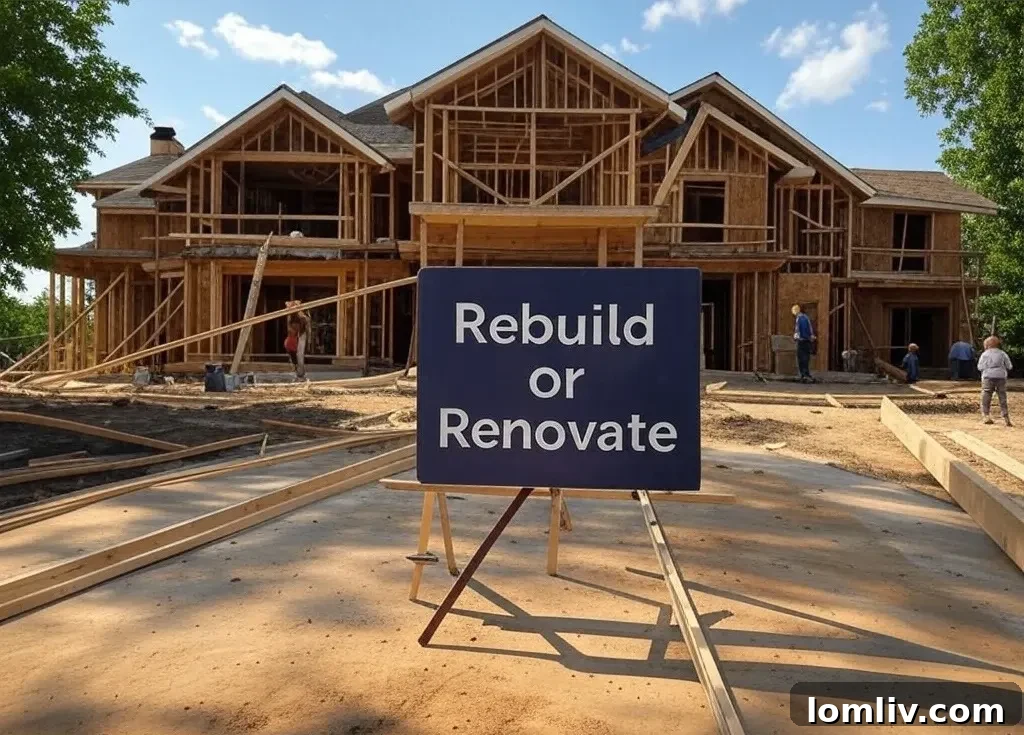
The moment your cherished home begins to show its age – perhaps the paint is peeling, floors creak and crack with every step, or the roof leaks relentlessly during a downpour – a profound question often arises: is it better to embark on a comprehensive renovation or to tear it all down and rebuild from the ground up? This isn’t merely a financial decision; it’s a pivotal choice concerning your lifestyle, future comfort, and long-term investment. Both paths, while offering the promise of an improved living space, come with their unique set of complexities, costs, and emotional tolls.
Rebuilding a house from scratch is often perceived as an undertaking of epic proportions, involving substantial financial commitment and a lengthy, decision-laden process. Conversely, the idea of renovating can seem more approachable, yet it carries its own significant risks, including escalating budgets, unforeseen delays, and the dreaded possibility of contractors abandoning projects midway. So, how does one navigate this critical fork in the road? While rebuilding might initially appear to be the more complex option, many homeowners ultimately choose this route, driven by a desire for complete control and a fresh start. This comprehensive guide will delve into the intricacies of both options, providing the insights needed to make an informed decision about the future of your home.
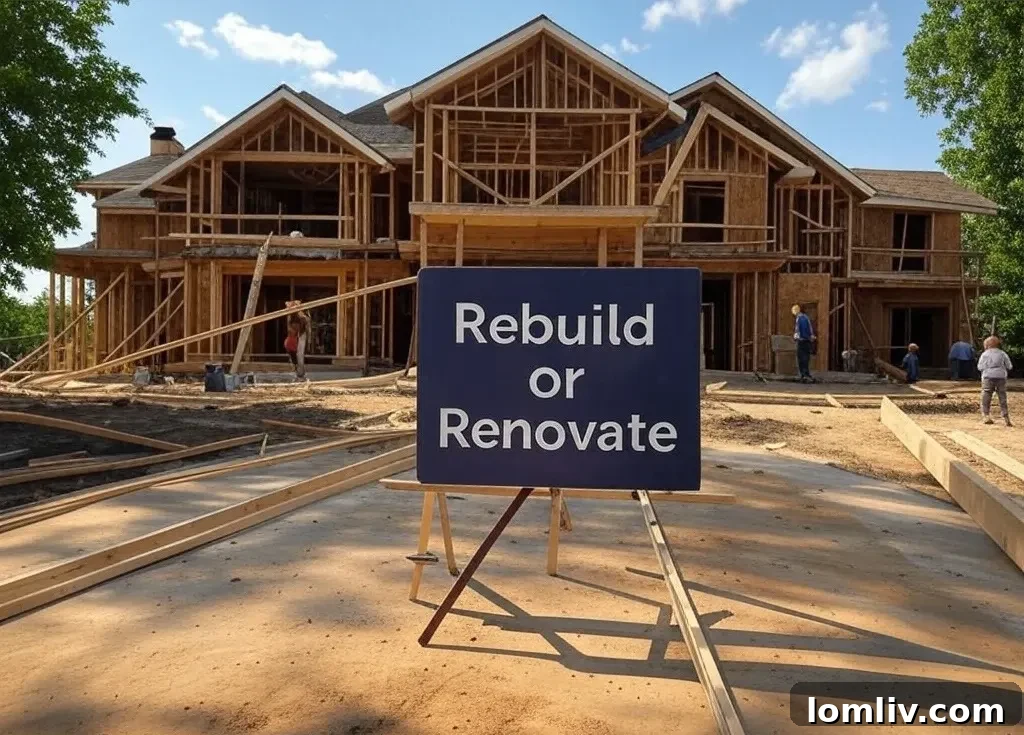
Rebuilding from the Ground Up: Crafting Your Dream Home
When the very core of your existing home is compromised – be it a weak foundation, a fundamentally poor layout that no longer serves your family’s needs, or hopelessly outdated systems – embarking on a complete rebuild can truly be the most advantageous and ultimately satisfying option. A new home offers an unparalleled opportunity to design every aspect of your living space according to your precise needs and aesthetic preferences. This includes everything from the flow of rooms and the placement of windows to the integration of modern amenities. You gain the freedom to create open-plan living areas, dedicated home offices, spacious master suites, and kitchens that are truly the heart of your home, all without the constraints of an existing structure.
One of the significant financial advantages of new home construction is the predictability of costs. With a well-defined project scope, construction costs are often easier to estimate, especially when working with a fixed-price contract. This contrasts sharply with renovations, which are notoriously prone to unexpected issues lurking behind walls or under floors, leading to costly surprises. Rebuilding also empowers you to specify high-quality, durable materials from the outset, incorporate cutting-edge sustainable designs, and integrate smart home technology seamlessly into the infrastructure. Modern building codes place a strong emphasis on energy efficiency, meaning a newly constructed home will typically boast superior insulation, high-performance windows, and efficient HVAC systems. This translates into significantly lower utility bills and reduced upkeep costs in the long run, making it a sound long-term investment. Beyond the practical benefits, a brand-new home provides immense peace of mind, knowing that every component is new, up-to-code, and built to last for generations.
Renovating Your Home: Preserving Charm with Modern Comforts
For homeowners who cherish the unique character and history embedded within their property, renovating offers a compelling alternative to tearing down. If your home boasts irreplaceable features such as original hardwood floors, intricate crown molding, antique fixtures, or beautiful stained-glass windows, a thoughtful renovation can be the ideal way to preserve its original charm while simultaneously updating it for modern living. This approach is particularly appealing if the structural integrity of your home remains sound and the primary goal is to address functional deficiencies, cosmetic updates, or minor expansions. In such cases, renovating can indeed be more cost-effective than a complete rebuild, allowing you to update specific areas like kitchens and bathrooms without disrupting the entire property.
However, the path of home renovation is rarely without its bumps. What might appear to be a straightforward update can quickly uncover a Pandora’s box of issues. Leaking pipes, outdated electrical systems that pose fire hazards, hidden mold, or even asbestos can dramatically increase costs and extend project timelines far beyond initial estimates. Living in your home during an extensive renovation can also be profoundly inconvenient and stressful. Imagine navigating daily life without a functional kitchen or bathroom for weeks or even months, dealing with constant dust, noise, and the presence of construction crews. While a renovation can breathe new life into an old home, it’s crucial to approach it with a realistic understanding of potential challenges and a substantial contingency budget.
Key Factors to Consider When Making Your Decision
The choice between renovating and rebuilding is multifaceted, demanding careful consideration of various practical, legal, and financial factors. Understanding these elements in depth is crucial for making a decision that aligns with your long-term goals and budget.
- Property Value and Zoning Regulations
- Land Condition and Site Accessibility
- Permits, Regulations, and Historical Districts
- Cost, Budget, and Financing
- Time, Convenience, and Lifestyle Impact
Before committing to either a renovation or a rebuild, it’s essential to assess how each option will impact your property’s value and how local zoning laws might restrict your plans. Not all rebuilding projects automatically translate into a significant boost in home value, especially if the new structure over-improves for the neighborhood. Consult with local real estate experts to understand market conditions and buyer preferences in your area. Zoning laws, which dictate aspects like building height, setbacks from property lines, maximum lot coverage, and architectural styles, can profoundly influence what you are permitted to build or change. For instance, you might be restricted in expanding outward or upward, making a full rebuild less flexible than anticipated, or a renovation the only feasible option to add space.
The characteristics of your land play a pivotal role in determining the feasibility and cost of a project. Flat, easily accessible land is generally simpler and less expensive to build on. Conversely, sloped land, uneven terrain, or properties with challenging soil conditions can significantly increase construction costs. These conditions may necessitate extensive excavation, the construction of retaining walls, specialized foundation systems, or complex drainage solutions. Consulting with local builders and geotechnical engineers is crucial to understand the specific challenges and associated costs of working with your particular land. Additionally, consider access for heavy machinery and material delivery, as restricted access can also add to the project’s complexity and expense.
Navigating the labyrinth of permits and regulations is a critical step in both renovation and rebuilding, but it’s often more complex for new construction. Most cities and counties have stringent building codes that must be met, requiring various permits for demolition, construction, electrical work, plumbing, and HVAC installations. The permitting process can be particularly arduous and time-consuming if your home is located in a historic district or a protected conservation area. These areas often have stricter rules regarding material usage, architectural preservation, and aesthetic conformity, which can limit design choices for new builds and impose additional requirements for renovations aimed at preserving historical integrity. Engaging an architect or general contractor experienced with local regulations can streamline this process significantly.
The financial implications are often the deciding factor for many homeowners. While renovations may initially appear more affordable, their costs can quickly escalate due to unforeseen issues, scope creep, and material choices. It is highly advisable to set aside a contingency fund of 15-25% for renovation projects to cover these unexpected expenses. Rebuilding, on the other hand, typically requires a larger upfront investment, encompassing demolition, architectural fees, permit fees, and all new construction materials and labor. However, once the scope is meticulously defined, a new build often offers a more predictable budget with fewer hidden surprises. It’s crucial to obtain detailed quotes for both scenarios and carefully compare them. Also, consider the different financing options available: renovation loans (like FHA 203k) versus construction loans, and how each might impact your financial planning.
The duration and inconvenience associated with each project vary significantly. Renovations can be notoriously time-consuming and filled with uncertainties, especially if undertaken in phases while living on-site. The constant disruption, noise, dust, and loss of functional spaces can be highly stressful and taxing for families. Rebuilding, while requiring a period of temporary relocation, usually follows a more defined and often faster schedule once construction commences. The various stages, from demolition to foundation, framing, and finishes, are typically well-orchestrated by an experienced general contractor. If minimizing disruption and adhering to a predictable timeline are top priorities, and you’re prepared for a temporary move, a rebuild managed by a reputable home builder may be the more practical and less stressful choice.
Making the Right Decision: A Personal Journey
Ultimately, the choice between renovating and rebuilding extends beyond a mere comparison of investment and cost; it delves into how you envision living your life within your home’s walls. Do you desire a home that is custom-tailored to your exact needs, adapting seamlessly to your lifestyle, or are you willing to adapt your lifestyle to the charming quirks and inherent limitations of an existing structure? Each path offers unique rewards and challenges.
A renovation allows you to honor the past, preserving the history and character of your existing property while infusing it with modern functionality and comfort. It’s a journey of discovery, often revealing hidden treasures and challenges in equal measure. A rebuild, conversely, offers a blank canvas, empowering you to create a future-proof home that embodies contemporary design, energy efficiency, and personalized features from the very foundation up. It’s an opportunity to eliminate past problems and create a space perfectly aligned with your vision of modern living.
To navigate this significant decision effectively, it is highly recommended to consult a team of trusted professionals. Architects can help you visualize the potential of both options and provide preliminary design concepts. Experienced general contractors can offer detailed cost estimates and realistic timelines for both renovation and new construction. Real estate agents can provide insights into local market values and how either choice might impact your home’s resale potential. Finally, financial advisors can help you understand the long-term financial implications and available financing options. By gathering comprehensive information and reflecting deeply on your priorities, you can confidently choose the path that best serves your family’s needs, budget, and aspirations for the future of your home.