

Welcome to this special edition of our Tarrant County real estate insights, where we navigate the ever-evolving landscape of property financing. In today’s dynamic housing market, understanding innovative financial tools is paramount for both prospective homebuyers and astute sellers. Our focus today is on a powerful mortgage strategy that has garnered significant attention: the 2-1 Buydown.
As a dedicated real estate professional who guides clients through the complexities of property transactions, I understand that the world of numbers and intricate financial calculations can often seem daunting. My passion lies in connecting people with their dream homes, not crunching complex algorithms. Therefore, to ensure we provide the most accurate and insightful information on buydowns, I’ve consulted with two highly esteemed local lenders whom I’ve had the privilege of collaborating with for nearly two decades: Gary Linville of Legacy Mutual Mortgage and Bailey Head of USA Mortgage. Their expertise is invaluable in shedding light on this increasingly popular financing option.
Understanding the 2-1 Buydown: A Strategic Advantage in Real Estate
The 2-1 Buydown is a compelling and increasingly popular mortgage solution designed to create a win-win scenario for both homebuyers and sellers in today’s challenging market. It acts as a bridge, making homeownership more attainable for buyers by significantly reducing initial monthly payments, while simultaneously empowering sellers to attract a wider pool of interested purchasers and expedite the sales process. This strategy has become particularly relevant amidst the backdrop of fluctuating interest rates and persistently high property valuations, offering a much-needed breath of fresh air for those navigating the housing market.
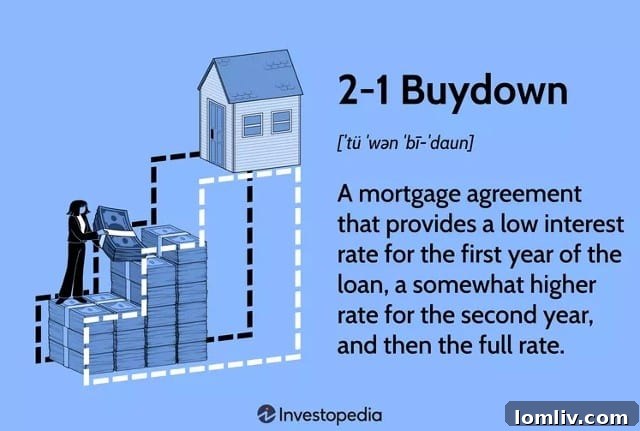
“The 2-1 Buydown is a fantastic tool that provides the buyer with a much lower initial payment compared to current market rates,” explains Gary Linville of Legacy Mutual Mortgage. “The payment then gradually increases after the first year and again after the second year. This structured increase allows new homebuyers to ‘grow’ into their house payments, adapting comfortably as their financial situation potentially improves or as market conditions normalize.”
At its core, a 2-1 Buydown functions as a temporary interest rate subsidy, typically funded by the seller, a builder, or in some cases, the buyer themselves. This subsidy is applied during the initial years of the mortgage term, creating a period of reduced payments. The mechanism is straightforward yet impactful: for the first year of the loan, the interest rate is effectively reduced by 2 percent below the standard note rate. In the second year, this reduction lessens to 1 percent below the standard rate. From the third year onwards, the interest rate then reverts to its original, un-bought-down rate for the remainder of the loan term. For example, if the standard interest rate on a mortgage is 7%, a 2-1 buydown would mean the buyer pays at 5% for the first year, 6% for the second year, and then 7% from the third year onward.
This temporary relief is often strategic. In the current real estate climate, there’s a prevailing hope and expectation that within two to three years, economic factors—such as adjustments by the Federal Reserve in response to inflation—will lead to a more stabilized and potentially lower interest rate environment, perhaps settling in the desirable 5 to 5.5 percent range. Should these predictions materialize, homeowners who utilized a 2-1 Buydown would be well-positioned to refinance their mortgage into a new, fixed rate that could be even lower than their initial standard rate, thereby securing long-term savings and stable payments.

Significant Benefits for Homebuyers
For potential homeowners, the 2-1 Buydown offers a suite of immediate and long-term advantages that can significantly ease the path to property ownership:
- Enhanced Affordability from Day One: The most tangible benefit for buyers is the substantially lower monthly mortgage payments during the initial years. This reduction in the immediate financial burden makes homeownership more accessible, potentially allowing buyers to qualify for a larger loan amount or to comfortably afford a more desirable property than they might otherwise. It mitigates the initial “payment shock” often associated with entering the housing market, freeing up crucial funds for moving expenses, home improvements, or establishing an emergency fund.
- A Smooth Financial Transitioning Period: A buydown provides a thoughtful grace period, allowing buyers to settle into their new home without the full weight of the standard mortgage payment. This is particularly beneficial for individuals or families who anticipate an increase in their income over the coming years through career advancement, bonuses, or other financial growth. The graduated increase in interest rates allows for gradual adjustments to higher payments, aligning with potential future earning capabilities. It offers a cushion, especially for first-time homebuyers who are learning to manage new household expenses.
- Strategic Financial Planning and Budgeting: With a 2-1 Buydown, buyers gain a clear roadmap for their mortgage payments over the initial three years. Knowing precisely when and by how much their payments will adjust allows for meticulous financial planning and effective budgeting. This predictability enables buyers to strategize savings, manage debt, and allocate resources more efficiently, ensuring they are well-prepared for the eventual stabilization of their interest rate. It’s a structured approach to budgeting that removes much of the guesswork.
- Access to a Stronger Market Position: In competitive markets, the ability to qualify for a slightly higher loan amount or simply to feel more comfortable with the initial payments can empower buyers to make more confident offers. This can be the difference between securing an ideal home and settling for less, or even being priced out of their desired neighborhoods entirely.
Compelling Benefits for Property Sellers
“In a market where price reductions are often the first thought, sellers can instead strategically invest in reducing the buyer’s payment,” states Gary Linville. This approach can be far more appealing than a straightforward price cut, as it directly addresses a buyer’s immediate financial concern: the monthly outlay.
For sellers and home builders, offering a 2-1 Buydown presents several powerful advantages that can significantly impact the sale of a property:
- Enhanced Market Attractiveness and Visibility: In a market flooded with listings, a property offering a 2-1 Buydown immediately stands out. It’s a compelling incentive that can draw in a larger pool of potential buyers who might otherwise be hesitant due to high interest rates. This added appeal often translates into increased showing activity, more serious inquiries, and ultimately, a faster sale. For builders, it’s a critical tool for moving inventory efficiently.
- Gaining a Crucial Competitive Edge: When similar properties are vying for attention, offering a flexible financing option like a buydown provides a distinct competitive advantage. It differentiates a listing from others that may only offer price reductions. This can be particularly effective in buyer’s markets or areas with ample inventory, where sellers need every tool at their disposal to secure a transaction.
- Reinforced Negotiation Power: While it may seem counterintuitive, offering a buydown can actually bolster a seller’s negotiating position. By proactively addressing a buyer’s affordability concerns, sellers can often maintain their asking price more effectively. Instead of a blanket price reduction that may be perceived as a sign of desperation, a buydown is a targeted financial contribution that adds tangible value without devaluing the property itself. It shifts the focus from price to payment, which is often a more critical factor for buyers.
The primary objective for any seller or builder is to move their product efficiently and at a favorable price point. While some sellers might feel that offering incentives like a buydown reveals too much of their hand before a contract is even on the table, the current market dynamics, particularly as observed in October 2023, dictate a different reality. The balance of power has shifted, with buyers and their agents acutely aware of where the leverage lies, especially until housing inventory significantly increases or interest rates experience a substantial decline.
In this environment, sellers often find themselves with limited negotiating power. Even when a buydown is offered, buyers frequently view it as a baseline incentive and may still pursue further reductions in the contract price. It’s a challenging period for sellers who enjoyed unprecedented advantages over the past several years. However, if the goal is to successfully sell a home and transition to the next chapter, embracing strategic solutions like a 2-1 Buydown is often a necessary and prudent step in adapting to current market conditions.
Key Considerations When Opting for a Buydown
While the 2-1 Buydown offers numerous advantages, it’s crucial for both parties to approach it with a comprehensive understanding of all implications. Not every financing option is universally ideal, and individual circumstances should always guide the decision-making process.
“For many buyers, buying down the interest rate with discount points often proves to be a more attractive and financially sound long-term option compared to a temporary buydown,” advises Bailey Head of USA Mortgage. “This method provides a straightforward and cost-effective way to achieve a lower interest rate for the entire life of the loan. This approach allows you to enjoy consistent lower monthly payments from the outset and can result in substantial savings in interest over the full term of the mortgage, especially if you plan to stay in the home for an extended period.”
It’s a common desire for buyers to have the seller cover the cost of lowering their interest rate for the entire duration of the loan. However, this scenario involves significantly increased costs for the seller, which many are either unable or unwilling to bear. Consequently, the temporary nature of a 2-1 Buydown often strikes a practical balance, particularly as many buyers are optimistic that interest rates will naturally decrease within a few years, making the temporary rate reduction an acceptable compromise.
Beyond the comparison with discount points, several other factors warrant careful consideration:
- Thorough Long-Term Financial Planning: Buyers must meticulously evaluate their future financial stability and ensure they will comfortably afford the mortgage payments once the interest rates revert to their standard level after the initial subsidized period. This involves projecting income growth, potential changes in expenses, and having a clear understanding of their overall budget. A lack of foresight here could lead to payment shock and financial strain.
- The Imperative of Professional Consultation: It cannot be overstated: always, always, always engage with qualified local lending professionals. These experts can provide personalized advice, thoroughly explain the intricate details, and help you fully grasp the specific implications and multifaceted benefits of a 2-1 Buydown in relation to your unique financial profile and goals. They can also clarify what happens to the buydown funds held in escrow if you refinance or sell the home before the buydown period concludes.
- Market Rate Uncertainty: While there’s an expectation that interest rates may drop, market movements are never guaranteed. Buyers should consider a scenario where rates do not fall as anticipated, and refinancing might not be as advantageous as hoped. Being prepared for the standard rate to remain the long-term reality is crucial for sound financial planning.
“Ultimately, the decision between a temporary buydown and investing in discount points comes down to a buyer’s anticipated tenure in the home and their long-term mortgage strategy,” adds Linville. This highlights the importance of individual circumstances in selecting the most beneficial financing path.
Final Thoughts on the Strategic 2-1 Buydown
In conclusion, the 2-1 Buydown stands out as a highly relevant and often advantageous financing strategy deserving serious consideration for both prospective homebuyers and sellers navigating the dynamic Tarrant County real estate market. Its inherent ability to significantly enhance initial affordability for buyers, coupled with its power to boost a property’s market appeal and offer sellers a competitive edge, positions it as an invaluable option in today’s housing landscape.
This innovative mortgage solution is more than just a temporary rate cut; it’s a strategic investment in securing a successful transaction, offering flexibility and breathing room in a market that demands adaptability. As with all significant financial decisions, the key to success lies in making informed choices. By thoroughly understanding the mechanics, benefits, and considerations of a 2-1 Buydown—and crucially, by consulting with experienced lending and real estate professionals—participants in the Tarrant County market can navigate their real estate journeys with greater confidence and achieve their property goals effectively. Informed decisions are the bedrock of prosperous real estate transactions.