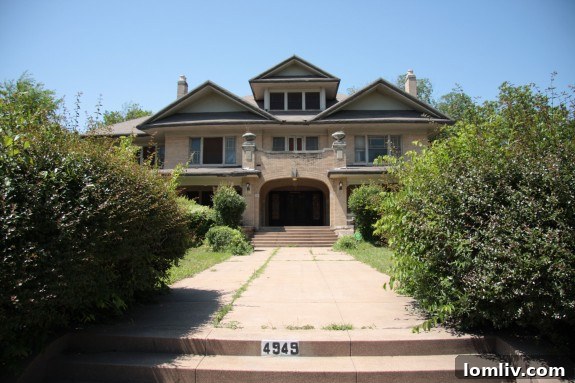
The Enduring Saga of 4949 Swiss Avenue: From Legal Turmoil to Grand Restoration
Within the prestigious Swiss Avenue Historic District of Dallas stands 4949 Swiss Avenue, a property steeped in both architectural splendor and a complex, often heart-wrenching, legal history. This once-elegant mansion, now on a remarkable journey back to its former glory, spent years entangled in poignant legal battles following the death of its owner, Mary Ellen Bendtsen, in 2005. The controversies surrounding her estate led to what many local real estate agents described as potentially the “messiest title in Texas,” underscoring the deep complexities of probate law and the vulnerability of the elderly. This detailed account delves into the accusations of elder exploitation, the dramatic courtroom proceedings, and the triumphant renaissance of a Dallas landmark.
A Controversial Inheritance: Allegations of Exploitation and Undue Influence
The core of the legal dispute centered on allegations against three individuals, notably two Dallas antique dealers, who prosecutors claimed conspired to take advantage of Mary Ellen Bendtsen’s fragile mental state and her innate kindness during her final days. The intensely watched trial in Dallas County brought to light critical issues concerning elder abuse and the ethical responsibilities of those entrusted with the care and financial affairs of vulnerable individuals. The prosecution’s case was built on the premise that these individuals had manipulated an 88-year-old woman, gravely ill and declining, to alter her estate plans in their favor, specifically targeting her valuable Swiss Avenue residence.
The trial commenced with Mark McCay, then 50, facing serious charges of attempted theft. Prosecutors meticulously presented evidence suggesting that McCay had systematically worked to alienate Bendtsen from her family, isolating her from her natural support system. This calculated estrangement, it was argued, created an opportunity for McCay to illicitly obtain a power of attorney from the vulnerable octogenarian. A central point of contention was the claim that McCay then persuaded Bendtsen to revise her will, diverting the historic 4949 Swiss Avenue property to him and his partner, rather than to her rightful heirs. This controversial will was reportedly signed by Bendtsen from her hospital bed at Baylor, mere days before her passing. In stark contrast, the defense maintained that McCay and his associates, referred to as “the boys,” had developed a genuine and enduring friendship with Bendtsen over a decade, providing companionship and entertainment. They contended that any bequests were a reflection of Bendtsen’s true, uncoerced wishes, stemming from a deep bond of affection.
The Hospital Bed Will: A Glimpse into Vulnerability and Contention
One of the most emotionally impactful moments of the trial involved the presentation of a video recording capturing Mary Ellen Bendtsen signing the contested will from her hospital bed. This footage was particularly harrowing, revealing Bendtsen in an extremely frail and compromised condition, having recently suffered a massive stroke. Medical professionals had already concluded that she was too mentally impaired to make sound legal decisions, casting a significant shadow over the legitimacy and voluntariness of the document she was signing.
The video documented a deeply poignant scene: Mark McCay and Burgess stood at the foot of Bendtsen’s hospital bed, observing intently, while their attorney, Edwin Olsen – who himself was implicated in the case – gently posed a series of questions to the ailing woman. Bendtsen, visibly pale and delicate in her hospital gown, responded softly to Olsen’s inquiries. Throughout the recorded exchange, she repeatedly raised her hands to rub her lips and eyebrows, gestures that could be interpreted by an observer as signs of distress, confusion, or profound weakness, further emphasizing her vulnerable state.
In a pivotal moment, Olsen directly asked Bendtsen if she wished for her daughter, Frances Ann Giron, to inherit her money.
“No,” Bendtsen replied in a hushed, almost inaudible tone.
When pressed about the ultimate fate of her cherished house, her response was similarly succinct and definitive:
“No.”
Olsen then sought further clarification, asking whom she truly intended to leave the house to.
“I want it,” she surprisingly stated, a response that seemed to conflict with the purpose of executing a will for posthumous distribution.
Seeking to resolve this ambiguity, Olsen rephrased his question: “What if you die? Who do you want to leave it to?”
Her final, and ultimately crucial, instruction was: “To the boys… the boys over there,” as she explicitly named McCay and Burgess. Following this profound exchange, Bendtsen made an attempt to sign her name, but the resulting signature was notably illegible, serving as a powerful visual testament to her severely compromised physical and mental capacity.
Probate Court’s Decision and Enduring Impact on the Bendtsen Estate
Despite the powerful and unsettling video evidence and the comprehensive testimony presented, the legal journey for the Bendtsen estate was protracted and complex. Following Mary Ellen Bendtsen’s passing, the controversial hospital-bed will was submitted to a probate court for official validation. However, due to a critical procedural flaw concerning a signature – specifically, not Bendtsen’s own signature but rather an issue with a witness signature or the overall improper execution of the document – the probate court ultimately ruled the hospital-bed will to be invalid. This decisive ruling highlighted the stringent legal requirements governing wills and testaments, which are designed precisely to protect individuals from potential fraud, undue influence, and exploitation, particularly when they are in vulnerable conditions. Consequently, the court reverted to and upheld a previous will, drafted in 2002, which unequivocally designated Bendtsen’s daughter, Frances Ann Giron, as the rightful heir to her estate. As a direct result, the 4949 Swiss Avenue property was awarded to Ms. Giron, who subsequently decided to sell the historic mansion.
For anyone who has personally endured or witnessed the emotional and logistical complexities of a challenging probate case, as I have experienced with a family relative, the profound heartbreak and stress inflicted upon Bendtsen’s family must have been immeasurable. Such protracted legal battles often exact a heavy toll, not only financially but also emotionally, prolonging grief and frequently sowing deep divisions within families. The contentious case of 4949 Swiss Avenue serves as a stark and sobering reminder of the absolute importance of meticulous estate planning, clear legal documentation, and the critical need to safeguard the vulnerable from predatory individuals seeking to exploit their declining health or mental faculties.
In 2009, Lee Hancock, a highly respected former journalist for the Dallas Morning News, published an outstanding long-form investigative piece that thoroughly dissected the intricate saga surrounding 4949 Swiss Avenue. Her meticulous reporting and insightful analysis brought much-needed clarity to the complex details of the case. My only minor point of divergence from her excellent work stemmed from her characterization of Mary Ellen as a “socialite.” While Bendtsen was undeniably an elegant woman, a former model who delighted in hosting gatherings and entertaining, I’ve always felt that the term “socialite” might have been an oversimplification, perhaps chosen for its attention-grabbing headline appeal rather than a precise reflection of her nuanced lifestyle. Additionally, following one of my earlier posts on this very subject, I received an email that suggested one of the accused men, potentially Mark McCay, was battling cancer. While such a personal detail could potentially add another layer to the human drama unfolding within the legal narrative, I was never able to independently confirm the veracity of this claim, which underscores the inherent challenges of verifying private information amidst complex and public legal battles.
A New Era of Grandeur: Restoration and Renewal at 4949 Swiss Avenue
Fortunately, the intricate and at times sorrowful narrative of 4949 Swiss Avenue takes a turn towards a truly uplifting conclusion. The magnificent property has, at long last, embarked on a new chapter, promising a triumphant return to its esteemed former glory. Last summer, the mansion was acquired by Cameron Kinvig, a dedicated and visionary preservationist whose profound appreciation for its rich history and architectural significance set the stage for its revitalization. Kinvig has since spearheaded an ambitious and comprehensive restoration project, meticulously working to revive the residence to the exquisite splendor it once exuded during its original ownership by the prominent Dallas figure, W.W. Caruth. This restoration is far more than a mere renovation; it represents a profound act of historical stewardship, ensuring that this significant piece of Dallas heritage will be cherished and appreciated by future generations.
The community’s eager anticipation for the revitalized estate was palpable when 4949 Swiss Avenue proudly featured on the highly anticipated Swiss Avenue Home Tour just last month. Visitors were granted a rare and exclusive glimpse into the painstaking efforts undertaken to meticulously restore its original charm and historical integrity. Among the most remarkable and exciting discoveries unearthed during the restoration were exquisite original wall paintings within the grand ballroom, believed to date back to Mattie Caruth’s celebrated debutante ball. These invaluable artistic treasures were not only carefully saved but are also slated to be beautifully showcased in their original, pre-restoration condition within the ballroom, offering a unique historical perspective and a tangible connection to the home’s illustrious past. The diligent preservation of such delicate and significant historical details truly elevates this restoration project to an exceptional level of authenticity and respect for heritage.
The excitement around this ongoing restoration continues to build with each passing day. We eagerly anticipate an exclusive update from the delightful Ms. Joanna England, who will undoubtedly provide us with a captivating sneak peak into the new grandeur and breathtaking transformation of 4949 Swiss Avenue. Her forthcoming report promises to reveal the stunning culmination of years of dedicated effort and vision. This remarkable journey, from a period of neglect and complex legal entanglement to its current state as a vibrant, fully restored landmark, powerfully embodies resilience, the enduring appeal of historic preservation, and the unwavering spirit of a community dedicated to its heritage. As always, stay tuned for more thrilling updates on this truly remarkable Dallas treasure!