Navigating the Texas Real Estate Boom: A Closer Look at Growth and Lingering Concerns
The Texas real estate market, encompassing dynamic hubs like Dallas, has been experiencing a period of unprecedented prosperity. Throughout 2014, the Lone Star State’s housing sector reached impressive new heights, marking its second-best year on record. This surge in activity saw a remarkable 66,664 homes sold across Texas in the final quarter of 2014 alone, contributing to a staggering total of nearly 285,000 homes changing hands statewide over the entire year. Such robust sales figures translated into significant commission opportunities for real estate professionals and underscored the vibrant health of the market, even before accounting for the numerous newly constructed dream homes contributing to the inventory.
A Market in Ascendance: Texas Housing Achievements in 2014
Scott Kesner, chairman of the Texas Association of Realtors, eloquently captured the sentiment of the time, stating, “The fourth quarter of 2014 marked three-and-a-half years of continual home sales growth for the Lone Star State and the highest annual home sales volume since 2006 – a testament to the strong and enduring demand of Texas real estate.” This sustained growth propelled Texas into a firmly established seller’s market, characterized by intense buyer competition and upward pressure on prices. Indeed, home prices statewide rose by a substantial 7.76 percent in the fourth quarter compared to the same period in 2013, elevating the median price of a Texas home to $185,900.
Dallas, in particular, stood out as a beacon of this flourishing market. The Dallas-area home price values saw an impressive 9.4 percent increase, pushing the median price of a home in the city to $207,900 by the fourth quarter of 2014. This milestone marked the first time Dallas’s median home price had ever surpassed the $190,000 threshold, illustrating the exceptional demand and rapid appreciation within its metropolitan area. Anecdotal evidence from the ground echoed these statistics, with numerous reports of homes selling above their list price, especially in the more accessible price brackets of $500,000 or under. However, the upper echelons of the market, specifically homes priced at $3 million and above, exhibited a slightly softer trend, suggesting nuanced dynamics within the broader boom.
The Energy Lifeline: Texas’s Economic Resilience and the Oil Question
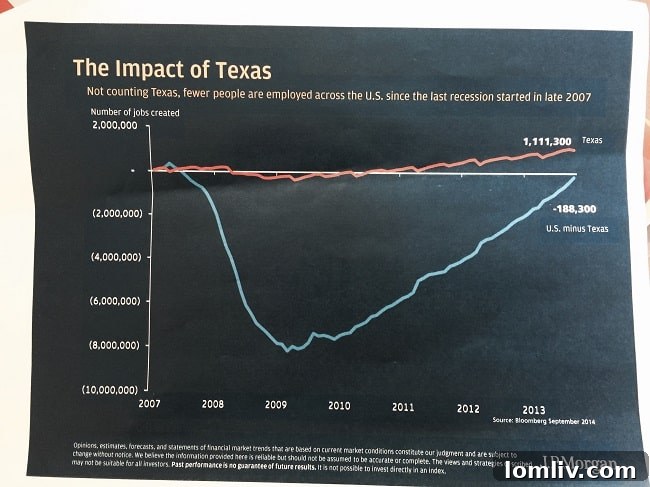
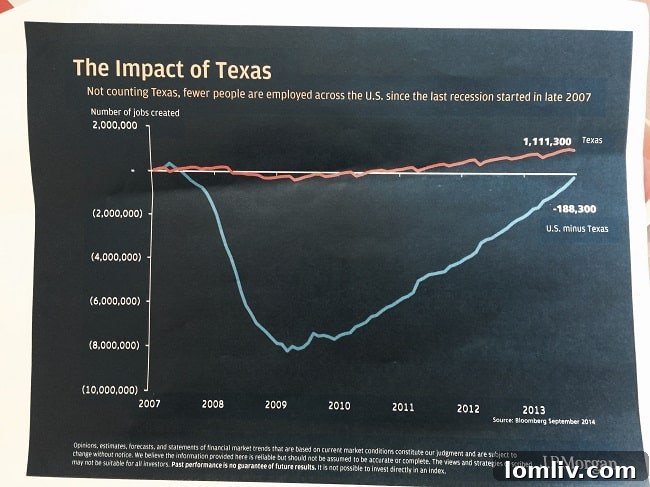
While the real estate market painted a picture of unbridled optimism, a deeper look reveals an underlying dependency that warranted cautious consideration: the impact of the oil and gas industry. During the Great Recession, when many other parts of the United States struggled profoundly, Texas’s robust energy sector served as a critical economic stabilizer, keeping the state not only afloat but thriving. A J.P. Morgan report from October 2014, which drew upon Bloomberg data from September of the same year, vividly illustrated this resilience. It depicted a consistently positive job growth trajectory for Texas between 2007 and 2013, with only a slight dip from 2008 to 2010. This contrasted sharply with the rest of the U.S., represented by a “blue line” that plunged in 2009, indicating the loss or non-creation of 8 million jobs. During this same period, Texas proudly created an impressive 1,111,300 jobs, outpacing the national recovery efforts.
This remarkable job growth was largely attributed to what some economists termed the “shale oil fracking situation” and the broader “energy renaissance.” As noted by experts like Gundlach, a significant portion—reportedly 35%—of the S&P’s capital expenditure was tied to the energy sector. He emphasized that much of the job growth observed since 2007 could be directly linked to this energy boom, particularly in regions like Texas and North Dakota. Without this vital contribution, many argued, job creation elsewhere had been stagnant. The energy sector, therefore, wasn’t just a part of the Texas economy; it was its engine, driving prosperity and supporting the burgeoning real estate market.
The Looming Shadow: How Plummeting Oil Prices Threaten the Boom
However, the very industry that fueled Texas’s success soon presented its most significant challenge: a dramatic fall in oil prices. As crude prices languished below $50 a barrel, the ripple effects began to emerge, casting a shadow over the otherwise sunny economic outlook. Reports from sources like the Wall Street Journal highlighted the immediate and tangible consequences. Hundreds of oil-industry workers across Texas, including a substantial 330 employees within General Electric Co.’s oil and gas division, faced impending job losses. GE Oil & Gas and two other energy companies formally notified the Texas Workforce Commission of plans to cut a total of 720 positions statewide.
Specifically, GE announced a significant reduction of approximately 45% of its staff at the Buck Creek oil field equipment manufacturing plant in Lufkin, Texas. These layoffs, scheduled to commence in late March, were framed as a necessary measure for long-term business health amidst a broader restructuring drive to reduce costs. Such decisions, while difficult, underscored the profound impact that sustained low oil prices were having on the operational viability and employment landscape of the energy sector. For a state so intertwined with oil and gas, these job cuts served as a stark reminder of the potential vulnerability of its economic bedrock.
Expert Forecasts: Dissecting the Local vs. National Impact
The debate surrounding lower oil prices presented a fascinating dichotomy. On one hand, they were widely perceived as a de facto tax cut for the middle class, freeing up disposable income for other expenditures. On the other hand, the implications for oil-producing regions were undeniably grim. At the prestigious Inman Real Estate Connect conference in NYC, industry leaders and economists convened to discuss this very issue. Brad Inman, a prominent figure in real estate, engaged top economists in a crucial discussion about oil’s influence, particularly its role in driving the luxury market.
Jeb Kolko from Trulia offered a key insight: “oil is all local.” He elaborated that falling oil prices, by putting more money into the hands of consumers, would largely benefit suburban areas, the Northeast, and the Midwest. This perspective suggested a geographical redistribution of economic advantage. Conversely, the consensus among the panel was that states heavily reliant on oil production, such as Texas, Oklahoma, and Louisiana, were inherently at a higher risk. Dr. Stan Humphries of Zillow further underscored this regional disparity, noting that oil was ten times more critical to Houston’s economy than to Austin’s. Indeed, observations indicated that Houston’s luxury home prices were already beginning to show signs of softening, a potential early indicator of the wider economic shift.
The economists also touched upon the differential impact across various housing price segments. Nationally, it was observed that the lowest one-third priced homes were appreciating more quickly, with an average rise of 6.8%. This segment, which had borne the brunt of the Great Recession, was now demonstrating robust recovery. Nela Richardson, an economist from Redfin, highlighted that low interest rates remained a significant positive factor for middle-income buyers, further supporting the recovery of more affordable housing tiers. Her sentiment captured the prevailing mood: “Wall Street is worrying,” she remarked, “Main Street is not.” This suggested a disconnect between the financial markets’ anxieties about energy sector performance and the average consumer’s immediate benefit from cheaper fuel.
However, even for “Main Street,” the benefits might not translate directly into immediate spending. The extra cash saved at the pumps—which for many, including the original author, amounted to significant savings—was not necessarily being channeled entirely into retail spending. Furthermore, Dr. Stan Humphries provided a crucial temporal perspective, estimating that it typically takes about two years from the initial drop in oil prices for the full effects to manifest in real estate values. This implied that the current prosperity in Texas’s housing market, while strong, might be living on borrowed time, with the full impact of oil price declines yet to be realized.
Dallas’s Continued Momentum and Future Headwinds
Despite the underlying concerns, Dallas’s real estate market continued to exhibit strength in the immediate aftermath of these oil price changes. Fourth-quarter Dallas-area sales were up an impressive 6.42 percent from the final quarter of 2013, demonstrating persistent buyer enthusiasm. Dr. James Gaines, an economist with the Real Estate Center at Texas A&M University, projected that “Texas home sales in the first half of 2015 are expected to be similar to what we’ve seen in 2014, but continued increases in home prices and record-low inventory levels should still continue.” He also provided historical context, noting that “Historically, Texas home prices have only risen 4.5 percent year-over-year,” underscoring the extraordinary growth observed in 2014.
The core challenge for Texas, and Dallas specifically, was clear: maintaining this vibrant demand. And sustaining demand, particularly in the housing market, is inextricably linked to robust job growth. The prospect of falling oil prices chipping away at this essential job creation remained a significant concern. At the Friday morning panel, economists’ confidence levels regarding the housing market spanned a positive, yet cautious, range from 65% to 90%. Stan Humphries placed his confidence at 70%, while Jed Kolko showed a 65% confidence for housing but a much higher 95% for rentals, reflecting a perceived shift in demand towards urban living.
This sentiment was echoed by a panelist who highlighted a “strong demand from young people who want an apartment in the city.” This trend, however, came with a critical caveat: “As long as they can afford the monthly rent.” The affordability factor in urban rental markets, coupled with the potential economic slowdown from the energy sector, presented a complex picture for the future. While Texas’s real estate market showcased impressive strength and resilience, the looming impact of oil price fluctuations introduced an element of uncertainty, compelling stakeholders to monitor economic indicators closely and adapt to evolving market dynamics.