Navigating the Shifting Tides: Texas Housing Market Sees Inventory Growth Amidst Economic Headwinds
For many professionals entrenched in the dynamic Dallas-Fort Worth real estate market, a significant shift is underway that could alleviate persistent tensions: housing inventory is finally on the rise. While the market continues to grapple with prevailing economic conditions, notably higher interest rates and persistent inflation, this growth in available homes offers a much-needed ray of optimism, signaling a potential move towards greater balance in a historically competitive landscape.
This pivotal insight comes from the comprehensive Texas Realtors’ second-quarter housing report, a crucial resource for understanding the state’s property trends. The report meticulously compares market performance across quarters, highlighting key indicators that paint a clearer picture for buyers, sellers, and real estate agents alike.
A Glimmer of Hope: Housing Inventory Levels on the Rise
One of the most encouraging statistics from the Q2 report is the notable increase in months of inventory. In the bustling Dallas-Fort Worth metropolitan area, inventory stood at 1.8 months in the second quarter of 2022, a substantial improvement compared to just 1.1 months recorded in the same period of 2021. This translates to an impressive 48.7 percent surge in active listings, with 16,455 homes available for prospective buyers, indicating a loosening grip on the tight supply that has characterized the market for years.
The statewide picture reflects an even more pronounced shift, with Texas’s overall inventory reaching 2.1 months in Q2 2022, up from 1.3 months in Q2 2021. This marks a historic turnaround, as it’s the first time inventory has increased year-over-year since the third quarter of 2019, and the first instance of it exceeding two months since the third quarter of 2020. This sustained period of low inventory had previously fueled intense bidding wars and rapid price escalation, making the current trend a welcome development.
Russell Berry, chairman of Texas Realtors, succinctly captured the sentiment surrounding these figures: “Housing inventory levels are finally on the rise in many areas of the state — something we haven’t seen for several years — but home prices continue to rise.” His statement underscores the complex nature of the current market, where increased supply offers relief, yet pricing pressures persist due to underlying demand and other economic factors. This growth, while still far from the six months typically considered a balanced market, represents a vital step towards normalcy.
Download the Texas Housing Quarterly Report | PDF
Economic Pressures: Interest Rates and Affordability Challenges
While inventory growth offers a silver lining, the broader economic landscape continues to exert significant influence on the housing market. The Federal Reserve’s aggressive stance against inflation has led to a series of interest rate hikes, with a notable 0.75 percent increase implemented during the reporting period. This move, which was the fourth of what could be several bumps in 2022, primarily impacts homeowners looking to refinance existing loans and individuals applying for new mortgages.
Clare Losey, an assistant research economist at the esteemed Texas Real Estate Research Center at Texas A&M University, elaborated on the ramifications of these rate adjustments in an interview with Bankrate.com. She noted, “Such increases diminish purchase affordability, making it even harder for lower-income and first-time buyers to purchase a home.” This highlights a critical challenge: as borrowing costs rise, the overall cost of homeownership escalates, potentially sidelining a significant segment of the buyer pool. The cumulative effect of these hikes means that even with increasing inventory, the path to homeownership remains steep for many.

The interplay of inflation with rising interest rates creates a dual challenge for potential buyers. Not only are mortgage payments higher, but the general cost of living is also elevated, impacting savings and disposable income. This economic pressure is a primary factor behind the observed moderation in sales activity, as buyers adjust their expectations and budgets to the new financial realities.
Price Dynamics: Continued Appreciation Despite Shifting Conditions
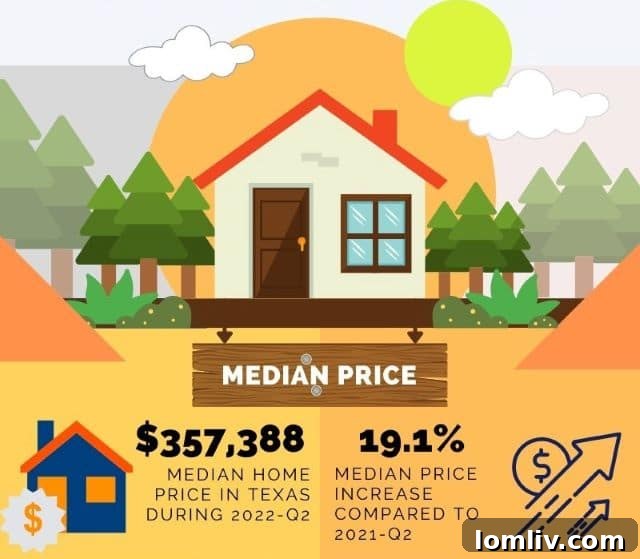
Despite the growing inventory and escalating interest rates, home prices across Texas continued their upward trajectory in Q2 2022. The statewide median price reached $357,388, representing a substantial 19.1 percent increase compared to the same quarter in the previous year. This persistent appreciation underscores the robust demand that still characterizes the Texas market, driven by factors such as strong population growth, a thriving job market, and a desirability that continues to attract residents from other states.
Within the Dallas-Fort Worth market, the median price witnessed an even sharper rise, climbing by 21.4 percent year-over-year. This higher percentage increase in DFW highlights the intense demand specific to this metropolitan area, which remains a hotbed for economic activity and relocation. Interestingly, nearly half of the 108,390 homes sold across Texas during the quarter fell within the $200,000-$399,000 price range. This indicates a strong market for mid-range properties, suggesting that while luxury segments might be feeling some pressure, the core market for accessible housing remains highly active.
The continued price appreciation, even as inventory slowly increases, suggests that while the pace of growth might moderate in the future, a significant market correction or widespread price declines are not immediately evident. Experts point to the long-term fundamentals of the Texas economy and its appeal as a prime destination for businesses and individuals as key drivers supporting these values.
Sales Activity and Market Pace: A Subtle Slowdown
While prices rose and inventory improved, other market indicators suggest a subtle cooling in transactional activity. Closed sales across Texas declined by 5.6 percent in Q2 2022. The D-FW market experienced a slightly steeper drop, with closed sales down by 6.6 percent compared to the same quarter last year. This reduction in the volume of transactions indicates that while demand remains, buyers are exercising more caution and fewer deals are being finalized, potentially due to affordability concerns or a wait-and-see approach regarding interest rates.
The “Days on Market” metric offers another glimpse into the market’s pace. In the D-FW area, homes spent an average of 54 days on the market in Q2, which was three days fewer than in Q2 2021. This seemingly faster pace, despite declining sales, could be attributed to multiple factors. Highly desirable properties or those priced competitively may still sell quickly, masking a broader slowdown in less attractive segments. It might also be a lagging indicator, reflecting properties that were listed earlier in the quarter before the full impact of rate hikes was felt, or a testament to the persistent buyer appetite for prime locations.
Expert Outlook: Towards a More Balanced Market?
The prevailing sentiment among real estate experts points towards a gradual rebalancing of the market. Jim Gaines, a research economist also with the Texas Real Estate Research Center at Texas A&M University, articulated this outlook: “If inventory continues to steadily increase and home sales price appreciation begins to slow, we could be moving towards a pre-pandemic environment.” A “pre-pandemic environment” would imply a market with more inventory, less intense competition, potentially more negotiation room for buyers, and a reduction in the frantic pace that defined the last two years.
Echoing this nuanced perspective, Seth Fowler of Williams Trew Real Estate in Fort Worth recently observed, “It is and will still continue to be a very strong seller’s market. But the signs are there for some normalcy and balance in the real estate market.” This acknowledges the existing power dynamic still favoring sellers but recognizes the emerging trends that could gradually shift conditions. A more balanced market typically sees closer to six months of inventory, offering buyers more choices, more time to make decisions, and a reduced likelihood of having to waive contingencies or pay significantly above asking price. The current trajectory suggests a move, albeit a slow one, in this direction.
The Dallas-Fort Worth Advantage: A Resilient Hub
The Dallas-Fort Worth metroplex stands as a testament to Texas’s robust economic health and attractiveness. Its sustained population growth, diversification of industries, and strategic geographic location continue to drive demand for housing, even amidst broader economic shifts. While DFW faces similar challenges as the rest of the state regarding affordability and interest rate impacts, its underlying economic strength often provides a cushion against more severe downturns. The nuanced data from the Q2 report reflects DFW’s unique position, experiencing both the statewide trend of increasing inventory and a slightly higher rate of price appreciation, indicating its continued desirability.
Understanding the Data: The Texas Realtors’ Quarterly Housing Report
The Texas Quarterly Housing Report is an indispensable resource for anyone seeking to understand the intricacies of the state’s property market. Published by the Texas Association of Realtors, an organization dedicated to advocating for Realtors and upholding private-property rights, the report provides a reliable and in-depth analysis of market conditions.
Presented with clear, chunky-style graphics, Texas Realtors meticulously compiles well-organized snapshots of 25 distinct markets across the state. The robustness of the data stems from the Texas Realtors Data Relevance Project, a collaborative partnership between the Texas Association of Realtors and local Realtor associations statewide. This ensures that the insights are derived from comprehensive and localized data. Further enhancing its credibility, the analytical interpretations within the report are provided through a research agreement with the highly respected Real Estate Center at Texas A&M University. This collaboration guarantees that the report is not just a collection of numbers but a thoroughly analyzed and expert-backed assessment of the Texas housing market.
Clarification: It is important to define “inventory” within the context of real estate reports. Inventory is a crucial metric that measures the length of time it would take for the current supply of available homes to sell if no new properties were added to the market, based on the current sales pace. For example, 2.1 months of inventory means that, at the current rate of sales, it would take approximately 2.1 months to sell all the existing homes on the market. This metric is a key indicator of whether a market favors buyers (higher inventory) or sellers (lower inventory).